



Harvest Hosts for Farms: Is Hosting RV Travelers Worth It? The $0 Campsite, the $30 Handshake and the County Letter That Threatened $1,000 a Day

In 2022, Rhonda Seybert was thinking about closing her alpaca farm.
Her place, Humming Desert Alpacas, sits near Algodones, New Mexico, between Albuquerque and Santa Fe. A fellow alpaca breeder told her about a program that sends RV travelers to farms for a free night. She applied, and about three weeks later she was approved.
Then her listing went live. Within about three minutes, she told the Santa Fe New Mexican, "I had five requests to stay."
By 2024, those RV travelers made up about 80 percent of the purchases in her farm store. She credits the program with saving the farm.
Now head west to the California coast. In late 2022, county code enforcement in San Luis Obispo County sent notices to 15 to 20 businesses and homes. The notices said they were advertising their land as a commercial campground. The letters warned of fines of up to $1,000 a day and even criminal prosecution.
One of the businesses that spoke up was Dark Star Cellars, a local winery. About 380 RV campers had stayed there that year and spent roughly $33,000. The owner estimated that was about 4 percent of the winery's annual sales.
Same program. Same free parking spot. In New Mexico, it saved a farm. In California, it brought letters from the county.
The program is Harvest Hosts. And the difference between those two stories was never the RVs. It was the homework.
I run a durian farm in Malaysia that welcomes paying visitors, and I spend my working life studying how farms around the world turn visitors into income. Of all the models I have studied, RV hosting is one of the most misunderstood. It looks free and simple. It is neither.
The timing matters, too. On September 30, 2026, Choice Hotels announced it was buying Harvest Hosts for about $130 million. When one of the world's biggest hotel franchisors pays that kind of money for a network of farm parking spots, it tells you RV travelers are serious business.
So in this guide I will give you the honest answer to one question: is hosting RV travelers through Harvest Hosts worth it for your farm?

What you will learn in this guide ✅ How Harvest Hosts works, and why it costs you nothing to join ✅ What farm hosts really earn, and why sales are not profit ✅ Real farms, wineries and ranches, with their numbers ✅ A free calculator to test your own farm in two minutes ✅ Why "free" does not exempt you from campground rules in several states ✅ The insurance Harvest Hosts requires, and what its damage plan does not cover ✅ Tax, biosecurity and safety rules for 45-foot rigs on farm ground |
What Is Harvest Hosts? How It Works in Plain English
Harvest Hosts is a membership club for RV travelers. Members pay the company a yearly fee. In return, they can ask to stay one night free at farms, wineries, breweries, museums and other small businesses that have agreed to host them.
The idea came from France, where a network called France Passion lets motorhome travelers stay with winemakers and farmers. An Arizona couple, Don and Kim Greene, started the American version in 2009. In 2018, entrepreneur Joel Holland bought it. Back then it had about 600 hosts and 6,000 members.
It has grown fast since. It bought the private-land network Boondockers Welcome in 2021, the UK network Brit Stops in 2023 and the Escapees RV Club in 2024. By February 2026, the core Harvest Hosts network listed more than 5,700 hosts. Its website lists about 2,400 farm hosts, 900 wineries and 700 breweries and distilleries. The company says it has more than 400,000 active members.

Here is the deal from your side of the fence:
You pay nothing. Listing is free, and Harvest Hosts takes no commission on anything you sell.
Harvest Hosts pays you nothing. Your income comes only from what guests buy, plus any optional fees you set for hookups or extra nights.
The first night must be free. You cannot charge for the parking spot itself, and you cannot require a purchase.
You stay in control. You set how many RVs you take, the longest rig you accept and your calendar. You approve or decline every request, and you can block dates or pause your listing.
Guests must be self-contained. Members need an RV with an inside toilet and kitchen. No tents, no sleeping in cars, no dumping gray water on your land and no outdoor cooking.
They come during business hours. Members are expected to arrive while you are open, keep a low profile and leave quietly.

The $30 Handshake
So how does a host get paid? Through a handshake. Harvest Hosts tells its members: "We suggest our Members spend $30 per one-night stay at the Host's business."
That suggestion used to be $20. Lancaster Farming reported a $20 minimum in 2021, and it has since risen to $30. Any hookup fee you charge counts toward the $30. The company also says members spend an average of $50 per visit, a figure Holland has repeated to reporters.
But notice what kind of money this is. It is not rent. It is a sale. And that one detail changes how you should judge the whole program.

What Do Harvest Hosts Farms Really Earn?
Here is every earnings figure I could find for hosts, from news stories, a university webinar and Harvest Hosts itself.

The middle of the pack lands around $12,000 to $15,000 a year in extra sales. A Penn State agritourism webinar in 2022, presented by a Harvest Hosts staff member, gave $12,000 as the average. Holland told Nebraska Farmer in 2021 that hosts averaged about $13,000, with some reaching $40,000 to $50,000. In 2024, he told the Albuquerque Journal the average was about $15,000.
Across the whole network, the company says members spent nearly $40 million at hosts in 2021 and more than $50 million in 2024. Demand keeps climbing. May 2025 set a record with 61,738 stay requests in a single month.
Now read those numbers the way a banker would. There are three warnings.
Warning No. 1: these are sales, not profit. If you sell a $30 bottle of wine that cost you $12 to make, you did not make $30. You made $18, before card fees and your time.
Warning No. 2: most of these figures come from the company. Harvest Hosts has every reason to quote its best results. Treat them as a ceiling, not a promise.
Warning No. 3: location decides a lot. Holland told the Gazette in 2023 that hosts near Denver earn four to five times what hosts in rural Kansas earn. A farm near an interstate on a popular route will see far more rigs than a farm at the end of a long gravel road.

Insight: Your margin is your real income Two farms can each host 100 RVs and each sell $3,000. The farm selling its own wine, honey or wool might keep $1,800 of it. The farm reselling bought-in souvenirs might keep $900. Before you join, write down what guests will buy and what each item really costs you. |
Real Farms, Real Results
Statistics are useful. Stories are better. Here are real farms and small businesses that host RV travelers, and what happened.
Humming Desert Alpacas, New Mexico: The Farm That Didn't Close
You met Rhonda Seybert at the top of this article. Most of her RV guests spend at least $30, though nobody is forced to buy anything.
Down the road in Bernalillo, Kaktus Brewing gets about 30 extra customers a month from the program. Their average ticket is $21, which is below the $30 suggestion. That is a useful reality check.

Heartland Criations Alpacas, Illinois: Customers She'd Never Have Met
Kathy Albert in Knox County hosted about 35 RV visits in 2024, and her guests bought wool products. As she told FarmWeekNow, "I would not have had them as customers."
Thirty-five visits a year is small. But for a fiber farm in rural Illinois, 35 new customers who would never have found her is real money and real word of mouth. If you raise alpacas, read how to start an alpaca agritourism farm.
Perkins' Good Earth Farm, Indiana: 250 Guests and a Few Signs
Dan and Julie Perkins in DeMotte started hosting in April 2021 and welcomed more than 250 guests in three years, according to Acres U.S.A. Very few spent under $20. They even sell Wi-Fi and electricity through an online store. Their biggest headache was guests turning up at all hours, and they fixed it with clear signs.
Trinity Gardens and Bent Limb Farm: Everybody Buys Something
By spring 2021, Dave Putnam's lavender farm in Washington had hosted more than 200 RVs since June 2020. In Pennsylvania, Pam Ellenberger at Bent Limb Farm saw purchases from $10 to $500. She told Modern Farmer that "everybody has bought something."
Spero Winery, Denver: Five Cases in One Sale
June and Clyde Spero usually host one RV a night, though their busiest night brought 11. They told the Gazette about one traveler from California who bought five cases of wine in a single visit.
Flathat Ranch, Colorado: When You Have Nothing to Sell
Raissa Wilkes and Joel Aguilar near Divide host RV travelers who come to meet their miniature cows. With no product to sell, they ask for an optional donation toward hay. They also found hookups too expensive to add, according to the Denver Gazette.
Crow Vineyard and Winery, Maryland: Set Boundaries Early
Judy Crow in Kennedyville sells wine, beef and gifts to RV guests. She told Lancaster Farming that hosting is "invigorating as well as stressful," and she advises new hosts to set clear boundaries.
The Big Numbers: Pals Brewing and Weldon Mills
Harvest Hosts' own case studies show what the top end looks like. Pals Brewing in North Platte, Nebraska reports $136,000 from more than 2,100 stays, about $65 a stay, and grew from 2 to 10 RV spots. Weldon Mills Distillery in North Carolina reports more than $340,000 from over 4,400 RV travelers since 2020. These are company case studies, so treat them as best cases.
Host | Location | RV guests | What happened |
Humming Desert Alpacas | Algodones, NM | Not published | RV guests about 80% of store purchases (2024) |
Heartland Criations Alpacas | Knox County, IL | About 35 visits (2024) | New customers for wool products |
Perkins' Good Earth Farm | DeMotte, IN | 250+ guests in 3 years | Very few spend under $20 |
Dark Star Cellars | San Luis Obispo County, CA | About 380 campers (2022) | About $33,000, roughly 4% of sales |
Spero Winery | Denver, CO | Usually 1 a night, record 11 | One guest bought five cases |
Pals Brewing (company case study) | North Platte, NE | 2,100+ stays | $136,000, about $65 a stay |
Notice the pattern. The winners sell something that travels well: a bottle, a jar, a skein of yarn, a case of wine. They sit on or near a travel route. And many offer a small experience, like animals to meet or a tasting, that turns a parking spot into a memory. For ideas, read how to set up a farm stand that attracts visitors and how to create a farm souvenir shop.

Who Are These RV Travelers?
Know your customer before you stock your shelves.

The RV Industry Association's 2025 owner study counted 8.1 million U.S. households that own an RV. The median owner is 49 years old, and owners use their RVs a median of 30 days a year.
Harvest Hosts members skew older. AARP reported in 2024 that about 80 percent of members are 50 or older. In the company's own survey of 2,029 members, 31 percent were full-time RVers and 77 percent were retired.
Here is the part that should get your attention. In a 2026 report, The Dyrt found that 59.8 percent of campers had camped for free at least once. Among those free campers, 73.6 percent had stayed at a rest stop or a parking lot, mostly RV and van travelers. That is your competition: a noisy parking lot under a streetlight.
Farm stays are rising fast. The Dyrt found 14.1 percent of campers camped on a farm in 2024, up from 4.2 percent in 2019. More than half of those farm campers traveled in an RV or trailer. And campers spend freely once they arrive. Kampgrounds of America (KOA) estimates campers spent $66 billion in local communities in 2025, over $200 per person per day, not counting where they slept. For the bigger picture, see the latest agritourism statistics.
So picture your typical guest: a retired couple with time, curiosity and a refrigerator in their rig. They want a story to tell and something good to take home. Sell them that.

Run Your Own Numbers: The Harvest Hosts Farm Profit Calculator
Change the boxes below to match your farm. Be honest about your product costs. Use $30 as your average spend until you have real sales data.
If the calculator does not load on your device, here are the same sums for three example farms. All costs are example inputs, not quotes.
The Farm Stand | The Alpaca Farm | The Winery | |
RV stays a year | 60 | 150 | 400 |
Average spend per stay | $35 | $50 | $65 |
Product cost | 45% of sales | 45% of sales | 35% of sales |
Hookups | None | 20% of stays at $15 | 25% of stays at $20 |
Paid extra nights | None | 15% of stays at $20 | 10% of stays at $25 |
Money in | $2,100 | $8,400 | $29,000 |
Product cost | -$945 | -$3,375 | -$9,100 |
Card fees (3%) | -$63 | -$252 | -$870 |
Yearly costs (insurance, gravel, signs, permits) | -$600 | -$1,800 | -$3,500 |
Left before income tax | $492 | $2,973 | $15,530 |
Break-even | 33 stays | 57 stays | 74 stays |

Look closely at the Farm Stand. Sixty RVs bought $2,100 of produce, yet only $492 is left after costs. That is about $8 a stay. If your insurer charges a lot to cover overnight guests, a small stand can lose money. But if your policy already covers you and the RVs park on a lane you already have, almost all of the gross profit is yours.
Now look at the Winery. High margins and a steady stream of rigs mean the first 74 stays pay the yearly costs, and every stay after that adds about $48 to the bottom line. That is the power of selling your own product at a good margin.
About 60 percent of hosts offer at least one extra night and about 25 percent offer electric hookups, so these extras are normal. Price them fairly and remember they may be taxable (more on that below). For more ways to lift each sale, read upsells that double your agritourism revenue.
Field-Tested Play: Run the $30 test Run the calculator with $30 as the average spend, not the $50 the company quotes, and use your real product cost. If your numbers only work at $50, they do not work. Then try a bundle priced at about $30, such as a jar of honey, a dozen eggs and a postcard, so the suggested spend becomes an easy yes. |
The Legal Side: "Free" Does Not Mean "Exempt"
Here is the trap that catches good farmers. Many assume that because the night is free, they are not running a campground. In several states, the law does not care whether you charge.
State | When a license or permit is needed | Does "free" get you out? |
Michigan | 5 or more RVs or campsites | No. The law covers sites offered free or for a fee |
Wisconsin | 4 or more sites, or 1 to 3 if advertised | No. Covers sites with or without charge. $175 a year plus a $380 pre-inspection |
Pennsylvania | No minimum number of sites | No. Applies whether or not a fee is charged |
New York | 5 or more campsites | The definition does not mention fees at all |
Ohio | 5 or more self-contained RVs | Probably not. The exemption is lost if you receive anything of value, including sales of goods |
California | 2 or more lots rented or held out for rent | The wording is about rent, but counties still act (see below) |
Look at Wisconsin. One to three sites need a license if they are advertised, and a Harvest Hosts listing could count as advertising. Look at Ohio. A host who expects a $30 purchase may not fit the exemption at five or more RVs. Most hosts take one to three rigs at a time, which keeps many of them under these thresholds. But the threshold is a state question, and zoning is a separate county question.

The San Luis Obispo Story: How One County Changed the Rules
Remember those letters in San Luis Obispo County? The county said its worry was health and safety, including pollution and wildfire risk from unregulated camping. One county supervisor, Bruce Gibson, called the hosting "a perfectly reasonable thing with minimal to no impacts" and asked staff to find a simple way to allow it.
On February 7, 2023, the board voted 4 to 1 to allow what it calls incidental RV camping. The rules are worth knowing because other counties may copy them:
The land must be in the rural or agriculture category.
RVs park in the permitted lot of a winery or olive oil tasting room, a restaurant, an equestrian facility or a farm stand.
Three to five RVs, depending on the size of the lot.
Self-contained RVs only, with no hookups.
One night at a time.
The stay itself cannot require payment, although tips and purchases are fine.
The lesson? Rules can be fixed when hosts speak up together. But those hosts got the letters first.
Other Places Writing Rules
San Luis Obispo is not alone. In July 2025, an Upper Mount Bethel Township, Pennsylvania, zoning officer flagged a Christmas tree farm hosting Harvest Hosts stays, and the township solicitor said two or more campsites may need a special exception from the zoning board. In Colorado, Alamosa County commissioners approved temporary special-use permits so Colorado Farm Brewery could host up to 10 RVs a night on up to 50 days a season.
Some places now write farm RV stays into their codes. Montgomery County, Maryland changed its zoning in 2024 to allow camping on farms of 25 acres or more, with 100-foot setbacks and stays of up to three nights. And Warren County, Iowa caps living in an RV on private land at 14 straight days and 28 days a year.
Field-Tested Play: The two-call rule Before you apply, call your county planning office and ask: "I want to let self-contained RVs park overnight at my farm shop through Harvest Hosts, one to three at a time, with no hookups and no charge for parking. Is that allowed in my zone, and do I need a permit?" Then call your state or county health department and ask whether that makes you a campground. Write down every name and date, and get the answer in writing. |
Tell your neighbors before the first rig rolls in. Most complaints start as surprises. Read how disputes with neighbors can hurt agritourism and farm wedding venue zoning for the same lesson on a bigger scale.
Does the "Free Night" Protect You From Lawsuits?
Every state has a recreational use statute. These laws protect landowners who let the public use their land for recreation, usually for free. So does a free Harvest Hosts night count? Nobody knows for sure, because I found no court case on Harvest Hosts itself. Here is what the closest law says:
Wisconsin: buying products does not count as a payment, and protection is lost only above $2,000 a year in recreational payments.
Pennsylvania: a "charge" means an admission price or fee, and voluntary contributions do not count.
New Hampshire: federal courts found that snack bar sales (2001) and membership dues (1994) were not a charge.
California: in 2017, campers paid a fee to the county, not the landowner, and the landowner still lost its immunity. Harvest Hosts members also pay a third party.
Ohio: protection covers users who pay no "fee or consideration," and a purchase could count.
My advice is simple. A traveler parked beside your open farm shop looks a lot like a customer, and the law expects you to keep customers reasonably safe. Do not build your safety plan around a statute. Build it around insurance and a safe site.
Your state's agritourism law may or may not help. Washington, Idaho, Delaware and Maryland list camping in their agritourism definitions. Pennsylvania's 2021 law excludes overnight lodging, and Vermont's definition excludes lodging at a farm. Check agritourism laws by state and where to post your warning signs.
Insurance: The Requirement Most New Hosts Skim Past
Harvest Hosts' own become-a-host page says you need commercial liability coverage in place to cover overnight guests. Its host code of conduct says hosts must carry and maintain sufficient liability coverage.
The company's messages are mixed, though. One of its business pages suggests most insurers will cover a guest. Insurers often see it differently once a business is involved.
What the Harvest Hosts Damage Plan Covers
Harvest Hosts offers a Property Protection Plan, but read it carefully. It is not liability insurance:
It pays the lower of 1.25 times your own insurance deductible or $5,000.
Damage must be over $100 and caused during a stay booked through the system.
You must have your own insurance and file within 14 days.
It excludes injury and death, animals, and trees and plants.
Payment is at the company's discretion, and it says the plan is not offered as an insurance policy.
Compare that with Hipcamp, which gives U.S. hosts up to $1 million of liability coverage (in excess of their own policy). Harvest Hosts provides no liability insurance for guest injuries. If you are weighing the two, read how much Hipcamp hosts earn on a farm.
Why Your Farm Policy May Not Pay
A 2018 presentation from Virginia Farm Bureau Mutual noted that basic farm liability policies exclude camping, bed and breakfasts and farm stays. A 2024 Farm Bureau Financial Services presentation explained that business activities are often excluded once receipts pass about $2,000. An endorsement may stretch that to about $20,000, and above that you usually need a commercial general liability policy.
Products matter too. The National Agricultural Law Center warns that processed goods like jam or wine can need product liability coverage, and that serving alcohol needs its own liquor liability coverage.
What does it cost? There is no national price list. Illinois offers a tax credit for agritourism liability insurance, and the average premium certified for agritourism was $1,282 in 2022 and $1,831 in 2023. Your quote could be higher or lower. If your insurer says no, read what to do when you can't find agritourism insurance.
Reality Check: 7 questions to ask your insurance agent 1. Does my farm policy cover RV travelers parked overnight, or is that excluded as camping or a business pursuit? 2. Do I need a business activities endorsement or a commercial general liability policy? 3. Are my product sales (jam, honey, meat, wine) covered for product liability? 4. If I sell or pour alcohol, do I have liquor liability coverage? 5. Am I covered if a guest's generator or propane causes a fire? 6. Am I covered if a guest is hurt by one of my animals? 7. Should my farm shop be in an LLC, and does the policy name it? |
For the full picture, read agritourism insurance: what coverage you need and do liability waivers protect your farm?
Taxes and Licenses
Sales tax. Retail sales to travelers usually need a sales tax permit. Rules vary by state. In New York, for example, food bought to eat later is exempt, but candy, soft drinks, crafts and prepared food are taxable, and you need a Certificate of Authority before you sell.
Income tax. Crops and livestock you raised are generally farm income. Processed goods, gift shop items and anything you buy to resell often belong on Schedule C as business income, and self-employment tax applies once your net earnings reach $400. Ask your tax preparer how to split your sales.
Hookups and extra nights. Charging for these can turn a free stay into a taxable rental. Nebraska taxes RV site rentals and utility hookups, and Missouri taxes RV site rentals. In Connecticut, by contrast, a bare campsite is not taxable. Lodging tax was one of San Luis Obispo County's concerns too.
Homemade food. Cottage food laws decide what you can sell from your home kitchen and how much. Michigan raised its yearly sales cap to $50,000 in 2026, and Texas allows up to $150,000. Read selling food on your farm without trouble from the health inspector and how to sell preserves, jams and jellies.

Alcohol. Wineries, breweries and distilleries need the right federal and state licenses for every kind of sale. Washington, for example, requires a federal permit plus a state liquor license.
Big Rigs, Generators and Your Animals
A Harvest Hosts guest is not a car. It can be a house on wheels. Class A motorhomes run from about 25 to nearly 45 feet long and about 11 to 13 feet tall. About 72 percent of Harvest Hosts locations can take a 40-foot rig, and 65 percent can take a 45-foot rig.
Here are the numbers to plan around:
Lanes: fire code calls for access roads at least 20 feet wide with 13 feet 6 inches of clearance overhead. Trim low branches along your lane.
Power lines: OSHA requires 10 feet of clearance from lines of up to 50,000 volts. Keep rigs well clear.
Soft ground: Ohio State University warns that a 10-ton axle load almost always compacts wet subsoil deeply. Park rigs on gravel, never on a wet hayfield.
Generators: carbon monoxide kills more than 400 Americans a year, according to the CDC. Generators should run more than 20 feet from windows, doors and vents. Harvest Hosts members need your permission to run one.
Fire: the U.S. Fire Administration reports about 4,200 RV fires a year. Keep a fire extinguisher by the parking area and the lane clear for fire trucks.

Protect Your Animals First
RV travelers move from farm to farm. That can carry disease. If you keep poultry or pigs, biosecurity comes first:
USDA guidance says to park visitors in a marked area outside your animal buffer zone.
USDA's bird flu checklist says to turn away visitors who have had contact with birds in the past two days, and to keep a visitor log.
University of Minnesota Extension advises keeping visitors at least 30 feet, and ideally 50 feet or more, from animal housing.
University of Vermont guidance suggests guests visit only one farm per day.
If you run a commercial poultry or hog operation, Harvest Hosts may simply not be worth the risk. For animal contact rules, read petting zoo handwashing and animal contact.
The Downsides Nobody Puts on the Brochure
No guaranteed income. Purchases cannot be required. Some guests will spend $10, and a ranch with nothing to sell has to rely on donations.
Your time. Requests need fast replies, ideally within 24 hours, and guests may arrive at random times. Every stay also needs a greeting, directions and a little conversation.
No-shows. Under Harvest Hosts' policy, a member's first no-show brings an automatic one-star review, and a third can lead to a suspension of up to a year. Some hosts with many no-shows have been allowed to hold spots with a credit card.
Zoning risk. As San Luis Obispo showed, a county can decide your parking spot is a campground.
Platform risk. The company is changing hands. Choice Hotels says Harvest Hosts will stay a separate brand, with Holland as CEO. But some long-time members said online that they will not renew, and the price of its All Access membership has risen from $129 to $179. Never build your farm's future on a single platform. Use it to meet customers, then invite them to your own email list.
Harvest Hosts vs Hipcamp vs Boondockers Welcome
Platform | How you earn | What it costs you | Best for |
Harvest Hosts | Guests stay free and are asked to spend about $30 in your shop | Free to list, no commission | Farms, wineries and breweries with something to sell |
Hipcamp | You set a nightly price for each site | 15% commission for private U.S. landowners | Tent sites, RV sites and glamping |
Boondockers Welcome | Guests stay free on private land | Free | Landowners who want to meet travelers more than earn |
Many farms use Harvest Hosts as a sales channel for the shop and Hipcamp for paid sites. If you already have spare land and a shop, an asset-light approach to agritourism lets you test demand before you build anything.
Is Harvest Hosts Right for Your Farm?
Use this decision map before you apply.
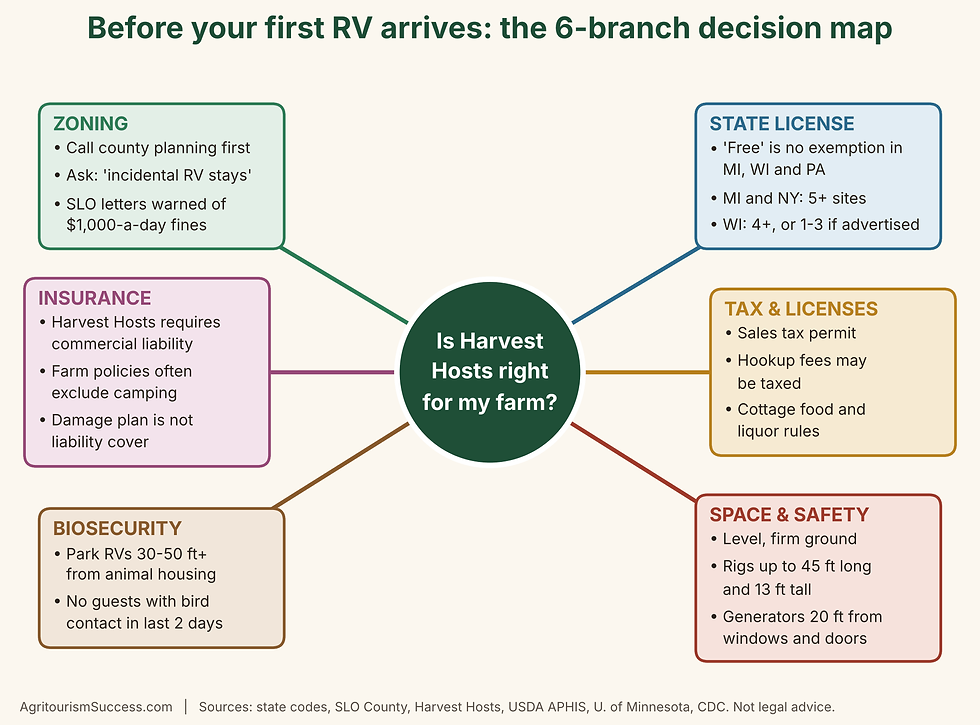
Harvest Hosts is probably a good fit if:
You have products guests can take with them: wine, honey, jams, meat, wool, flowers or crafts.
You keep regular opening hours.
You have a level, firm spot for one to three rigs, away from your animals.
Your farm is within easy reach of a highway or a popular travel route.
You enjoy meeting people, and your county says yes.
Think twice if:
You run a commercial poultry or hog operation with strict biosecurity.
You have nothing to sell and no plans to add a shop.
Your county treats any overnight RV as a campground.
You cannot reply to requests quickly during your busy season.
Field-Tested Play: Your 7-step launch plan 1. Make the two calls: county planning and the health department. Get answers in writing. 2. Call your insurance agent and get a quote for overnight guests. 3. Run the calculator at $30 a stay with your real product costs. 4. Prepare one to three level gravel spots with a clear lane, away from animals and power lines. 5. Stock the shop with products that travel, take cards and post your prices. Create a bundle at about $30. 6. Apply, then set your longest rig length, number of RVs and approval rules. Write short house rules and post arrival signs. 7. After your first 10 stays, check your sales per stay and ask happy guests for a review. |
Reviews drive future bookings, so treat every guest like a future advocate. Here is how reviews turn small farms into tourist destinations.
Frequently Asked Questions About Harvest Hosts for Farms
Does Harvest Hosts pay hosts?
No. Harvest Hosts pays hosts nothing and takes no commission. Your income comes from what members buy at your business, plus any optional fees you set for hookups or extra nights.
How much do Harvest Hosts hosts make?
Reported averages run about $12,000 to $15,000 a year in extra sales, with some hosts at $40,000 to $50,000. These are sales, not profit, and most figures come from Harvest Hosts itself. The company suggests members spend $30 per stay.
Can I charge Harvest Hosts guests for parking?
Not for the first night. You may charge for optional hookups and for extra nights, but those fees may be subject to sales or lodging tax in your state.
Do I need insurance to be a Harvest Hosts host?
Yes. Harvest Hosts says hosts need commercial liability coverage in place for overnight guests. Its Property Protection Plan only reimburses some property damage, up to $5,000, and is not liability insurance.
Do I need a permit to host RVs on my farm?
Possibly. Michigan, Wisconsin and Pennsylvania campground rules apply even when no fee is charged, and counties such as San Luis Obispo have treated free RV stays as campgrounds. Call your county planning office and health department before you list.
Your Next Step: Find Out If Your Farm Is Ready for Visitors
Here is the truth. The farms that profit from RV travelers are not the ones with the prettiest view. They are the ones with something worth buying, a safe place to park and the paperwork done before the first rig arrives.
You now know the numbers. The question is whether your farm is ready.
That is why I built the Farm Readiness Quiz. In a few minutes it shows you which parts of your farm are ready for visitors and which to fix first, so you don't spend money in the wrong place.
Then download my free ebook, the 21-Point Agritourism Blueprint. It walks you through 21 points to check before you welcome your first paying visitor, from insurance and signage to pricing.
P.S. Before you apply, make the two calls in this article: one to your county and one to your insurance agent. The hosts in San Luis Obispo County found out about the rules from a code enforcement letter. Make sure you find out from a phone call.
Written by Stephen Loke of AgritourismSuccess.com, whose farm is featured in Bloomberg News and Asahi Shimbun. This article is for education only and is not legal, tax, insurance or financial advice. AgritourismSuccess.com is not affiliated with Harvest Hosts. Laws, fees and prices change, so confirm details with your own professionals. Figures were checked in October 2026. Calculator results are estimates based on your inputs. Photos from Unsplash.
Sources
Harvest Hosts: What is Harvest Hosts? A complete guide (2026)
Harvest Hosts: How Pals Brewing turned RV parking into $136K
Harvest Hosts: How Weldon Mills Distillery turned RV parking into $340K
RV PRO: Harvest Hosts reaches record number of stay requests (2025)
Hotel Management: Choice Hotels acquires RV travel company for $130M (2026)
Modern Farmer: Harvest Hosts connects family farms with RV travelers (2021)
Nebraska Farmer: Harvest Hosts platform offers Papa Moon Vineyards new guests (2021)
Albuquerque Journal: Sleep at a winery or brewery with Harvest Hosts (2024)
Spokane Public Radio: Harvest Hosts offers places to park your RV (2023)
Santa Fe New Mexican: Airbnb for RVers brings customers (2024)
The Gazette: Vail company catering to RVers looks to expand (2023)
KSBY: Property owners ask SLO County to allow RV camping (2022)
RVtravel: Harvest Hosts locations issued violations in SLO County (2022)
Citizen Portal: Upper Mount Bethel Township Harvest Hosts discussion (2025)
Alamosa Citizen: Colorado Farm Brewery gets green light for RV campers
National Agricultural Law Center: Pennsylvania recreational use statute
U.S. District Court, New Hampshire: Hardy v. Loon Mountain (2001)
Penn State Extension: Pennsylvania Agritourism Activity Protection Act
Virginia Tech Extension / VA Farm Bureau Mutual: Liability insurance and agritourism (2018)
IA Magazine / Farm Bureau Financial Services: Agritourism coverage (2024)
Ohio State University Farm Office: Farm insurance and unique activities (2023)
National Agricultural Law Center: Ten legal issues for farm stay operators (2020)
University of Illinois: Agritourism liability exemptions, Illinois case study (2025)
Farmers.gov / Rural Tax Education: Tax considerations for agritourism
Cornell Small Farms: Collecting sales tax on farm product sales
Nebraska Department of Revenue: Campgrounds and RV sites (2024)
Farm-to-Consumer Legal Defense Fund: New Michigan cottage food law (2026)
University of Minnesota Extension: Keeping agritourism safe this fall (2025)
University of Vermont: Biosecurity considerations for agritourism (2025)
City of Mobile: Fire apparatus access road requirements (2021 IFC)


Comments