



Japan's Dairy Country Just Taxed Every Farm-Stay Bed: What Nasu's New Lodging Tax Means for You (and the Hidden Trap That Makes It Your Bill)

The strangest thing about Japan's newest tourist tax is not the money. It is who asked for it.
In August 2024, the Nasu Town Tourism Association, the group that speaks for the hotels, inns and guesthouses of Nasu in Tochigi Prefecture, sent the town hall a formal letter. It did not ask for a tax cut. It asked the town to start taxing their guests.
The town said yes. On October 1, 2026, Nasu became the first place in Tochigi to charge a lodging tax: ¥100 to ¥3,000 per guest, per night, depending on the room price.
Now, you may be thinking: "Stephen, I don't farm in Japan. Why should I care about a dairy town north of Tokyo?"
Because what happens in Nasu this year is coming to a town hall near you. Japan's cities started this. Now it has reached the dairy country, where farm stays live. And the same wave is rolling through Scotland, Wales, Bali, Italy, the United States and my own country, Malaysia.
I host paying visitors on my own durian farm in Malaysia, so I read rules like this with a farmer's eyes. Here is what I have learned: the tax itself rarely sinks anyone. What hurts is the paperwork you didn't know about, the booking you priced wrong, and the money you collected and accidentally spent.
So let me show you what Nasu is doing, what it means for farm stays in Japan, what other countries have already learned the hard way, and the seven things a seasoned farm lawyer or insurance adviser would tell you to do before your own town knocks on the door.

What you will learn in this guide ✅ Exactly what Nasu charges, who pays and who is exempt ✅ Why Japan's farm stays sit right on the most expensive line in the tax table ✅ Real numbers from Kyoto that show whether a tourist tax scares guests away ✅ The legal trap that turns the guest's tax into YOUR bill ✅ What Malaysia, Bali, Scotland, Wales, Vermont and Italy teach us ✅ A 7-point checklist to get your farm stay ready |
What Nasu Is Charging (and Who Pays)
Nasu is not Tokyo. It is a highland resort town of about 23,000 people at the foot of Mount Nasu, known for hot springs, dairy farms and fresh milk. It is also busy. In 2025, Nasu logged 2.085 million overnight stays, the second highest of any town or city in Tochigi.
Here is the tax, straight from the town's ordinance:

Room price per person, per night | Lodging tax per guest, per night |
Under ¥10,000 | ¥100 |
¥10,000 to ¥19,999 | ¥300 |
¥20,000 to ¥29,999 | ¥500 |
¥30,000 to ¥49,999 | ¥800 |
¥50,000 to ¥99,999 | ¥1,500 |
¥100,000 and up | ¥3,000 |
The town says the tax works out to roughly 1 to 3 percent of the room price. Now the details that matter to a farm-stay owner:
Who it covers: hotels and ryokan, "simple lodging" (the license most Japanese farm inns operate under) and registered home-sharing (minpaku).
Who is exempt: children under 12, and pupils and teachers on school trips. The school must give you a certificate, and you must keep it for five years.
Glamping counts. Fixed tents, bungalows and cabins you provide are taxed. A guest who pitches their own tent is not.
It is per person, even if you price per cabin. Divide the cabin price by the number of guests to find the band.
Meals don't count. The band is set on the room-only price and service charges. Food and consumption tax are left out.
Receipts must show it. The tax goes on its own line, by name and by amount.
You file every month, by the end of the following month, even in a month with zero guests.
The town expects about ¥300 million a year from the tax and says it will spend it only on tourism: public toilets at beauty spots, signboards, transport and other visitor infrastructure.
There is also help. Nasu pays half the cost of upgrading your till or booking system, up to ¥1 million, if you apply by October 30, 2026 and before you buy. And if you apply for the start-up arrangement, you can file October through February in one go, by March 31, 2027.
Field-Tested Play: Ask for the money before you spend it Nasu's subsidy only covers costs incurred after the town approves your application. Many tax subsidies work this way. Apply first, buy second. A farmer who buys the new booking software in a rush and applies afterwards gets nothing. |
Japan Is Not Stopping at Nasu
Tokyo started Japan's first lodging tax in 2002. For 15 years it stood almost alone. Osaka followed in 2017 and Kyoto in 2018. Then the dam broke.

On the very same day as Nasu, Morioka City in Iwate started its own tax. Hokkaido now charges a prefecture-wide tax on top of town taxes in places like Niseko, so some guests pay two lodging taxes on one night. Nagano Prefecture joined in June 2026. Okinawa follows in February 2027, and Tokyo switches to a 3 percent rate in April 2027.
When Kyodo News surveyed every local government in Japan in 2025, 42 had a lodging tax or a firm plan for one, and 92 more said they were studying it. One of those, Kochi City, put its finger on the problem: the paperwork could weigh heavily on small lodging businesses.
Small lodging businesses. That means farm stays.
Japan's government also tripled the departure tax nearly every traveler pays when leaving the country, from ¥1,000 to ¥3,000, on July 1, 2026. Tourism is now one of Japan's favorite things to tax, because it is booming. Japan welcomed a record 42.7 million foreign visitors in 2025, including 636,600 from Malaysia, up 26 percent.
Why Japan's Farm Stays Sit on the Most Expensive Line
Japan's farm-stay business, called nouhaku, is growing fast. In the year to March 2025, farm-stay regions recorded 8.68 million guest-nights, a record, including 748,000 from foreign guests. The farm ministry wants 12 million by 2029.

Here is the number that should make every Japanese farm-stay owner sit up. The ministry's survey found the average farm-stay guest spends ¥13,196 per night on lodging. That is well below the ¥18,940 average for all tourism in Japan, and it lands squarely in Nasu's ¥10,000 to ¥19,999 band.
That band is where the tax triples. A guest paying ¥9,999 pays ¥100. A guest paying ¥10,000 pays ¥300.
A hotel industry analysis of Nasu prices found the typical room in Nasu works out to about ¥9,700 per person for two people sharing, just under the line. In the autumn leaf season and over New Year, prices rise and the typical room jumps into the ¥300 band.
So the question is not whether you can afford ¥300. Your guests can. The question is whether you have priced, written and shown your stay correctly.
This is where the meal rule becomes your friend.

A ¥14,000 plan with dinner and breakfast is not a ¥14,000 room. If ¥5,000 of it is food, the band is set on ¥9,000, and the tax is ¥100. If your rate sheet and receipts lump it all together, you make it hard to prove the room was only ¥9,000.
Show the room and the meals separately on your price list, your booking page and your receipts. Use your real meal costs. Inflating the meal price to dodge a band is not a pricing trick. It is a tax problem waiting to happen, and tax offices check.
If you have not reviewed your nightly rate in a while, this is the perfect moment. My guide on why most farm stays are undercharging shows a simple pricing formula you can use alongside this.
Will a Tourist Tax Scare Your Guests Away?
It is the first question most farmers ask. The evidence says no, if you handle it well.
Look at Kyoto. On March 1, 2026, Kyoto raised its tax hard. Stays of ¥100,000 or more now pay ¥10,000 per person, per night, ten times the old rate. If a tourist tax were going to drive guests away, this was the test.
What happened? An analysis of more than 1,500 Kyoto properties found average listed room prices rose 18.6 percent compared with March 2025. That is about double the rise in nearby Osaka and three times the rise in Nara. And there was little sign of guests fleeing to neighboring cities. Kyoto expects its tax take to jump from ¥5.9 billion to ¥13.2 billion a year.
And in Nasu itself, the same analysis found room prices already swung by about ¥4,700 in just nine months. The lodging tax is only a small fraction of that. Guests who happily pay more for autumn leaves are not going to cancel over ¥300.
Guests choose a farm stay for the cows, the fresh milk, the morning walk and the host. Not for the tax line. That is why what tourists really expect from a farm stay matters far more than a few hundred yen.

Field-Tested Play: Put a story on the tax line Guests resent taxes that vanish into a black hole. They accept taxes they can see. Nasu publishes what the money pays for: toilets, signs and transport. Put one line on your receipt or welcome card: "Your ¥300 lodging tax helps pay for the trail toilets and signs you'll use tomorrow." You just turned a cost into goodwill. |
The Hidden Trap: It's the Guest's Tax, But It's YOUR Bill
This is the part most farmers miss, and it is the part an experienced farm lawyer or insurance adviser worries about most.
Legally, the guest pays the lodging tax. But in Japan, you are the town's official "special collector." You charge it, you hold it and you hand it over. If you forget to charge a guest, the town does not chase the guest. It comes to you.
Accountants advising hosts in Wales put it even more bluntly: under Wales's new levy, legal liability rests with the accommodation provider, not the visitor.

Here is how that trap springs on a small farm:
The forgotten charge. Your teenage helper takes a walk-in booking and forgets the tax. Six guests, three nights, ¥300 each. You still owe ¥5,400, out of your own pocket.
The spent tax. The tax lands in your farm account with the feed money. A bad month comes. You use it. Now you owe the town money you no longer have, plus whatever penalties the rules allow.
The missing receipt line. Morioka's official filing guide warns that if the tax is not clearly shown by name and amount on the receipt, it may itself be treated as part of your sales for consumption tax. A tax on a tax.
The lost certificate. You let a school group stay tax-free but cannot find their certificate when the town audits you. That exemption may now be your cost.
Now the insurance angle. Farm insurance policies generally do not pay lodging tax you failed to collect or remit. Taxes and penalties are almost always outside the cover. And if an employee pockets cash, including tax money, that is a crime or "employee dishonesty" cover question, which many small farm policies do not include. Ask your agent this one question: "If a worker steals our guest payments, including tax we owe the town, am I covered?" If you are reviewing your cover anyway, my guide to agritourism insurance and what coverage you need walks you through it.
Reality Check: Three questions before your town's tax arrives 1. Do I know which license or registration my farm stay holds? It decides whether I pay at all. 2. If I took a booking today for next year, does my booking page let me add a new tax later? 3. Where would tax money sit in my bank right now, and could I spend it by accident? |
For the wider legal basics of running guest rooms on a farm, see how to protect your farm stay.
How Lodging Taxes Hit Farms in Other Countries
Japan is late to this party. Here is what the rest of the world has already learned.
Place | What visitors pay | The farm-stay catch |
Nasu, Japan | ¥100 to ¥3,000 per person, per night | Meals excluded; glamping taxed |
Malaysia | RM10 per room, per night (foreign guests only) | Small homestay exemption lost on booking platforms |
Bali, Indonesia | IDR 150,000 once per trip | Most visitors still skip it |
Edinburgh, Scotland | 5% of the room price, up to 5 nights | Hit bookings made 10 months early |
Wales | £1.30 per person, per night (75p campsites) | Every host must register first |
Vermont, USA | 9% rooms tax, plus 3% on short-term rentals | Your license type decides the rate |
Italy | Set by each town, often €1 to €10 per person | Agriturismi collect it too |
Malaysia: the exemption that vanishes on Agoda
This one is personal. Malaysia has charged foreign tourists RM10 per room, per night since September 2017. Malaysians and permanent residents don't pay. Homestays and kampungstays registered with the tourism ministry are exempt, and so are premises with four rooms or fewer.
So a little farm stay with three rooms is safe, right? Not always. Agoda's own guidance to hosts, citing the Customs department's rules for booking platforms, says those exemptions do not apply when the booking is made through a digital platform. The same three-room farm can owe the tax when a foreign guest books on Agoda, but not when that guest books by WhatsApp. If you run a homestay in Cameron Highlands, Bentong or Sabah, check this with Customs before your next foreign guest arrives. My Farm Stay vs Airbnb guide covers the platform trade-offs in more detail.
Bali: when guests are left to pay on their own
Since February 14, 2024, every foreign visitor to Bali must pay a one-off IDR 150,000 levy. The catch: it was designed to be paid by the visitor online or at the airport, not added to the hotel bill.
The result? In 2024, only about 32 percent of foreign visitors paid. In 2025, 35.4 percent, raising IDR 369 billion against a target of IDR 500 billion. Since August 2025, Bali has signed up about 150 accommodation providers to collect it for a 3 percent commission, and by August 2026 compliance had climbed to 43 percent.
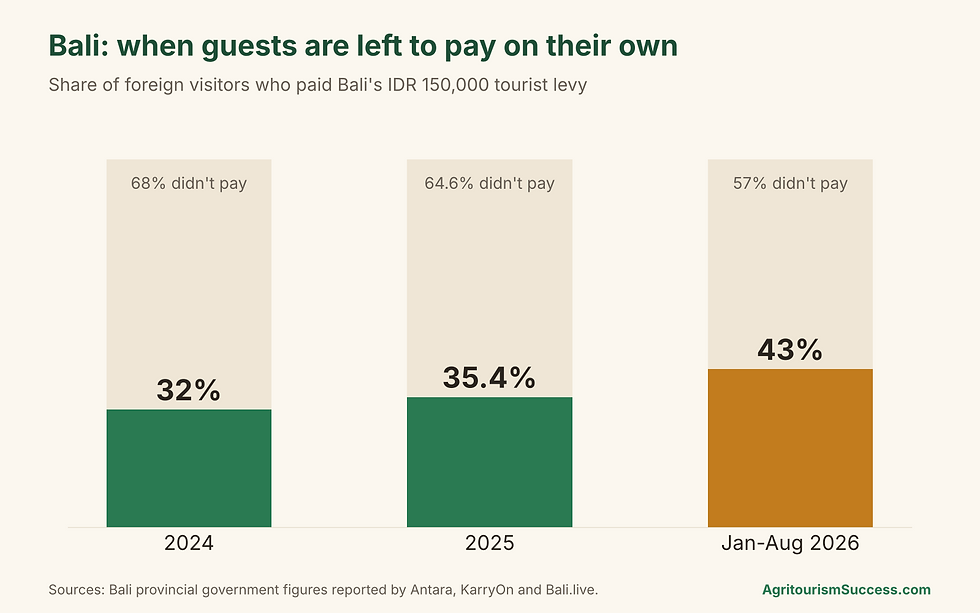
The lesson for governments: tax collected at the bed gets paid. The lesson for you: when your government offers a collection fee, take it. Morioka in Japan pays collectors up to 3.5 percent if they file online.

Scotland: the tax that reached back ten months
Edinburgh started a 5 percent visitor levy on July 24, 2026, capped at five nights. Campsites and even temporary tent pitches are included. But here's the twist: it applies to stays booked and paid on or after October 1, 2025. Any host who sold those stays at a fixed "all-in" price, with no clause allowing new taxes, faced a choice: ask the guest for more money or pay the levy from their own margin.
Fix your booking terms now: "Prices exclude any local tourist or lodging taxes, which will be added at the rate in force on your stay dates."
Wales: the register comes before the tax
Wales passed its visitor levy law in September 2025: £1.30 per person, per night, or 75p at campsites and hostels, with under-18s exempt there. Councils can charge it from April 2027. But here's what farmers miss. From autumn 2026, every host in Wales must register with the Welsh Revenue Authority, even if their own council never charges a penny. Registration is the real change. Once a government knows who you are, a tax is easy to add.
Vermont: your license decides your bill
Vermont charges a 9 percent rooms tax, plus 1 percent in some towns. Since August 1, 2024, short-term rentals pay an extra 3 percent, while licensed hotels, inns and B&Bs do not. Two farms with the same cabin can pay different taxes just because of how they are licensed. Airbnb collects for bookings on its site, but direct bookings are the host's job.
Italy: what Japan will look like in ten years
In 2011, only 13 Italian towns charged a tourist tax. By 2025, it was more than 1,300, and the take passed €1 billion a year in 2024. Italy's agriturismi collect it like everyone else. In Perugia, farm-stay guests pay between €0.50 and €2.50 a night. Italy's farm stays still thrive, as you can see in my case study of Fattoria di Maiano in Tuscany.
Japan's map today looks like Italy's map a decade ago. Expect the same spread.

Your 7-Point Lodging Tax Checklist
Whether you farm in Hokkaido, Pahang, Perthshire or Pennsylvania, do these seven things before your town's tax arrives.

Ask your town hall. Ring the tax or tourism office and ask: "Is a lodging or tourist tax being discussed?" Join the consultation. Nasu's tax came from the tourism association's own request, so the industry shaped it.
Know your license type. Hotel, inn, homestay, registered home-share or campsite. It decides whether you pay, how much and who collects.
Fix your booking terms. Add a line saying local taxes are extra and may change. Edinburgh shows why.
Show the tax on every receipt. Its own line, by name and amount, in English and the local language.
Split room and meals honestly. Where meals are not taxed, a clear breakdown can keep a guest in a lower band.
Open a separate tax account. Move tax money there every week. Never mix it with farm money.
Claim every subsidy and collection fee. Nasu pays half your till upgrade, up to ¥1 million. Morioka pays up to 3.5 percent. Bali pays 3 percent. That money is yours if you claim it.
Field-Tested Play: Make the tax part of your premium Stays priced just above a band line can feel like they "cost more" for nothing. Don't fight the line. Add value when you cross it: a glass of fresh farm milk at check-in, a sunrise walk to the cows, or late checkout. The guest pays ¥200 more in tax and gets a ¥2,000 memory. My guide to upsells that double your agritourism revenue has more ideas. |
Frequently Asked Questions
What is the Nasu lodging tax?
From October 1, 2026, Nasu Town in Tochigi, Japan charges overnight guests ¥100 to ¥3,000 per person, per night, based on the room-only price. Children under 12 and school trips are exempt.
Does Nasu's lodging tax apply to farm stays and glamping?
Yes, if the farm stay is a licensed hotel, inn, simple lodging or registered minpaku. Fixed tents, bungalows and cabins are taxed. A guest's own tent on a campsite is not.
Are meals included when calculating the tax?
No. Nasu sets the band on the room-only price and service charges. Meals and consumption tax are excluded.
Who is responsible if a farm stay forgets to collect the tax?
The accommodation operator. In Japan the operator is the official special collector, and the town expects the money from the operator.
Do small homestays in Malaysia pay the RM10 tourism tax?
Registered MOTAC homestays and premises with four rooms or fewer are exempt for direct bookings, but Agoda's guidance says that exemption does not apply to bookings made through a booking platform. Check with Customs for your own case.
Your Next Step: Find Out If Your Farm Is Ready for Paying Guests
Here is the truth. A ¥300 tax has never closed a good farm stay. Messy pricing, missing paperwork and money that "disappeared" have closed plenty.
The farms that thrive treat a new tax like any other rule of the game. They learn it early, price for it, show it proudly and keep the money separate. Then they get back to what guests really come for.
So where does your farm stand? That is exactly why I built the Farm Readiness Quiz. In a few minutes it shows you which parts of your farm are ready for visitors and which ones to fix first, so you don't spend money on the wrong thing.
Then download my free ebook, the 21-Point Agritourism Blueprint. It walks you through 21 points to check before you welcome your first paying visitor, from insurance and signage to pricing, so you open your gate with confidence instead of guesswork.
P.S. Make one phone call this week. Ring your town hall and ask if a tourist or lodging tax is being discussed. Nasu's tax took two years from the first letter to the first yen. If yours is being discussed now, you have time to get ready, and maybe even to help shape it.
Written by Stephen Loke of AgritourismSuccess.com, whose farm is featured in Bloomberg News and Asahi Shimbun. This article is for education only and is not legal, tax, insurance or financial advice. Tax rules, rates and exemptions change, so confirm the details with your local tax office and your own professionals. Figures were checked in October 2026. Photos from Wikimedia Commons under Creative Commons licenses.
Sources
Nasu Town: Introduction of the Nasu Town Lodging Tax (Japanese)
Kyoto City: Lodging tax revision effective March 1, 2026 (Japanese)
Tochigi Prefecture: 2025 tourist visitors and overnight stays survey (PDF, Japanese)
Ministry of Agriculture, Forestry and Fisheries: Current state of nouhaku farm stays (PDF, Japanese)
Kyodo News via OANDA: 92 local governments considering a lodging tax (Japanese)
Travel Voice: International arrivals in Japan exceeded 42 million in 2025
Travel Voice: Departure tax raised to ¥3,000 from July 2026 (Japanese)
Chartered Tax Institute of Malaysia: Tourism Tax gazette orders (2017)
Bali.live: Bali tourist levy to be announced on international flights
City of Edinburgh Council: Edinburgh declares Scotland's first visitor levy
Independent Hotel Show: Edinburgh visitor levy comes into effect (2026)
Business Wales: Visitor accommodation registration and visitor levy
Mountain Times: New 3% tax on short-term rentals begins (2024)
LentePubblica: Tourist tax revenue passes €1 billion in 2024 (Italian)
Wikimedia Commons: Guernsey cattle in Minamigaoka Dairy, by Miyuki Meinaka (CC BY-SA 4.0)
Wikimedia Commons: Minamigaoka Farm, Nasu, by 663highland (CC BY-SA 4.0)
Wikimedia Commons: Shirakawa Gassho-zukuri, by Zairon (CC BY-SA 4.0)
Wikimedia Commons: Jatiluwih rice terraces, Bali, by Jorge Franganillo (CC BY 2.0)


Comments