



Olive Oil at 12 Times the Market Price, and From €50 to Brush a Donkey: How Fattoria di Maiano Built a €3 Million Agritourism Estate (13 Lessons Any Farmer Can Steal)

In 2026 the average price Italian farmers got for a kilo of extra virgin olive oil fell to €4.82, about half what it was a year earlier. On a hill five kilometres from Florence, one family sells oil from the same kind of trees for roughly €61 a kilo, and customers happily pay it.
That family is the Miari Fulcis family, and their estate is Fattoria di Maiano. They have about 20,000 olive trees. That's a lot of trees, but on their own they're not a fortune, especially in a year when olive oil prices halved.
So I went through everything I could find: their company filings, Italy's official statistics, interviews with the family, menus, price lists and guest reviews. What came out is not really a story about olive oil. It's the story of a farm that refused to sell only one thing.
Today the same hill sells park tickets, donkey-grooming sessions, school trips, birthday parties, lunches, rooms, a tower suite, weddings and award-winning oil. Revenue at the company behind the estate climbed from €1.1 million in 2020 to just over €3 million in 2024. More than 50 people work there.
And here's the part that matters to you: almost none of that growth came from growing more olives.
You don't need a 600-year-old villa or a visit from Queen Victoria to use what this family figured out. You need the playbook. That's what this case study gives you: 13 lessons, pulled apart and translated so a farmer with 10 acres or 100 hectares can put them to work.

What you will learn ✅ How one family turned a commodity crop into a brand that sells for about 12 times the market price ✅ The five income engines Maiano runs on the same 270 hectares ✅ Why children are the real customers, and how to price for their parents ✅ The price ladder that lets a visitor spend nothing or €600, and why your farm needs one ✅ The honest weak spots in their numbers, so you can avoid them |
Fattoria di Maiano at a Glance
Fact | Detail |
Location | Via Benedetto da Maiano 11, Fiesole, in the hills about 5 km from the centre of Florence, Tuscany, Italy |
Owners | The Miari Fulcis family, in the family since 1917. Count Francesco Miari Fulcis and his children run it today, with Tommaso managing the estate |
Company | Maiano Società Agricola Srl |
Land | About 270 hectares: 110 farmed and more than 100 replanted as woodland |
Main crop | Around 20,000 olive trees, certified organic for more than 30 years |
Signature product | Laudemio Fattoria di Maiano extra virgin olive oil |
Attractions | A 50-hectare historic park and Botanic Garden, educational farm, 12 km of trails, a lake and a tea house |
Hospitality | Rooms, apartments and the Torre di Maiano tower suite (about 50 beds), plus the Lo Spaccio restaurant |
Events | Weddings, birthdays, school groups, corporate dinners and seasonal fairs |
Revenue | €3.01 million in 2024, up from €1.10 million in 2020 |
Team | More than 50 people, over 30 of them full-time |
Recognition | NYIOOC Gold (2023), Forbes Italia 100 Eccellenze (2025), AD Italia's most beautiful farms (2026), member of Grandi Giardini Italiani |
The Origin Story: Six Centuries of History, and a Family That Finally Opened the Gate
Most farm stories start with a tractor. This one starts with a stonemason.
For centuries the hills of Maiano were quarried for pietra serena, the grey sandstone that built Renaissance Florence. The estate's own history says stone from the quarry beside its lake went into the columns of the Medici princes' chapel at San Lorenzo, and into Michelangelo's famous staircase in the Laurentian Library. The Renaissance sculptors Giuliano and Benedetto da Maiano came from this little village. On Monte Ceceri, the hill above it, Leonardo da Vinci is said to have tested a flying machine in 1506.
In 1844 a wealthy English politician, Sir John Temple Leader, bought the village of Maiano, its villa and its quarries. He spent the next half-century turning the place into a romantic dream. He rebuilt in neo-medieval style, diverted the Mensola stream to flood an old quarry and create a lake, added a tower and a tea house, and laid out a park in the English style. In 1893 Queen Victoria came to open it.
In 1917 Elisabetta Corsini, from the princely Florentine family, arrived with her husband, the surgeon Teodoro Stori. They kept farming and kept planting. The reforestation of Monte Ceceri, the bare quarry hill above the estate, began in 1929. It was finished in 1987 by Francesco Miari Fulcis, the current owner. That's 58 years to grow a forest. Remember that number. We'll come back to it.

Then came the decision that turned an old aristocratic farm into a modern agritourism business. In 2010 the family began restoring the overgrown 19th-century park and opening it to the public. The aim, Tommaso Miari Fulcis told Open Up magazine, was to join the farming half of the estate to its historic half. In 2015 they launched educational programmes for children and families, and turned Temple Leader's tower into a guest suite.
The trails alone were a mountain of work. Tommaso's team found Temple Leader's old paths and rebuilt them by hand, without maps or machinery. They recovered more than 12 kilometres of trails and roads that visitors now walk through woods, olive groves and viewpoints.

Insight Notice what the family did not do. They did not invent a story. They dug up the one they already owned, cleaned it up and charged admission to walk through it. Every farm has a history: who built the barn, what the land grew in your grandfather's time, the flood, the fire, the year the bank nearly took it. That history is raw material for your business. |
The Numbers Behind the Growth
Italian company accounts are public, so we don't have to guess. Here is what the filings for Maiano Società Agricola Srl, the company that runs the estate, show.
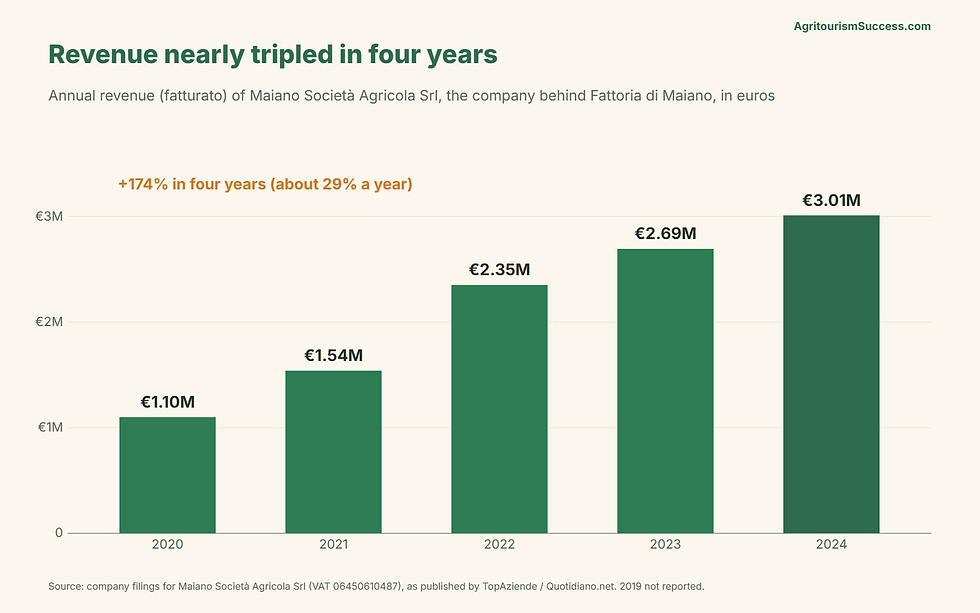
Revenue grew every single year, from €1.10 million in 2020 to €3.01 million in 2024. That's an increase of 174%, or roughly 29% compound growth a year. The value of production, a wider measure that also counts things like stock, reached €3.41 million in 2024.
For context, Italy's statistics office, Istat, puts the average economic value produced by an Italian agritourism farm at about €71,600 a year (2023 figures). In 2023 Maiano's revenue was nearly 38 times that. It isn't a perfect comparison, because the estate also sells oil, but it shows how far a farm can go beyond a few rooms and a breakfast.
Now the part most case studies leave out. The same filings show the company made a loss in four of those five years: about €75,000 in 2020, €229,000 in 2021, €286,000 in 2023 and €12,000 in 2024, with a profit of €27,000 in 2022. The filings don't explain why. With restoration work, new attractions and a growing team, my reading is that the family is reinvesting heavily as it builds. Treat that as my interpretation, not theirs.
Reality check Revenue is vanity, profit is sanity. Maiano shows you can triple sales with agritourism. It also shows that growth eats cash. Before you add a third attraction, know your margin on the first two. My article Is Agritourism Profitable? walks through the real numbers from U.S. farms. |
The Maiano Money Machine: One Hill, Five Ways to Get Paid
Here is the whole business model on one page. Every income stream sits on the same land, and each one feeds the others.

The genius isn't any single stream. It's the way they connect. A parent books a donkey session for a seven-year-old's birthday. The family eats at the restaurant afterwards. Someone buys a box of oil on the way out. Six months later they come back for an autumn weekend with the olive harvest included. One family, five sales.
Let's take the machine apart, piece by piece.
The 13 Lessons Every Farmer Can Steal From Fattoria di Maiano
Lesson 1: Stop Selling a Commodity. Sell a Name.
In 2026, according to Ismea, Italy's agricultural market institute, Italian extra virgin olive oil fetched an average of €4.82 a kilo at origin. A year earlier it was €9.47, so the price roughly halved. If you sell into that market, someone else sets your price.
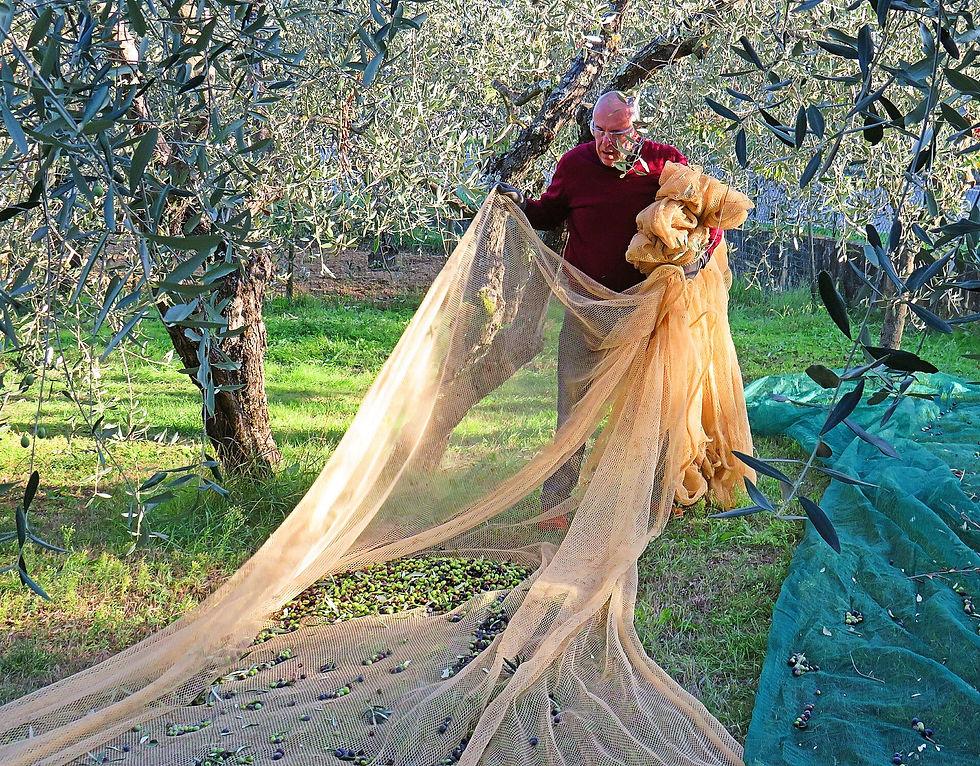
Maiano bottles its best oil under the Laudemio Fattoria di Maiano label and sells it direct. A box of six 500 ml bottles costs €168 in the estate's online shop. That's about €56 a litre, or roughly €61 a kilo.

Yes, the shop price covers bottles, packaging, tax and marketing, so it isn't all profit. But the gap is far too big to ignore. The same olive is worth about 12 times more once it carries a name, a story and a direct route to the buyer.
They stretch the range too: an everyday extra virgin oil in bottles and tins, plus organic woodland honey from the Botanic Garden. Small products, good margins, and every one leaves the farm with the Maiano name on it.
Steal this Take your best 10% of produce and give it a name, a label and a story. Sell it only direct: at your farm gate, online and at your events. For ideas, read Creating Unique Farm Products to Boost Revenue. |
Lesson 2: Borrow Credibility You Couldn't Build Alone
Every small producer has the same problem: why should a stranger believe your product is special?
Maiano solved it by joining a club with rules. Laudemio grew out of the devastating 1985 frost that killed olive trees across Tuscany, and was formally set up in 1989. Today 21 estates share the same bottle and cap, each with its own label, and an oil can only carry the Laudemio name after a panel of seven government-accredited tasters approves it. In 2025 the consortium produced a record 232,325 litres.
Then Maiano stacked more outside proof on top: a Gold Award at the 2023 NYIOOC World Olive Oil Competition, a place in Forbes Italia's 100 Eccellenze for 2025, membership of the Grandi Giardini Italiani network of great gardens, and a spot in AD Italia's 2026 round-up of Italy's most beautiful farms.
None of those badges cost what a big advertising campaign would. All of them do the selling.
Steal this Enter one competition a year, join one association with real standards, and pitch one local journalist. Put every badge you earn on your labels, your website and your Google profile. Praise from someone else sells better than anything you say about yourself. |
Lesson 3: Dig Up Your Story and Put It to Work
Maiano's history is a marketer's dream: Renaissance sculptors, Michelangelo's stone, Leonardo's flight and a Victorian queen. And the family uses every bit of it. Guided tours explain the quarries and their link to the Medici. The lake, the tower and the tea house were all Temple Leader's ideas, and every one of them now earns money.

Your story doesn't need royalty in it. Visitors love hearing why your family chose this valley, how the old barn survived the storm, or what the land grew 50 years ago. Story is also the one thing the farm down the road can't copy. They can plant the same trees. They can't have your past.
Steal this Write down five true stories about your land and your family. Turn the best one into a 30-minute guided walk, a sign at each stop and the first paragraph of your website. Read Why Sharing Your Farm Story Is Essential. |
Lesson 4: Charge Admission to the Land Itself
The cheapest asset on any farm is the view. Maiano sells it.
The historic park and Botanic Garden, about 50 hectares, open every day from 9 am to 6 pm. A day ticket covers the educational farm, the Laghetto delle Colonne lake and the Queen's Romantic Park, and there's a season pass for regulars. The estate bills it as the largest botanical garden in Italy. Parking outside the gate is free, and the pool is not included in the ticket, which leaves room for an upsell.
Once people are inside, the land keeps selling: day and night "safari" tours by off-road vehicle, trekking routes along the old quarry paths, picnics among the olive trees and, new for 2026, park golf for the whole family.
Steal this Map one loop walk on your farm, put up three signs that tell your story and add a bench with a view. Charge a small entry fee or bundle it into a tour, then offer a season pass. Regulars become your best marketers. See How to Launch an Agritourism Business Using Only the Infrastructure You Already Own. |
Lesson 5: Make the Children the Customer (the Parents Will Pay)
Maiano's educational programmes started in 2015, and they've become one of its main engines. The farm keeps Amiata donkeys, horses, Shetland ponies, goats, cows, geese, ducks, hens, rabbits and even ostriches. Workshops let children collect eggs, meet the bees, plant the vegetable garden, sit on a pony for the first time and groom a donkey.
That donkey session is the most requested activity, according to Tommaso. It's sold as a 35 to 45 minute experience from €50, with park entry included.

Tommaso told Open Up that many visiting children have never collected an egg and can't tell a cricket from a grasshopper. That isn't a problem for a farm. It's a market. In 2023, 2,085 Italian agritourism farms ran educational farm services, and Maiano layers school trips, birthday parties and family workshops on top of its daily visitors.
Animals bring risk as well as revenue, so check your cover before you open the gate. My guide to petting zoo insurance explains the traps.
Steal this Design one 45-minute, hands-on activity for children aged 3 to 10: brushing an animal, collecting eggs or planting a seed. Price it per child, sell it online and package it as a birthday party. Read The Exact Farm Experiences Schools Happily Pay For. |
Lesson 6: Build a Price Ladder With a Step for Every Budget
Look at what a visitor can spend at Maiano, from the bottom step to the top.

A local family can come for a day ticket. A tourist can add a donkey session and lunch, where most dishes cost €10 to €17. A couple can stay the night from around €80 to €110 for two. A family can book a "Bread, Oil and Farm" weekend from €440 for two nights. Honeymooners can book the tower suite for €550 to €600 a night. And a bride's family can rent the whole setting.
The ladder means nobody walks away because the price was wrong. It also means today's €15 visitor can become next year's €440 guest.
Steal this Write your own ladder: one free thing (a blog, a video, a newsletter), one offer under $20, one under $75, one overnight stay and one premium experience. If a step is missing, that's your next product. See The Experience Premium and Upsells That Double Your Agritourism Revenue. |
Lesson 7: Create One Bucket-List Product That Sells the Whole Farm
In 2015 the family converted Temple Leader's neo-Gothic tower, built between 1870 and 1894 beside the lake, into a suite for two. It has four floors: a kitchen, a living room, a bedroom and a Turkish bath at the top, plus a private patio with a Jacuzzi. The Italian architect Simone Micheli designed the interiors. Guests get breakfast, the pool in summer, park entry and a golf cart to drive to dinner. The price runs from €550 to €600.
How many people book a €600 tower? Not many, and that's fine. Its job is to be photographed, shared and talked about. It makes Maiano look like somewhere special, and that helps sell every €80 room and every €50 donkey session.
Steal this Pick one unusual structure on your farm, such as an old water tower, a silo, a hilltop shed or a big tree, and turn it into one show-stopping stay or experience. Give it its own name and its own page. Read The Signature Experience Formula. |
Lesson 8: Feed Your Visitors From Your Own Fields
The restaurant, Lo Spaccio, is run by Tommaso's sister Anna. According to Open Up, about 90% of its ingredients come from the estate. The menu follows the seasons with Tuscan classics like ribollita with new oil, pappa al pomodoro, white beans and frittatas made with the farm's own eggs. The best seller is humble: a sausage panino. The kitchen opens at 8 am and serves until 8 pm, so it catches early walkers, lunching families and sunset diners.
There's a clever twist. For what they don't produce, Maiano trades with neighbours: Falorni supplies cured meats and Palagiaccio del Mugello supplies dairy, and in return Maiano supplies its own Laudemio oil. Every plate tells a local story, and every partner keeps the Maiano name in front of its own customers.

Steal this You don't need a restaurant to start. Hold one farm-to-table dinner a month, or serve a simple lunch plate built from what you grow, and swap products with two neighbours to fill the gaps. See Hosting Farm-to-Table Dinners to Showcase Local Produce. |
Lesson 9: Rent Out the Beauty for Life's Big Days
A view you've already paid for can be rented again and again. Maiano markets its panoramic terrace, the olive mill square, a 15th-century cloister and the Countess's loggia as settings for weddings, ceremonies, birthdays and corporate dinners, with menus built on local produce.
Next door, the family's Villa di Maiano adds star power. Merchant Ivory's crew stayed and filmed there for A Room with a View (1985), the film that went on to win three Oscars, and the villa's Red Lounge appears on screen. Today the villa hosts weddings, gala dinners and fashion shows.

Steal this Walk your farm and find the three most beautiful spots. Photograph them at golden hour and build a one-page "host your event here" offer. Check your zoning first, because weddings can trigger rules that farming doesn't. Start with Tips for Organizing Farm Weddings and Special Events and Farm Wedding Venue Zoning. |
Lesson 10: Let Someone Else Fill Your Bus
Since at least 2014, the tour operator Trafalgar has brought guests on its Italian itineraries to Maiano for a private tour of the estate and a tasting of its organic oil, as part of its "Be My Guest" local experiences. Trafalgar says each guest is welcomed by a member of the family, then served a meal of Tuscan dishes.
Think about what that deal means. A coach arrives on schedule. The tour company has already done the marketing and collected the money. The farm hosts, feeds and sells oil. Then it happens again next week.
Steal this List every hotel, tour company, cooking school and travel agent within an hour's drive. Offer one of them a fixed-price, fixed-length experience with a guaranteed slot and a commission. Read How Your Farm Can Partner With Hotels, Resorts and Tour Companies. |
Lesson 11: Turn the Calendar Into a Product
Seasons are a farmer's natural events calendar, and Maiano sells every one of them. In spring the estate has run a ticketed market fair, "La Primavera in Fattoria". In autumn there are olive-harvest stays with a mill visit and tasting, a Halloween treasure hunt in the park for children aged 4 to 10, and Sunday barbecues. In winter there's a Christmas lunch built on farm produce and Laudemio oil. Next on the list, according to Tommaso, are evening walks to see the fireflies.
Each event gives people a fresh reason to come back, and gives the estate something new to post, email and promote.
Steal this Plan four events for the next 12 months, one per season, each tied to something real on your farm: blossom, harvest, newborn animals or the first frost. Sell tickets in advance. See The 365-Day Yield and 30 Farm Event Ideas by Season. |
Lesson 12: Publish Like a Media Company
Maiano's website runs in Italian, English and Japanese. Its blog publishes about twice a month, and look at the topics: where to have a picnic in and around Florence, original birthday ideas for children in Florence, parks near Florence, Christmas lunch at an agriturismo near Florence. Every one answers a question real people type into Google.
It works. When I checked the estate's Google listing in October 2026, it showed 4.4 stars from 1,380 reviews. That's a mountain of social proof for a farm. A newsletter sign-up and gift vouchers then turn one-off visitors into repeat buyers.
Steal this Write one article a month that answers a question local people search for, such as "things to do with kids near [your town]". Ask every happy visitor for a Google review on the same day. See How Reviews Turn Small Farms Into Tourist Destinations and Getting Found on Google Maps. |
Lesson 13: Play the Long Game, and Know Your Numbers
The forest on Monte Ceceri took 58 years to plant. The farm has been certified organic for more than 30 years. The park restoration started in 2010 and is still growing, with a rose garden, a garden of bee-friendly plants and a teaching vegetable garden added recently. Nothing at Maiano happened in one season.
The family also works with universities and Italy's National Research Council (CNR) on oil quality, and its website shows a biodiversity partnership with 3Bee. The site's footer carries the logo of Tuscany's Rural Development Programme (PSR), the EU-backed scheme that co-finances farm investments. In other words, they invest patiently, and they don't do it all with their own money.
But patience isn't the same as ignoring the numbers. As we saw, revenue tripled while profit hovered around zero. Big plans need a budget, a cash cushion and a clear view of which streams actually make money.
Steal this Before you build anything, check your country's farm diversification grants and co-funding schemes. Then track revenue and profit for each income stream separately, every month, and cut what doesn't pay. See Budgeting Tips for a Successful Agritourism Business. |
Where Maiano Still Struggles (and What That Teaches You)
No case study is honest without the weak spots. On KAYAK, the estate's accommodation scores 8.3 out of 10 from 103 verified reviews. Guests love the location (rated 9.0), the pool, the friendly service and the spacious rooms. But the restaurant and breakfast score just 5.0. Some guests mention uncomfortable beds, air-conditioning trouble, wear and tear, and missing basics. The hilltop location also makes a car close to essential.
The lesson: growth stretches your systems. Every new attraction adds work, and it's the small things, like a stocked bathroom, a working air conditioner and a good breakfast, that decide your review score. Fix the basics before you add the next big thing. My guide to using feedback to improve your agritourism business shows how.
Why This Matters for Your Farm Right Now
Agritourism isn't a niche in Italy anymore. Istat counted 26,360 authorised agritourism farms in 2024, up 0.9%, and they welcomed 4.7 million guests, up 4.3%. More than half of those guests (54.8%) came from abroad. Tuscany alone is home to 22.2% of all Italy's agritourism farms.

Look closely at that chart. About half of Italy's agritourism farms offer no extra activities beyond food and lodging, and only about a quarter offer tastings. That gap is the opportunity. Most farms stop at a bed and breakfast. Maiano stacks a park, animals, education, a shop, tastings, events and premium stays on top.
The same is true wherever you farm. Commodity prices swing (Italian olive oil just lost about half its value in a year), but people's appetite for real, hands-on farm experiences keeps growing. The farms that win sell experiences, not just produce. It's the same lesson our Farmer Copleys case study taught, from a pumpkin field in Yorkshire.
What Fattoria di Maiano Did NOT Do
They did not try to grow more olives to make more money. They made each olive worth more.
They did not rely on one season. They built reasons to visit in all four.
They did not hide the farm work. They made it the show: the mill, the harvest, the animals and the bees.
They did not do it all at once. The park came first in 2010, then education and the tower suite in 2015, then new gardens and events.
They did not wait for tourists to find them. They built a website in three languages, a steady blog and partnerships with tour operators.
They did not chase only luxury. A €50 donkey session sits right next to a €600 suite.
How to Apply the Maiano Playbook on a Small Farm
You don't need 270 hectares or a Renaissance villa. Here's how each big move translates to a small farm.
What Maiano did | Your small-farm version |
Branded Laudemio oil, sold direct for about 12 times the commodity price | Label your best 10% of produce with your farm's name and sell it only direct |
Joined a 21-estate quality consortium and won NYIOOC Gold | Join one association, enter one competition and show off the badge |
Restored 12 km of historic trails and charged park entry | Create one signed loop walk with a bench and a small entry fee |
Donkey grooming from €50, school trips and birthdays | Launch one 45-minute hands-on kids' activity, sold online and as a party package |
A price ladder from free to €600 | Build five offers: free, under $20, under $75, an overnight stay and one premium |
The tower suite as a bucket-list stay | Turn one unusual structure into a named, photogenic stay |
Lo Spaccio, with about 90% of ingredients from the estate | Host a monthly farm-to-table dinner or serve a simple farm lunch plate |
Trafalgar coach groups | Sign one hotel or tour partner to a fixed-price, commissioned experience |
A blog in three languages and 1,380 Google reviews | Publish one article a month and ask for reviews the same day |
Your 90-Day Maiano-Style Launch Plan
Days 1 to 15: find your story and your star. Write down your farm's five best true stories and choose one signature product or experience.
Days 16 to 30: give it a name. Design a simple label or sign, set up your Google Business Profile and take 20 good photos.
Days 31 to 45: open the gate. Launch one paid activity, ideally for families with children, with online booking.
Days 46 to 60: build the ladder. Add one cheaper offer and one premium offer around your first activity.
Days 61 to 75: borrow an audience. Pitch two local partners, such as a hotel, a tour operator, a school or a cooking school.
Days 76 to 90: measure and fix. Track revenue and profit for each activity, read every review, and fix the basics before adding anything new.
Frequently Asked Questions About Fattoria di Maiano
Where is Fattoria di Maiano?
Fattoria di Maiano is at Via Benedetto da Maiano 11 in Fiesole, in the hills about 5 km from the historic centre of Florence, Tuscany, Italy. The park is open every day from 9 am to 6 pm.
Who owns Fattoria di Maiano?
The estate has been in the family since 1917, when Elisabetta Corsini arrived. Her niece Lucrezia Corsini and her husband, Count Giacomo Miari Fulcis, continued the work. Today their son, Count Francesco Miari Fulcis, and his children run it, with Tommaso managing the estate and Anna running the restaurant.
How big is Fattoria di Maiano?
About 270 hectares. That includes roughly 20,000 olive trees, 110 hectares of farmed land, more than 100 hectares of replanted woodland and a 50-hectare historic park and Botanic Garden.
How much revenue does Fattoria di Maiano make?
Company filings for Maiano Società Agricola Srl show revenue of €3.01 million in 2024, up from €1.10 million in 2020. The company reported small losses in four of those five years, with a small profit in 2022.
What is Laudemio olive oil?
Laudemio is a premium Tuscan extra virgin olive oil made by a group of 21 estates. The consortium was formally set up in 1989 after the 1985 frost, and every oil must be approved by a panel of seven accredited tasters. Fattoria di Maiano's Laudemio won a Gold Award at the 2023 NYIOOC World Olive Oil Competition.
Was A Room with a View filmed at Fattoria di Maiano?
Scenes were filmed at the neighbouring Villa di Maiano, the family's historic villa, including its Red Lounge. The 1985 Merchant Ivory film went on to win three Oscars.
What can a small farm learn from Fattoria di Maiano?
Brand your best produce and sell it direct, turn your story and your land into paid experiences, create activities for children, build a price ladder with a step for every budget, and partner with tour operators. Then track profit for each income stream.
Your Next Step: Find Out Where Your Farm Stands
Fattoria di Maiano had six centuries of history, but the money only started flowing when the family asked one question: what else could this land sell?
Your farm has its own answer. The hard part is knowing where to start, and which idea fits your land, your budget and your time.
That is exactly why I built the Farm Readiness Quiz. In a few minutes it shows you which parts of your farm are ready for visitors and which ones to fix first, so you don't waste money building the wrong thing.
Then grab my free ebook, The 21-Point Agritourism Blueprint. It walks you through the checklist I use to plan, price and open a farm to paying visitors, step by step.
P.S. Remember the €4.82 kilo of olive oil at the start of this story? The same fruit, with a name, a story and a gate that opens to visitors, sells for more than €60. Your farm has its own version of that gap. Take the free quiz now and find it.
Sources
Photo credits
Hills of Maiano seen from Settignano: Sailko, CC BY 3.0, Wikimedia Commons
Olive harvest in Tuscany: PROPOLI87, CC BY-SA 4.0, Wikimedia Commons
Pietra serena quarry on Monte Ceceri: Sailko, CC BY 3.0, Wikimedia Commons
Amiata donkey and foal: Justlettersandnumbers, CC BY-SA 4.0, Wikimedia Commons
The farm village at Fattoria di Maiano: Sailko, CC BY-SA 3.0, Wikimedia Commons
Disclaimer
This article is an independent case study written by AgritourismSuccess.com for educational and informational purposes only. All facts, figures, prices, quotes and other details about Fattoria di Maiano, its owners and its business were compiled from publicly available information, including the estate's own website, published company records, government statistics, news articles, travel sites and review platforms, as listed in the Sources section above. We have not independently verified this information, and it may be incomplete, inaccurate, out of date or changed since publication. Any opinions or interpretations are our own and do not represent the views of Fattoria di Maiano or the Miari Fulcis family.
AgritourismSuccess.com does not take any responsibility or accept any liability for errors or omissions in this information, or for any loss, damage or decision arising from reliance on it. This article is not sponsored by, endorsed by or affiliated with Fattoria di Maiano or any business or person named in it, and all trademarks and brand names belong to their respective owners. Nothing here is financial, legal, tax or professional advice. Please check current details directly with the business concerned and seek qualified advice before making decisions for your own farm.
Photos are resized but otherwise unaltered; photos labelled illustrative were not taken at Fattoria di Maiano. Charts and diagrams by AgritourismSuccess.com.


Comments