



Farm Wedding Venue Zoning: Can You Host Weddings on Agricultural Land? (The $50,000 Lesson From Ohio's Wedding Barn Wars)

In 2017, an Ohio landowner named Darren Powlette started building a two-story, 8,000-square-foot barn on 26 acres in Miami Township, just outside Dayton. He told the township it was for horses. That one word mattered, because under Ohio law a barn used for agriculture is exempt from township zoning.
Then the barn got chandeliers. Decorative windows. Outdoor decks. Two restrooms. A staging area for bridal parties. Soon it was being advertised as Stoney Hill Rustic Weddings.
What followed was more than four years of hearings and lawsuits. The township cited him. The zoning board ruled against him. The county court ruled against him. The building department stopped work on the barn, and an appeals court backed it. In September 2022, the Second District Court of Appeals upheld a permanent ban on paid weddings in the barn. That same month, a trial judge fined him $50,000 for hosting weddings anyway.
Now here is the part that should make every farm owner sit up. Under the very same Ohio law, another barn full of brides, on land zoned residential, won its fight against the township. It won unanimously, at the Supreme Court of Ohio.
Same state. Same statute. Same kind of rustic barn. Opposite results.
The difference was not money, lawyers or luck. It came down to one question every judge in these cases asked: what is this building really for?
If you are thinking about turning your farm into a wedding venue, or you already host a few "friends of friends" weddings each summer, this guide will walk you through the real cases, the data, the permit conditions counties actually impose, and a step-by-step plan to get to "yes" without betting your farm on a guess.
THE SHORT VERSION 1. "Agricultural zoning" protects farming. It does not automatically protect a commercial wedding business, even on a working farm. 2. In Ohio, a barn whose main job was making and selling wine could host weddings, because renters had to buy the farm's wine. A barn built mainly as an event hall could not. 3. Most townships and counties that allow farm weddings require a conditional use permit (CUP) with limits on guests, hours, parking and noise. 4. Zoning is only the first gate. Building and fire codes, septic, alcohol rules and insurance are the second gate, and they sink just as many venues. 5. Never take a couple's deposit until every approval is in writing. |

Why Farmers Are Rushing Into Weddings (and Why Townships Push Back)
The demand is real. The Knot's Real Weddings Study found that 15% of couples held their reception at a barn, farm or ranch in 2017, up from just 2% in 2009. The venue is also the single biggest check most couples write. According to The Knot, couples spent an average of $12,200 on their venue in 2024.

For a farm, that is serious money. The 2022 USDA Census of Agriculture counted 28,617 U.S. farms earning income from agritourism and recreation, averaging $44,004 each. Total agritourism income reached $1.26 billion, up 33% from 2017 before inflation. Ohio was one of the fastest-growing states, with the number of agritourism operations up 27% over those five years, according to a data brief from the Northeast Regional Center for Rural Development.

If you want to see whether the numbers could work on your own place, start with my breakdown of whether agritourism is actually profitable and what it really costs to set up a barn for agritourism.
But look at it from the other side of the fence. A wedding is not a corn maze. It brings 100 to 300 people, amplified music, alcohol and a line of cars pulling onto a rural road near midnight, often every Saturday from May to October. Neighbors who moved to the country for the quiet do not experience that as agriculture. They experience it as a nightclub next door. So they call the township.
That is why wedding barns have become one of the most fought-over corners of agritourism law. Ohio State University's Agricultural and Resource Law Program has noted that the question of whether wedding barns are exempt "has often ended up in court."
The Ground Rule Most Farmers Get Wrong
Here is the misunderstanding that costs farm families the most: "My land is zoned agricultural, so I can do anything farm-related on it."
Zoning does not work that way. For every district, a zoning code sorts uses into three buckets:
Permitted uses are allowed by right, usually with a simple zoning certificate.
Conditional or special uses are allowed only after a public hearing and a permit with conditions attached.
Everything else is prohibited.
"Wedding venue," "event center," "banquet hall" and "place of assembly" very often land in the second or third bucket, even in an agricultural district.
On top of local zoning sits state law. Many states limit how much local government can regulate farming. In Ohio, Revised Code sections 519.21 (townships) and 303.21 (counties) stop local zoning from prohibiting the use of land for agriculture. The same law protects buildings used primarily for making and selling wine on land where grapes are grown. Since August 2016, Ohio has also limited local power to prohibit agritourism, which state law defines this way:
"Agritourism" means an agriculturally related educational, entertainment, historical, cultural, or recreational activity, including you-pick operations or farm markets, conducted on a farm that allows or invites members of the general public to observe, participate in, or enjoy that activity. (Ohio Revised Code 901.80)
Read that definition twice. The two words that decide most wedding cases are "agriculturally related." The legislature never defined them. Ohio's courts have had to, one farm at a time.
WHAT THIS MEANS FOR YOU A farm exemption protects the farming. Whether it also protects the party depends on how tightly the party is tied to the farming. That is the whole game, and the rest of this article shows you how judges score it. |

Ohio's Wedding Barn Wars: Three Farms, Three Verdicts
Ohio is the best classroom in America for this question, because its courts have ruled on every version of the farm-wedding story. Study these cases closely. The facts that won and lost them are the same facts a zoning inspector will look for on your farm.

Case 1: The Blueberry Barn That Won at the Ohio Supreme Court
Forever Blueberry Barn sits in Litchfield Township, Medina County, on land the township zoned residential. In 2015 the township sued, calling the barn an illegal rental hall for wedding receptions.
The trial court first sided with the township and issued an injunction. Then the farm made the change that turned the whole case. It grew grapevines, made wine and stored that wine in the barn along with its winemaking equipment. And it made buying its wine a condition of renting the barn. The trial court lifted the injunction under the winery part of Ohio's agricultural exemption.
The township fought it all the way up. It argued that only 4% of the barn's space was used for making and selling wine. In April 2020, the Supreme Court of Ohio ruled unanimously for the farm. Justice Melody Stewart wrote that the time or space a building devotes to a use does not always control its "primary" use, and offered an analogy every farmer should remember. If Ohio Stadium hosted 20 events a year and only 7 were Ohio State football home games, it would still be hard to argue the stadium's primary use was anything but football.
Because renters had to buy the farm's own wine, the Court held that the trial court could reasonably find the barn's primary use was vinting and selling wine. The township could not shut it down. The case is Litchfield Township Board of Trustees v. Forever Blueberry Barn, 2020-Ohio-1508.
Look at how narrow that win was. It was not a ruling that weddings are agriculture. At the appeals stage the vote was only 2-1, and the dissenting judge believed the evidence showed the barn existed "primarily as an event venue." The farm won because it could prove the wine came first. If you run a vineyard, my guide on how vineyards build wine, dine and stay revenue shows how to grow that side of the business.

Case 2: Stoney Hill, the "Horse Barn" With Chandeliers
Back to Darren Powlette. When the township challenged his weddings, the Board of Zoning Appeals and the Montgomery County Common Pleas Court found he was using the barn as a place of "public assembly," not for agriculture. He then planted grapevines and began making wine, hoping to follow the Blueberry Barn path.
It did not work. The trial court found that the only agricultural use of the barn was hay stored upstairs, and the evidence showed that hay was used for decoration and seating, not as feed. In September 2022 the Second District Court of Appeals upheld a permanent injunction against renting the barn for weddings, receptions and parties for a fee. It also rejected his argument that the weddings were agritourism, writing:
"Instead, the barn was built in order to serve as an event venue in a rural, agricultural setting."
The court left one narrow door open. He could ask to lift the injunction if he truly made vineyard and wine production the barn's primary use. Meanwhile the losses stacked up. In 2020 the same appeals court upheld a building department stop-work order, ruling the barn could not keep its agricultural exemption from the Ohio Building Code once its real purpose came to light. And the trial court fined him $50,000 for continuing to hold weddings despite the injunction. His response, reported by Ohio State's ag law program, was that he no longer charged a fee and instead held free weddings for guests who bought his wine.
Case 3: Whattapuddle Farms, Where the Corn Maze Passed and the Weddings Did Not
The Lusardi family owned 13.5 acres in Caesarscreek Township, Greene County. The property had a pole barn, a one-acre pond, several acres of woods and an eight-acre hayfield they had cut for years. They applied to run corn mazes, hayrides and celebrations such as weddings as agritourism.
The township's zoning board approved the corn maze and hayrides. It refused the weddings. The board saw no evidence that crops or flowers grown on the property would be used in the events, and no link between the hay and the celebrations. The courts agreed. In 2020 the Second District Court of Appeals declined to declare that weddings are agritourism as a matter of law, observing that the question "shades to gray quite quickly."
The lesson here is subtle and important: a beautiful farm backdrop is not an agricultural connection. Being on a farm is not the same as being about the farm.
The Case Behind the Cases: One Grapevine
All three cases lean on an earlier decision. In Terry v. Sperry (2011), Milton Township in Mahoning County tried to close Myrddin Winery after neighbors complained, arguing it was really a restaurant or retail business in a residential district. The lower courts agreed with the township. The Supreme Court of Ohio reversed, holding that winery buildings are exempt from township zoning as long as grapes are also grown on the property. As the Court later summarized, grape growing does not have to be the property's primary use, and even a single vine could qualify.
That is why the wine path keeps showing up in Ohio wedding cases. But notice what Blueberry Barn added nine years later: the land may only need a vine, yet the building must be used primarily for making and selling wine.

THE PATTERN JUDGES FOLLOW When the farm product is the main event and the wedding is the side dish, courts lean toward the farm. When the wedding is the main event and the farm is the backdrop, local zoning applies. Judges look at what the building was built for, what is inside it, where the money comes from, and whether guests must buy what you grow. |
The 4-Question Test Before You Spend a Dollar on String Lights

Run these four questions in order, and write down the answer to each one.
Is your property under local zoning? Some rural townships and counties have no zoning at all. That removes one gate, but not building, fire, health, alcohol or insurance rules.
Does your state shield farms, agritourism or farm wineries from local zoning? Most states protect agriculture in some way, but the details vary enormously. My 50-state guide to agritourism laws is a good starting point for your state's agritourism statute. Zoning protection is often in a separate section of law, so ask your county planner which one applies to you.
Is the event genuinely tied to what you grow or make? Think wine, cider, flowers, produce served at the meal, or an orchard tour built into every booking. If the honest answer is "the barn is pretty," the answer is no.
If you are not exempt, what does your zoning code say about event venues in your district? Permitted, conditional or not listed? That single answer sets your path and your timeline.
It Is Not Just Ohio: Four Stories From Other States
Virginia: The $15,000 Birthday Party
In 2012, Fauquier County cited farmer Martha Boneta of Liberty Farm in Paris, Virginia, after she hosted a birthday party for eight 10-year-old girls without a permit. The county also went after her for advertising pumpkin carving and for what she sold in her farm shop. Each violation carried a $5,000 fine, and reports put the total at $15,000. Local farmers staged a "pitchfork protest" in her support.
Two years later the Virginia General Assembly passed the so-called Boneta Bill, signed by Governor Terry McAuliffe in 2014. It protects customary activities at agricultural operations, including agritourism, from local bans unless they have a substantial impact on public health, safety or welfare.
Two lessons. First, enforcement often starts with one neighbor's complaint, even over a small gathering. Second, state law can change when farmers organize, so stay close to your state Farm Bureau.
Wisconsin: When an Alcohol Law Cut the Calendar
For years, Wisconsin wedding barns let couples bring their own alcohol without the barn holding a liquor license. Then 2023 Wisconsin Act 73 took effect on January 1, 2026. Barns now need a liquor license, or a "no-sale event venue" permit that allows only six events a year where alcohol is consumed, no more than one a month, and beer and wine only.
Dave Muehl, who has run Badger Farms with his wife for 21 years, called the limit "arbitrary and capricious." Farmers say their wedding seasons have been cut by as much as 75%. A bipartisan bill would raise the cap to 36 events a year, but early 2026 reporting gave it long odds in the state Senate. A lawsuit by barn owners, including Farmview Event Barn, was allowed to proceed by a circuit court judge in 2024.

The lesson: zoning approval is not the only thing that can shut a venue down. A change in alcohol law can do it from the state capitol.
Pennsylvania: The Barn That Kept Booking
The Barn at Forestville in Bucks County, a restored German swing barn more than 150 years old, was cited by Buckingham Township in January 2018 for operating as a venue without a zoning permit. Officials said it failed requirements for sewage disposal, water supply, fire protection and access for people with disabilities. The managers agreed to stop hosting events by November 2018, and a court later ordered them to permanently stop offering the barn for paid events. In January 2020 the state Attorney General sued the managers, alleging couples who had booked their weddings were scammed, and sought restitution.
The human cost of these fights lands on the couples. In another Pennsylvania case, a bride wrote on The Knot's community forum that 43 days before her wedding, her barn's owner called to say the township had taken him to court and her date was in doubt.
There is good news in Pennsylvania too. The state Senate passed a wedding barn bill, 28-19, that would let existing farm buildings host occasional weddings without installing sprinkler systems, provided owners meet safety conditions such as up-to-date wiring, working smoke detectors, fire extinguishers, no open flames and multiple exits. Check whether it, or a newer version, has become law before you rely on it.
Michigan and North Carolina: Two Different Fixes
Michigan House Bill 4006, introduced in January 2025, would stop local zoning from prohibiting barns on agricultural land from being used as commercial wedding venues, while still letting local governments regulate noise, advertising, traffic and hours. In North Carolina, the Office of State Fire Marshal issued guidance in 2019 that farm buildings used for weddings outside a city's building-rules jurisdiction are exempt from the state building code as agritourism buildings, except for electrical work, which is never exempt.
The takeaway: the answer changes at every state line, and sometimes at every township line. Never assume the rules a friend follows in another county apply to you.
The Conditional Use Permit: Your Most Likely Road to "Yes"
For most farms, the realistic path is not an exemption fight. It is a conditional use permit, also called a special use permit, special exception or major use permit. The local planning commission or zoning board holds a public hearing, neighbors get notice and a chance to speak, and the board approves, denies or approves with conditions.
Here is what real approvals have looked like.
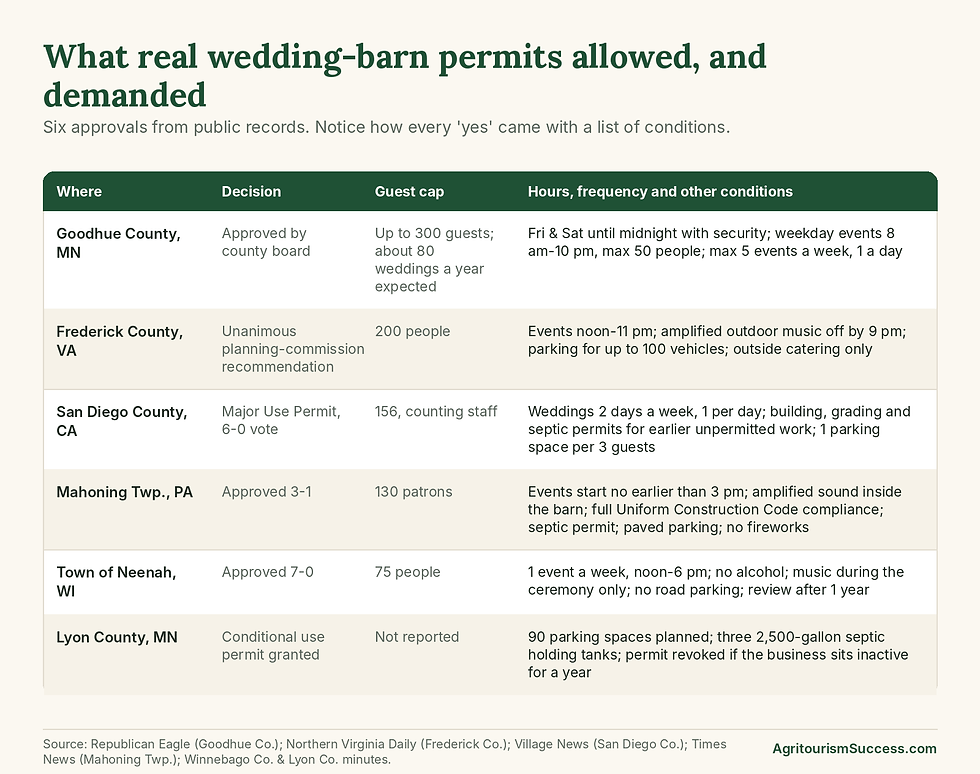
Notice the range. Goodhue County, Minnesota approved a venue expecting about 80 weddings a year with up to 300 guests. The Town of Neenah, Wisconsin approved one capped at 75 people, one event a week, noon to 6 p.m., with no alcohol at all. Mahoning Township, Pennsylvania approved a 130-patron barn on a 3-1 vote, but required full building code compliance, a septic permit and paved parking.
A "yes" almost always means "yes, if." And those "ifs" are binding. In Grant, Minnesota, the 2014 permit for Dellwood Barn Weddings states that any violation of its conditions will result in revocation. Lyon County, Minnesota wrote into one wedding barn permit that it would be revoked if the business sat inactive for a year.
How to Win the Public Hearing
Boards are made up of local residents who will see your neighbors at church and at the grain elevator. Here is how to make it easy for them to vote yes.
Meet every neighbor within sight and earshot before you file. Surprise is what turns a neighbor into an opponent. My guide to avoiding disputes with neighbors covers how to have that conversation.
Propose your own conditions. Offer a guest cap, an events-per-year limit, an end time and an amplified-music cutoff. Boards trust applicants who limit themselves.
Bring a parking and traffic plan. Show on-site spaces, a fire-truck turnaround and no parking on the public road. San Diego County's standard for event venues is one space for every three guests.
Show your sound plan. Amplified music indoors, a cutoff time, and a phone number neighbors can call on event nights.
Prove the farm is still a farm. Bring photos, sales records and a description of how farm products are part of every event.
Have the wastewater, building and fire answers ready. Boards rarely approve what the health department has not blessed.
Bring supporters. Local caterers, florists, photographers and long-time farm customers who will speak about the jobs and visitors you bring.
The Second Gate: Building, Fire, Septic, Alcohol and Insurance
Zoning answers one question: may this use happen here? Codes answer another: is this building safe for 200 people at night?
A barn is normally treated as an agricultural building. Once it hosts weddings, it may be treated as an "assembly" building, which can mean exit signs, fire alarms, an occupancy limit and sometimes sprinklers. That is exactly the gate that stopped Stoney Hill's construction.
The costs are not small. A Pennsylvania state senator said sprinkler systems and similar features could cost farmers "tens of thousands of dollars." Minnesota venue owners told state lawmakers sprinklers cost hundreds of thousands. Wastewater is just as real. One Minnesota wedding barn planned three 2,500-gallon holding tanks after a septic designer estimated 4,000 to 5,000 gallons of sewage per weekend.
Then there is alcohol, which Wisconsin showed can change overnight, and insurance. If your weddings do not legally count as agritourism, do not count on your state's agritourism liability law to protect you either. Read my guide to agritourism insurance coverage and my breakdown of whether liability waivers really protect your farm, then get your insurer to confirm in writing that weddings and alcohol service are covered.
How to Make Weddings Agriculturally Related, For Real
If your state protects agritourism or farm wineries, the strongest legal position comes from a business where the farm product genuinely comes first. That means building the farm into every booking, not decorating with it.
Put your product at the center. Wine, cider, flowers you grow, produce on the menu, honey or preserves as favors.
Make the purchase part of the package where your state's alcohol and consumer laws allow it. That was the deciding fact for Blueberry Barn.
Keep the barn working. Production equipment, product storage and a real sales area should live in the building, all year.
Build the farm into the program. An orchard or vineyard walk, a harvest experience or a farm-to-table dinner made from what you grow.
Keep records. Production volumes, product sales and how event revenue ties to them. In a dispute, paper wins.
Ask first, build second. Get the zoning office's written interpretation before you spend money on the conversion.
DO NOT DO WHAT STONEY HILL DID Do not declare a barn "for horses" and then furnish it for brides. Do not plant vines after you are sued and expect the court to be impressed. Do not keep hosting after an injunction. In Ohio that cost $50,000. Judges look at what is really inside the building, and they are very good at it. |

For practical tips on running the events themselves once you are approved, see my guide to organizing farm weddings and special events.
The Money Math: Why the Permit Is the Cheapest Part
Let's run a simple illustration. Say your barn rents for $5,000 a date, well under the $12,200 national average venue spend, and you book 20 weddings a season. That is $100,000 in gross revenue.
Now picture an injunction in June. You lose the rest of that season's revenue. You owe refunds to every couple still on the calendar. Your reviews fill with stories from brides whose weddings collapsed weeks before the date. And if you keep hosting, you risk a fine like the $50,000 in Ohio, or an Attorney General lawsuit like the one in Pennsylvania.
Compare that with the cost of doing it right: application fees, a site plan, a few hours of a land-use attorney's or engineer's time, and some conversations over the fence with your neighbors. The permit is not a cost of the wedding business. It is the insurance policy on all of it.
Your Permit Roadmap

Follow these steps in this order. The order matters, because each step changes what you do in the next one.
Read the map. Find your zoning district and look up "event venue," "assembly," "banquet" and "agritourism" in the code.
Meet the planner. Ask for a pre-application meeting and leave with a list of the permits that apply to you.
Talk to neighbors before anything is filed.
File the application with a site plan covering parking, septic, lighting, sound, guest cap and hours.
Prepare for the public hearing using the seven tactics above.
Accept and calendar every condition. Put your guest cap, end time and events limit into your booking contract.
Get the code permits: building and fire, health and septic, liquor and signage.
Take bookings only after the last approval is in hand.
The 12-Point Wedding Barn Legal Checklist
Print this and keep it with your farm records. Every box should be checked before you accept a single deposit.

Frequently Asked Questions
Do I need a permit to host weddings on my farm?
In most places, yes, if you charge for them. A paid wedding venue is usually treated as a commercial event use, which many zoning codes allow only as a conditional use. The main exceptions are areas with no zoning, or states where a farm, agritourism or farm winery exemption covers the activity, and even then building, fire and health codes usually still apply.
Are farm weddings considered agritourism?
Sometimes, but not automatically. In the Ohio Lusardi case, a court refused to declare that weddings on a farm are agritourism as a matter of law. What helps is a clear tie to what the farm produces. Other states treat it differently, so check your state's statute and how your local officials read it.
Can I host my own family's wedding on my farm without a permit?
A private, unpaid family gathering is generally treated differently from a commercial venue, and most places will not require a permit for it. But rules vary, and the Virginia Boneta case shows a neighbor's complaint can trigger enforcement even over a small party. A quick call to your zoning office settles it.
How many weddings can I host a year?
Whatever your permit allows. Real examples range from one event a week in Neenah, Wisconsin, to two event days a week in San Diego County, to about 80 weddings a year in Goodhue County, Minnesota. In Wisconsin, barns without a liquor license are now limited to six events a year where alcohol is served.
Will hosting weddings affect my farm's property tax status?
It can. In Ohio, the 2016 agritourism law says agritourism does not disqualify farmland from Current Agricultural Use Value taxation. An event business that does not qualify as agritourism may not get that protection. Ask your county auditor or assessor before you start.
What happens if I host weddings without the right permits?
Expect citations, injunctions and fines. In Ohio, one owner was fined $50,000 for continuing after an injunction. In Pennsylvania, a barn was ordered to stop paid events and its managers were later sued by the state Attorney General. You may also owe refunds to every couple on your calendar.
The Bottom Line
Can you host weddings on agricultural land? Very often, yes. But almost never by accident.
The farms that win build the wedding around the farm, not the farm around the wedding. They talk to the planner before the contractor, to the neighbors before the hearing, and to the insurer before the first couple signs. The farms that lose usually started booking first and asked permission later.
If you want to see how ready your farm really is to welcome visitors, including the rules and insurance questions that trip up most beginners, take my free Farm Readiness Quiz. Then grab my free 21-Point Agritourism Blueprint, the same checklist I use to plan new agritourism ventures the right way.
Sources
Ohio State University: Court rules in favor of Myrddin Winery (Terry v. Sperry)
Ohio General Assembly: Senate Bill 75 (agritourism), effective August 16, 2016
USDA Economic Research Service: Most U.S. counties generate some agritourism income
The Hustle: The Knot data on barn, farm and ranch receptions, 2009 to 2017
National Agricultural Law Center: Virginia agritourism bill after the Boneta case
The Roanoke Star: Landmark agriculture bill now law in Virginia
Channel 3000: New alcohol regulation now in effect for Wisconsin's wedding barns
Wisconsin Institute for Law and Liberty: Judge allows wedding barn lawsuit to continue
PhillyVoice: Bucks County wedding venue sued by Pennsylvania Attorney General
Pennsylvania Farm Bureau: Wedding barn bill passed by Senate
North Carolina Office of State Fire Marshal: Wedding venues and farm buildings guidance
Minnesota House: Barns hosting wedding events could be exempt from sprinkler requirements
Republican Eagle: Goodhue County wedding barn venue approved
Northern Virginia Daily: Frederick County planners support special event facility
Village News: San Diego County Planning Commission permits De Luz wedding venue
Winnebago County, Wisconsin: Planning and Zoning Committee public hearing minutes, March 29, 2016
Lyon County, Minnesota: Planning Commission minutes on 5 Family Ranch wedding barn
City of Grant, Minnesota: Resolution 2014-11, Dellwood Barn Weddings conditional use permit
This article is general education, not legal advice. Zoning, building and alcohol rules differ by state, county and township and change often. Before you build, convert a barn or take a booking, confirm the rules with your local zoning office and a land-use attorney licensed in your state.


Comments