



Do Liability Waivers Protect Your Farm? Waivers vs Your State's Agritourism Act


Last reviewed: October 2026. General education, not legal advice.
Fifty-six minutes into a webinar about farm insurance, somebody finally asked it.
The Global Agritourism Network had put two farm insurance specialists, one from Canada and one from the United States, in front of its North America members for a session called "On-Farm Risk & Insurance: What Agritourism Operators Need to Know." It was May 2026. Co-chairs Scottie Jones of Oregon and Keleigh Cormier of Alberta hosted. The Q&A had already dealt with the difficulty of finding liability insurance after four years of trying, and with what insurers want to see before they say yes.
Then came the question every farm host asks sooner or later. The session's chapter notes word it this way:
Do liability waivers help? Are they worth having visitors sign?
You can hear the specialists' answer for yourself at the 56:34 mark of the recording. This article does a different job. It answers the question the way a courtroom would: with the statutes, and with the files of six farms that learned what their paperwork was worth after somebody got hurt.
Most farm owners treat a waiver like a force field. Sign here, and nothing can touch me. Most also have a warning sign nailed up somewhere, because somebody at a conference said the state requires one. Very few can tell you which of the two is doing the work. Fewer still know that in some states, one of them does no work at all.
So, do liability waivers protect your farm? Sometimes. Partly. And never alone. Here is what decides it.
THE SHORT VERSION 1. A waiver is a contract. It binds only the person who signed it, and only as far as your state's courts allow. 2. Your state's agritourism act is a statute. It can protect you against visitors who never signed anything, but only if you meet its conditions to the letter. 3. 37 states have an agritourism liability act and 13 do not. Six of the 37, Texas among them, let you choose between a posted sign and a signed document. Two require both. 4. Neither one protects you from a hazard you knew about and ignored. Neither one pays for a lawyer. 5. The farms that come through a claim intact stack four layers: a safe farm, the act, a waiver and insurance. |
Two Shields, Two Different Jobs
A liability waiver (lawyers also call it a release) is a contract. One visitor, one signature, one promise not to hold you responsible. Its power comes from contract law, which means a judge in your state gets to decide whether that promise is one the law will enforce.
An agritourism liability act is a statute. Your legislature decided that people who choose to walk onto a working farm accept the ordinary risks of being there: uneven ground, unpredictable animals, weather, machinery. Kansas passed the first one in 2004. By my October 2026 count, 37 states now have one.
They are not two versions of the same thing. They are two different tools, switched on in two different ways and broken in two different ways.
Signed waiver | State agritourism act | |
What it is | A private contract between you and one visitor | A state law that applies to every operator who qualifies |
Who it binds | Only the person who signed, and often not that person's child | Every participant, including the ones you never met |
What switches it on | A signature, before the activity starts | Meeting the statute's conditions, usually a sign with exact wording |
What it can cover | Whatever the wording clearly covers and your state's courts allow | Usually the inherent risks of farm activities, as the statute defines them |
What defeats it | State public policy, a minor's claim, gross negligence, vague wording, a lost form | A missing or misplaced sign, an activity outside the definition, the statute's exceptions |
What it costs | A form and a routine at the gate | In most states, a sign |
Notice what the table does not say. It does not say one is better. Each catches things the other misses, and both have holes. That is why risk managers think in layers. The safety engineers who study plane crashes call it the Swiss cheese model: every slice has holes, so you stack slices until the holes stop lining up.

The first layer is the one no lawyer can draft for you. The fourth is the only one that writes a check. The two in the middle are what this article is about, and no state shows the choice between them more plainly than Texas.
Texas: One Law, Two Doors
Texas spells the choice out about as plainly as a statute can. Senate Bill 610 passed in 2015 without a single vote against it: 31 to 0 in the Senate, 140 to 0 in the House. It became Chapter 75A of the Civil Practice and Remedies Code, the Texas Agritourism Act.
The rule is short. An agritourism entity is not liable for a participant's injury from an agritourism activity if, at the time, one of two things was true.
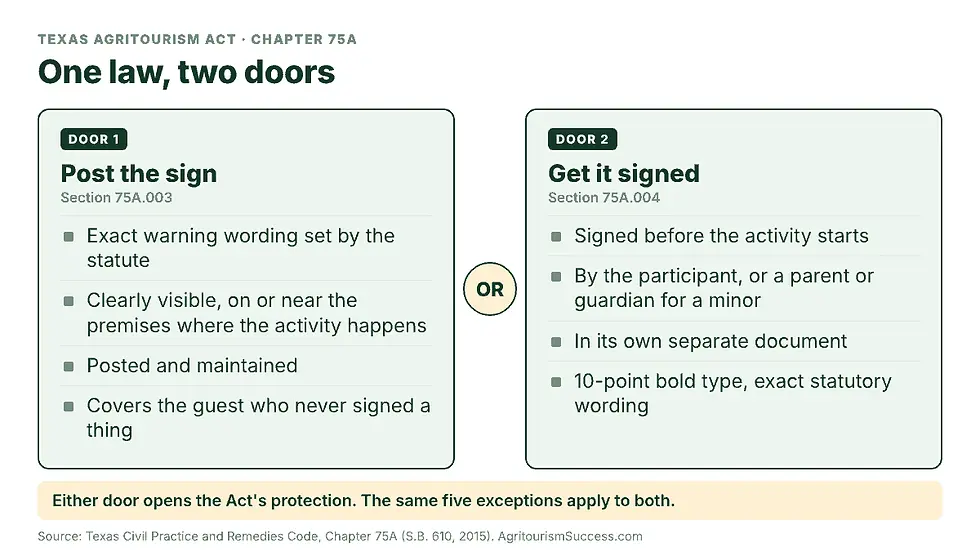
Door 1 is the sign. It must be posted where visitors can clearly see it, on or near the premises where the activity takes place, and it must carry these words:
WARNING UNDER TEXAS LAW (CHAPTER 75A, CIVIL PRACTICE AND REMEDIES CODE), AN AGRITOURISM ENTITY IS NOT LIABLE FOR ANY INJURY TO OR DEATH OF AN AGRITOURISM PARTICIPANT RESULTING FROM AN AGRITOURISM ACTIVITY.
Door 2 is the signed agreement. Here the statute gets fussy. The paper counts only if it ticks five boxes:
It was signed before the visitor took part in the activity.
It was signed by the participant or, if the participant is a minor, by a parent, managing conservator or guardian.
It is a separate document from any other agreement between you and the visitor. The only thing it may be combined with is another warning, consent or assumption of risk statement.
It is printed in bold type of at least 10 points.
It contains the statute's own "AGREEMENT AND WARNING" wording, which begins: "I UNDERSTAND AND ACKNOWLEDGE THAT AN AGRITOURISM ENTITY IS NOT LIABLE FOR ANY INJURY TO OR DEATH OF AN AGRITOURISM PARTICIPANT RESULTING FROM AGRITOURISM ACTIVITIES."
A TEXAS AGRITOURISM AGREEMENT IS NOT A GENERAL WAIVER Tucking the statutory words into paragraph nine of your online booking terms is likely to fail box 3. Eight-point type fails box 4. Your own hold-harmless wording, however stern, is not the statute's wording. If you choose Door 2, copy the statute exactly. Ask your attorney whether your broader waiver can share the page. The conservative answer is to keep them apart: two documents, two jobs. |
Which door? Tiffany Dowell Lashmet, the agricultural law specialist at Texas A&M AgriLife Extension, has been answering that for years. In her FAQ on the Act she notes that operators are not required to do both, "but it is prudent to do so." Her reasoning is practical. The sign covers the guest you never expected: the cousin who tagged along, the visitor who walked in while you were out on the tractor. The signed agreement gives you proof that a particular person was warned.
The signed agreement also does something for children that an ordinary waiver often cannot. The Texas Supreme Court has never ruled on whether a parent can sign away a child's injury claim, and at least one Texas appeals court has said a parent cannot. Chapter 75A sidesteps the argument. It expressly allows a parent or guardian to sign the statutory agreement for a minor.
So do both. The sign costs less than a tank of diesel, and the form costs a clipboard.
Then read the five exceptions, because this is where Texas cases get fought. The Act does not protect you when the injury was caused by:
Negligence on your part that shows a disregard for the participant's safety
A dangerous condition on your land, facilities or equipment that you knew about or reasonably should have known about
The dangerous propensity of a particular animal that you knew or should have known about and did not disclose
Your failure to train, or to properly train, an employee who was actively involved in the activity
An injury you caused intentionally
Read the second one again. Knew, or should have known. The rotten step on the hayloft stairs. The gate latch you have been meaning to fix since spring. No sign and no signature covers those.
Lashmet makes one more point that operators tend to skip past: the Act "is not a substitute for insurance." I cover what Texas policies cost and what they exclude in Texas agritourism insurance.
How the Other 49 States Treat the Signed Paper
Texas gives you a choice. Most states do not. When I sorted all 50 states by what their law says about signed paperwork, they fell into six groups.

Sign, plus the warning in your written contracts (19 states). The biggest group, and it includes Florida, North Carolina, Tennessee and Virginia. The sign is the trigger, and the same warning language has to appear in the contracts you sign with visitors. That is a notice requirement, not a full waiver. I walk through one of these states in agritourism insurance in North Carolina.
Your choice: a sign or a signed document (6 states). Colorado, Indiana, Kentucky, Maine, Nebraska and Texas.
Sign or posted notice only (6 states). Alabama, Minnesota, New York, Ohio, Utah and Wisconsin. Under the act itself, a signature adds nothing.
Both a sign and a signed waiver (2 states). Georgia and Pennsylvania. In Georgia, the protection reaches only participants aged 18 or older who signed.
No sign or paperwork required (4 states). Alaska, Connecticut, Montana and Wyoming.
No agritourism liability act at all (13 states). Arizona, California, Delaware, Hawaii, Illinois, Maryland, Massachusetts, Michigan, Nevada, New Hampshire, New Jersey, New Mexico and Rhode Island. Other laws, such as equine activity or recreational use statutes, may still help. Otherwise a waiver and your insurance are the only paper standing between you and a claim.
Statutes change every session. Confirm your state's current wording in my 50-state guide to agritourism laws or the National Agricultural Law Center's state compilation, and follow the placement rules in where to post agritourism warning signs.
Where Waivers Fail: 4 Weak Spots
1. Your state may refuse to enforce it
Most states will enforce a clear, well-drafted waiver signed by an adult, at least for ordinary negligence. Three will not. Louisiana, Montana and Virginia refuse them outright. Virginia's Supreme Court reaffirmed its rule in 1992.
Other states are tightening. Since October 1, 2024, a Maryland law has voided negligence waivers used by commercial recreational facilities, and University of Maryland educators have warned that it may reach horse riding and some agritourism. Maryland is also one of the 13 states with no agritourism act. Neither shield is safe to count on there.
And sometimes you only find out in court. In October 2002, a woman booked a riding lesson at Windswept Farm in Connecticut. She signed the farm's release, which covered the farm's own negligence, and described herself as an experienced rider. The horse bucked and threw her. The trial court read the release and ruled for the farm. In 2006 the Connecticut Supreme Court reversed: the release was void as against public policy.
The paper was signed, dated and clear. It was worth nothing.
2. A child cannot be signed away
This is the weak spot that matters most, because your visitors are families.
In 2008 the Florida Supreme Court decided Kirton v. Fields. A father had signed a release so that his 14-year-old son could ride an ATV at a commercial motorsports park. The boy was killed. The court held that a release signed by a parent before the injury could not be enforced against a commercial business. Two years earlier, New Jersey's Supreme Court had reached the same result in a skate park case, and observed that most courts across the country do the same.
A few states go the other way. Maryland's highest court upheld a parental release in 2013. But the safe working assumption is this: a parent's signature binds the parent, not the child.
This is exactly where an agritourism act earns its keep. The act does not need anybody's signature. In most states it applies to the nine-year-old on the slide just as it applies to her father, provided you met the statute's conditions.
3. No waiver survives gross negligence
As a rule, courts will not enforce a waiver against gross negligence, recklessness or intentional harm. That is black-letter contract law.
On October 11, 2014, the vehicle pulling a haunted hayride wagon at Harvest Hill Farm in Mechanic Falls, Maine, lost its brakes. Cassidy Charette, 17, was killed. More than 20 other riders were injured. The farm pleaded guilty to a criminal charge of driving to endanger, went into bankruptcy and was sold at auction. The family's civil suit settled in 2017 for an undisclosed sum.
Acts and waivers are built for inherent risks. Failed brakes are not one of them.
4. Sloppy paper, sloppy process
Courts read a waiver against the party who wrote it. Vague wording, tiny print, a form signed after the wagon had already left, a clipboard nobody can find three years later when the claim finally arrives: each one is a way to lose. Before you rely on yours, put it through the five questions a court will ask.

If you cannot answer yes to all five, you do not have a waiver. You have a piece of paper.
Where Your State's Agritourism Act Fails: 3 Weak Spots
The act looks stronger than the waiver, and in many ways it is. But it has its own holes, and farms fall through them every year.
1. You missed a condition
A visitor injured her hand on a slide at Leesburg Animal Park in Loudoun County, Virginia. The park had posted the statutory warning sign in two places: at the outside entrance and inside the gift shop. Virginia's statute calls for signs "at the entrance to the agritourism location and at the site of the agritourism activity." The park ran more than a dozen activities.
On March 10, 2026, the judge ruled that without a sign at each activity, the park could not claim the act's protection. The ruling was reported in Southern Ag Today by Jesse Richardson and Tiffany Dowell Lashmet, who summed up the lesson in six words: "signs are cheap, lawsuits are not."
Now remember that Virginia is one of the three states that will not enforce a waiver. For that park, the act was the only paper shield available, and it was lost for the price of a few signs. I cover the ruling and the fix in where to post agritourism warning signs.
CHECK THIS TODAY Count your activities. Count your warning signs. If the first number is bigger than the second, you have a job for this week. Then photograph every sign where it stands and keep the dated photos. In a 2023 Washington case, a farm could not show where its sign had been posted in relation to the slide where the visitor was hurt. |
2. The activity is not "agritourism"
A wedding guest in Wisconsin misstepped off an elevated area inside a barn built in the 1800s and was injured. The farm had posted the notice Wisconsin's statute requires. According to Wisconsin Lawyer, the circuit court was persuaded that a wedding is not "agricultural tourism" under the statute at all. No appeals court has settled the question, so it stays open. Lashmet has flagged the same uncertainty for weddings in Texas.
If your income is drifting from pumpkins toward weddings, corporate retreats, concerts and farm stays, assume the act does not follow you there until a lawyer in your state tells you otherwise. This is where a well-drafted waiver or event contract stops being optional.
3. The exceptions swallow the claim
Every act has exceptions, and they are the first thing a plaintiff's lawyer reads. You saw the five in Texas. Most states carry some version of the same list: known dangers, undisclosed animal behavior, untrained staff, disregard for safety.
In Minnesota, a seven-year-old girl visited the petting zoo at Dehn's Pumpkins, touched the animals and contracted E. coli. She developed a complication that attacks the kidneys. There were no hand-washing stations. The owners settled for $415,000, and in 2017 a jury put her total damages at $7.55 million, as recorded in a review of agritourism litigation by Ohio State's Peggy Kirk Hall and Ellen Essman.
The published accounts of that case mention no agritourism act defense. Now read the exceptions in your own state's act and ask which side of the line a petting zoo with nowhere to wash your hands would fall on.
And when the act works, it works
An elderly woman rode a church bus to an outing at a Tennessee farm. The bus crossed two drainage berms on the farm's gravel driveway, and the jolt severely injured her. A jury put 85% of the fault on the farm and 15% on the church.
The farm paid nothing. Tennessee's agritourism act made it immune, and in November 2018 the Court of Appeals confirmed the result: she could recover only the church's 15%. No waiver was needed. The statute did the work.

So, Do Liability Waivers Protect Your Farm?
A waiver protects your farm when four things are true: your state enforces waivers, an adult signed it, the wording clearly covers what happened, and what happened was an ordinary accident, not a hazard you ignored. Take away any one of the four and the protection thins or disappears.
Your state's agritourism act protects you against the people a waiver never reaches: children, walk-ins, the guest of a guest. But it works only for activities inside the statute's definition, and only if you met every condition.
Here is how the two perform in the situations farms actually face.
Situation | Signed waiver | Agritourism act |
An adult twists an ankle in a rutted pumpkin field | Likely helps, in most states | Likely helps, if your sign is right |
A walk-in guest who never saw your form is hurt | No help | Helps. The sign speaks to everyone |
A child is hurt on the corn maze slide | Weak. Most courts will not hold a child to a parent's signature | Helps, if the conditions were met at that activity |
A wedding guest falls in your barn | Wedding guests rarely sign one. The event contract matters more | Uncertain. A wedding may not count as agritourism |
The hayride brakes you knew were bad give out | No help | No help |
Your farm is in one of the 13 states with no act | The only paper shield you have | Not available |
One thing is missing from that table, and it is the one that matters when the letter from the lawyer arrives. Insurance is the only layer that pays for your defense in every row, provided the activity is listed on your policy. A waiver and an act are arguments your lawyer makes. Somebody still has to pay the lawyer.
University of Minnesota Extension puts the limits plainly. A waiver can communicate risks, deter some claims and satisfy an insurer's recommendation. It cannot take away a visitor's right to sue, guarantee protection, or replace safe practices and insurance.
THE VERDICT A waiver is worth having, and it is the weakest layer you own. Use it. Do not lean on it. The act is stronger and usually cheaper, but it is unforgiving about its conditions. Meet every one. Insurance pays. Safety prevents. Those two carry the weight. |
Your 7-Step Protection Plan
Do these before your next open day. Most of them cost an afternoon.
Read your statute tonight. Find your state in the 50-state guide and work out which of the six groups you are in. Ten minutes of reading will tell you more than ten years of conference hallway advice.
Post the sign, word for word. Use the exact wording and any letter size your statute sets, at the entrance and at every activity. Photograph each one.
Put the warning in your contracts. If you are in one of the 19 states that require it, the statutory language belongs in every contract, group booking and rental agreement you sign.
Add a waiver where the act runs out. Horse rides, weddings, farm stays, equipment rental, anything outside your statute's definition. Have a lawyer licensed in your state draft it. A downloaded template was written for somebody else's state.
Have parents sign for children anyway. It proves the family was warned, and in states like Texas the statute gives that signature real force. Just do not count on it to stop a child's claim.
Fix what you know about, and write it down. Brake checks, hand-washing stations, staff training, a weekly walk-through with a dated log. Known hazards defeat both shields at once.
Call your insurance agent. Confirm that every activity you run is on the policy, ask what signs and waivers the insurer expects, and ask how long to keep signed forms. Start with what agritourism insurance covers.
Frequently Asked Questions
Do I need both a waiver and a warning sign?
In Georgia and Pennsylvania, the act requires both. Elsewhere it is usually optional, and usually wise. The National Agricultural Law Center's fact sheet on agritourism immunity laws notes that a statute can remove the need for a waiver, but that waivers remain useful for activities the act does not cover, and that your insurer or attorney may still want them.
Is a liability waiver enforceable if a child gets hurt?
Often not. Courts in most states refuse to let a parent sign away a child's injury claim against a commercial business. A few states allow it, and some statutes, including the Texas Agritourism Act, expressly let a parent sign for a minor. Treat a child's waiver as proof of warning, not as a shield.
Does a waiver stop someone from suing my farm?
No. Anyone can file a lawsuit. A good waiver gives your lawyer a defense and may persuade the other side not to file. It does not prevent the suit, and it does not pay your legal bills.
Does the Texas Agritourism Act require a signed waiver?
No. Texas protects an agritourism entity that has either posted the statutory warning sign or obtained the statutory signed agreement. You need one of the two. Texas A&M's Tiffany Dowell Lashmet recommends doing both.
Can I use a free farm liability waiver template?
As a starting point for a conversation with your lawyer, yes. As a finished document, no. Enforceability turns on your state's law, and several statutes require exact wording, type size and format. A template cannot know any of that.
Will my insurance company require waivers?
Some insurers do, and many ask about them when they quote. Ask your agent what the company expects, and get the answer in writing.
The Bottom Line
A waiver is a promise from one visitor. The act is a promise from your legislature. Insurance is a promise from a company with a checkbook. A safe farm is the promise you make yourself, and it is the only one of the four that keeps anybody from getting hurt in the first place.
Stack all four. Then, when somebody asks whether liability waivers are worth having visitors sign, you will have the answer that holds up: yes, as one layer of four.
P.S. Walk out to your entrance today and photograph your warning sign with your phone. If a claim ever comes, one of the first questions will be where the sign stood and whether you can prove it.
This article is general education for farm and agritourism operators. It is not legal advice and does not create an attorney-client relationship. Statutes and case law change, and outcomes turn on the facts. Have an attorney licensed in your state review your signs, waivers and contracts, and talk to your insurance agent before you rely on any of them.
Sources
Global Agritourism Network, On-Farm Risk & Insurance: What Agritourism Operators Need to Know, North America Regional Meeting, May 2026 (recording at 56:34)
Texas Legislature, Senate Bill 610 (2015), Civil Practice and Remedies Code, Chapter 75A
Tiffany Dowell Lashmet, Texas A&M AgriLife Extension, Texas Agritourism Act FAQ and Signage Requirements Under Agritourism Liability Acts: What About Texas? (April 20, 2026)
Jesse Richardson and Tiffany Dowell Lashmet, Signage Requirements Under Agritourism Liability Acts, Southern Ag Today (April 10, 2026)
Peggy Kirk Hall and Ellen Essman, Recent Agritourism Litigation, Ohio State University Extension and National Agricultural Law Center
John Day, Agritourism Statute Provides Immunity From Liability But Allows Fault Allocation, Day on Torts (Green v. St. George's Episcopal Church, Tenn. Ct. App. 2018)
Wisconsin Lawyer, October 2023, on the agricultural tourism immunity statute and barn weddings
Associated Press, Lawyer: Settlement reached in fatal Maine hayride crash lawsuit (August 9, 2017)
Bryan Cave Leighton Paisner, 50-state survey of liability waiver enforceability
Insurance Journal, Connecticut Supreme Court on Reardon v. Windswept Farm (2006) and Florida Supreme Court on Kirton v. Fields (2008)
Sports Litigation Alert, Hojnowski v. Vans Skate Park (N.J. 2006)
University of Maryland, Maryland Risk Management Education Blog, New Maryland Law Limits Liability Waivers for Recreational Facilities
Peggy Kirk Hall and Evin Bachelor, Agritourism Immunity Laws fact sheet (National Agricultural Law Center, 2019), and the Center's state statute compilation
University of Minnesota Extension, Protecting Your Farm and Your Guests: Understanding Agritourism Liability in Minnesota (May 20, 2025)
Mitchell Hamline Law Review, Sign Here: How Parental Waivers Exceed the Bounds of Parents' Fundamental Rights (2024)


Comments