



Agritourism Warning Signs: Where to Post Them After the 2026 Virginia Ruling


Last reviewed: October 2026. General education, not legal advice.
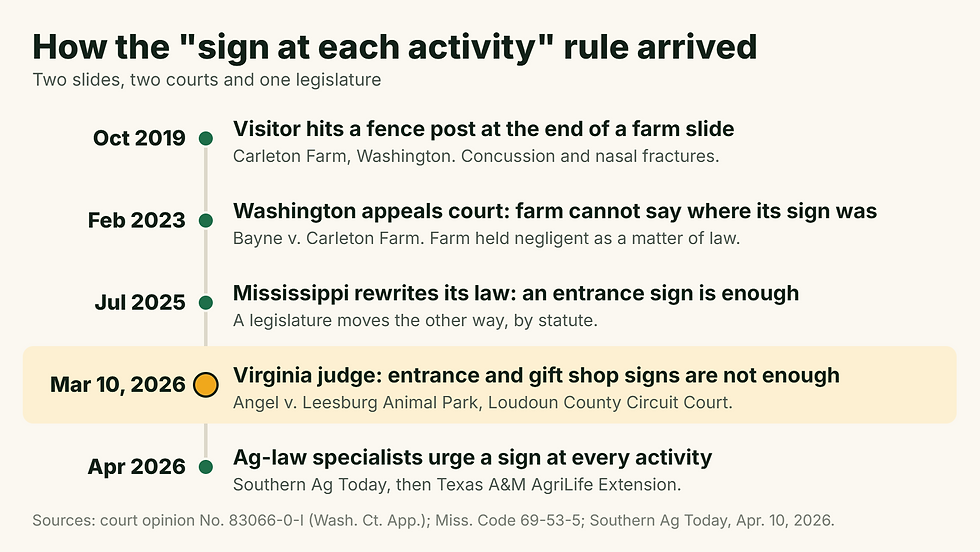
On March 10, 2026, a judge in Loudoun County, Virginia, took away an animal park's strongest legal shield.
The park had not ignored the law. It had the agritourism warning sign. It had posted it twice: once at the outside entrance and once inside the gift shop.
It was not enough.
A visitor had hurt her hand on a slide. The park raised the Virginia Agritourism Activity Act, the law meant to protect farms from claims over the inherent risks of a farm visit. The judge ruled from the bench that the park could not use it, because no warning sign stood at the slide itself. That is the account published by agricultural law specialists Jesse Richardson and Tiffany Dowell Lashmet in Southern Ag Today.
Two signs posted. More than a dozen needed. Protection gone.
If your farm has one sign at the gate and none anywhere else, this article is for you. It covers what the judge decided, the eight words in the statute that decided it, an earlier Washington case that points the same way, which states follow the same rule, and exactly where to post your agritourism warning signs. The fix is cheap, and you can finish it in an afternoon.
THE SHORT VERSION 1. A Virginia circuit judge ruled on March 10, 2026 that signs at the entrance and gift shop did not satisfy the state's agritourism law. A sign was needed at each activity. 2. Eleven states have the same two-place rule: a sign at the entrance and at the site of the agritourism activity. 3. The ruling binds one county court, but lawyers in every state can borrow its reasoning. 4. The fix: one sign at every public entrance, one at every activity, and a dated photo of each. |
What Happened in Loudoun County
The case is Angel v. Leesburg Animal Park, LLC, Case No. CL23005507-00, in the Loudoun County Circuit Court. Here is what the published account tells us.
The injury. The plaintiff hurt her hand on a slide at the park.
The defense. The park raised the Virginia Agritourism Activity Act, which says an agritourism operator is not liable for injuries that come from the inherent risks of the activity, as long as the required warning is posted.
The signs. The park had posted the statutory warning in two places: inside the gift shop and at the outside entrance.
The argument. The plaintiff said that was not what the statute requires. A sign had to stand at each separate activity. For this park, that meant more than a dozen signs.
The ruling. On March 10, 2026, the judge agreed with the plaintiff. Failing to post a sign at each activity disqualified the park from the Act's protection.
Richardson and Lashmet described the ruling as a surprise to many agricultural lawyers. It surprised them because most operators, and plenty of attorneys, had read the statute the way the park did: one sign where people come in, one more somewhere visible, done.
Court | Loudoun County Circuit Court, Virginia |
Date | March 10, 2026, ruling from the bench |
Activity | A slide at an animal park |
Signs posted | Outside entrance and inside the gift shop |
Signs the plaintiff said the law requires | One at each separate activity, more than a dozen in all |
Result | The park cannot rely on the Agritourism Activity Act |
Binding on | That court only. Persuasive everywhere else. |
WHAT THE RULING DID NOT DECIDE The judge took away a statutory defense. That is not the same as deciding the park was at fault. Without the Act, a claim is argued under ordinary negligence law, where a farm has to defend its conduct on the facts. A ruling from the bench also leaves no written opinion to study, so what is public about this case comes from the specialists' report. That report does not say how the case ended. |

The Eight Words Most Farms Skip
Virginia's sign rule sits in Va. Code § 3.2-6402. The key sentence is short:
The sign shall be placed in a clearly visible location at the entrance to the agritourism location and at the site of the agritourism activity.
Read the last eight words again: and at the site of the agritourism activity.
Not "or." And. The statute names two places. Most farms post at the first and never think about the second.
The fight in Loudoun County was over what the second place means on a farm with a dozen things to do. One reading says the whole property is the site, so a sign near the action covers everything. The other says every activity has its own site: the slide is one, the petting pen is another, the wagon ride is a third. The judge took the second reading.
Then comes the part that makes this expensive. The same section says that failing to comply with the sign requirements prevents an operator from invoking the Act's immunity. There is no partial credit. Miss the sign condition for the activity where someone gets hurt, and the shield is gone for that claim.
Virginia's section also asks for two more things that farms miss:
Black letters at least one inch high. Small print on a clipboard does not meet that.
The same notice in your written contracts. The statute reaches every written contract for professional services, instruction or equipment rental.
For the exact wording and letter rules in your state, use the 50-state guide: Agritourism Laws by State.
Washington Got There First
The Virginia ruling was not the first sign of trouble. In October 2019, Erin Bayne took her family to the fall festival at Carleton Farm in Washington State. Her three-year-old stepson wanted to ride the roller slide, got nervous at the top, and asked her to come down with him. At the bottom, their momentum carried them into a wooden fence post standing about six feet from the end of the slide. She suffered a concussion and nasal fractures that needed surgery.
She sued. The farm pointed to its agritourism warning sign. Then came the sentence that should make every operator wince. Asked where the sign was, the farm answered in discovery that there was a warning sign on the property "but its exact location is unknown."
In February 2023, the Washington Court of Appeals was blunt about what that was worth:
There is no evidence of the location of the sign and, thus, no evidence that this warning was directed specifically toward the slide or users of the slide.
The court upheld the ruling that the farm was negligent as a matter of law, and sent one question back for a jury: whether Bayne shared some of the fault by riding with a child on her lap. The case is Bayne v. Carleton Farm, No. 83066-0-I, an unpublished opinion.
One point of accuracy, because it matters. The appeal was argued as an ordinary negligence case. The farm had pleaded agritourism immunity, but that defense was not the issue on appeal. The court's words about the sign came up when the farm tried to use the sign as proof that it had warned visitors. So Bayne is not a holding about the immunity statute. It is something just as useful: an appeals court saying that a general sign, somewhere on the property, is no evidence that the people using a particular activity were warned. Washington's statute, RCW 4.24.835, uses the same placement language as Virginia's.
TWO LESSONS FROM TWO SLIDES 1. The sign has to be at the activity. A sign the injured visitor never passed protects no one. 2. You have to be able to prove where it was. A dated photo beats anyone's memory. Notice what both cases have in common: play equipment. A slide is not a cow or a tractor. The further an attraction is from farming, the less you should count on a farm-risk statute to cover it, and the more its design and upkeep matter. |
Does This Apply in Your State?
Strictly speaking, the Virginia ruling binds one court: the Loudoun County Circuit Court. The Washington opinion is unpublished. Neither one controls a judge in Ohio or Texas.
That is the comfortable answer. Here is the practical one. Agritourism liability statutes were copied from state to state, often word for word. When a plaintiff's lawyer in your state takes a farm injury case, the first step is to read your statute, and the second is to search for rulings on the same words. Richardson and Lashmet's own conclusion was that the reasoning may lead courts elsewhere to rule the same way.
So the real question is how your statute is worded. A review of the sign rules in 33 state agritourism liability laws sorts them into four groups. Ten states use Virginia's sentence word for word, and Oregon reaches the same result in its own words.

Where the sign must go | States | What to do |
Entrance and the site of the activity | Florida, Idaho, Kentucky, Louisiana, North Carolina, Oklahoma, Oregon, Tennessee, Virginia, Washington, West Virginia | Treat the Virginia reading as your rule: entrance plus every activity. |
Entrance or the activity site | Ohio, Pennsylvania, South Carolina, Utah, Wisconsin | Either location meets the text. Posting at both closes the argument. |
Entrance, or "at or near" the location | Alabama, Arkansas, Georgia, Indiana, Iowa, Kansas, Mississippi, Missouri, Nebraska, South Dakota, Vermont | One well-placed sign may meet the text. Check for a waiver or contract requirement on top. |
Other wording | Colorado, Maine, Minnesota, New York, North Dakota, Texas | Wording such as "on or near" the premises, or at ticket points in New York. No court has said how many. |
Two cautions about that table. First, statutes change. Mississippi used the Virginia wording until July 1, 2025, when its legislature cut the requirement back to a sign at the entrance. Second, the groups describe the text, not how a court will read it. Texas law asks for a sign "on or near any premises" where an activity is conducted, and Lashmet has pointed out that no Texas appellate court has yet said how many signs that means. Her advice to landowners is that extra signs cost far less than a lawsuit fought without the statute.
You will find each state's rule, wording and letter size in Agritourism Laws by State. If you farm in Texas or North Carolina, see the state guides on Texas agritourism insurance and North Carolina agritourism insurance.
When the Signs Are Right, the Law Works
It would be easy to read all this and decide the statute is worthless. It is not. A Tennessee case shows what it buys you.
A woman on a church outing was injured when the bus she was riding hit a drainage berm on a farm's gravel driveway. She sued the church, not the farm. When fault was sorted out, 85 percent of it was assigned to the farm. The farm paid nothing, because Tennessee's agritourism statute shielded it. The Court of Appeals agreed in 2017 that a jury may assign fault to a protected farm, but the farm itself cannot be made to pay. The case is Green v. St. George's Episcopal Church, summarized by the National Agricultural Law Center.
Eighty-five percent at fault. Zero dollars owed. That is the value of the protection you lose when a sign is missing.
What a Sign Will Never Cover
Signs protect you from one thing: claims over the inherent risks of a farm visit. Uneven ground. An animal that behaves like an animal. They do not protect you from your own carelessness, and no number of signs changes that.
In Minnesota, a seven-year-old girl contracted E. coli after touching animals at a pumpkin farm's petting zoo. Her family argued that the farm skipped basic precautions such as hand-washing stations. The farm's owners settled for $415,000. A jury then assessed $7.55 million in damages against the remaining defendants. A warning sign was never going to decide that case. It was a negligence case.
A properly posted sign helps with | A sign does nothing for |
Inherent risks: land, animals, weather, ordinary farm equipment | Negligence: unsafe design, poor upkeep, untrained staff |
Visitors who ignore your instructions | A danger you knew about and did not warn of |
Claims the statute was written to stop | Activities outside your state's definition of agritourism |

That chart is the whole argument for doing this today. Fourteen metal signs run about $168 at the prices the Texas Farm Bureau lists for its signs: $6 in plastic, $12 in metal composite. Farm injury claims run from six figures to seven. As one agricultural lawyer put it in the Southern Ag Today report, "signs are cheap, lawsuits are not."
Signs are the first layer. Insurance is the second, and it is the one that pays when a claim falls outside the statute. If you have not checked your policy against your activity list, start with Agritourism Insurance: What It Covers, What It Costs and How to Get Quotes.
Where to Post Agritourism Warning Signs: A Walk-Through
Set aside an afternoon. Take a clipboard, your phone and a copy of your state's statute. Then walk the farm the way a visitor does.
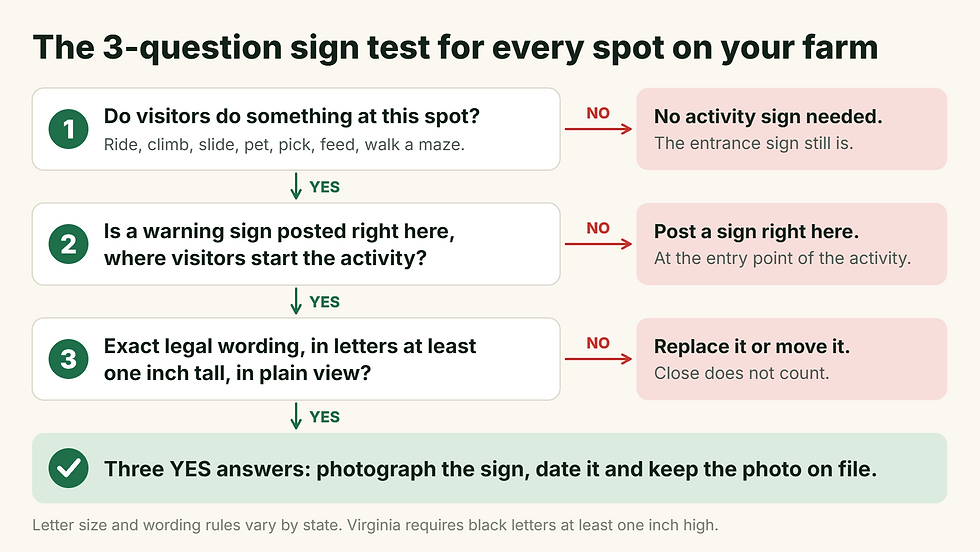
List every activity. Anything a visitor rides, climbs, slides down, pets, feeds, picks or walks through is an activity. So is the wagon, the maze, the play area and the pond. If you sell tickets or wristbands for it, it goes on the list.
Post at every public entrance. Not only the main gate. Include the overflow parking gate and the back entrance you open on festival weekends.
Post at the site of each activity. Put the sign where visitors start: the queue, the pen gate, the loading step, the maze opening. Mount it at eye level, facing the people walking in.
Do not count indoor signs toward outdoor activities. In the Virginia case, a sign inside the gift shop did nothing for a slide outside.
Use your state's exact wording and letter size. Virginia requires black letters at least one inch high. A homemade sign that paraphrases the notice is a gamble.
Photograph every sign. Take one close shot that shows the wording and one wide shot that shows where it stands. Keep the dated photos with a simple map. Carleton Farm could not say where its sign was. You should be able to answer in ten seconds.
Walk the signs every week you are open. Virginia's statute says to post and maintain them. Signs fade, fall, and get hidden behind hay bales and pumpkin bins.
Add the notice to your written contracts. Group bookings, school visit agreements and rental forms should carry the statutory warning where your law requires it.
New activity, new sign. Put the sign up before the first visitor uses it, not after the season.
HOW MANY SIGNS DO YOU NEED? Count your public entrances. Count your activities. Add them together. A farm with 2 entrances and 12 activities needs 14 signs. At about $12 each in metal, that is $168 and one afternoon with a post driver. |
Signs are one line in a wider plan. For the rest, see How to Write a Risk Management Plan for Your Agritourism Business, 10 Common Agritourism Safety Hazards and How to Address Them and, if you keep animals near visitors, Tips for Managing Liability When Hosting Farm Animals.
Common Questions About Agritourism Warning Signs
Is the 2026 Virginia ruling now the law across Virginia?
No. It is a circuit court ruling from the bench, binding only in the Loudoun County Circuit Court. Other Virginia judges may follow it or not. Until an appellate court or the General Assembly settles the question, the safe course for a Virginia farm is a sign at the entrance and at every activity.
How many agritourism warning signs do I need?
In the eleven states that require a sign at the entrance and at the site of the activity, plan on one per public entrance plus one per activity. In other states, read the placement sentence in your statute, then add signs at each activity anyway. They are the cheapest protection you will buy this year.
Does a sign in the gift shop or ticket booth count?
Not for an activity somewhere else on the farm, judging by the Virginia ruling. New York is a special case: its law calls for the notice at the points where tickets are sold or handed out.
Can one large sign at the gate list all my activities?
In an entrance-and-activity state, no. The size of the gate sign does not change where the statute says the second sign must stand.
What counts as a separate activity?
No court has drawn that line. Use a practical test: if it has its own entry point, its own queue, its own rules or its own ticket, give it its own sign.
Do warning signs replace a waiver or liability insurance?
No. Signs address inherent risks under your state's statute. A waiver may add protection where your state enforces it, and insurance pays for the claims that get through. A farm that hosts the public should have all three reviewed by an attorney and an insurance agent.
The Bottom Line
For years the working rule on most farms was simple: buy the sign, hang it at the gate, forget about it. A Virginia judge has now said that rule does not match the words of the statute, and a Washington appeals court had already shown what happens when a farm cannot prove where its sign stood.
You do not need to wait for a court in your state to agree. Count your entrances and activities, order the signs, post them, photograph them. It is one afternoon and a couple of hundred dollars against a claim that can run to six or seven figures.
P.S. Signs are one of several things that decide whether your farm is ready for paying visitors. To see where you stand on the rest, take the Farm Readiness Quiz.
Important: This article is general education, not legal advice. The Virginia ruling was delivered from the bench and is reported here from published secondary accounts. Statutes are amended often and courts read them differently. Before you rely on any protection described here, read your current statute and speak with an attorney licensed in your state and with your insurance agent. |
Sources
Jesse Richardson and Tiffany Lashmet, Signage Requirements Under Agritourism Liability Acts, Southern Ag Today, April 10, 2026.
Code of Virginia § 3.2-6402 and Chapter 64, Agritourism Activity Liability.
Bayne v. Carleton Farm, Inc., No. 83066-0-I (Wash. Ct. App. Feb. 13, 2023) (unpublished), reproduced as Appendix A to the petition for review.
Revised Code of Washington, RCW 4.24.835, agritourism warning notice.
Tiffany Dowell Lashmet, Signage Requirements Under Agritourism Liability Acts: What About Texas?, Texas A&M AgriLife Extension, April 20, 2026.
Peggy Kirk Hall and Ellen Essman, Recent Agritourism Litigation in the United States, National Agricultural Law Center, 2020.
Peggy Kirk Hall and Evin Bachelor, Agritourism Immunity Laws in the United States, National Agricultural Law Center, 2019.
National Agricultural Law Center, States' Agritourism Statutes.
Mississippi Code § 69-53-5, 2025.
Texas Farm Bureau, Agritourism liability signs available, updated August 2, 2024.


Comments