



Canada Is Drawing a Farm Trail From Saskatoon to Winnipeg, and the Tourism Money Is Following the Map: Why Farms That Team Up With Their Neighbours Get Paid First (9 Lessons for Farmers Everywhere)

It is an October morning in Saint-Louis-de-Blandford, a small town in Quebec that calls itself the national cranberry capital.
A bus pulls away from the Cranberry Interpretation Centre. A short ride later, the visitors step off at a working cranberry farm, climb onto a tractor-drawn wagon and roll out past fields of red berries at the height of harvest.
Now look closely at who did what.
The centre sells the ticket. The centre has the parking, the washrooms, the tasting room, the shop and the bus. The grower's job is the one thing only a grower can do: open the gate and show people the harvest.
Everybody gets paid. Nobody has to do it all alone.
This year the event, called Canneberge en fête, runs from October 1 to 18, 2026. An adult visit to the centre is listed at about C$16.50, and groups of up to 140 people can book tours in French or English.
Hold that picture in your head: one front door, many farms behind it. Because Canada is now putting national planning and public money behind exactly that picture. And if you farm anywhere in the world, you should pay attention to where that money is going.
By the way, if you are still wondering whether visitors are worth the trouble at all, start with my breakdown of the latest agritourism statistics and who is really making the money. U.S. farms alone earned $1.26 billion from agritourism in the 2022 Census of Agriculture, up 12.4% from 2017 after inflation.
What you will learn in this article ✅ What Canada's Field to Fork agritourism corridor is, where it runs and which farms are in the zone ✅ Where the C$21.1 million for Quebec tourism is aimed, and why "circuits" are in the rules ✅ Why governments now fund routes and clusters instead of lone farms ✅ The "front door" model that lets small farms share one ticket office ✅ 9 lessons any farmer, in any country, can use this season ✅ A 30-day plan to start a farm trail with your neighbours |
What Canada Actually Announced (in Plain Farmer English)
Two pieces of Canadian news deserve your attention right now. On their own, each looks like government paperwork. Put them side by side and they tell you exactly how the tourism game is changing.
News No. 1: A Field to Fork farm corridor from Saskatoon to Winnipeg
Destination Canada, the country's national tourism marketing agency, has published its strategy for the Field to Fork Agritourism Corridor. It was built with Travel Manitoba and Tourism Saskatchewan, and it is Destination Canada's first corridor with a culinary focus.
The idea is simple. Instead of marketing one farm here and one festival there, the corridor ties farms, First Nations, small towns, chefs and heritage sites into one journey across Canada's agricultural heartland. The gateway cities are Winnipeg, Brandon, Saskatoon and Regina.
Here is the part every Prairie farmer should read twice. The corridor includes communities and operators within 100 kilometres of three highways: Highway 1 between Moose Jaw and Richer, Highway 11 between Saskatoon and Regina, and Highway 16 between Russell and Portage la Prairie.

The strategy defines agritourism broadly. It counts farm-to-table meals, tastings, U-pick, farmers markets, on-farm stays, festivals, workshops, tours and Indigenous food traditions. In other words, if visitors can touch your food story, you are in.
It sits inside Destination Canada's 2030 Tourism Strategy, which aims to put Canada back in the world's top 7 tourism destinations. After more than 40 interviews and workshops and a week-long field visit, the team landed on four pillars and 14 initiatives. Here is what each pillar means for a farm owner:
The pillar | What it means for your farm |
Grow operator capacity | Training on pricing, safety, storytelling, booking and social media, built for part-time and seasonal operators |
Indigenous and inclusive tourism | Mentoring, seed funding and new itineraries co-created with cultural communities |
Booking, wayfinding and data | Help to get online, get bookable and show up correctly on Google and provincial tourism websites |
Export-ready experiences | Themed food trails, festival tie-ins and 2- to 4-day packages that tour operators can sell |
News No. 2: C$21.1 million for Quebec tourism, aimed at the regions
The second piece of news is about money. Ottawa's Tourism Growth Program put C$108 million on the table nationally, delivered through regional development agencies. Quebec's share is C$21.1 million, handled by Canada Economic Development for Quebec Regions (CED). Its intake was set to run until March 31, 2026, but the rules show you exactly where tourism money is pointed.
Read the fine print and you will find the rules are written for farms that work together. CED says it wants to help local attractions draw visitors from outside Quebec, particularly in rural and remote regions. Projects should create or improve the regional tourism offer and stretch the season beyond the summer peak. About 15% of the program's funding goes to Indigenous tourism.
And here is the line that matters most: even a project based in a city can qualify if it sends tourists out to quieter regions, and the program's own example is "new tourism circuits."
A circuit is a route. A route is a group of businesses. One farm is not a circuit.
This is not a one-off, either. Since April 2020, CED says it has backed more than 700 tourism projects with close to C$400 million in support, which helped drive more than C$1.9 billion in investment.
Insight When a government writes "circuits," "corridors" and "packages" into its funding rules, it is telling you who will be first in line. Farms that show up with neighbours, a shared map and a plan to keep visitors overnight look like a safe bet. A farm that shows up alone looks like a hobby. |
Why the Money Now Follows Routes, Not Lone Farms
The Field to Fork strategy is refreshingly honest about why rural agritourism struggles. Its list of problems will sound familiar to almost any small farm:
Experiences are spread far apart, so visitors cannot fill a day.
Many farm experiences are not packaged or promoted as tourism at all.
Many are not bookable online, and some do not even have a basic website.
There are not enough rural places to sleep, so visitors drive home the same day.
Agritourism is often dismissed as a farmer's "hobby," not real rural economic development.
Now ask yourself one question. Would you drive three hours to spend 45 minutes on one farm?
Neither would your visitors. But they will happily drive three hours for a weekend of five stops, two great meals and a night on a farm. That is the whole logic of a trail.

The proof: 2.7 million visitors on one shared map
Look at the Kentucky Bourbon Trail. It started in 1999 with a handful of distilleries. In 2025 it drew 2.7 million visitors, matching its record from the year before, while plenty of other American attractions saw fewer visitors.

Notice the numbers that matter to you. About 80% of visitors came from outside the state. Groups typically stayed three to five days and spent $600 to $1,400 per trip on lodging, food, entertainment and transport. That money did not go to one business. It spread across a whole region.
You do not need bourbon to make this work. In Oregon's Hood River Valley, the Fruit Loop was created in 1992 for one reason: to bring attention and money to the valley and help local farmers reach more customers. Today about 30 farm stands, orchards, wineries and lavender and alpaca farms share a 35-mile loop, all marketed under one name.

Is it worth the effort? The market says yes
Here is the bigger picture. The research cited in the Field to Fork strategy put the global agritourism market at about $33.8 billion in 2022, with a forecast of $111.1 billion by 2032. That is growth of roughly 12% a year. North America alone held about 46% of the market in 2024.
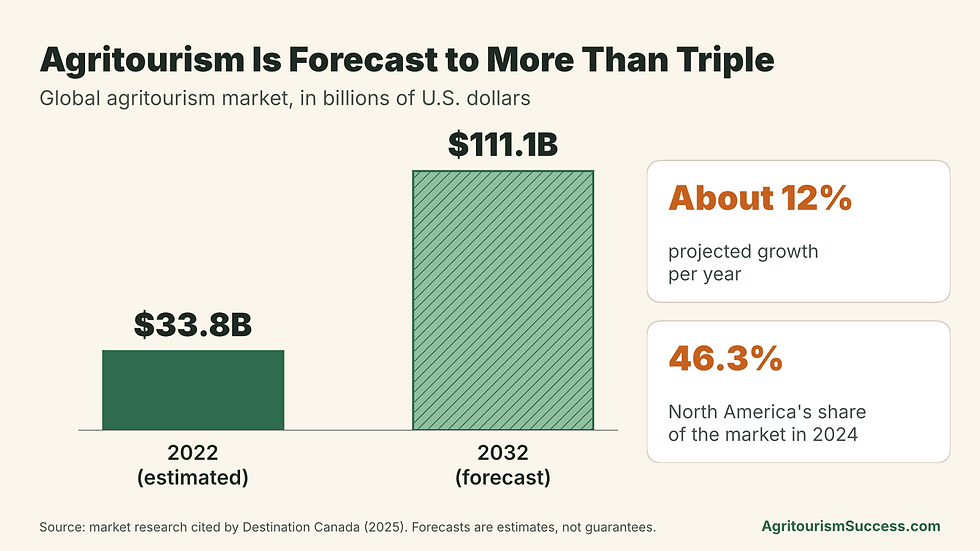
Forecasts are estimates, not promises. But even if the real number lands well below that line, the direction is clear: more people want to see where their food comes from, and the farms that are easy to find, easy to book and easy to combine into a trip will get the lion's share.
The "Front Door" Model: How Small Farms Share One Ticket Office
Go back to that cranberry bus.
The genius of the Saint-Louis-de-Blandford set-up is that the grower does not have to build a visitor business from scratch. The Cranberry Interpretation Centre is the front door: it handles the tickets, the parking, the toilets, the tasting room, the shop and the transport. The farm delivers the experience.

You can copy this almost anywhere. The front door can be a visitor centre, a farmers market, a café, a winery with a big car park, or simply the farm in your group with the best road access and the cleanest toilets. Every other farm becomes a stop on the route.
Front door or stop, both roles pay. The front door earns from tickets, food and retail. The stops earn from tours, U-pick and product sales, without each one having to build a gift shop and a booking system.
Field-Tested Play: Try This on Your Farm Sit down with two neighbours this month and ask one question: "Which of us is the best front door?" Look for parking, toilets, road signs and someone who enjoys talking to people. Agree that the front door hands out a map of every stop, and every stop sends people back to the front door for lunch and shopping. |
9 Lessons Farmers Everywhere Can Learn From Canada's Field to Fork Push
Lesson No. 1: Visitors buy a trip, not a stop
Bourbon Trail visitors stay three to five days. The Field to Fork strategy wants 2- to 4-day packages. Nobody plans a holiday around a single 45-minute farm tour. Build your offer so it fits inside a bigger day out, and then make sure that bigger day exists.
Lesson No. 2: Be the front door or be a stop, but be on the map
If you have the space, parking and people skills, become the front door. If you would rather stay in the field, become the best stop on someone else's route. The farm that refuses to be either is the one left off the map.
Lesson No. 3: Pick a story bigger than your farm
"Field to Fork" is not one farm's name. Neither is "Fruit Loop." The strategy suggests trail themes like Prairie Grains and Bread, Indigenous Foodways, Farm-to-Pint, and Fermentation and Foraging. A shared theme gives journalists, tour operators and tourism offices something easy to write about.
If you need help choosing the hook for your own farm, my guide to the signature experience formula walks you through it.
Lesson No. 4: If you cannot be found and booked, you do not exist
The strategy openly tells operators to update their Google listings and GPS coordinates and to keep their listings current on provincial tourism websites. That is a national tourism agency telling farmers that a missing Google pin is costing them visitors.
I see this on my own durian farm, Bloopy Durians in Malaysia. Most of our visitors find us because we rank at the top of Google. Here is my step-by-step guide to turning Google into a 24/7 customer machine for your farm.
Field-Tested Play: Try This on Your Farm Search for your own farm on Google Maps from your phone today. Check the pin, the opening hours, the photos and whether there is a "Book" or "Website" button. Then do the same for your two closest neighbours and send them a friendly note if theirs are wrong. A trail is only as findable as its weakest stop. |
Lesson No. 5: Ride the events that already exist
Stakeholders told Destination Canada that adding farm content to existing festivals was cheaper and more effective than building new products from scratch. The corridor also wants to catch business visitors to big farm shows like Canadian Western Agribition and Ag in Motion, who already arrive from more than 75 countries.

Look at the fairs, harvest festivals and trade shows near you. Offer a pre-show farm breakfast, a post-show tour or a discount for anyone with a show badge. For more ideas, see 30 farm events by season, with real ticket prices.
Lesson No. 6: Fix the bed problem
The strategy names a lack of rural and group accommodation as a barrier to keeping visitors in the region longer. Visitors who sleep nearby eat dinner nearby, shop nearby and come back the next morning.
You do not have to build a lodge. One farm stay, one B&B or a few glamping tents on the route can turn a day trip into a weekend. If you add rooms, read why most farm stays undercharge and the pricing formula that fixes it first.

Lesson No. 7: Apply for funding as a group
Funders love projects that spread benefits across a region. Canada's earlier Canadian Experiences Fund explicitly backed agritourism, culinary trails and farmers markets. In Alberta alone, it funded 81 organizations with more than C$14.8 million. One of them, Prairie Gardens, received C$99,912 to build a year-round culinary tourism experience so it could host guests in any season.
Taiwan shows how far this can go. Its government designates recreational agriculture areas, now more than 100 of them, and certifies leisure farms for quality. Those farms have become a draw for international visitors. According to Taiwan's leisure farm association, about one in four Singaporean tourists in Taiwan includes a leisure farm in their trip.
Outside Canada, the same rule applies. For one example, see how U.S. farms can get ready for Airbnb's Farm to Stay grant of up to $10,000.
Field-Tested Play: Try This on Your Farm Before you apply for any grant, write one page with your neighbours: the route, the stops, the theme, who the front door is, how many visitors you expect and how you will count them. Grant officers read hundreds of applications. A one-page plan signed by five businesses stands out from a stack of single-farm wish lists. |
Lesson No. 8: The off-season is where the money is waiting
The strategy flags high seasonality as a core problem, and Quebec's program rewards projects that extend the season. Cranberry season in Quebec lands right on top of the autumn colours, so the cranberry festival sells two experiences in one trip. Ask what your quiet months could pair with: autumn leaves, winter markets, spring blossoms, a holiday dinner.

Lesson No. 9: Count your visitors, or no one will believe you
Destination Canada wants corridor-wide visitor data, from booking records to QR-code surveys. Why? Because numbers win funding, investment and media attention. You do not need fancy tools. A tally sheet at the gate, a simple sign-up form and a WhatsApp or email list of past buyers will do.
On my own farm, a WhatsApp list of loyal customers who buy every time our durians are ready has become one of our most reliable sources of income. It also gives me a real number to show partners.
How to Start a Farm Trail With Your Neighbours in 30 Days
You do not have to wait for a national agency to draw your route. Here is a simple plan any group of farms can run in a month.

Week 1: List your neighbours. Write down 5 to 10 places within about 45 minutes' drive: farms, a café, a B&B, a winery, a craft maker. Visit each one in person.
Week 2: Pick one story. Agree on a theme and a name, the days you will open and who will be the front door.
Week 3: Make the map. Create a one-page printed map and a free online map. Make sure every stop is correct on Google Maps. Put each other's flyers on every counter.
Week 4: Launch a weekend. Use a stamp card or passport that rewards visitors for visiting three or more stops. Time it with an event that already draws a crowd, and count visitors at every stop.
If hotels, resorts or tour companies are part of your plan, read my guide on how farms partner with hotels, resorts and tour companies to bring in more visitors.
Reality check A trail does not fix a weak experience. If visitors leave your stop bored, they will tell the next stop, and the next stop will stop sending people to you. Agree on a basic standard together: opening hours you keep, clean toilets, a friendly welcome and a clear price. |
If You Farm in Canada, Do These 5 Things This Month
Check the map. If you farm within about 100 km of Highways 1, 11 or 16 in Saskatchewan or Manitoba, you are in the Field to Fork zone. Tell your local tourism office you want to take part.
Fix your listings. Update Google Maps and your listing on Travel Manitoba or Tourism Saskatchewan, as the strategy recommends.
Get bookable. Add a simple online booking or enquiry form, even if it only takes reservations for one tour a week.
Talk to your regional development agency. In Quebec that is CED; elsewhere it is your region's equivalent. Ask what tourism funding is open now and whether group projects score higher.
Find your neighbours. Two or three farms with one plan will get a warmer welcome than one farm with a wish list.
Frequently Asked Questions
What is the Field to Fork Agritourism Corridor?
It is a Destination Canada strategy, developed with Travel Manitoba and Tourism Saskatchewan, to link farms, Indigenous communities, towns and food businesses between Saskatoon and Winnipeg into one bookable agritourism journey. It is Destination Canada's first corridor with a culinary focus.
Which farms are inside the Field to Fork corridor?
The strategy includes communities and operators within 100 kilometres of Highway 1 between Moose Jaw and Richer, Highway 11 between Saskatoon and Regina, and Highway 16 between Russell and Portage la Prairie. Its gateway cities are Winnipeg, Brandon, Saskatoon and Regina.
Is there government funding for agritourism in Canada?
Yes, through several programs that change over time. The federal Tourism Growth Program provided C$108 million nationally, including C$21.1 million for Quebec focused on rural and remote regions. The Canadian Experiences Fund has also supported agritourism and culinary trails. Check with your regional development agency for what is open now.
What is an agritourism trail?
An agritourism trail is a group of farms and food businesses marketed together under one name and map, so visitors can plan a full day or weekend. Well-known examples include the Hood River Fruit Loop in Oregon and the Kentucky Bourbon Trail.
Can a farm outside Canada learn from this?
Absolutely. The same ideas work anywhere: team up with neighbours, choose a shared theme, appoint a front door, get every stop on Google, add somewhere to stay and count your visitors. Those are also the things funders and tour operators look for.
Your Next Step: Find Out If Your Farm Is Ready to Join a Trail
Here is the truth. When the tourism money and the tourists start following routes, they will not wait for the farm that is "almost ready."
They will go to the farms that are easy to find, easy to book and good enough that the farm next door is proud to send people over.
So which one is your farm today?
That is exactly why I built the Farm Readiness Quiz. In a few minutes it shows you which parts of your farm are ready for visitors and which ones to fix first, so you don't spend money building the wrong thing.
Then download my free ebook, the 21-Point Agritourism Blueprint. It walks you through 21 points to check before you welcome your first paying visitor, from insurance and signage to pricing, so you can walk into any trail meeting or grant interview with confidence instead of guesswork.
P.S. You do not need permission from Ottawa to start. Pick up the phone tonight and call the two farms nearest to you. The cranberry farm on that Quebec bus route does not need its own ticket office, gift shop or bus. The front door already has them. Your neighbours might be your front door, or you might be theirs.
Written by Stephen Loke of AgritourismSuccess.com, whose farm is featured in Bloomberg News and Asahi Shimbun. This article is for education only and is not legal, tax or financial advice. Funding programs, dates and prices change, so confirm details with the program or organizer before you act. Figures were checked in October 2026. Photos from Unsplash.
Sources
Destination Canada: Field to Fork Agritourism Corridor Strategy Summary (2025)
Destination Canada: Destination Canada Announces Four New Tourism Corridors
Government of Canada (CED): Government of Canada invests $21.1M in Quebec's tourism industry
Government of Canada: Question Period Note, CED support in tourism (January 2026)
Québec Vacances: A day out at the Cranberry Interpretation Centre
Bonjour Québec: Centre d'interprétation de la canneberge, Canneberge en fête
USDA Economic Research Service: 2022 Census of Agriculture, agritourism income
PrairiesCan: Rural culinary experiences boost Alberta tourism
Atlantic Canada Opportunities Agency: Canadian Experiences Fund
Taiwan Today: Leisure farms and recreational agriculture zones


Comments