



A Concrete Contractor's Weekend Pumpkin Patch Now Pulls In 150,000+ Visitors a Year: 15 Kuipers Family Farm Lessons Every Farmer Can Use

In 1998, a concrete contractor and his wife opened 71 acres of pumpkins to the public in Maple Park, Illinois, about 50 miles west of Chicago. It was a weekend hobby.
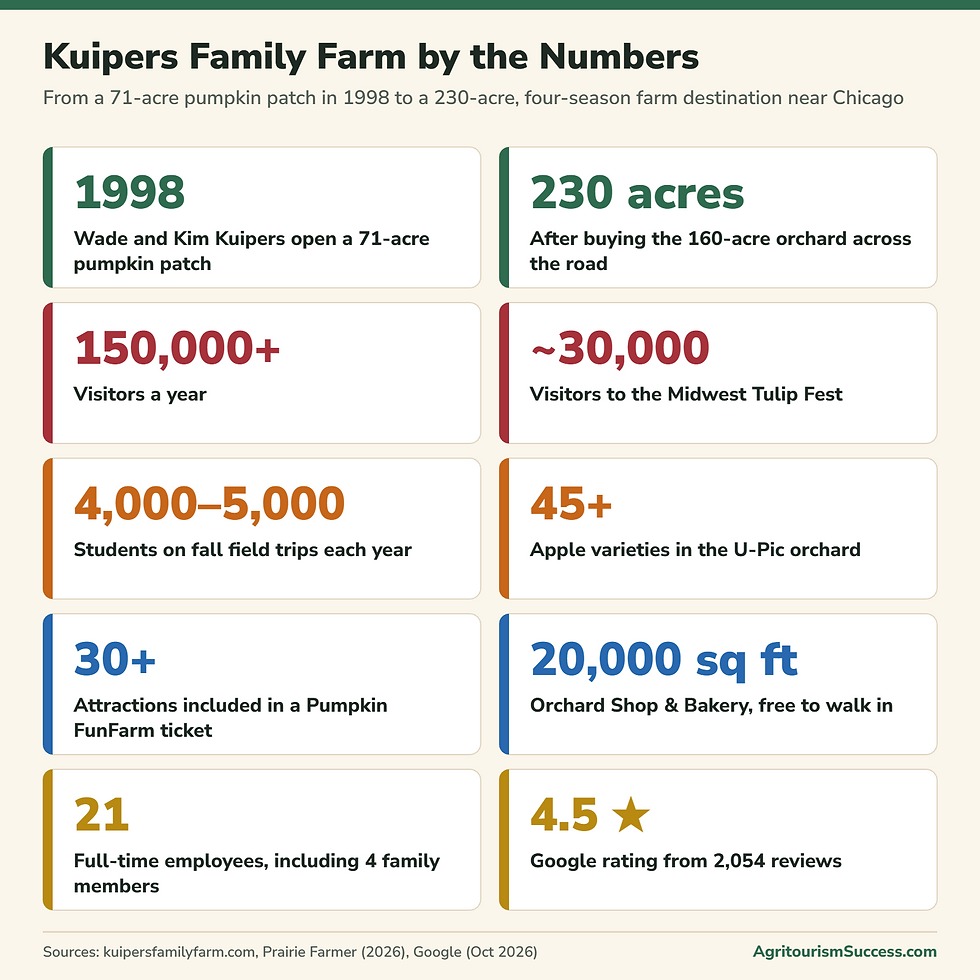
Today, Kuipers Family Farm covers 230 acres and welcomes more than 150,000 visitors a year, according to Prairie Farmer. About 30,000 of them come in spring just to see tulips. Another 4,000 to 5,000 arrive by school bus every fall. The farm runs four named festivals, employs about 21 people full-time and holds a 4.5-star Google rating from more than 2,000 reviews.
Now here's the part most farmers miss.
The building that earns the most money on this farm doesn't charge admission. Anyone can walk in. In 2018, co-owner Kim Kuipers told public radio station WNIJ that the farm's stores were its biggest source of income.
Let that sink in. The paid attractions bring the crowds. The free shop takes the money.
That's the first of 15 lessons in this case study. We pulled together nearly 20 years of news coverage, the farm's own website, prices, policies and job listings, and USDA data. This isn't a travel review. It's a teardown of a working agritourism business, written for farmers who want to earn more from the land they already have.
What You'll Learn in This Case Study ✓ How a weekend pumpkin patch grew into a 150,000-visitor farm, one careful step at a time ✓ Why the free-to-enter shop out-earns the paid attractions ✓ The 14-rung price ladder that runs from $5 to $300 ✓ How a family name became a 30,000-visitor spring festival ✓ How to give teenagers, grandparents, grown-ups and slow weekdays a reason to come ✓ A small-farm version of every lesson, plus a 90-day action plan |
Kuipers Family Farm at a Glance
Fact | Detail |
Location | Watson Road, Maple Park, Illinois, about 50 miles west of Chicago |
Founded | 1998, by Wade and Kim Kuipers |
Size | 230 acres: the original 71-acre pumpkin farm plus the 160-acre orchard across the road |
Who runs it | Owners Wade and Kim Kuipers, with son Joe Kuipers as general manager |
Team | About 21 full-time employees, including 4 family members, plus seasonal staff |
Visitors | 150,000+ a year, including about 30,000 at the Midwest Tulip Fest |
Main draws | U-Pic apples (45+ varieties), Pumpkin FunFarm (30+ attractions), Midwest Tulip Fest, flower fields, a 20,000 sq ft Orchard Shop & Bakery |
2026 season | Mid-April to late November, across four festivals |
Reputation | 4.5 stars from 2,054 Google reviews (October 2026) |
The Story: From Pouring Concrete to Pressing Cider
Wade Kuipers grew up on a produce farm. Then he went into construction and ran a concrete company, according to a 2007 profile in Vegetable Growers News. He and Kim had three young children, and they often took them to visit farms in the area.
Those trips planted an idea. Kim later told WNIJ that their kids wanted to climb on everything, so the couple decided to "see if we can duplicate it at our own farm."
In fall 1998, Kuipers Pumpkin Farm opened on their 71 acres with a pumpkin patch, tractor rides, a straw bale maze, a few goats and a tent. That's it. For a few years it stayed a weekend hobby. Then the neighbors across Watson Road offered to sell their 160-acre apple orchard, known as Pine-Apple Orchard. The Kuipers bought it, a purchase Northwest Quarterly dates to 2001, and renamed the combined 230 acres Kuipers Family Farm. Only after that did they sell the construction company and become full-time farm marketers.
Notice the order: proof of demand first, the orchard second, quitting the day job last.
By 2007 the farm had 6 full-time employees and as many as 80 workers in October. It had two gift shops, a bakery selling pies, fudge and doughnuts, a café, pick-your-own apples, a pumpkin patch and Christmas trees that stretched the season to December.
Since then it has become a four-season business. The children who inspired it grew up in it, and son Joe Kuipers now runs the farm as general manager. In August 2026, the farm opened what it called its 25th fall season. Joe told the Daily Herald that the families who return year after year "become a part of our family."

The Bigger Picture: Why Kuipers Matters to Your Farm
Before the lessons, a reality check on the industry.
The USDA's 2022 Census of Agriculture found that farms earned $1.26 billion from agritourism in 2022, up 12.4% from 2017 after adjusting for inflation, according to USDA's Economic Research Service. But only 28,617 farms reported any agritourism income at all. That's about 1.5% of American farms, and their average take was $44,004, according to a 2024 data brief from Penn State's Northeast Regional Center for Rural Development.
Averages hide a huge spread. Most farms with agritourism income earn a little. A few, like Kuipers, operate on a completely different scale. The difference isn't luck or land. It's a set of habits you can copy.
There's a second lesson in where Kuipers sits. Illinois grows more pumpkins than any other state, just over a third of the U.S. crop in 2024, according to Investigate Midwest. But nearly 70% of Illinois pumpkin acres go to processing for pie filling and other uses. Most Illinois pumpkins leave the farm as a commodity. Kuipers sells its pumpkins as a day out.
For the full picture of who makes money and who doesn't, read Is Agritourism Profitable? Real Numbers From U.S. Farms.

15 Lessons From Kuipers Family Farm
Lesson 1: Prove It as a Hobby Before You Bet the Farm
Most failed agritourism projects die the same way. A big loan, a big build, then a long wait for customers who never show up.
The Kuipers did the opposite. The pumpkin patch ran as a weekend sideline while the concrete business paid the bills. When families kept coming, they bought the orchard. When the orchard worked, they sold the construction company.
Every step was small enough to survive if it failed. And every step was backed by proof from the step before. That's not timid. That's how you stay in business long enough to get big.
Field-Tested Play: Try This on Your Farm Run one weekend event this season using only what you already own: a field, a wagon, a barn, a view. Charge a modest admission. Count the cars, ask people where they drove from and ask what would bring them back. If you can fill one weekend, you've earned the right to plan a second. Read From Farm to Cash Flow: How to Test Agritourism With a 60-Minute MVP and How to Launch an Agritourism Business Using Only the Infrastructure You Already Own. |
Lesson 2: Let Them In Free, Then Sell Them Everything
The Orchard Shop & Bakery is a 20,000-square-foot country store. No ticket needed.
Inside are home decor, dips and jams, gifts and apparel, and a bakery turning out pies, cream and butter fudge, freshly pressed cider and hand-spun caramel apples. An Apple Market sells bagged apples by the half-peck and peck, and staff at an Apple Sample Counter help shoppers pick a variety. A Sample Kitchen offers tastes from hundreds of specialty foods. Nearby, the Farmhouse Kitchen and the Crispy Caboose serve food, and the cashless Bin Bar pours cider, wine and beer.
Why let people in for free? Because free entry kills the biggest objection a visitor has: "Is it worth paying to get in?" Anyone driving past can stop. A grandmother who won't climb a hay bale can still shop. And every family leaving the paid attractions walks past the donut case on the way to the car.
The shop also keeps working after the fields close. In 2026 the Pumpkin FunFarm and the U-Pic orchard closed on November 1, but the Orchard Shop stayed open on select days until November 25, selling holiday pies and gifts.
Admission gets people onto the farm. The shop is where they spend.

Field-Tested Play: Try This on Your Farm Separate "free to enter" from "paid to play." Put your farm stand, bakery case or gift shelf where anyone can reach it without a ticket, and where every paying visitor passes it on the way out. Stock it with your best product at eye level. Read Creating a Farm Souvenir Shop to Enhance Visitor Experience and Upsells That Double Your Agritourism Revenue (Without More Visitors). |

Lesson 3: Make One Food Famous
Ask people what they remember about Kuipers and there's a good chance they'll say the apple cider donuts. FOX 32 Chicago reported in 2024 that the donuts are the shop's bestsellers. Joe Kuipers put it simply: "These apple cider donuts are to die for."
The farm builds promotions around them all season. Thursdays bring pumpkin donuts. The 2026 "25 Days of Fall Fun" kicked off with a free cider donut for anyone who spent $25 in the shop. On Tuesdays, two non-perishable food donations for the local pantry earn 30% off a dozen. Even the staff are paid partly in donuts: the job page lists two cider donuts on every scheduled workday as a perk.
The donuts work because they're tied to the farm's own crop. In 2011, the Daily Herald documented Kuipers pressing cider two or three times a week, making 800 to 2,000 gallons at a time from bins holding 18 bushels each, at about 3 gallons per bushel. The leftover pulp went back onto the orchard as fertilizer.
Apples become cider. Cider becomes donuts. Donuts bring people back. That's a loop, not a product.

Field-Tested Play: Try This on Your Farm Pick one food made from your own crop that you can serve fresh, that people can smell from the parking lot and that sells for under $15. Make it the best version in your county, then give it its own weekly promotion. Never let it sell out before closing time. Read How to Sell Preserves, Jams and Jellies in Agritourism and The Signature Experience Formula. |
Lesson 4: Find the Family Member You're Losing
In 2006 the Kuipers spotted a gap. Families with small children loved the farm, but families with teenagers weren't coming. Kim told Vegetable Growers News: "That's an aspect of the family we were kind of missing out on."
The fix was a 5-acre corn maze with 2 miles of paths, designed for older kids rather than toddlers.
That habit of asking "who isn't here yet?" still drives the farm. Today there's Daisy's Cow Train and a jumping pillow for little ones, a tube slide with a 42-inch height minimum and Apple Blasters for bigger kids, bars and live bands for parents, an $11.99 senior ticket and a train ride for grandparents, field trips for schools and discounts for neighbors.
Here's why it matters. A family only comes if the whole car agrees. Give every seat in the car its own reason to say yes, and you win the whole family, year after year.


Field-Tested Play: Try This on Your Farm Picture a typical car pulling into your farm: a toddler, a 10-year-old, a teenager, two parents, a grandparent. Next to each, write the one thing on your farm built for them. Any blank line is your next project. Read How Smart Farm Owners Turn Simple Land Into a Kid Magnet and How to Harvest a Double-Planted Corn Maze Without Clogging Equipment. |
Lesson 5: Tour Other Farms, Then Add One Thing at a Time
The Kuipers didn't invent their attractions alone at the kitchen table. In 2007 Kim said many of their ideas came from farm tours, especially those run by the North American Farmers' Direct Marketing Association. The next year, Kuipers itself was set to be a stop on one of those tours. They went from students to teachers.
Then they kept adding. The bee barn was remodeled with an observation hive for all visitors in 2019. A Sunflower Festival arrived in 2021, the Midwest Tulip Fest in 2022, Daisy's Cow Train in 2023, an annual pass in 2025, and two new festivals in 2026.
But the growth wasn't nonstop. In 2007 the family deliberately added nothing new and spent the year fixing infrastructure instead. Kim said it gave them a chance to catch their breath.
And the off-season is never empty. In 2019 Kim told Northwest Quarterly that the quiet months were spent hiring staff, pouring concrete and making changes around the farm. A former concrete contractor still pouring concrete. Some skills never stop paying.
Field-Tested Play: Try This on Your Farm Join your state's agritourism or farm direct-marketing association and visit at least two farms outside your area every year. Photograph their signs, queues and price boards. Then add only ONE new thing next season. Every few years, add nothing and fix what you have. Read How to Run a Profitable Agritourism Business Without Burning Out and our case study on Applecrest Farm Orchards, another orchard that grew one step at a time. |
Lesson 6: Turn Your Family Name Into a New Season
Kuipers is a Dutch name. In 2022 the family turned that heritage into a spring crop. Joe Kuipers told Prairie Farmer: "We wanted to do a crop that represented that heritage side."
The timing was smart. According to Prairie Farmer, the farm's Christmas tree business ended in 2018 and was replaced with a crop for a different season. Tulips filled April and May, months when an apple and pumpkin farm normally earns nothing from visitors.
The first Midwest Tulip Fest opened in May 2022 with 300,000 bulbs in more than 30 varieties across 5 acres, planted the previous November, Shaw Local reported. Weekday tickets were $11.99 online.
Then it scaled. Almost 500,000 bulbs on 7 acres in 2024. More than 700,000 tulips on 8 acres in 2025. More than a million blooms in 2026, with the farm's website advertising 11 acres. Weekday tickets now cost $19.99, 67% more than year one, and about 30,000 people come.
Do the rough math. At $15 to $20 per visitor after discounts, passes and free toddlers, 30,000 visitors is roughly $450,000 to $600,000 in spring admissions, before a single U-Cut tulip, drink or donut. That's our estimate, not a published figure, and the 2026 fest was open for just 17 days.
It's serious farming. The bulbs are imported from the Netherlands and planted in late October and early November, Prairie Farmer reports. About 80% come back the next year, so each section is kept for two years to manage costs. Early, mid and late varieties stretch the color.


Field-Tested Play: Try This on Your Farm What in your family's story or your region's history could become a crop, a festival or a theme? Write down three ideas, then test the cheapest one on a single acre before you go big. Kuipers started with 5 acres, not 11. Read Why Sharing Your Farm Story Is Essential and our Farmer Copleys case study, another farm that added a spring tulip festival. |
Lesson 7: Stack Your Festivals Like a Crop Rotation
In 2026, Kuipers ran the Midwest Tulip Fest (April 16 to May 3), a Mother's Day Weekend Fest (May 9 and 10), the Blooms & Bushels Fest of flowers and early apples (August 22 to September 17) and the Fall Harvest Fest (September 18 to November 1), with the shop open on select days until November 25.
Every festival has a name, a start date and an end date. That gives the farm something new to announce four times a year, and gives families four reasons to come back.
Each one also reuses the same parking lots, ticket booths, food stands, bars, stages and staff. The FunFarm attractions that earn their keep in October also run during the Tulip Fest.
Blooms & Bushels shows how Kuipers iterates. The Sunflower Festival ran from 2021 to 2025. In 2026 the farm folded flowers and early apples into one bigger late-summer festival, with more than 8 acres of sunflowers, zinnias, cosmos, marigolds and amaranth at $11.99 a ticket. Staggered plantings keep the fields blooming for about three weekends.
One warning: get permission before you build. In 2014 Kane County approved a zoning change that let Kuipers run an amusement-park-sized train and host weddings and receptions in an existing building. County Board member Drew Frasz said the plan fit because "they have all the infrastructure in place."

Field-Tested Play: Try This on Your Farm Draw a 12-month strip of paper and shade the months your farm earns money from visitors. Pick the biggest empty stretch and plan one named event for it, using buildings, parking and staff you already have. Check your zoning before you spend a dollar. Read Farm Event Ideas: 30 Events by Season and Farm Wedding Venue Zoning. |
Lesson 8: Build a Price Ladder, Not a Price
Most small farms have one price. Kuipers has a ladder with 14 rungs, from $5 for Apple Blasters to $300 for a private birthday party space.
Every rung has a job:
Weekday vs weekend: The Pumpkin FunFarm costs $19.99 on weekdays and $26.99 on weekends and holidays. Weekend crowds pay 35% more, and price-conscious families are nudged toward quieter days.
Online vs gate: Promo codes work online only, and weekday U-Pic tickets ($11.99) are sold only at the gate.
Discounts that fill gaps: Seniors 65 and over and military pay $11.99 at the FunFarm gate, groups of 20 or more save $2 a ticket, and children 2 and under are free.
Bundles: A weekend ticket bundle starts at $35.99 online and saves $7.
Premium: "Tulips for Two" is an $84.99 Friday date night with two tickets, a photographer in the fields, two drinks, a 10-tulip carrier and a souvenir magnet.
Add-ons: Apple Blasters at $5 for 8 shots, a $7 train ride and $19.99 U-Cut tulips.
Prices climb steadily, too. In 2018 the pumpkin farm charged $11.99 Monday to Wednesday, $13.99 Thursday and Friday, and $15.99 on weekends, Shaw Local reported. The same weekend visit costs $26.99 in 2026.
And Kuipers tests packages. In 2024, a tulip "Date Night on the Farm" cost $140 per couple on one evening. By 2026 it had become a simpler $84.99 package offered every Friday of the fest.

Field-Tested Play: Try This on Your Farm List every way a visitor can spend money on your farm, from cheapest to most expensive. If you have fewer than five rungs, add one below (a $5 add-on), one above (a premium package for two) and one for groups. Charge more on your busiest days. Read The Best Way to Set Entry Fees and Ticket Pricing for Agritourism and The Experience Premium: How to Price Your Farm for Profit. |
Lesson 9: Sell the Season Before It Starts
Kuipers sells a $69.99 Pumpkin FunFarm Season Pass for unlimited visits, and a $79.99 Annual Pass that covers the Tulip Fest, the Mother's Day Fest and the FunFarm. Shaw Local reported the farm offering the Annual Pass in 2025.
Do the math on the season pass. At $26.99 per weekend visit, it pays for itself on the third visit. Families who plan to come back buy it. The farm gets paid up front, before anyone knows whether October will be dry, and every repeat visit is another chance to sell donuts, drinks and pumpkins.
Look at the guardrails, too. The season pass is sold online only, and each pass covers one guest and must be registered with a photo, so a single pass can't be passed around the neighborhood.
Everyday tickets are just as simple. They aren't tied to a date, so any weekend ticket works on any weekend, and the farm's FAQ says tickets don't sell out. Nobody fears booking the wrong day.

Field-Tested Play: Try This on Your Farm Price a season pass at about two and a half times your single-visit price. Sell it online only, tie it to one named person and sell it hardest in the four weeks before you open. Read How Small Farms Can Sell Event Tickets Without Losing Money on Fees and The 365-Day Yield: Converting Seasonal Footfall Into Recurring Revenue. |
Lesson 10: Put the Product Inside the Ticket
A Kuipers U-Pic ticket isn't a cover charge. At $11.99 on weekdays and $14.99 on weekends, it comes with a quarter-peck bag to fill. Visitors can taste apples as they pick, and the farm asks groups to share them to cut waste. Anyone entering the orchard needs a ticket, even just to walk.
The same idea runs across the farm. In 2020, FunFarm admission included a pumpkin. The $19.99 U-Cut tulip carrier holds 10 stems. The $19.99 fall flower bucket allows unlimited blooms, but no more than five sunflowers.
Why does this work? A ticket that comes with something feels like value. A clear limit protects the crop. And anyone who wants more buys a bigger bag in the Apple Market, sold by the half-peck or peck.

Field-Tested Play: Try This on Your Farm Bundle a small, fixed amount of your crop into the admission price: one bag, one pumpkin, five stems. Set a clear limit, sell anything above it by the bag or by weight, and put the bigger bags where people pay. Read Pick-Your-Own vs Guided Tours: Which Makes More Money? and our Carter Mountain Orchard case study. |
Lesson 11: Give Every Weekday a Job
Weekends at a farm attraction are packed. Weekdays can be empty. Kuipers gives each weekday its own crowd:
Monday: Good Neighbor Monday, 15% off in the shop for residents of Maple Park, Kaneville and Elburn. Teachers get 15% off Monday through Thursday.
Tuesday: Food Pantry Tuesday, 30% off a dozen donuts for two non-perishable donations, up to four dozen.
Wednesday: 15% off for seniors 65 and over.
Thursday: 15% off for military, plus Pumpkin Donut Thursday.
Weekdays: school field trips, with orchard tours Wednesday to Friday and FunFarm visits Tuesday to Friday.
The Monday deals don't apply on Labor Day or Columbus Day, two holidays the farm prices like weekends, and no deal can be combined with another. Good Neighbor Monday also builds goodwill with the people who live with the farm's traffic. Food Pantry Tuesday fills a slow day and helps the community at the same time.

Field-Tested Play: Try This on Your Farm Look at your slowest open day. Pick one group that's free that day, such as retirees, homeschool families or shift workers, and give them a simple reason to come. Exclude holidays and keep the rules short. Read The 12-Month Farm: Creative Revenue Streams for the Off-Season. |
Lesson 12: Sell the Grown-Ups a Seat and a Drink
Kuipers markets the Pumpkin FunFarm to parents with a simple promise: relax on the sidelines with a drink while the kids play.
It backs that up with three bars. The cashless Bin Bar on the orchard side serves flights, hard cider, wine, beer and spiked cider slushies. The Countryview Bar opens on FunFarm weekends, and the Tulip Tavern runs in spring.
Kuipers didn't build a winery to do this. Its sweet red, cherry and sparkling peach fruit wines are made for the farm by a winery and cidery in Michigan, Northwest Quarterly reported in 2019. In 2022 and 2023 it teamed up with Obscurity Brewing in nearby Elburn on an apple cider doughnut beer and a pumpkin beer. Kim summed it up in 2023: "The adult beverages have become very popular."
How popular? The farm's job page says its bartenders, paid $9 an hour plus a share of tips, averaged $27 to $50 an hour in 2024, not counting cash tips.
Reality Check: Alcohol Brings Rules Selling alcohol means licenses, insurance and trained staff. Kuipers requires its bartenders to be 21 or older and BASSET-certified, the Illinois alcohol-server training. Talk to your local liquor authority and your insurer before you pour a single glass. Read Selling Food on Your Farm: the Permits Each One Needs and Wine, Dine and Stay: The Secret to Vineyard Prosperity. |
Field-Tested Play: Try This on Your Farm Start with a private-label product made by a licensed partner, or invite a local brewery or winery to pour at one event under its own license. Put shaded seating where parents can watch the kids play. A comfortable parent stays longer and spends more. |
Lesson 13: Turn School Buses Into Lifelong Customers
Every fall, 4,000 to 5,000 students visit Kuipers on field trips, according to Prairie Farmer.
The Orchard Educational Tour runs Wednesday to Friday in August and September. It's fully guided, lasts 1 hour and 15 minutes and costs $12.99 per student. Teachers get free lesson plans for before and after the trip. Children learn how apples grow, visit the Bee Barn's observation hive, learn how cider is pressed, taste different varieties and ride a wagon through the orchard. Each child goes home with a bookmark, a donut, an apple and a sample of cider.
The terms are tight: a 20-student minimum, a $200 deposit and one payment from the school. Chaperones pay the student price and teachers are free. A FunFarm field trip costs $9.99 per student, and an $8 lunch can be added.
Weekday school trips fill days when families are at work. And a child who goes home with a donut and a story asks to come back on Saturday with Mom and Dad.
The same thinking shapes the weekend shows. There are hourly pig races at "Squealington Park," a "Magic on the Farm" show with Farmer Tim, and a farm game show called "Wheels of Agriculture." All of it serves the farm's stated mission of connecting people with agriculture and each other.

Field-Tested Play: Try This on Your Farm Build one 60 to 75 minute field trip around a single crop, with a short lesson plan teachers can use before and after. Require a deposit and one payment from the school, set a 20-student minimum, and send every child home with something small to show their parents. Read Why Farms Struggle to Get School Field Trips and The Exact Farm Experiences Schools Happily Pay For. |

Lesson 14: Tell Visitors Exactly When to Come
Pick-your-own farms live and die by timing. A family that drives an hour for Honeycrisp that are already gone leaves a bad review.
So Kuipers tells people exactly what's ready. Its Apple Varieties page lists 47 varieties on its ripening calendar, from Zestar and Dandee Red in mid-August to Evercrisp, Pink Lady and Granny Smith in late October. Each one is rated from 1 (fair) to 5 (best) for eating, baking and sauce, and most have a "Get Notified" button that alerts visitors when their favorite is ripe. A phone line, extension 1, is updated weekly. In spring, the Bloom-O-Meter does the same job for tulips.
When the weather changes the plan, Kuipers changes the event instead of cancelling it. A warm March in 2026 made the tulips bloom early, so they were gone before Mother's Day. The farm launched its first Mother's Day Weekend Fest anyway, with a new raised-bed garden of more than 5,000 tulips, a vendor market, a painting session and a free photographer for moms. Later that year, Joe Kuipers told WBEZ the apples were "ripening several weeks earlier than usual this year," and urged families to visit early.
Field-Tested Play: Try This on Your Farm Create a simple "what's ready now" page and update it every week. Add a sign-up for "tell me when ___ is ripe." When the weather wrecks your plan, rename the weekend rather than cancel it. Read How to Create Effective Email Marketing Strategies for Agritourism and How to Prepare for Weather-Related Risks in Agritourism. |
Lesson 15: Build a Team and Rules That Run Without You
In 2007 Kuipers had 6 full-time employees. Today it has about 21, including 4 family members, organized into teams for agriculture, operations and agritourism, Prairie Farmer reports. The farm's leadership team lists a Farming Director, an Operations Director and an Agritourism Director alongside Wade, Kim and Joe.
Seasonal hiring is just as organized: nine role types, a minimum age of 15, pay starting at $14.50 an hour under 18 and $17.00 at 18 and over, and perks including two cider donuts on every workday. The farm even spells out three values: Dedication, Determination and Care.
The house rules are just as clear, and nearly every one protects safety, revenue or the visitor experience:
No outside food or coolers. Kids' snacks and water are fine, and families can picnic in the parking lot. The picnic tables are for people who buy food on the farm.
Pets stay home, except service animals. Dogs are welcome on special "K-9s at Kuipers" days, which turns a rule into an event.
Photographers buy a ticket and can't stay in one spot for more than 5 minutes.
No drones during open hours. After hours, drone shoots may be allowed for a fee or in exchange for approved marketing photos.
Donations are tickets, not produce. The farm doesn't give away apples, pumpkins or baked goods, but it does donate FunFarm tickets to charity events in set months.
Notice how several rules turn a problem into income: photographers, drones and dogs.
Field-Tested Play: Try This on Your Farm Write your top 10 house rules on one page: food, pets, photographers, drones, refunds and donations. For each, ask whether it protects safety, revenue or the visitor experience, and whether it could become a paid option or an event. Read How to Build a Strong Team for Your Agritourism Business and Hiring Seasonal Staff for Your Agritourism Farm. |
Where Kuipers Is Still Exposed (and What That Teaches You)
No farm is perfect, and a case study that pretends otherwise isn't worth your time. Here's where Kuipers still carries risk:
Weather runs the calendar. Tulips bloomed early in 2026, apples ripened weeks early, and back in 2006 rain washed out two weekends of the brand-new corn maze.
The selling windows are short. The 2026 Tulip Fest was open for 17 days, and the Pumpkin FunFarm for about six and a half weeks.
Not every venture lasts. Christmas trees ended in 2018. Weddings and events once filled the off-season, about 40 to 50 a year in 2019, but the farm's WeddingWire listing now says it is no longer hosting weddings. Pruning is part of the strategy.
Listings don't all match. The farm's website footer gives 1N145 Watson Road, while its Google profile and many news stories use 1N318 Watson Road. A farm that straddles a road may have two addresses, but mixed listings can confuse GPS and search engines. Keep your name, address and phone number identical everywhere. Here's a guide to getting found on Google Maps.
The takeaway: diversification protects you, but every new venture adds work and risk. Add one thing at a time, get it running smoothly, and be willing to drop what no longer fits.
How to Use the Kuipers Playbook on a Small Farm
You don't need 230 acres or 150,000 visitors to use these ideas. Here's the small-farm version of each big move:
Kuipers does this | Your small-farm version |
20,000 sq ft Orchard Shop, free to enter | A free-to-enter farm stand by the exit, stocked with your best product |
Famous apple cider donuts | One signature food from your own crop, made fresh on site |
Corn maze added to win teenagers | One feature for the age group you're missing |
1 million+ tulips on 11 acres | One acre of a second-season crop, tested for a single weekend |
Four named festivals | One named event in your emptiest month |
A 14-rung price ladder | At least five price points: add-on, weekday, weekend, group and premium |
$69.99 season pass | A three-visit pass sold online before opening |
Weekday discount days | One themed weekday deal for one group of people |
Private-label fruit wine | A product made for you by a licensed partner |
4,000 to 5,000 field-trip students | One 60-minute school tour with a lesson plan |
Apple alerts and a Bloom-O-Meter | A weekly "what's ready" post and an email or text list |
For more proof that these ideas travel, read how Hunt Club Farm built a year-round petting farm business in Virginia.
Your 90-Day Kuipers Action Plan
Days 1 to 30: Audit
Do the "car seat" exercise from Lesson 4 and find the visitor you're missing.
List every price you charge and count your rungs.
Shade your 12-month calendar and find the biggest empty stretch.
Days 31 to 60: Build
Test one signature food made from your own crop.
Set up a free-to-enter stand or shelf on the path to the exit.
Launch one weekday deal for one group.
Create a "what's ready now" page and an email or text sign-up.
Days 61 to 90: Launch
Run one named event in your emptiest month.
Sell a season pass or bundle online before opening day.
Send a one-page field trip menu to 10 schools within 30 minutes of your farm.
Frequently Asked Questions About Kuipers Family Farm
Where is Kuipers Family Farm?
Kuipers Family Farm is on Watson Road in Maple Park, Illinois, about 50 miles west of Chicago. The farm straddles the road, with the Pumpkin FunFarm on the west side and the orchard across from it. Its website lists 1N145 Watson Road, while its Google profile lists 1N318 Watson Road.
Who owns Kuipers Family Farm?
Wade and Kim Kuipers opened the farm in 1998. Their son Joe Kuipers is general manager, and four family members work among about 21 full-time employees.
How many people visit Kuipers Family Farm?
More than 150,000 people visit each year, including about 30,000 at the Midwest Tulip Fest and 4,000 to 5,000 students on fall field trips, according to Prairie Farmer.
How much does Kuipers Family Farm cost in 2026?
U-Pic apple admission is $11.99 on weekdays and $14.99 on weekends, including a quarter-peck bag. The Pumpkin FunFarm costs $19.99 on weekdays and $26.99 on weekends. The Orchard Shop & Bakery is free to enter. Check the farm's website for current prices.
When is the Midwest Tulip Fest?
The Midwest Tulip Fest runs in spring, depending on the bloom. In 2026 it ran from April 16 to May 3 with more than a million tulips, and the farm added a Mother's Day Weekend Fest on May 9 and 10.
Your Next Step: Find Out Where Your Farm Stands
Kuipers didn't become a 150,000-visitor farm overnight. It took a concrete contractor, a family that kept asking "what's next?", and more than 25 years of adding, testing and pruning one idea at a time.
As Joe Kuipers told WGN in 2026: "Ultimately, we're harvesting people's memories."
You don't have 25 years to figure it out by trial and error. But you can start today by finding out exactly where your farm stands.
Step 1: Take the free Farm Readiness Quiz.
In a few minutes you'll see which parts of the Kuipers playbook your farm is ready for now, and which gaps to close first.
It walks you through the checklist for planning, pricing and opening your farm to paying visitors, step by step.
P.S. Remember the building on the Kuipers farm that doesn't charge admission, yet earns the most money? Your farm has its own version of that hidden profit center. Take the free quiz now and find it.
Sources
Every fact in this case study comes from the public sources below, accessed in October 2026.
Prairie Farmer: Colorful scenes from the Midwest Tulip Fest (May 2026)
Vegetable Growers News: Market appeals to visitors of all ages (September 2007)
Northwest Quarterly: Kuipers Family Farm, counting down to fall fun (July 2019)
Northwest Quarterly: What's new at Kuipers Family Farm (September 2023)
Kane County Connects: Kuipers farm to add train, country weddings and banquets (June 2014)
Daily Herald: Kuipers Family Farm opens for 25th fall season (August 2026)
Daily Herald: A look at how apple cider is made in Maple Park (September 2011)
FOX 32 Chicago: Fall festivities abound at Kuipers Family Farm (September 2024)
WGN-TV: Still time to see the spring tulips at Kuipers Family Farm (May 2026)
Shaw Local: Kuipers Family Farm to debut inaugural Tulip Fest (May 2022)
Shaw Local: Vibrant colors in full bloom at Kuipers' Midwest Tulip Fest (April 2023)
Shaw Local: Beauty to abound at Midwest Tulip Fest (April 2024)
Shaw Local: Kuipers Farm and Richardson Farm tulip festivals set to open (April 2025)
AgriNews: 1 million blooms at Kuipers' Midwest Tulip Fest (April 2026)
Patch: Fall fun amid COVID-19 as orchards and fall fests reopen (September 2020)
NERCRD Data Brief: U.S. agritourism in the 2022 Census of Agriculture (2024, PDF)
USDA NASS: 2022 Census of Agriculture news release (February 2024)
Investigate Midwest: Where do your pumpkins come from? Illinois keeps the crown (October 2025)
Google Business Profile for Kuipers Family Farm: 4.5 stars from 2,054 reviews, viewed October 11, 2026
Photo Credits
Photos are illustrative and were not taken at Kuipers Family Farm. They are resized but otherwise unaltered. Charts and diagrams by AgritourismSuccess.com.
Pumpkin patch (cover): timlewisnm, Mesilla Valley Pumpkin Patch, CC BY-SA 2.0, via Wikimedia Commons
Apple cider doughnuts: Veganbaking.net, Vegan Apple Cider Doughnuts, CC BY-SA 2.0, via Wikimedia Commons
Zestar apples: Pete Markham, Apple Jacks Orchard, Zestar Apples, CC BY-SA 2.0, via Wikimedia Commons
Tulip fields: brewbooks, Tulip fields, Skagit Valley, CC BY-SA 2.0, via Wikimedia Commons
Corn maze: Rüdiger Stehn, Maislabyrinth, CC BY-SA 2.0, via Wikimedia Commons
Farm market: Jim, the Photographer, Linvilla Orchards Farm Market, CC BY 2.0, via Wikimedia Commons
Hayride: Freeholdman12, Hayride at Battleview Orchards, CC BY-SA 4.0, via Wikimedia Commons
Cider pressing: National Park Service staff, Pressing apples for cider at Buckner Orchard, public domain, via Wikimedia Commons
Disclaimer
This article is an independent case study written by AgritourismSuccess.com for educational and informational purposes only. All facts, figures, prices, quotes and other details about Kuipers Family Farm, its owners and its business were compiled from publicly available information, including the farm's own website, news articles, government statistics and listing sites, as listed in the Sources section above. We have not independently verified this information, and it may be incomplete, inaccurate, out of date or changed since publication. Revenue figures marked as estimates are our own rough calculations, not figures published by the farm. Any opinions or interpretations are our own and do not represent the views of Kuipers Family Farm or the Kuipers family.
AgritourismSuccess.com does not take any responsibility or accept any liability for errors or omissions in this information, or for any loss, damage or decision arising from reliance on it. This article is not sponsored by, endorsed by or affiliated with Kuipers Family Farm or any business or person named in it, and all trademarks and brand names belong to their respective owners. Nothing here is financial, legal, tax or professional advice. Please check current details directly with the business concerned and seek qualified advice before making decisions for your own farm.


Comments