



“If We Were in the Wholesale Business, We’d Be Out of Business”: How Applecrest Flipped From 90% Wholesale to 80% Retail by Letting Everyone In Free (14 Lessons Every Farmer Can Use)

In July 2024, American apple growers were paid about 66 cents a pound for fresh apples, according to the USDA. On a hillside in Hampton Falls, New Hampshire, families pay roughly $3.80 a pound for apples they pick themselves. Then they line up for hot cider donuts.
That hillside belongs to Applecrest Farm Orchards, planted in 1913 and run by the Wagner family since 1954. It bills itself as New Hampshire’s oldest and largest apple orchard. On a sunny October Saturday the fields fill with cars, a bluegrass band plays by the barn and a tractor hauls families out to the trees.
But here’s what most visitors never learn: this farm nearly didn’t make it.
For decades Applecrest sold most of its fruit wholesale. Peter Wagner, the farm’s president, told the University of New Hampshire that wholesale once made up nearly 90% of the business. When the apple market collapsed in the 1980s, the family sold land to developers just to keep going. Then they turned the business inside out. By 2014, 80% of sales came from retail.
Wagner put it bluntly to the Boston Globe in 2017: “If we were in the wholesale business, we’d be out of business.”
So I went through the farm’s own pages and price lists, a decade of press coverage, university reports, USDA data and the family’s own words. What came out is a playbook built on an idea that sounds crazy to most farmers: let everyone in for free, then give them a dozen reasons to spend.
You don’t need 220 acres, a 200-year-old barn or a famous novelist on your old payroll to use it. Here are 14 lessons, translated so a farmer with 5 acres or 500 can put them to work this season.

What you will learn ✅ How one family escaped the wholesale trap, and the numbers behind the switch ✅ Why a free front gate can earn more than a ticket booth ✅ How 34 named festival days turn one harvest into a season of paydays ✅ The pricing moves behind a $38 peck of apples ✅ The prepaid “house account” that gets customers to pay before the season starts ✅ The honest weak spots, so you can avoid them |
Applecrest Farm Orchards at a Glance
Fact | Detail |
Location | 133 Exeter Road (Route 88), Hampton Falls, New Hampshire, minutes from Hampton Beach and less than an hour from Boston |
Founded | 1913, by Walter Baldwin Farmer |
Owners | The Wagner family since 1954. Peter Wagner, the president, became sole owner in 2006 and runs the farm with his wife Linda and son Todd |
Land | 220 acres of orchards by the farm’s own count, down from about 600 acres at its peak |
Crops | 40+ apple varieties, plus strawberries, blueberries, peaches, nectarines, pears, raspberries, pumpkins, sweet corn and more than 20 vegetables |
Ways to spend | Pick-your-own, Farm Market and scratch bakery, Creamery, corn maze, barnyard animals, corn roast and an on-site restaurant, a prepaid MarketShare CSA, plus wholesale |
Events | 2026 is the 52nd year of harvest festivals: summer fruit festivals and every fall weekend, always with free admission and parking |
Team | About 220 employees (Boston Globe, 2017) |
Sales mix | About 80% retail and 20% wholesale (2014), down from nearly 90% wholesale |
Reviews | 4.5 stars from 1,849 Google reviews (October 2026) |
Claim to fame | Novelist John Irving worked here as a teenager and thanked the Wagners in the author’s notes of The Cider House Rules |
The Origin Story: A Man Named Farmer, an Apple Train and a Hurricane
An English settler named James Prescott first farmed this land in 1665.
The orchard story starts in 1913. That year Walter Baldwin Farmer (and yes, the farm’s own history page insists that really was his name) moved up from Brookline, Massachusetts, with his wife Gertrude and their two daughters. He bought the neighbouring land, dredged the brooks, blasted granite boulders out of the fields and planted thousands of apple trees.
Then he waited. Young trees took years to bear a real crop, so for about a decade Farmer paid the bills with chickens. A local history records nearly 200 chicken houses dotting the hills while the orchard grew.
Remember that. It’s the first lesson hiding in this story: Applecrest has always had a second income to carry the first.
Visitors came early, too. A Boston and Maine Railroad “apple train” ran weekly from downtown Boston so city people could see the orchards and buy fruit. That’s agritourism, decades before anyone used the word.
In 1954 Bill and Jean Wagner, New Yorkers who knew little about apples, bought the farm in the same week Hurricane Carol tore through New England. They taught themselves fruit growing. Jean proved a tireless businesswoman who started the farm’s first fall festival and worked into her 80s.
One of the local teenagers they hired was a boy from neighbouring Exeter named John Irving. Decades later he wrote The Cider House Rules, a novel set partly on an apple orchard, and thanked the Wagners for giving him his first job.
Their son Peter earned an MBA from the University of New Hampshire in 1968 and had a job waiting at Eastman Kodak. He was in Germany with the military when his father called: the family was thinking of selling. Was he interested? He was. He came home in 1972 and never left.

Insight Look at the pattern. Walter Farmer used chickens to carry the farm while the trees grew. Jean Wagner used a festival to bring buyers to the trees. Each generation found a second way to get paid. Your farm needs one too, and it rarely looks like more of what you already grow. |
The Near-Death Experience: When Wholesale Stopped Paying
The 1970s were boom years for apples. Everybody seemed to be planting trees, and by the 1980s the market was flooded. Then came the 1989 Alar scare, when health fears about a chemical sprayed on apples sent demand tumbling. Peter Wagner remembers growers going out of business all around him.
Applecrest survived by doing something painful: it sold land. In 1985, 44 acres became 18 house lots. A 33-acre parcel followed in the late 1980s, then more through the 1990s. A farm that once covered about 600 acres now farms around 220. In 2004 the family also closed its two off-farm Applemart stores.
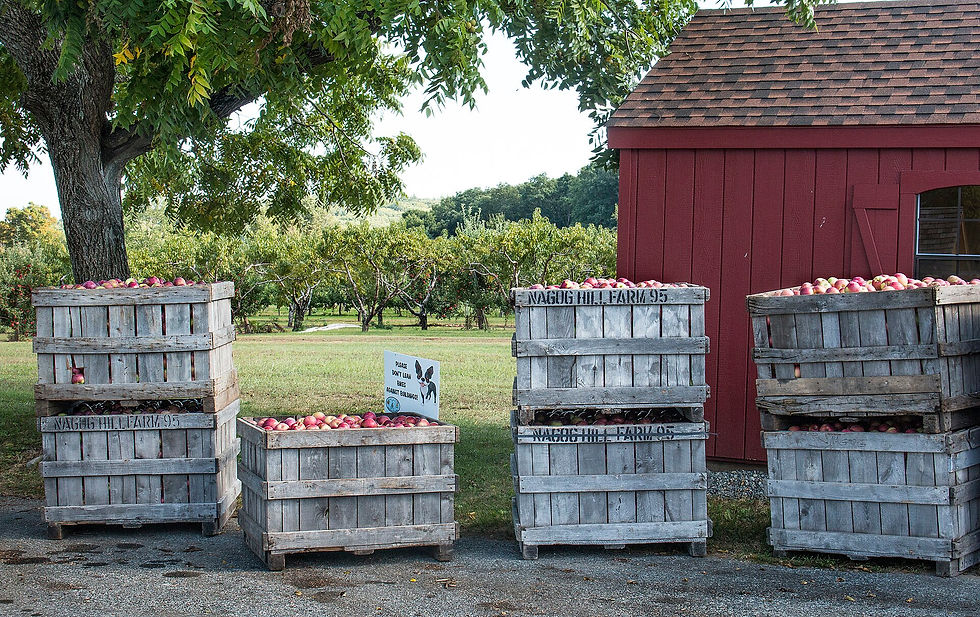
Wagner has described a 20-year stretch when it was brutally hard to make a living farming. So the family looked at what it already had: a location minutes from Hampton Beach, under an hour from Boston, surrounded by seacoast towns full of young families. They rebuilt the farm around those people.

By 2014 the mix had flipped: 80% retail and 20% wholesale. Without that switch, Wagner told the Globe, the orchards would all be house lots today.
The wider numbers explain why. In 2022 the average New Hampshire farm made just $6,568 in net cash farm income, according to the USDA Census of Agriculture. A farm that only sells by the truckload lives at the mercy of a buyer who sets the price.
Reality check If most of your crop leaves on a truck, you are a price-taker. Wholesale isn’t evil, and Applecrest still does about a fifth of its business that way. But it can’t be the whole plan. Read Farms Turning to Agritourism as Crop Prices Fall and Agritourism vs Traditional Farming: An Income Comparison. |
The Applecrest Money Machine: A Free Gate and Seven Ways to Get Paid
Here’s the whole business on one page. Notice what sits in the middle: a gate that costs nothing to walk through.

Picture a family driving in on a Saturday in September. Parking, music and the tractor ride are free. Then the kids want to pick apples, Dad smells the cider donuts, Grandma wants a pie and everyone gets a cone at the Creamery. On the way out they buy a jug of cider at the Farm Market.
Nobody paid to get in. Everybody paid.
Let’s take the machine apart, piece by piece.
14 Lessons Every Farmer Can Put to Work From Applecrest
Lesson 1: Escape the Wholesale Trap by Bringing the Buyer to the Tree
In July 2024, U.S. growers received about 66 cents a pound for fresh-market apples, according to the USDA’s Economic Research Service. Apples the USDA bought for processing under 2024 contracts went for roughly 21 to 49 cents a pound.
At Applecrest in 2026, a peck of pick-your-own apples costs $38. The farm’s own guide says a peck holds about 10 pounds. That’s about $3.80 a pound, and the customer did the picking, carried the fruit and paid for the privilege.

Yes, pick-your-own has real costs: staff, containers, toilets, parking, insurance and dropped fruit. But the gap is far too wide to ignore. The same apple is worth five to eight times more when the buyer comes to the tree.

Field-Tested Play: Try This on Your Farm Work out what you earn per pound (or per kilo) on your main crop today. Then price the same crop as pick-your-own or farm-gate retail. Choose one block of trees or one field and test it for two weekends. Read Pick-Your-Own vs Guided Tours: Which Makes More Money? and The Benefits of Selling Fresh Produce Directly to Visitors. |
Lesson 2: Make the Front Gate Free, and Charge for the Fun Inside
Applecrest’s FAQ is blunt: there is no entrance, parking or admission fee, ever. On fall festival weekends the live bluegrass is free, and so are the tractor rides out to the orchards.
That sounds like money left on the table. It isn’t. A free gate removes the one decision that stops a family turning into the driveway. Once they’re parked, the farm has seven chances to sell them something they want.
Peter Wagner summed up the goal to UNH in 2014: “you can spend the whole day here without spending a lot of money.” Families believe it, so they come back again and again, and they spend a little every time.

One warning: a free gate only works when there’s plenty to buy inside. If you have one activity, charge for it at the gate. And free rides still carry real safety and insurance duties, so get those right first.
Field-Tested Play: Try This on Your Farm List everything a visitor can do on your farm, then mark each one free or paid. With fewer than three paid stations, keep your admission fee. With four or more, test a free-entry weekend and compare spend per car with a paid weekend. See The Best Way to Set Entry Fees and Ticket Pricing, Upsells That Double Your Agritourism Revenue and How to Make Your Farm Ride Offerings Stand Out. |
Lesson 3: Give Every Weekend a Name and a Reason to Come Back
Jean Wagner’s first harvest festival grew into a tradition. In 2026 Applecrest is running its 52nd year of festivals.
Look closely at the 2026 calendar and you’ll spot a clever trick. The farm doesn’t run one festival. It runs a season of them, each with its own name: Strawberry Festival, Blueberry Celebration, Peach Festival, then Fall Harvest Kick-Off, Autumn Equinox, Harvest Moon, Fall Foliage, Hunter’s Moon and a Festival Closer on November 1.
Count them up and there are 34 named festival days between mid-June and November 1. Almost every one comes with free live music from a rotating cast of local bluegrass and folk bands.

The core ingredients barely change from weekend to weekend: picking, music, the corn roast, donuts. What changes is the name and one special hook. On October 17 and 18, 2026, a Viking-age living-history group from nearby Exeter sets up camp with food, textile and battle demonstrations. On the Sunday, a master carver attacks an 800-pound pumpkin in front of the crowd.
Every new name gives the farm something fresh to post and email, and gives a family who came in September a reason to return in October.

Field-Tested Play: Try This on Your Farm Open next year’s calendar and give every weekend of your season a name tied to something real: what’s ripe, the harvest moon, the first frost, the leaves turning. Keep the same core activities and add one small hook each time. Read How to Organize a Farm Harvest Festival in the Fall and 30 Farm Event Ideas by Season. |
Lesson 4: Plant a Season, Not a Crop
Most fruit farms have a few frantic weeks and a long, quiet year. Applecrest planted its way out of that problem.
According to the farm’s season guide, strawberries run from mid-June to mid-July, then blueberries to mid-August. More than 20 kinds of peaches and nectarines ripen from August into September, alongside fall raspberries, and more than 40 apple varieties carry the season from mid-August to the end of October, with pumpkins beside them.
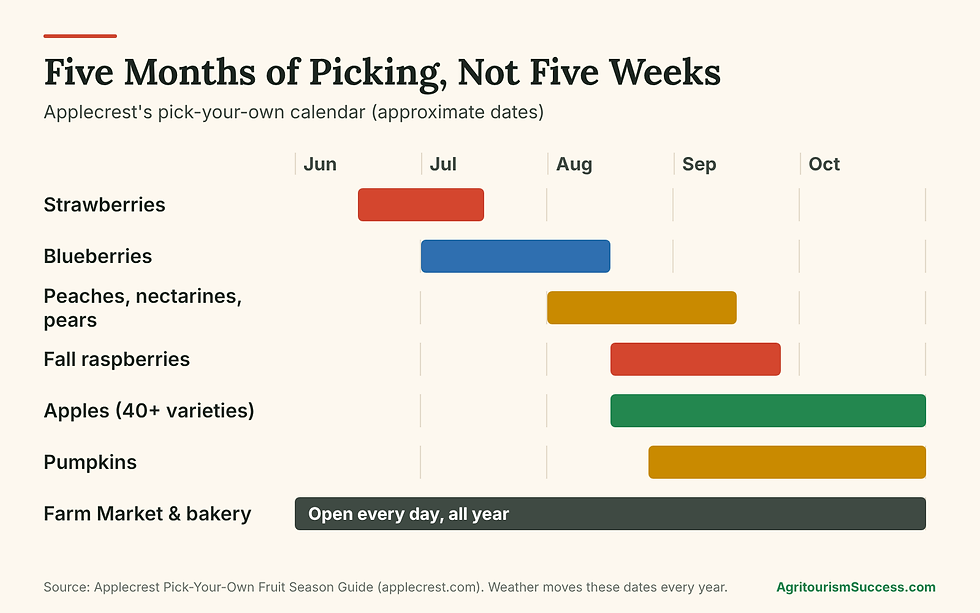
That’s five months of reasons to visit instead of five weeks. The 40-plus apple varieties matter here too. Because they ripen at different times, something is always at its peak, and each new variety is another reason for a repeat trip.

Field-Tested Play: Try This on Your Farm Draw your own picking calendar, month by month, and circle the empty months. Then ask which early or late crop, or which early or late variety of what you already grow, could fill one gap. See Seasonal Agritourism: How to Capitalize on the Changing Seasons and The 365-Day Yield. |
Lesson 5: Create a Signature Product People Can Smell From the Parking Lot
Applecrest bills its hot cider donuts as famous, and its market page calls them a reason in themselves to visit. The farm sets out hot cider donuts in the Farm Market every morning, seven days a week. They often sell out, so the farm tells customers to come early or order ahead.
On festival weekends they come warm out of a food truck, and the TV series Amazing America named the cider donut sundae among the farm’s must-eat fall foods. Behind them sits a scratch bakery that puts the farm’s own apples into its pies, the way Grandmother Wagner did.

Why does a donut matter so much? Because it does three jobs at once. It turns a cheap ingredient, apple cider, into a high-margin product. It gives people a reason to visit in months when nothing is ripe. And it’s a smell. People remember a smell long after they’ve forgotten a price.
Field-Tested Play: Try This on Your Farm Choose one food made from your own crop that you can make fresh every morning, sell warm and smell from a distance. Make it the same way every time, give it a name and put it in every photo you post. Read Creating Unique Farm Products to Boost Revenue and The Signature Experience Formula. |
Lesson 6: Price Like a Professional With Containers, Premiums and Family Add-Ons
Applecrest’s 2026 pick-your-own price list is a small masterclass. Apples sell by the container: $38 a peck, $48 a half bushel. Families can add up to two half-peck family bags at $18 each. Honeycrisp, the variety everyone asks for, is priced separately at $28 a half peck and $48 a peck. Raspberries are $12 a prepaid pint.
Four smart moves are hiding in that list:
Container prices. The farm stopped selling by the pound for 2026. A fixed price per bag is quicker at the till, easier to understand and nudges people to fill the bag.
A premium for the famous variety. Honeycrisp costs noticeably more per pound than the standard mix, because people ask for it by name.
An add-on for the kids. The $18 family bag lets every child pick, which keeps the outing happy and lifts the average sale.
Register and prepay first. Every picker registers at the main farm stand before heading out, and after 5 p.m. picking is prepaid only, which keeps the cash under control.
Prices move, too. A visitor told PickYourOwn.org they paid $30 a peck in September 2020. In 2026 it’s $38, and the crowds still come.
Field-Tested Play: Try This on Your Farm Switch from weighing every bag to fixed container prices. Put a premium on your most requested variety. Add a small, cheap kids’ bag that can only be bought with a full-size one. Review your prices every year, not every five years. See The Experience Premium and How to Price Your Agritourism Activities and Services. |
Lesson 7: Get Paid Before the Season Starts
For years Applecrest ran a classic CSA, a weekly box of produce paid for up front. It has since replaced it with something simpler, which it calls the MarketShare.
Here’s how it works. A member prepays into a private house account. The farm adds bonus credit: 5% on $200, 10% on $400, 15% on $600 and 20% on $800. Members spend the balance whenever they like, on anything in the Farm Market, from produce and meat to bread, pies and donuts. They also get member-only specials and priority curbside pickup, and they can top up at any time.

Think about what that does. The farm gets cash before the busy season, when it needs it most. The customer gets a discount and total flexibility. And once someone has $440 sitting in your account, where do you think they’ll buy their pies?
Applecrest says it changed because of member feedback. Many people no longer want a fixed box on a fixed day. They want to choose.
Field-Tested Play: Try This on Your Farm Offer a prepaid farm card in two or three tiers, with a 5% to 10% bonus for paying up front. Sell it hardest in late winter, when your cash is lowest and customers are dreaming of summer. Read How to Create Effective Email Marketing Strategies for Agritourism to fill it. |
Lesson 8: Stay Open When the Fields Are Asleep
Pick-your-own ends in October. Applecrest doesn’t. Its Farm Market opens every day of the year.
The shelves carry the farm’s own hand-pressed cider, fruit and vegetables alongside local honey, milk, maple syrup, cheese, meat and seafood from other producers, plus pies and breads baked daily. For the holidays, the farm’s LocalHarvest listing mentions turkeys, wreaths, Christmas trees and gift baskets. Customers can also order online.

The market sits in a newer barn that the Wagners built partly from reclaimed materials: old apple bins, barn boards and the metal roof of a cider mill that had collapsed on the property, Todd Wagner told Taste of the Seacoast magazine. The farm’s 1804 post-and-beam barn next door now houses the Creamery.
Field-Tested Play: Try This on Your Farm Ask what a local family needs from you in January. Then stock a small year-round shelf with your own preserves, frozen produce or baking, plus a few products from neighbours. A shop that’s open all year turns a seasonal visitor into a weekly customer. |
Lesson 9: Feed Them, but Think Hard Before You Build
For its 100th anniversary in 2013, Applecrest broke ground on its biggest bet. In May 2015 it opened a 12,000-square-foot barn with 35-foot ceilings, housing a farm store, a coffee shop and the Applecrest Farm Bistro. New Hampshire Business Review put the total investment at more than $3 million.
The bistro ran seven days a week, all year. North Shore magazine reported 125 seats, 50 inside and 75 on the patio, with the kitchen canning about 100 pounds of farm tomatoes a week for winter sauces. Before it opened, the farm had sold ticketed farm dinners at $150 a head with guest chefs.
Why build it? Todd Wagner told NHBR that demand for farm dinners, weddings and events was huge, and serving drinks at them needed a full liquor license, which in turn called for a proper restaurant.
Peter Wagner didn’t pretend it was safe. He called the model very risky, with workers in the fields at dawn and others in the kitchen until midnight. Restaurants also evolve: the farm’s current website doesn’t feature the bistro, and recent listings from Visit New Hampshire refer to an on-site restaurant called the Orchard Grille.
Reality check A $3 million barn is not step one. Applecrest built it after 40 years of festivals and a proven crowd. Test food the cheap way first: a corn roast, a food truck or a monthly farm dinner. Read Hosting Farm-to-Table Dinners to Showcase Local Produce and How Much Does It Cost to Set Up a Barn for Agritourism? before you sign anything. |
Lesson 10: Partner With Neighbours Instead of Building Everything
Applecrest doesn’t make everything itself, and it doesn’t pretend to. When Peter Wagner, who by the farm’s own account is very particular about his ice cream, wanted a creamery, the farm teamed up with Richardson Farms, a well-known dairy nearby, to make ice cream blended with Applecrest fruit.
The pattern repeats everywhere. Compost from neighbouring farms feeds the soil. The market carries local meat, dairy and seafood. Local bands play the festivals, and a Viking re-enactment group and a master pumpkin carver pull crowds on big weekends.
Every partner brings its own audience, its own skills and its own social media posts. The farm gets new attractions without new payroll.

Field-Tested Play: Try This on Your Farm Write down five neighbours who already have what your visitors want: a dairy, a baker, a band, a craft group, a food truck. Offer each one a weekend slot, a shelf or a share of sales. See How to Partner With Local Businesses to Boost Farm Tourism. |
Lesson 11: Turn Your History Into Marketing
Applecrest’s website sums up its approach in four words: “History sure tastes good.”
The farm uses its past everywhere: the apple train, Walter Farmer and his chickens, the hurricane week of 1954. It leans on its standing as New Hampshire’s oldest and largest apple orchard and, by its own description, America’s oldest continuously operated one.
For its centennial in 2013, the farm read aloud a short Applecrest memoir by John Irving, along with an excerpt from The Cider House Rules, on festival weekends. It also ran a $1,000 “Your Farm Story” essay contest, and the winner wrote about her first job on the farm. Former workers and loyal customers became the storytellers.
One note of caution. The “oldest in America” claim is the farm’s own, and Wikipedia flags it as needing a citation. Use your history proudly, but stick to claims you can back up.
Field-Tested Play: Try This on Your Farm Collect five true stories about your land: who farmed it first, the big storm, the year you nearly lost it, the famous visitor. Put the best one on your homepage and on a sign by your busiest spot. Then invite customers to share their own memories of your farm. |
Lesson 12: Spread Your Risk Before the Weather Does It for You
Peter Wagner told the Globe he has lived through hurricanes, hailstorms and freezes that wiped out entire crops. His rule: save the money in a good year, because a bad one is coming.
2023 proved him right. A February cold snap killed most of New Hampshire’s peach buds, then a May 18 freeze hit at peak apple bloom. A UNH Extension survey found 869 acres of apple orchards damaged and an estimated $7.9 million in lost apple revenue statewide. Applecrest’s strawberry patch dropped to 25°F that night, but the farm ran its irrigation for frost protection and the berries looked promising, according to Extension field notes.
Todd Wagner explained the deeper protection to NHBR. The farm grows many crops, runs a CSA, sells at farmers’ markets and pairs pick-your-own with music and hayrides. “All of those things help to spread out the risk to some degree,” he said.
When apples have a bad year, the donuts, ice cream, music, vegetables and market still pay the bills.
Field-Tested Play: Try This on Your Farm List every income stream you have, and next to each one write the crop it depends on. If one crop failure would wipe out more than half your income, your next project is a stream that doesn’t depend on it. See How to Prepare for Weather-Related Risks in Agritourism. |
Lesson 13: Let How You Farm Become Part of the Pitch
Applecrest isn’t certified organic, and it doesn’t pretend to be. Instead its FAQ answers the question head-on and explains what it does: hand weeding, cover crops, crop rotation, compost from neighbouring farms and plastic sheeting to hold down weeds. More than 30 years ago it was one of the first farms in New Hampshire to adopt Integrated Pest Management, using natural predators and pest-resistant varieties to cut spraying.
In 2013 the farm also reported a 50-kilowatt solar system, with more panels planned for the new barn.
Visitors ask how their food is grown. A clear, honest answer builds more trust than a label you can’t use.
Field-Tested Play: Try This on Your Farm Write a plain-English “How We Grow” page and a one-minute answer your staff can give at the till. Show the practices on your farm walk: the cover crop, the beneficial insects, the compost pile. Read How to Educate Visitors on Sustainable Farming Practices. |
Lesson 14: Bring the Next Generation Home With a Real Job to Do
Todd Wagner didn’t plan to farm. He studied film at Middlebury College, raced as a nationally ranked downhill skier and worked as a documentary filmmaker at George Lucas’s Skywalker Ranch. In 1999 he walked the Oscars red carpet as associate producer of the Academy Award-nominated documentary Regret to Inform.
Then he called his father to say he and his wife were coming home to stay. Peter admitted to the Globe that the farm was struggling at the time. Todd came anyway, bringing skills a farm can rarely afford to hire: marketing, storytelling and running a business.
By 2017 he was the marketer, HR department, paymaster for about 220 employees, restaurateur and mechanic all at once. Today his family lives in the original farmhouse, and a fourth generation is growing up on the land.
There’s a warning in this too. Peter told the Globe he sometimes worried his son was stretched too thin. Wearing 20 hats works for a while. It doesn’t work forever.
Field-Tested Play: Try This on Your Farm If you want your children to take over one day, give them a business to run, not a list of chores: the market, the events, the website, the social media. Let them bring outside skills home, and build systems so nobody has to wear every hat. See How to Run a Profitable Agritourism Business Without Burning Out. |
Where Applecrest Still Struggles (and What That Teaches You)
No case study is honest without the weak spots.
Thin margins and long hours. The family told the Globe about 90-hour weeks and razor-thin margins. Agritourism added income. It didn’t make farming easy.
The land is gone. Selling hundreds of acres kept the farm alive, but those acres will never be orchard again.
Rain is the enemy. Festivals don’t run in the rain, and a wet October weekend in peak season is money that can’t be recovered.
Small gaps show. Most portable toilets aren’t wheelchair accessible, and school tours aren’t currently offered.
The facts online don’t match. Depending on the source, Applecrest has 124, 150, 220, 225, 250 or more than 400 acres, and somewhere between 12,000 and 20,000 apple trees. Old listings never die.
That last one is a lesson for every farm. Customers and Google both read what’s out there about you. Check your Google Business Profile, your website and the big directories once a year and make the facts match. My guides to getting found on Google Maps and how reviews turn small farms into tourist destinations show how. Applecrest’s 4.5 stars from 1,849 Google reviews show what years of crowd-pleasing weekends can earn.
Why This Matters for Your Farm Right Now
Applecrest isn’t a fluke. It’s riding a trend the USDA can measure.
U.S. farms and ranches earned $1.26 billion from agritourism and recreation in 2022, up 12.4% from 2017 after inflation, according to the USDA’s Economic Research Service. Researchers at Penn State found that the average participating farm earned about $44,000 from agritourism. In New Hampshire, the number of farms in agritourism grew from 16 in 2002 to 156 in 2022, while their agritourism income rose from $265,000 to $4.54 million.
USDA researchers also found that fruit farms, and farms in more populated counties, tend to earn more from agritourism. That’s Applecrest exactly.
If you grow fruit within a couple of hours of a town, you’re sitting on the same opportunity. Our Farmer Copleys case study and Fattoria di Maiano case study teach the same lesson from a Yorkshire pumpkin field and a Tuscan olive grove.
How to Apply the Applecrest Playbook on a Small Farm
You don’t need 220 acres. Here’s how each big move translates to a smaller farm.
What Applecrest did | Your small-farm version |
Moved from about 90% wholesale to 80% retail | Sell your best block or field direct before you sell it by the truckload |
Free admission, parking, music and tractor rides | Keep entry free only once you have four or more paid activities |
34 named festival days in 2026 | Name every weekend of your season after what’s ripe or happening |
Five months of picking, June to October | Add one early or late crop to fill your quietest month |
Hot cider donuts every morning | Create one warm, smellable signature product from your own crop |
Container prices, a Honeycrisp premium and family add-ons | Fixed bag prices, one premium variety and a small kids’ bag |
MarketShare prepaid accounts with up to a 20% bonus | A prepaid farm card with a 5% to 10% bonus, sold in late winter |
Farm Market open every day of the year | A small year-round shelf of preserves, frozen produce and baking |
Creamery partnership with a local dairy | Bring in one neighbour’s product or performance each month |
Centennial story contest and a John Irving reading | Collect and share five true stories about your land |
Your 90-Day Applecrest-Style Launch Plan
Days 1 to 15: measure the gap. Compare what you earn per pound wholesale with what the same crop would bring direct.
Days 16 to 30: pick your signature. Choose one product to sell fresh and warm, and one field to open for picking.
Days 31 to 45: set your prices. Fixed container prices, one premium option and one family add-on.
Days 46 to 60: name your weekends. Give each weekend a name and a hook, and post the calendar online.
Days 61 to 75: invite the neighbours. Sign up two local partners, such as a dairy, a baker or a band.
Days 76 to 90: launch a prepaid card. Offer two tiers with a small bonus, then track spend per car every weekend.
Frequently Asked Questions About Applecrest Farm Orchards
Where is Applecrest Farm Orchards?
At 133 Exeter Road (Route 88) in Hampton Falls, New Hampshire, in the state’s seacoast region, minutes from Hampton Beach and less than an hour from Boston. The Farm Market is open every day, all year.
Who owns Applecrest Farm Orchards?
The Wagner family, who bought it in 1954. Peter Wagner became sole owner in 2006 and runs it with his wife Linda and son Todd.
Is Applecrest the oldest apple orchard in America?
Applecrest calls itself New Hampshire’s oldest and largest apple orchard and America’s oldest continuously operated one, planted in 1913. The national claim is the farm’s own and hasn’t been independently verified.
How much does apple picking cost at Applecrest?
In 2026, pick-your-own apples cost $38 a peck and $48 a half bushel, and Honeycrisp $28 a half peck. Admission and parking are always free.
What does Applecrest have to do with The Cider House Rules?
Author John Irving worked at Applecrest as a teenager and thanked the Wagners in the author’s notes of his 1985 novel The Cider House Rules. The 1999 film version won two Academy Awards.
What can a small farm learn from Applecrest?
Sell direct instead of wholesale, name every weekend of your season, stretch your picking calendar, build a signature product, take prepayments and spread your risk across many small income streams.
Your Next Step: Find Out Where Your Farm Stands
Applecrest was one bad decade away from becoming a housing development. What saved it wasn’t more apples. It was a family that asked a different question: what if the buyers came to us?
Your farm has its own version of that question. The hard part is knowing which answer fits your land and budget.
That’s exactly why I built the Farm Readiness Quiz. In a few minutes it shows you which parts of your farm are ready for visitors and which ones to fix first, so you don’t waste money building the wrong thing.
Then grab my free ebook, The 21-Point Agritourism Blueprint. It walks you through the checklist I use to plan, price and open a farm to paying visitors, step by step.
P.S. Remember the 66-cent apple at the start of this story? At Applecrest the same pound of fruit sells for about $3.80, and the customer does the picking. Your farm has its own version of that gap. Take the free quiz now and find it.
Sources
Applecrest blog: 100th anniversary and restaurant groundbreaking (2013)
Boston Globe: The hard work behind your weekend apple-picking trip (2017)
PickYourOwn.org: Southeastern New Hampshire pick-your-own farms
USDA AMS: Fresh bulk apples for processing, purchase award 2024 (PDF)
USDA ERS: Agritourism income in the 2022 Census of Agriculture
Valley News: agritourism growth in New Hampshire and Vermont (2025)
USDA NASS: 2022 Census of Agriculture, New Hampshire state profile (PDF)
UNH Extension: May 18, 2023 frost and freeze damage notes (PDF)
Photo credits
Applecrest Farm Orchards sign and barn: Allagash Brewing, CC BY 2.0, Wikimedia Commons
Apple bins by a red barn: Muffet, CC BY 2.0, Wikimedia Commons
Apple trees at Nagog Hill Orchard: Muffet, CC BY 2.0, Wikimedia Commons
Bluegrass band: Paul VanDerWerf, CC BY 2.0, Wikimedia Commons
Blueberry picking at Butler’s Orchard: USDA, public domain, Wikimedia Commons
Apple cider donuts: Veganbaking.net, CC BY-SA 2.0, Wikimedia Commons
Apples going into a cider press: CitizenCider, CC BY-SA 4.0, Wikimedia Commons
Pumpkins in Hollis, New Hampshire: Captain-tucker, CC BY-SA 3.0, Wikimedia Commons
Disclaimer
This article is an independent case study written by AgritourismSuccess.com for educational and informational purposes only. All facts, figures, prices, quotes and other details about Applecrest Farm Orchards, its owners and its business were compiled from publicly available information, including the farm’s own website, news and magazine articles, university and government publications, travel sites and review platforms, as listed in the Sources section above. We have not independently verified this information, and it may be incomplete, inaccurate, out of date or changed since publication. Any opinions or interpretations are our own and do not represent the views of Applecrest Farm Orchards or the Wagner family.
AgritourismSuccess.com does not take any responsibility or accept any liability for errors or omissions in this information, or for any loss, damage or decision arising from reliance on it. This article is not sponsored by, endorsed by or affiliated with Applecrest Farm Orchards or any business or person named in it, and all trademarks and brand names belong to their respective owners. Nothing here is financial, legal, tax or professional advice. Please check current details directly with the business concerned and seek qualified advice before making decisions for your own farm.
Photos are resized but otherwise unaltered; photos labelled illustrative were not taken at Applecrest Farm Orchards. Charts and diagrams by AgritourismSuccess.com.


Comments