



Your Empty Barn Could Pay You Rent Every Month: How to Rent Out Farm Buildings to Businesses


John Dale is a seventh-generation farmer near Dorking, Surrey. For years he ran a dairy.
Today he is a former dairy farmer. He told the BBC in August 2025 about "really paltry margins on milk" and said he had come to hate the job.
He didn't sell the farm. He did something smarter. His old farm buildings now earn rent from a brewery and a boxing gym.
Can renting your empty barn really pay? Yes. In England, letting buildings is the most common and the most profitable form of diversification on farms (Defra, 2024/25). Farms that let buildings earned an average of £27,900 a year from it.
The short answer: Yes, an empty farm building can earn steady monthly rent. Half of all English farms in the Farm Business Survey now let buildings for non-farm use, averaging £27,900 a year (Defra, 2024/25). In the US, storage customers pay many times the "farm rate" for shed space. But the money only sticks if you sort planning or zoning, the lease, tax and insurance BEFORE the tenant moves in. This guide shows you how. |
Below: what John Dale's farm teaches, what real farms in England, the US and Canada charge, how to price and pick tenants, and the traps that have cost other farmers thousands.
The John Dale Story: From Paltry Milk Margins to Rent From a Brewery and a Gym
The BBC doesn't name his farm, but an earlier Surrey Live story did: John Dale's Aldhurst Farm, on Temple Lane in Capel, just south of Dorking. The brewery and the boxing gym described below are both based there. At the time of that story the family had 450 Holstein Friesians, and John had opened a raw-milk hut at the gate to add value to his milk.
The BBC says he first tried running a milk float, and that he has earned income by leasing out old farm buildings.
Tenant No. 1: a brewery in the barn
Dorking Brewery moved its production to Aldhurst Farm around the end of 2017, according to CAMRA. Its CAMRA listing says the site is capable of producing 35,000 pints a week.
The paperwork tells the real lesson. In December 2018, Capel Parish Council looked at a planning application (MO/2018/1950) for "change of use of a further part of agricultural barn to micro-brewery".
Read that again: a further part. The brewery already used part of the barn and wanted more. Councillors noted the barn was used for storage and the brewery would not harm the farming. They recommended approval.
That is how good tenants grow. They start small, do well, and ask you for more space.
The brewery even fed the farm. Its own website says: "Our spent grain goes a few metres up the track to feed the cows."
CAMRA's local branch says the brewery's Tap & Gun taproom is on site, in a former gun shop.
Tenant No. 2: a boxing gym in Unit 4
Backyard Boxing Limited was set up in October 2024. Its registered office at Companies House is Unit 4, Aldhurst Farm.
Unit 4. That number suggests the farm has several units, not one lucky letting.
The gym was founded by Marley Bygrave, who first ran it from his garden, and it has run a free non-contact boxing course for children aged 10 to 14. A use like that brings local families up the track. That is rent, plus goodwill in the village.
What the story does NOT tell you
No source publishes the Dales' rents or how much of their income comes from letting, so I won't guess.
What we do know: diversification let John focus on the parts of farming he enjoys. He also called recent inheritance tax changes a worry. Remember that. Rent and inheritance tax are linked, as you'll see later.
Field-Tested Play: Let part of a building, not the whole thing. At Aldhurst Farm, the brewery used part of a storage barn and later applied for a further part. A first tenant on a small area tests the market, the planning route and your landlord skills before you commit the whole barn. |
The Numbers: Letting Buildings Is England's No. 1 Farm Diversification
You don't have to take one farmer's word for it. Defra's Farm Accounts in England report found this for 2024/25:
72% of farm businesses in England had some diversified activity.
Letting buildings for non-farm use was the most common activity, at 50% of all farms in the survey.
Farms letting buildings earned an average of £27,900 a year from it, the highest of any activity.
For 16% of all farms, letting buildings was their ONLY diversified activity.
One note: Defra's "letting" category also counts land let for non-farm purposes, so it isn't buildings alone.

Solar came second, at 27% of farms. Every other activity sat between 7% and 13%. Now look at the money.

That doesn't mean farm tourism is a bad idea. It means letting is the quiet workhorse: less glamour, less hosting, steadier money. With input costs still climbing, steady money matters.
On cereal farms, Defra says diversification income rose 28% to £32,600 per farm, with letting out buildings singled out as a driver. That is about two-thirds of the average cereal farm's £49,700 Farm Business Income (my calculation).
It's growing, too

In 2014/15, Farmers Weekly reported that 41% of farms let buildings, earning £16,100 on average. Ten years later it was 50% of farms and £27,900. That is about 73% more in cash terms (my calculation, not adjusted for inflation).
Farming in Ohio, Ontario or Alberta? England is crowded, with strict planning rules. If half its farmers can make letting work, the idea isn't fragile. Your rules will differ, but demand for cheap, secure rural space is everywhere.
The pressure is everywhere too. The UK saw a record 6,365 agriculture, forestry and fishing businesses close in the year to June 2025 (ONS), and US farm debt is forecast to reach about $605 billion in 2026 (USDA). The US doesn't count barn rent separately: its Census of Agriculture asks farms for rent from "farmland and/or buildings" in one figure.
Landlord or Operator? Why This Isn't the Same as Running Your Own Barn Business
I've written before about turning an old barn into your OWN agritourism business: see From Dairy Barn to $2.8 Million: Your Old Buildings May Be Your Best Agritourism Asset. This article is different. Someone else runs the business. You collect rent.
The trade-off in plain words:
Operator: higher possible income, but you hire staff, serve customers, work weekends, and carry the risk.
Landlord: lower ceiling, but the tenant does the work. Your job is to maintain the building, collect rent and manage the lease.
Tilted Barn Brewery brews beer in its own barn. At Aldhurst Farm, a separate brewery business brews in the farm's barn. Same idea, two very different lives.
A Canadian example makes the contrast sharp. Dennis and Laurie Duncan of Coulee Ridge Farms near Bentley, Alberta, milked cows for 44 years and then sold their 70 dairy cows. "The day we sold the dairy we talked about a marine business," Dennis told The Western Producer.
By 2018 their 23,000 sq ft former dairy barn housed Rainy Creek Marine, which stored about 100 boats over winter and serviced about 200 boats a year. The farm sits on the main highway to a busy boat launch at Sylvan Lake. The barn earns from other people's boats, but the family runs that business itself. That's the operator path.
Many farmers do both: run what they love, rent out what they don't need. For low-effort starts, see Asset-Light Agritourism and launching with the infrastructure you already own.

7 Real Farms Turning Empty Buildings Into Rent
John Dale isn't alone. Here are real farms in England, Wales and the US, with the numbers they have made public.
Barn Store, Hampshire: 140 storage units in under-used farm buildings
On the Southwick Estate near Fareham, Martin Bazeley's farm merged its two dairy herds. That left buildings under-used.
In 2003 he started an indoor self-storage business in them. By 2018, Farmers Weekly reported 140 units across 14,000 sq ft, from 40 to 320 sq ft each. A 40 sq ft unit cost £90 a month. A 160 sq ft unit cost £290 a month.
Storage fees brought in about £140,000 a year. The idea was franchised to 12 other farms.
One honest detail: Bazeley is a tenant farmer. The estate paid for the conversion and takes part of the income.
The Matts family, Northamptonshire: up to 28 units, fully let
At Twigden Barns and Matts Lodge Farm in Creaton, the Matts family lets up to 28 office and workshop units on two sites. By 2018 they had been letting for 17 years.
Their tenants include an architect, an engineering firm, a sign maker and a tree surgeon. Fully let, with low turnover. Their rules are the best tenant advice I've found; more below.
Hunters Hill Farm, North Yorkshire: from fire to 10 office suites
A fire in 2017 forced the Gibson family at Crakehall, near Bedale, to stop dairying. Tim Gibson called it "a very difficult few years since the cows went".
In 2020 the old cow housing became YoreStore self-storage. Two former dairy buildings became 10 office suites, plus 4 clean kitchen rooms for food start-ups.
Penllyn Estate Farm, Vale of Glamorgan: 45 tenants
The Homfray family near Cowbridge in Wales converted obsolete farm buildings into commercial units. Farmers Weekly named them a 2026 Diversification Farmer of the Year finalist, with 45 tenants on the farm.
One unit there, 705 sq ft, was advertised at £9,000 a year plus VAT on a full repairing and insuring lease. The listing now shows it as let agreed.
Hyde Hall Farm, Hertfordshire: 100+ people at work every day
Ben and Fiona Cannon converted obsolete farm buildings into offices and industrial units. The farmyard now houses more than 20 business tenants across 3,400 m², from rural solicitors to upholsterers, and over 100 people work there daily. They funded it by borrowing against their land.
Daywell Farm, Shropshire: a dairy barn becomes 5 start-up units
In 2025 Shropshire Council approved plans to turn a redundant dairy cattle barn at Gobowen into 5 commercial units for small local businesses needing storage or workshop space. The application cited "financial pressures and uncertainty" in farming.
The Bidens, Maine: room for 75 vehicles in a cattle barn
Jeff and Linda Biden raised Red Angus cattle in Dresden, Maine, for 11 years. Their children didn't want to take over.
So in 2018 they planned to add a fourth wall to a three-sided cattle barn so it could hold about 75 vehicles over the winter, at $399 per vehicle and $249 per motorcycle for the season. If all 75 spaces held cars, that's about $29,900 a season (my calculation; the paper didn't report their income).
"It was a fun way of life. We enjoyed it," Linda said of the cattle years. Their plan: let the barn keep earning after the cattle left.
Field-Tested Play: Barn Store, Hunters Hill, Daywell and Coulee Ridge all started when a change in the dairy left buildings spare. If your herd has shrunk or gone, those empty buildings may be your best rental asset. See why so many dairy farmers are diversifying. |
What Each Farm Building Could Earn: Real Rents by Country
Real published rents, asking rents and price guides, each labelled by country and year. Asking rents are what the landlord advertised, not proof of what a tenant agreed.
Building or use | Rent found | Country, year | What it is |
|---|---|---|---|
Rural office space | £8 to £20 per sq ft a year | England, 2018 | Farmers Weekly price guide |
Rural workshop space | £3 to £7 per sq ft a year | England, 2018 | Farmers Weekly price guide |
Converted barn office, 4,209 sq ft (Yattendon Estate) | £44,250 a year (about £10.51 per sq ft) | England, 2024 | Asking rent |
Steel portal farmyard unit, 3,000 sq ft (Bedfordshire) | £1,750 a month (about £7 per sq ft a year) | England, current listing | Asking rent |
Former farm storage buildings (Dovecote Farm, Kettering) | £4 per sq ft; 3,750 sq ft for £15,000 a year | England, 2026 listing | Asking rent |
Commercial unit, 705 sq ft (Penllyn Estate) | £9,000 a year plus VAT | Wales, current listing | Advertised, let agreed |
Indoor self-storage units, 40 to 160 sq ft (Barn Store) | £90 to £290 a month | England, 2018 | Charged rate |
Caravan storage, single axle | About £370 a year average; some sites over £800 | UK, 2022/23 | Farmers Weekly figure |
Machine shed, farm-to-farm rate | $0.30 per sq ft a year average | US (Minnesota), 2023 | Extension survey |
Machine shed, farm-to-farm rate | $0.45 per sq ft a year average | US (North Central region), 2014 report | Extension survey |
Unheated vehicle, boat and camper storage | About 10 cents per sq ft a month | US (Virginia), 2018 | Extension agent's local figure |
Winter vehicle storage in a cattle barn (Bidens) | $399 per vehicle, $249 per motorcycle, per season | US (Maine), 2018 | Advertised rate |
RV storage, 30x10 unit | $169.35 a month average | US, 2023 booking data | SpareFoot marketplace |
Self-storage, 10x10 unit | $74.98 a month national average | US, 2026 | SpareFoot marketplace |
Farm buildings let to non-farm users | No published survey found | Canada | Price from local storage and commercial listings |
Two things jump out. First, converted space earns far more than a bare shed, but conversion money is money at risk. Second, look at the gap between the US "farm rate" and what storage customers pay. That gap is the biggest opportunity in this article.
The Hidden Gold: The Farm-Rate vs Storage-Market Gap
When farm buildings are rented for farm use, extension surveys put machine-shed rent very low: $0.30 per sq ft a year in Minnesota (2023), $0.45 in a 2014 Midwest survey.
Storage customers pay far more. SpareFoot data, reported in April 2026, put the US average 10x10 self-storage unit at $74.98 a month. That's about $9 per square foot a year (my calculation).

What that gap means for one building (my own sums):
A 3,000 sq ft machine shed let to a neighbour at Minnesota's $0.30 average: about $900 a year.
The same shed let for unheated vehicle storage at Virginia's 10 cents a month: about $3,600 a year.
In England, the same 3,000 sq ft let as workshop space at £3 to £7 a foot: about £9,000 to £21,000 a year. That top figure matches the real Bedfordshire asking rent above.
Same roof. Same land. Very different cheque.
Reality Check: Don't price your barn like a self-storage centre. Those businesses have units, gates, cameras, insurance and staff. The gap is real, but the moment you let space to a non-farm customer you may trigger zoning, building code, property tax and insurance changes. In British Columbia, one farmer had grossed about $330,000 in a year from storage before a court ordered him to stop. More on that below. |
University of Illinois Extension adds a sobering point. Upkeep, taxes, insurance and a demolition reserve on an old pole shed can top $6,000 a year, and refurbishing can top $25,000. Some old sheds aren't worth keeping. That's why pricing matters.
How to Price Your Barn Rental: 4 Methods That Work
Penn State Extension, in guidance updated in June 2026, sets out four ways to price farm buildings. It also warns: "Whether vacant or in use, farm buildings cost the owner money."
Method No. 1: Cost-based
Add up what the building costs you each year: depreciation, interest, property tax, insurance and repairs. That's your floor. University of Minnesota Extension's rule of thumb: older facilities rent for about 10% to 15% of their original investment a year; new ones built to rent, 12% to 16%.
Method No. 2: Market-based
What do similar buildings nearby rent for? Search local listings and ring two or three land agents. Ask what they've actually let, not what they've advertised.
Method No. 3: Income potential
What can the tenant earn from your space? A storage operator who fills your barn with 75 cars at $399 each can afford more than a neighbour storing a combine.
Method No. 4: Commercial equivalent
What would a similar unit in town cost? Penn State notes farm buildings often rent slightly below commercial equivalents. That's your pitch: cheaper than town, with easy parking.
Field-Tested Play: Rural agent Howie Kent & Co put it simply in 2024: "Demand, rather than price, is the key factor at play." In 2026 the firm warned landlords not to over-spec. Ask each prospect which improvements they would pay more rent for. Fit only those. |
Which Tenant Fits Which Building?
Not every tenant suits every barn. Here are the real pairings from this article.

Dry storage, vehicles, offices and quiet workshops are the easy wins. Machinery, food production, crowds or fumes need more care. A UK broker told Farmers Weekly in 2019 that insurers tend to see storage of materials and equipment as fairly low risk, while paint spraying or spirits storage would mean a higher premium.

How to Pick Tenants Who Pay (the Matts 20% Rule)
A bad tenant can cost more than an empty barn. John Matts' rules, from Farmers Weekly in 2018:
Interview every tenant. Get a feel for their character and how they'll use the building.
Cap any one tenant at 20%. No single tenant should hold more than 20% of your space or your rent. If one goes bust, you lose a fifth, not everything.
Chase arrears at once. Don't let a late month become three.
Do your landlord jobs straight away. In his words: "Attend to anything that is your responsibility as a landlord straight away."
Prefer local tenants. The Matts family encourages tenants who live within about 5 miles.
A Farmers Weekly guide (December 2023), drawing on Knight Frank advisers, adds: rent by direct debit, credit checks, personal guarantees, and a clear written agreement on permitted use, so a quiet storage tenant can't become a noisy workshop.
University of Illinois Extension adds the US view: an attorney-drafted lease, renter's insurance naming you as additional insured, and clauses on hazardous materials, sub-letting and abandoned property.
Field-Tested Play: Write your 20% rule down before your first tenant arrives. It's easy to say yes when one big firm wants the whole barn. The 20% cap means one tenant's bad year never becomes your bad year. |
Cash flow keeping you awake? Monthly rent is one of the simplest fixes. See farm cash flow problems.
Your Step-by-Step Plan: From Empty Barn to Signed Lease
Here is the order I'd follow. The order matters most.

Step 1: Walk and measure. Size, doors, floor, power, water, access and condition of every building.
Step 2: Ask your four advisers (questions below) BEFORE you spend a penny.
Step 3: Find the tenant first. Farmers Weekly's 2018 advice: don't spend on a conversion until a tenant is lined up.
Step 4: Set the rent with the four methods above, covering rates, insurance and repairs.
Step 5: Vet the tenant. Interview, credit check, references, 20% rule.
Step 6: Get the permission. In England, Farmers Weekly (2018) put a straightforward change-of-use application at about 8 weeks.
Step 7: Fix only what the tenant will pay for. In one 2023 Class R case, minor works (new sheets, a second-hand roller door, guttering) readied a shed estimated to earn about £20,000 a year.
Step 8: Sign a written lease. If consents are pending, Bidwells advises an "agreement for lease" first, so the tenant doesn't move in early.
Step 9: Tell your insurer, then hand over the keys. Collect the tenant's insurance certificate and diary every review date.
If you need help funding the work, see Agritourism Grants and Funding 2026.
The Traps: Real Farmers Who Got Burned
Every one of these is real. Many might have been avoided by asking first.
Trap No. 1: The court shut his storage business down (Delta, British Columbia)
In 2012, Bob Robertson of Ladner, in Delta, BC, had been storing about 360 vehicles for other people on his 16.5-hectare farm. The Vancouver Sun reported the business grossed about $330,000 the year before.
But it was farmland. The Agricultural Land Commission, which protects BC's farmland reserve, and Delta took him to the BC Supreme Court, which barred him from storing non-farm property such as vehicles, boats, RVs and trailers. He had ignored an earlier stop-work order.
He said he cleared the vehicles before the court's deadline, and he put the farm up for sale. "I'm selling because they won't let me fill my barns up," he said.
Trap No. 2: "Grandfathered" didn't save them (Kelowna, British Columbia)
In 2015, Global News reported that a Kelowna property zoned for agriculture had been storing 22 motor homes and trailers, 9 boats and 10 steel containers. On appeal, the BC Supreme Court upheld a ruling that the owners were breaking city bylaws, rejected the argument that the use was "grandfathered", and ordered them to pay the city's legal costs for the appeal.
Nearby in Lake Country, a couple who rented RV pads on a property more than half of which is in the Agricultural Land Reserve were fined $60,000 by the Agricultural Land Commission in June 2026 (reported in August 2026). They also owed nearly $24,000 in separate bylaw fines. That was an RV park, not a barn, but the lesson is the same: farmland rules bite.
Trap No. 3: The gym that got an enforcement notice (West Sussex, England)
In Washington, in the South Downs, landowner Andy Allan's daughter and her partner, both Team GB athletes, ran small personal-training sessions in a barn built during lockdown without planning permission.
Horsham District Council refused permission after the fact and issued an enforcement notice requiring demolition. He appealed. "We haven't intentionally put something in without planning permission," Allan told the local paper.
A gym can be a great tenant, as Aldhurst Farm shows. The difference is checking planning first.
Trap No. 4: The backdated business rates bill (England and Wales)
Farm buildings used for farming are exempt from business rates. Let one to a commercial firm and, under the Valuation Office Agency's manual, that exemption usually ends.
Bills can be backdated. Back in 2000, Farmers Weekly warned that backdated bills "can mount up to thousands of Pounds". The VOA said it usually learned of changes from other local businesses affected by the diversification. In February 2026, Carter Jonas said liability can usually be backdated to when the new use began, potentially as far back as 2023.
The good news: in England, if a tenant's unit has a rateable value of £12,000 or less and it's their only property, Small Business Rate Relief may cut their bill to nothing. See how a farm business could pay zero business rates.
Trap No. 5: The insurance that didn't cover it
Most farm policies cover farming. Ohio State University's farm office lists leasing buildings to others among activities a standard farm policy may not cover. A UK broker warned that if you don't tell your insurer about a change of use, cover may be invalid.
At Hunters Hill, the fire insurance payout was still incomplete years later and heading for a legal dispute. Not a letting problem, but it shows what a gap in cover costs. See Agritourism Insurance: What Coverage Do You Need.
Trap No. 6: Losing the free planning route by moving too fast
In England, Class R lets you change some farm buildings to commercial use without a full application. But Bidwells warns that permitted development rights may be forfeited if a commercial tenant occupies the building before its use has been changed.
Reality Check: Most of the traps above share one root: the use started first and the questions came later. Flip that order and many of these stories might never have happened. |

Paperwork, Permission and Protection: Questions to Ask Your Advisers
This is not legal advice. Rules differ by country, state, province and council. What I can give you is the right questions to take into each meeting.
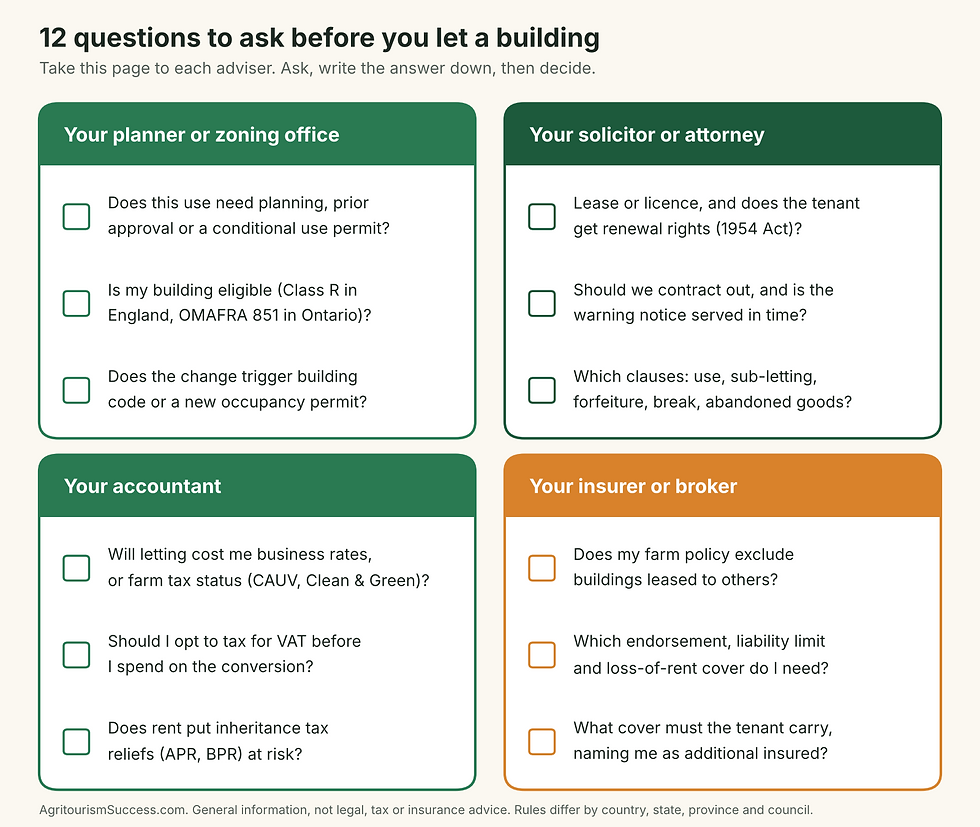
In England and the UK
Ask your planner:
"Does my building qualify for Class R?" Since 21 May 2024, Class R (England only) lets up to 1,000 square metres of farm buildings per agricultural unit change to flexible commercial use, up from 500. Uses include storage, offices, hotels, outdoor sport and some on-site processing. The building must have been in agricultural use as part of an established agricultural unit, and listed buildings are excluded.
"Do I need prior approval?" Above 150 square metres, you must apply to the council to decide whether prior approval is needed on transport, noise, contamination and flooding. At or below 150, you notify the council.
"Does my tenant's use fall outside Class R?" Under Class R, general industrial use is limited to processing raw goods (not livestock) produced on the farm and sold there. A brewery using bought-in ingredients may well fall outside that, so ask before you assume. Dorking Brewery's 2018 expansion at Aldhurst Farm went through a planning application.
Ask your solicitor:
"Will my tenant get the right to renew under the 1954 Act?" Business tenants in England and Wales generally can; tenancies of 6 months or less are generally excluded.
"Should we contract out?" For a fixed-term lease, you serve a warning notice before the tenant is bound, and the tenant signs a declaration. The Law Commission consulted on reform in 2026, but nothing has changed in law yet.
"Is this a lease or a licence?" The label doesn't decide it. Exclusive business use for rent can create a protected tenancy.
Ask your accountant:
"Who pays business rates, and do I need to report changes?" Most farmers pass rates on to tenants, Farmers Weekly reported in 2006. New reporting duties are coming, but GOV.UK says: "This will not become mandatory before 2032."
"Should I opt to tax for VAT?" Rent is usually VAT-exempt, so you generally can't reclaim VAT on conversion costs. Opting to tax normally lets you reclaim it but adds VAT to rent. You normally notify HMRC within 30 days of deciding. Apart from a 6-month cooling-off window, the option generally can't be revoked until 20 years have passed.
"Will rent hurt my inheritance tax reliefs?" Farmers Weekly warned in 2018 that if rental income tops 50% of overall income, agricultural property relief on other farm assets may be at risk. See The Budget Kept the Family Farm Tax and Agritourism and Taxes: Questions to Ask Your Accountant.
"Does my building need an EPC?" Since April 2023, commercial landlords need at least an E rating unless a valid exemption is registered. Very basic farm buildings may qualify for one. In June 2026 the government said it plans to require a B rating from 2031 for rented commercial buildings over 1,000 square metres, with smaller ones staying at E. That still needs legislation.
Ask your insurer:
"What liability and loss-of-rent cover do I need?" One UK broker told Farmers Weekly £10 million minimum public liability, and 24 months or more of loss-of-rent cover.
In Scotland, Wales or Northern Ireland, Class R does not apply; ask your council what does. Scottish readers, see why Scottish farm support has lost 27% of its value.
In the United States
Ask your county or township zoning office:
"Is renting my barn to a non-farm business a separate use?" Farm exemptions protect farming. In Ohio, a court ruled that commercial tractor sales were not an agricultural use. Depending on local rules, a non-farm tenant may need a zoning permit or conditional use approval.
Ask your building department:
"Will I lose my agricultural building exemption?" Sherburne County, Minnesota, says an exempt farm building must be used for agriculture "in its entirety". Non-farm use is a change of occupancy, needing permits and current code. My guide to the 50-100-300 rule, ag exemptions and building codes covers the visitor side.
Ask your tax assessor and accountant:
"Will this trigger rollback taxes?" Pennsylvania's Clean and Green allows a rural enterprise on up to 2 acres, but those acres owe rollback taxes. Ohio's CAUV can recoup three years of tax savings when land stops qualifying.
"How is the rent taxed for me?" Keep separate records from day one.
Ask your insurance agent:
"Do I need an endorsement?" Ohio State's Robert Moore wrote: "Almost any asset or activity can be covered with the addition of an endorsement". One agent recommended at least $1 million liability cover.
For zoning on event barns, see Farm Wedding Venue Zoning.
In Canada
Ask your municipality (Ontario):
"Is this an on-farm diversified use?" OMAFRA Publication 851 says these uses on prime farmland must be secondary to farming, and recommends limiting them to about 2% of the parcel, to a maximum of 1 hectare. Your municipality sets the actual rules. Existing buildings can count at a discount, such as 50%. Seasonal boat or trailer storage and welding shops are among the examples.
"Will MPAC reclassify part of my farm?" MPAC classifies the part used for other purposes by its current use, so your property tax could rise.
Ask in British Columbia: "Is my land in the Agricultural Land Reserve, and what does the Agricultural Land Commission allow?" The Delta and Kelowna cases show what happens when you don't ask.
Field-Tested Play: Print the 12-question checklist and take it to each adviser. Write down each answer and the date. If anyone questions your letting later, you have a record that you asked first. |
Why Steady Rent Matters: A Lesson From a Durian Farm
I'm Stephen Loke, founder of Bloopy Durians, a durian farm in Bentong, Malaysia.
Durian seasons are short. We get about four to five months of fruit a year, roughly December to February and June to August. That leaves long stretches of the year without durians to sell.
So I value income that keeps coming. The farm welcomes visitors from all over the world, many companies send their staff and management, and we supply durians for corporate events. A reliable income for us is our WhatsApp list of loyal customers who buy whenever durians are available.
Rent works the same way. A tenant paying on the first of every month doesn't care whether it rained or prices crashed.
Your buildings are worth more than you think. You walk past them and see a cost. A tenant sees a home for their business. For more ways to fill quiet months, read The 12-Month Farm.
FAQ
Can I rent out my farm buildings without planning permission?
Sometimes. In England, Class R lets up to 1,000 square metres of farm buildings change to some commercial uses without a full application, but you still notify the council or get prior approval. In the US and Canada, it depends on zoning, building code and farmland rules. Ask before a tenant moves in.
How much rent can I charge for my barn?
It depends on the building, use and area. Real figures range from $0.30 per square foot a year for a Minnesota machine shed (2023) to £3 to £7 for English workshops and £8 to £20 for rural offices (2018 guide). Use the cost, market, income-potential and commercial-equivalent methods.
What is the most profitable farm diversification in England?
Letting buildings for non-farm use. In 2024/25 it was both the most common and the most profitable diversification on English farms, done by 50% of farms and earning an average of £27,900 a year (Defra).
What are the best tenants for a farm building?
Low-risk tenants that fit the building: dry storage, vehicle and caravan storage, offices, quiet workshops and local trades. Breweries, gyms and food businesses can work well too, as Aldhurst Farm shows, but they usually need more planning and insurance checks.
Will renting my barn affect my farm taxes?
It can. In England and Wales, a let building can lose its rates exemption, and rent may affect inheritance tax reliefs. In the US, it can trigger rollback taxes under Pennsylvania's Clean and Green or recoupment under Ohio's CAUV. In Ontario, MPAC may reclassify the part you let. Ask your accountant first.
Do I need special insurance to rent out a barn?
Usually. A standard farm policy may not cover buildings leased to others. Tell your insurer, ask about an endorsement and loss-of-rent cover, and require tenants to carry their own insurance naming you.
Should I use a lease or a licence?
Ask a solicitor or attorney. In England and Wales, calling an agreement a "licence" doesn't stop it becoming a protected business tenancy if the tenant has exclusive use and pays rent. A written agreement drafted for your situation protects you either way.
What should I do with redundant farm buildings that need lots of repair?
Get the costs first. Refurbishing an old pole shed can top $25,000 (University of Illinois Extension). Find a tenant, ask what they'd pay extra for, then decide whether to repair, convert or demolish.
Get 150 More Ways to Earn From What You Already Own
Your empty barn is one hidden asset. Most farms have a dozen more sitting in plain sight.
That's why I wrote the free ebook 150 Ways to Unlock Hidden Wealth From Your Farm. Here's what you get:
150 money-making ideas, sorted into clear categories, so you can find the ones that fit your farm fast.
Each idea rated for difficulty, so you know which ones you can start this month.
A possible price setup for each idea, so you know what to charge.
The earning potential of each idea, so you can focus on the ones worth your time.
A practical way to get more revenue from the land, buildings and equipment you already own.
It's free. Download it, grab a cup of coffee, and tick the ideas that fit your farm.
Not sure where your farm should start? Take the free Farm Readiness Quiz to see where you're strong and where to begin.
P.S. John Dale didn't build a theme park. He didn't open a hotel. He let part of a storage barn to a brewery that needed space, and later a unit to a boxing gym. The milking is over, but the buildings still pay. Walk round your yard this week and ask one question about every building you pass: who would pay me to use this?
Written by Stephen Loke of AgritourismSuccess.com, whose farm is featured in Bloomberg News and Asahi Shimbun. This article is general information, not legal, tax or financial advice. Rules differ by country, state, province and council, so check with your own planner, solicitor or attorney, accountant and insurer before you let a building.
Sources
Can glamping and cafes help save British farmers?, BBC News, 7 Aug 2025: https://www.bbc.com/news/articles/c2djex7xzg2o
Udderly fresh: A Capel farm has started to sell raw milk direct from the gate, Surrey Live, about 2019 (undated): https://www.getsurrey.co.uk/news/surrey-news/udderly-fresh-capel-farm-started-16441273
Dorking Brewery (brewery listing), CAMRA, accessed Nov 2026: https://camra.org.uk/brewery/dorking-capel-2661
Dorking Brewery, East & Mid Surrey CAMRA, accessed Nov 2026: https://ems.camra.org.uk/viewnode.php?id=98209
About us, Dorking Brewery, accessed Nov 2026: https://dorkingbrewery.com/pages/about-us
Dorking Brewery, Surrey Hills, accessed Nov 2026: https://surreyhills.org/enterprise/dorking-brewery/
Planning Committee minutes, December 2018, Capel Parish Council, 3 Dec 2018: https://www.capel-pc.gov.uk/files/view/meeting-minutes/planning-committee/vm_Planning_December_2018.pdf
BACKYARD BOXING LIMITED, company 16023881, Companies House, checked 5 Nov 2026: https://find-and-update.company-information.service.gov.uk/company/16023881
Non-contact boxing with Backyard Boxing, EEQU, accessed Nov 2026: https://eequ.org/book/non-contact-boxing-pad-and-technique-work-with-backyard-boxing-27446
Farm Accounts in England, Chapter 5: Diversification (2024/25), Defra, updated 12 May 2026: https://www.gov.uk/government/statistics/farm-accounts-in-england/chapter-5-diversification--2
Farm Accounts in England, Chapter 3: Cropping farms, Defra, updated 12 May 2026: https://www.gov.uk/government/statistics/farm-accounts-in-england/chapter-3-cropping-farms--2
Farm Accounts in England, Chapter 2: Key results, Defra, updated 12 May 2026: https://www.gov.uk/government/statistics/farm-accounts-in-england/chapter-2-key-results-and-overview-across-england
Farm business income by farm type in England 2024/25, Defra, updated 8 Sep 2026: https://www.gov.uk/government/statistics/farm-business-income/farm-business-income-by-farm-type-in-england-202425
Let buildings prove profitable form of farm diversification, Farmers Weekly, 14 Dec 2015: https://www.fwi.co.uk/business/let-buildings-prove-profitable-form-farm-diversification
25% of farms make bulk of income from diversification, Farmers Weekly, 19 Dec 2016: https://www.fwi.co.uk/business/diversification/25-farms-make-bulk-income-diversification
Almost two in three farms have diversified, Defra stats show, Farmers Weekly, Dec 2017: https://www.fwi.co.uk/business/almost-two-in-three-farms-have-diversified-defra-stats-show
Highlights from the farm income forecast, USDA Economic Research Service, updated 3 Sep 2026: https://ers.usda.gov/topics/farm-economy/farm-sector-income-finances/highlights-from-the-farm-income-forecast
2022 Census of Agriculture report form, USDA NASS (via Purdue), 2022: https://ag.purdue.edu/usda/gl/default-docs/census-of-ag/2022_coa_questionnaire_final.pdf
Interest in farm diversification rises, AHDB, 12 Nov 2025: https://ahdb.org.uk/news/interest-in-farm-diversification-rises
Almost three-quarters of farms diversify to subsidise income, Farmers Weekly, 23 Jan 2026: https://www.fwi.co.uk/business/business-management/finance/almost-three-quarters-of-farms-diversify-to-subsidise-income
So you want to... offer self-storage on farm?, Farmers Weekly, 11 Sep 2018: https://www.fwi.co.uk/business/diversification/so-you-want-to-offer-self-storage-on-farm
So you want to... rent out office and workshop space, Farmers Weekly, 9 Nov 2018: https://www.fwi.co.uk/business/diversification/so-you-want-to-rent-out-office-and-workshop-space
New uses found for dairy buildings after fire, Hambleton Today, 16 Sep 2022: https://hambletontoday.co.uk/?p=38162
Former farm buildings in Bedale ravaged by fire take on new lease of life, Yorkshire Post, accessed Nov 2026: https://www.yorkshirepost.co.uk/country-and-farming/former-farm-buildings-in-bedale-ravaged-by-fire-take-on-new-lease-of-life-as-family-are-forced-to-diversify-3853129
FW Awards: Diversification Farmer of the Year 2026 finalists, Farmers Weekly, 20 Jul 2026: https://www.fwi.co.uk/business/diversification/fw-awards-diversification-farmer-of-the-year-2026-finalists
Unit 2 Chorley, Penllyn Estate (listing), Guild Property, accessed Nov 2026: https://www.guildproperty.co.uk/property-to-rent/cowbridge/cf71-7ff/4372912
FW Awards: Meet the 2025 Diversification Farmer of the Year finalists, Farmers Weekly, 3 Sep 2025: https://www.fwi.co.uk/business/diversification/fw-awards-meet-the-2025-diversification-farmer-of-the-year-finalists
Shropshire farmer hopes to host local start-ups in former dairy barn, Shropshire Star, 14 Oct 2025: https://www.shropshirestar.com/news/2025/10/14/shropshire-farmer-hopes-to-host-local-start-ups-in-former-dairy-barn-with-diversification-plan/
Dresden couple transitions from beef to storage, Lincoln County News, 3 Aug 2018: https://lcnme.com/business/dresden-couple-transitions-from-beef-to-storage/
Farm diversification takes an unusual turn, The Western Producer, 15 Nov 2018: https://www.producer.com/2018/11/farm-diversification-takes-an-unusual-turn
Converted barn office, Unit 3 Childs Court Farm (particulars), Yattendon Estate, Mar 2024: https://yattendon.co.uk/wp-content/uploads/2024/05/Property_Particulars.pdf
Grain Store, Dovecote Farm (particulars), BTG Eddisons, 2026: https://images.loopnet.ca/d2/BGZ_w3OByvwT74g76oR16kxKA7C2fSYNaNsl7VIxr78/Grain%20Store%20Dovecote%20Farm.pdf
Rural business unit, Woburn Road (listing), Bidwells, accessed Nov 2026: https://www.bidwells.co.uk/properties/rural-business-unit-farm-woburn-road/378291/
Case study: Class R diversification, Howkins & Harrison, 18 Oct 2023: https://howkinsandharrison.co.uk/farm-rural/case-study-class-r-diversification/
So you want to offer caravan storage, Farmers Weekly, 2022/23: https://www.fwi.co.uk/business/diversification/so-you-want-to-offer-caravan-storage
Rural rental market update: navigating the shift, Howie Kent & Co, 17 Jul 2024: https://howiekentandco.com/latest-news/rural-rental-market-update-navigating-the-shift/
Over-spec of farm buildings, Howie Kent & Co, 1 Sep 2026: https://howiekentandco.com/uncategorised/over-spec-of-farm-buildings/
Selected Farm Rents, Rates, and Values, University of Minnesota Extension, Dec 2023: https://richland.extension.wisc.edu/files/2024/05/umn-farm-2024_2-19-select-rents-rates-and-values.pdf
Farm Building Rental Rate Survey, North Central Farm Management Extension Committee (via Purdue), May 2014: https://ag.purdue.edu/commercialag/home/wp-content/uploads/2014/05/201405_NCFMEC_FarmBuildingRentalRateSurvey.pdf
What is a fair rental price for farm buildings?, Ohio State University Extension, 29 Oct 2014: https://u.osu.edu/ohioagmanager/2014/10/29/what-is-a-fair-rental-price-for-farm-buildings/
Got space?, Progressive Dairy, 7 Dec 2018: https://agproud.com/articles/21338-got-space
Farmland owners: can I rent out my old pole barn?, University of Illinois Extension, 18 Mar 2025: https://extension.illinois.edu/blogs/farm-coach/2025-03-18-farmland-owner-series-farmland-owners-can-i-rent-out-old-pole-barn
Determining a Rental Rate for Farm Buildings, Penn State Extension, updated 30 Jun 2026: https://extension.psu.edu/determining-a-rental-rate-for-farm-buildings
Determining fair rent for farm buildings, UNL CropWatch, 27 Sep 2024: https://cropwatch.unl.edu/2024/determining-fair-rent-farm-buildings
Self-storage rental costs (SpareFoot report), Commercial Observer, 22 Apr 2026: https://commercialobserver.com/2026/04/self-storage-rental-costs-sparefoot-report/
How much does RV and camper storage cost?, SpareFoot, 22 Oct 2025: https://sparefoot.com/blog/how-much-does-rv-camper-storage-cost
Farm owner fumes after business ruled illegal, Vancouver Sun (via PressReader), 25 Aug 2012: https://www.pressreader.com/canada/vancouver-sun/20120825/281586647764918
Kelowna farm property owners illegally storing RVs, Global News, 3 Mar 2015: https://globalnews.ca/news/1862177/kelowna-farm-property-owners-illegally-storing-rvs/
Years-long farm land dispute ends with $60,000 fine for Lake Country RV park, iNFOnews (iNwheels), Aug 2026: https://infonews.ca/inwheels/news/6844/years-long-farm-land-dispute-ends-with-60000-fine-for-lake-country-rv-park/
Battle over South Downs farm barn being used as a gym, Sussex Express, accessed Nov 2026: https://www.sussexexpress.co.uk/news/people/battle-over-south-downs-farm-barn-being-used-as-a-gym-3839767
Beware rates hike after change of use, Farmers Weekly, 19 Apr 2000: https://www.fwi.co.uk/news/beware-rates-hike-after-change-of-use
So you want to... offer storage, Farmers Weekly, 5 Jun 2006: https://www.fwi.co.uk/business/so-you-want-to-offer-storage
Business clinic: rates and EPCs on building conversions, Farmers Weekly, Feb 2026: https://www.fwi.co.uk/business/business-clinic-rates-and-epcs-on-building-conversions
Rating Manual section 2, part 6D: agricultural premises, Valuation Office Agency (GOV.UK), updated 18 Sep 2026: https://www.gov.uk/guidance/rating-manual-section-2-maintaining-the-rating-list/part-6-exemptions-part-d-agricultural-premises
Small Business Rate Relief, GOV.UK, updated 20 Oct 2026: https://www.gov.uk/apply-for-business-rate-relief/small-business-rate-relief
Business rates: duty to notify, GOV.UK, updated 29 Oct 2026: https://www.gov.uk/government/publications/business-rates-and-duty-to-notify/business-rates-duty-to-notify
GPDO 2015 Schedule 2 Part 3 Class R, legislation.gov.uk, as amended May 2024: https://www.legislation.gov.uk/uksi/2015/596/schedule/2/part/3/crossheading/class-r-agricultural-buildings-to-a-flexible-commercial-use
Changes to permitted development rights, Defra Farming blog, 10 May 2024: https://defrafarming.blog.gov.uk/2024/05/10/changes-to-permitted-development-rights
Permitted development right changes come into force, NFU, 22 May 2024: https://www.nfuonline.com/updates-and-information/permitted-development-right-changes-come-into-force/
Rural Spectator: commercial tenancies of rural properties, top tips, Bidwells, page dated 27 Apr 2024 (content appears to date from 2018): https://prod.bidwells.co.uk/insights-reports-events/rural-spectator-commercial-tenancies-of-rural-properties-top-tips/
Leases, security of tenure and contracting out, Myerson, accessed Nov 2026: https://myerson.co.uk/news-insights-and-events/leases-security-of-tenure-and-contracting-out
Renting out farm buildings, Thompson Smith & Puxon, updated Sep 2024: https://www.tsplegal.com/insights/renting-out-farm-buildings/
1954 Act reform: have your say on business tenancies consultation, Gowling WLG, 26 Jun 2026: https://gowlingwlg.com/en/insights-resources/articles/2026/1954-act-reform-have-your-say-on-business-tenancies-consultation
MEES in the non-domestic private rented sector: interim response, GOV.UK (DESNZ), 18 Jun 2026: https://www.gov.uk/government/consultations/non-domestic-private-rented-sector-minimum-energy-efficiency-standards-epc-b-implementation/outcome/minimum-energy-efficiency-standards-mees-in-the-non-domestic-private-rented-sector-interim-response
Opting to tax land and buildings (VAT Notice 742A), HMRC (GOV.UK), updated 26 May 2026: https://www.gov.uk/guidance/opting-to-tax-land-and-buildings-notice-742a
Business clinic: insurance implications of changing building use, Farmers Weekly, 25 Oct 2019: https://fwi.co.uk/business/business-management/business-clinic/insurance-implications-of-changing-building-use
Top tips for successful commercial lets on farm, Farmers Weekly, Dec 2023: https://www.fwi.co.uk/business/diversification/top-tips-for-successful-commercial-lets-on-farm
Ohio zoning law and agriculture (slides), OSU Agricultural & Resource Law Program, accessed Nov 2026: https://farmoffice.osu.edu/sites/aglaw/files/site-library/OH%20Zoning%20Law%20%26%20Ag%20PPT.pdf
Agricultural Building Permit Exemption handout, Sherburne County, Minnesota, accessed Nov 2026: https://www.co.sherburne.mn.us/DocumentCenter/View/11074/Agricultural-Building-Permit-Exemption-Handout
Clean and Green frequently asked questions, Union County, Pennsylvania, 2022: https://unioncountypa.org/wp-content/uploads/2022/02/5.FrequentlyAskedQuestions_ShortList_CLEAN-AND-GREEN.pdf
Agricultural Use (CAUV), Franklin County Auditor, Ohio, accessed Nov 2026: https://auditor.franklincountyohio.gov/Real-Estate/Appraisal/Agricultural-Use-CAUV
Farm insurance policy: unique assets and activities, OSU Farm Office, 23 Mar 2023: https://farmoffice.osu.edu/blog/thu-03232023-209pm/farm-insurance-policy-unique-assets-and-activities
Renting farm buildings (Farm and Dairy report), Farm and Dairy, 11 Dec 2014: https://www.farmanddairy.com/?p=230675
Guidelines on permitted uses in Ontario's prime agricultural areas (Publication 851), OMAFRA, PDF dated 2 Apr 2024: https://www.ontario.ca/files/2024-04/omafra-publication-851-guidelines-on-permitted-uses-in-ontarios-prime-agricultural-areas-en-04-02-2024.pdf
Farm property assessments, MPAC, accessed Nov 2026: https://mpac.ca/en/PropertyTypes/FarmPropertyAssessments


Comments