



US Farm Debt Just Hit a Record $605 Billion. The Farmers Climbing Out Are Selling Experiences, Not More Bushels.

Update (October 2026): Farm Cash Flow Problems: Why You Pay for Months Before You Get Paid. The timing side of the same problem, and how deposits and pre-sold visits fix it.

Rex Larsen's family has farmed the same ground in Leland, Utah, since 1869. Corn, barley, alfalfa, hay and cattle. Seven generations have called that farm home.
Around 2017, it stopped being enough. Crop markets were depressed and only the cattle were paying. So Rex turned to his family for ideas, half-joking that they should help him make more money.
His daughter Kara had the answer. A corn maze.
They turned an alfalfa field into a parking lot, cut the maze with GPS and named it after Rex's father, Glen Ray. Today the farm runs a haunted maze, a pumpkin patch, giant slides and, since April 2026, a tulip festival with 250,000 bulbs. The visitor side brings in about 10% of the farm's income and pays its own way. Rex's verdict, as told to Utah public radio station KUER: "It's financially better than just growing corn."
Hold that story in your mind, because the numbers USDA just released say a lot more farmers are about to face Rex's question.
The Short Answer: USDA forecasts US farm debt will hit a record $605.1 billion in 2026, while production costs rise 4.5% and net farm income falls 2.6%. Borrowing to grow more of the same crop rarely fixes that squeeze, because you still take the market's price. Agritourism adds cash you price yourself, often with modest start-up costs. And a written, numbers-backed plan is what turns that idea into something your banker will take seriously. |
What USDA Actually Said (and Why It Matters at Your Next Bank Meeting)
On September 3, 2026, USDA's Economic Research Service released its latest farm income forecast. Farm Policy News at the University of Illinois put the headline in plain words on October 9: farm sector debt is heading for a record high.
Here is what sits behind that headline:
Total farm debt: $605.1 billion, up $26.4 billion (4.6%) in a single year.
Real estate debt: $399.0 billion, up 4.6%.
Non-real estate debt (operating loans, equipment and the like): $206.1 billion, up 4.4%.
Solvency: USDA says it will get worse, because debt is growing faster than assets or equity. The debt-to-asset ratio climbs from 13.34% to 13.54%.

And the real figure may be higher. Reuters reports that farmers are borrowing more and more from suppliers, co-ops, equipment makers and fintech lenders, and USDA officials told Reuters this kind of credit has left gaps in the government's ability to measure farm debt. USDA is starting research projects to track it.
Now look at the other side of the ledger. USDA expects total production expenses of $492.8 billion in 2026, up 4.5%. Fuel and oil alone are forecast to jump 28.8%. Fertilizer is forecast to rise 15.3%. Meanwhile, cash from crop and livestock sales is expected to slip 0.3%, and net farm income to fall to $158.4 billion.

One more number should stop you cold. USDA forecasts that the median farm household will earn minus $467 from farming in 2026. The typical household stays afloat on about $94,000 of off-farm income. Direct government payments are forecast to jump 69.8% to $47.4 billion. Many farms are being held up by jobs in town and checks from Washington.

If you have felt the squeeze in your own books, you are not imagining it. We broke down the price side in Crop Prices Falling? How Farms Are Using Agritourism to Fill the Gap, and the fuel side in The $8 Billion Fuel Bailout Won't Save Your Farm.
Why Borrowing to Grow More of the Same Deepens the Hole
When cash gets tight, the instinct is to go bigger. Rent another quarter section. Add 50 head. Borrow for the inputs and make it up on volume.
Here is the trap. A corn, soybean, milk or cattle producer is a price taker. You don't set the price per bushel or per hundredweight. The market does. So when you borrow to grow more of the same thing, you buy more of the inputs that USDA expects to cost 4.5% more this year, pay interest on a bigger note, and sell into the same market that just handed you flat or falling receipts.
More volume at a thin or negative margin isn't growth. It's a bigger version of the same problem.


Reality Check: None of this means "never borrow." Good debt that adds a new, profitable income stream is how most farms grow. The danger is borrowing to do more of exactly what is already losing money. Before you sign, ask your lender to run the numbers with this year's input costs, not last year's. |
The Other Road: Selling Experiences You Price Yourself
When a family pays to walk your corn maze, pick your pumpkins or brush your calves, you set the price. The ticket isn't tied to the Chicago Board of Trade.
That road is already well travelled. USDA's 2022 Census of Agriculture found US farms and ranches earned $1.26 billion from agritourism services, up 12.4% from 2017 after inflation. Agritourism income showed up in about 57% of US counties.
Real farms are using it to add income their crops can't:
Heap's Giant Pumpkin Farm, Minooka, Illinois. A five-generation corn and soybean family that grew a high-school pumpkin stand into a U-pick patch, corn maze and giant pumpkin weigh-off. When corn and soybean prices sank, co-manager Kaylee Heap told Reuters: "If we just focused on row crops, we'd be having a different conversation."
Curious Cows and Company, Corcoran, Minnesota. A 120-cow dairy. Milk prices ran about $16 to $18 per hundredweight in 2025, below the roughly $20 dairies need to profit. Starting in 2025, the family began charging $25 for 30 minutes of brushing and feeding calves.
Boots Farms, near Moberly, Missouri. A corn and soybean farm where a son's FFA pumpkin project grew into a 6-acre corn maze. A $10 ticket covers the maze and activities, and the farm estimates upwards of 1,000 families come each year.
For more farms that made the switch, read Crop Prices Down, Diesel Up: Why Farms Are Turning to Agritourism and our Farmer Copley's case study.

The start-up costs can be modest compared with a new combine or another 80 acres. Here is the sample corn maze budget Rutgers Cooperative Extension published for a 5-acre maze:
Sample 5-acre corn maze (Rutgers) | Amount |
Growing the corn | $2,375 |
Maze design and first cut | $1,500 |
Marketing | $9,000 |
Hired labor | $9,120 |
Extra liability insurance | $1,500 |
Signs, toilets, wristbands, upkeep, staff shirts | $2,330 |
Total costs | $25,825 |
Revenue: 7,200 visitors at $7.50, plus corn sold | $56,500 |
Net return in the sample | $30,675 |
That budget dates from 2013, so expect today's costs to be higher. Notice where the money goes, though: most of it is marketing and labor, not land or iron. We walk through the full numbers in How to Start a Corn Maze and How to Start a Pumpkin Patch, and compare dozens of options in How Much Does It Cost to Start an Agritourism Business?
Reality Check: Agritourism is not a lottery ticket. University of Missouri Extension notes that in 2017, half of US agritourism operations earned less than $5,000 from it. The farms that earn real money treat it as a business, with a plan, a price and a marketing budget. Read Is Agritourism Profitable? before you spend a dollar. |
Field-Tested Play: Test before you borrow. Run one paid weekend, such as a pumpkin day, a farm breakfast or a guided tour, using what you already own. Real ticket sales from a real weekend are worth more to a lender than any guess. Our 60-minute MVP guide shows you how. |
How to Make the Bank Take You Seriously
Here is the part most farmers skip, and it's the part that decides whether the bank says yes.
Your lender isn't grading your enthusiasm. They are scoring risk. GreenStone Farm Credit Services sums up what lenders weigh as the five Cs of credit: character, capital, capacity, collateral and conditions. A new venture with no numbers fails at least two of them on sight.
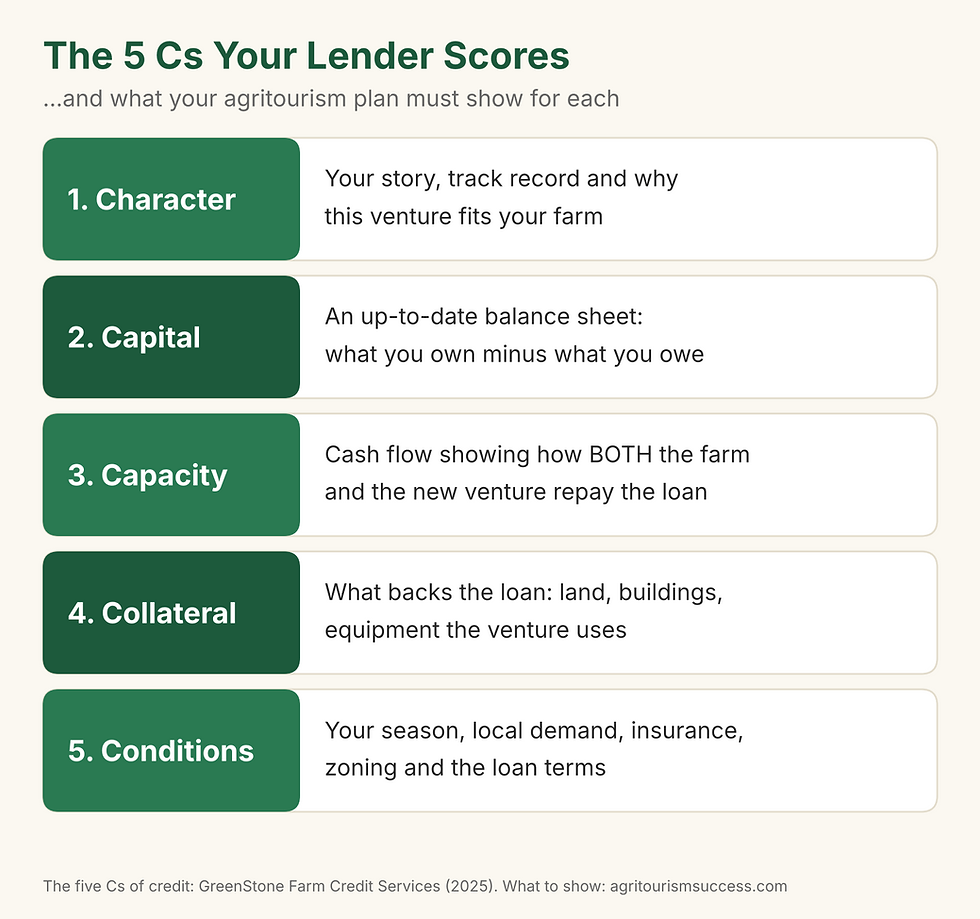
What a bank-ready agritourism plan includes:
A current balance sheet. USDA's own Farm Service Agency loan paperwork, the Farm Business Plan Worksheet (Form FSA-2037), starts with one.
A cash flow projection that shows the existing farm and the new venture side by side, month by month, so your banker sees the cash coming in at harvest and in October.
More than one scenario. GreenStone says projections for several scenarios on your repayment plan are even better than a single plan. Show a rainy-season version, not just the sunny one.
Proof of demand. Your test-weekend sales, pre-bookings, inquiries and local competitor prices.
The risk answers. Insurance quotes, your state's agritourism liability law, zoning approval and parking.
Field-Tested Play: Walk into the meeting with the plan already printed and bound, your numbers on one summary page at the front, and a short list of the questions you expect them to ask. A banker who sees you have already thought about the downside relaxes. A banker who has to dig for it worries. |
Need a starting point? Our free Agritourism Business Plan Template covers the structure. And if you'd rather fund part of the start-up without a loan, see Agritourism Grants and Funding in 2026 and USDA's Value-Added Producer Grant.
Questions to Ask Before You Borrow a Dime for Agritourism
This isn't legal advice. These are the questions to put to your lawyer, insurer and county office first:
Insurance: Does my farm policy cover paying visitors, or do I need agritourism coverage? See Agritourism Insurance: What It Covers and What It Costs.
Liability law: Does my state have an agritourism act, and what exact sign wording does it require? Start with Agritourism Laws by State.
Zoning: Is a maze, a farm stand or an event allowed on my land, and do I need a permit?
Loan terms: Will the lender count projected agritourism income, or only income I have already earned?
A Note From My Own Farm
I run a durian farm, Bloopy Durians, in Bentong, Malaysia. Our seasons last only about four to five months a year, which taught me early that you can't live on harvest-time cash alone.
Today we welcome visitors from all over the world, and many companies send their staff and management to the farm. Our WhatsApp list of loyal customers buys whenever durians are in season. That steady, direct cash is exactly the kind of income a lender likes to see, because it doesn't wait on a commodity price.
Frequently Asked Questions
How much is US farm debt in 2026?
USDA's Economic Research Service forecasts US farm sector debt will reach a record $605.1 billion in 2026, up 4.6% from 2025. Real estate debt is $399.0 billion and non-real estate debt is $206.1 billion.
Is US farm solvency getting worse?
Yes, slightly. USDA says solvency will worsen in 2026 because debt is growing faster than assets or equity. The debt-to-asset ratio rises from 13.34% to 13.54%.
Can agritourism help a farm in debt?
It can add cash flow that isn't tied to commodity prices. Glen Ray's in Utah says its maze helps support the rest of the farm, and Heap's in Illinois credits diversifying with getting through tight years. It is not a quick fix, and it works best when you test demand and plan the numbers first.
How much does it cost to start agritourism?
It depends on the activity. Rutgers' sample budget for a 5-acre corn maze came to $25,825 in total costs, mostly marketing and labor. A guided farm tour or a single paid event can start for far less using what you already own.
Will a bank lend money for an agritourism business?
Lenders do fund agritourism when the plan is strong. They look for a current balance sheet, realistic cash flow projections, proof of demand and answers on insurance and zoning.
What should an agritourism business plan include for a lender?
A balance sheet, month-by-month cash flow for the farm and the new venture, several scenarios, proof of demand, start-up costs, pricing, and your insurance, liability and zoning answers.
Your Next Step
The record debt number is out of your hands. The plan you carry into your next bank meeting isn't.
The Bank-Ready Agritourism Business Plan is the 38-page guide I wrote for exactly this moment. It includes 7 fill-in worksheets, a full sample plan with 3-year projections, a lender presentation script, answers to the tough questions bankers ask, and a 20-point scorecard to grade your plan before they do. US$47, instant download, 30-day money-back guarantee.
Not sure agritourism fits your farm yet? Take the free quiz first, then grab the free blueprint.
P.S. Rex Larsen didn't answer his problem by planting more corn. He asked his family what else the land could do, and today that answer pays its own way and adds about 10% to the farm's income. Your next bank meeting is the best reason you will get this year to ask the same question, and to bring the numbers with you.
By Stephen Loke of AgritourismSuccess.com, whose farm is featured in Bloomberg News and Asahi Shimbun. This article is general information, not legal, financial or lending advice. Talk to your lender, accountant, insurer and lawyer about your own situation.
Sources
Farm Sector Income & Finances: Highlights From the Farm Income Forecast, USDA ERS (Sept 3, 2026)
2022 Census of Agriculture: The Majority of U.S. Counties Generate Some Agritourism Income, USDA ERS
Why Some Utah Farmers Are Turning Fields Into Tourist Attractions, KUER (Apr 7, 2026)
Utah County Farm Finds Sustainability Through Corn Maze Attraction, KSL-TV (Oct 3, 2025)
Cow Cuddling: How Dairies Diversify Amid Low Milk Prices, KCUR / Harvest Public Media (Jan 26, 2026)
Corn Mazes Keep Family Farms Running, Columbia Missourian via KCUR (Oct 25, 2025)
Budgeting for a Corn Maze, Rutgers Cooperative Extension Bulletin E343 (2013)
Agritourism, University of Missouri Extension (May 22, 2023)
Heap's Giant Pumpkin Farm History, Illinois Farm Bureau Partners (2015)
Growing Giant Pumpkins a Tough Hobby for Illinois Enthusiasts, WTTW (Oct 4, 2019)
Form FSA-2037 Farm Business Plan Worksheet, USDA Farm Service Agency
Photos: Jake Lorefice, Vitaly Gariev and Bernd Dittrich on Unsplash (Unsplash License)


Comments