



Exporters and Distributors: The Janny MT Modules That Buy You the One Thing Every Fruit Shipment Runs Out Of (Time)


In January 2025, China rejected more than 100 containers of Thai durians. China now required lab test results for a banned yellow dye, Basic Yellow 2, and those containers lacked them. Each container was worth about 5 million baht. Rejected fruit sold at home for about half the price.
The fruit's clock never stops, even when paperwork does.
So how can exporters and distributors benefit from Janny MT modules? They buy you time. More days to hold, grade, ship and sell, so you sell on your schedule, not the fruit's.
The Short Answer What it is: A Janny MT module is a 610-litre pallet bin with a sealed lid. Membranes in the lid hold oxygen and carbon dioxide at about 1-5% around the produce, inside an ordinary cold room. What exporters and distributors gain: More selling days, less weight loss, the power to hold stock through a glut, steadier supply to buyers, and less fruit thrown away. What it is not: A fridge or a shipping container. It needs a cold room, and results depend on the crop, ripeness and handling. Stephen's own tests: At Bloopy Durians, Stephen found the module extended durian shelf life by 5-10 days, and mangosteens lasted up to 18 days. These are his own field tests, not published studies. |
I'm Stephen Loke. My farm, Bloopy Durians in Bentong, Malaysia, is featured in Bloomberg News and Asahi Shimbun. Bloopy Durians holds the rights to distribute and sell Janny MT modules in Malaysia and can supply them across South East Asia and Asia. As far as I know, I am the first to test the module on durians in Malaysia.
This article is for the people who move fruit: exporters, distributors, packhouse owners and the farm owners who sell to them. If you want the farmer's view first, read my farmer's guide to Janny MT controlled atmosphere storage modules.
Why Time Is the Most Expensive Thing in Fresh Produce
Fresh fruit is still alive after harvest. It keeps breathing, burning sugar and losing water. Every day it breathes, it loses a little weight and a little value.
The losses are big. The UN Food and Agriculture Organization (FAO) estimates that 13.3% of the world's food was lost between harvest and retail in 2023. For fruits and vegetables, the figure was 25.4%, the highest of any food group.

In Malaysia, the picture is worse. CodeBlue reported in September 2025 that the Ministry of Agriculture and Food Security's draft National Food Security Blueprint 2030 puts fruit and vegetable losses in the supply chain at 20% to 50%.
The same draft found that about 27% of fruits and vegetables go straight to wholesalers with no post-harvest handling. Only 14% of stakeholders use cold storage. High costs, limited capacity, remote locations and poor management were the barriers named.
For a distributor, that loss is not a statistic. It is the crate you bin on Monday, the claim a buyer files on Thursday and the discount you give to clear the cold room before the next truck comes.
The Exporter's Squeeze: Gluts at Home, Rules at the Border
Exporters get squeezed from both ends.
At home, everyone harvests at once. In June 2026, The Star reported that Malaysia's durian production had gone past the 600,000 tonnes recorded in 2024. Kampung durians sold for RM1 to RM4 a kilo in some areas, and Musang King fell below RM30 a kilo.
The New Straits Times found Musang King at RM10 to RM19 a kilo at one Johor stall. Another trader, in Bandar Utama, called the season "truly extraordinary because there are simply too many durians."
The Federal Agricultural Marketing Authority (FAMA) moved to buy 1,000 tonnes, worth RM7 million, through 42 centres to steady prices. I wrote about why gluts crush farm-gate prices in Crop Prices Falling? How Farms Are Using Agritourism to Fill the Gap.
At the border, the rules keep tightening. The Thai containers in my opening story were rejected over missing test reports. When paperwork stalls a shipment, the fruit's clock keeps ticking.
Reality Check: No storage system fixes missing paperwork. Janny MT modules can give you more days to sort out a problem. They cannot make an uncertified orchard or a missing lab report acceptable. Get the compliance right first. |
The Prize: China's Durian Market and Asia's Fresh Fruit Trade
The prize is huge. The South China Morning Post, citing customs data, reported that China imported a record 1.56 billion kilograms of durian in 2024, worth US$6.99 billion.
Thailand exported more than US$7.5 billion of durians in 2025, with over 90% going to China, FreshPlaza reported in May 2026. A new rail service now carries Thai durians to Kunming in about three days.
Malaysia is a newer player in fresh durian exports. It signed a phytosanitary protocol with China in June 2024, and the first fresh whole durians landed in Zhengzhou by air on 25 August 2024. The Star reported in October 2026, from an answer by Agriculture and Food Security Minister Mohamad Sabu, that Malaysia's fresh durian exports to China were worth about RM150.6 million in 2025.
A FAMA director told The Star in June 2026 that China takes 60% of Malaysia's durian exports, worth RM1.5 billion a year. Figures differ between sources: in a 2025 written reply to Parliament, the ministry projected Malaysian durian exports at RM1.8 billion in 2030. That is a forecast, not a promise.

If you want the tourism side of the durian boom, see how Malaysia put 66 farms and orchards on its official tourism menu.
What a Janny MT Module Actually Is
Janny MT is a French company based in Péronne, Burgundy. It has sold its modular storage system since 2009. The company says more than 100,000 controlled-atmosphere modules have been sold, with users in 35 countries and on every continent.
Each module has two parts:
The bin: a 610-litre pallet bin, 100 x 120 cm on the ground and 83 cm high.
The lid: a clip-on lid with a seal and selective membranes. Removable caps open or close membranes to suit each crop.
Here is how it works, in plain words:
You cool the produce in your cold room first.
You clip the lid on and set the membranes for that crop.
The produce breathes and uses up the oxygen inside the bin.
The membranes let a little oxygen in and a little carbon dioxide out, so both settle at about 1-5%.
The produce slows down. It ripens more slowly and loses less water.
No gas tanks and no machines. The fruit does the work, and the membranes set the limits. For a deeper look at the parts and models, read The Complete Guide to Janny MT Post-Harvest Modules.
Janny MT fact | What the company states |
Volume | 610 litres per module |
Footprint | 100 x 120 cm, 83 cm high |
Stacking | 9 or 10 high, depending on contents |
Gas levels | O2 and CO2 held at about 1-5% |
Weight loss | Reduced to 1.5% at most (vs about 10% for apples or cherries in conventional packs) |
Working life | 15 years or more; membranes never need replacing; no consumables |
Range | More than 20 vegetables, 15 fruits, 3 mushrooms and 3 flowers |
Shipping the modules | Up to 117 per truck or 95 per 40-foot container |
Source: jannymt.com concept page, FAQ and About us page, checked October 2026.
8 Ways Exporters and Distributors Benefit From Janny MT Modules
1. A Wider Shipping Window
Every extra day of shelf life is an extra day to find space, finish paperwork and ship. When fruit has only days, you are forced into the fastest, most expensive route.
The Star reported in October 2026 that air freight for fresh durians is costly, while sea freight takes much longer. In September 2026, The Star reported that Hernan Corp shipped two tonnes of Malaysian durians to Dalian by sea in a 12-day trip using a Daikin controlled-atmosphere container. The fruit arrived fresh. Hernan said it was their third trial in two years.
That trial used a CA container, not Janny MT modules. But it shows the same principle: slow the fruit down and slower routes start to open. Reports on Hernan's trial and on a separate Wan Hai Lines sea shipment both say ocean transport could lower logistics costs for larger volumes. More days at the start of the chain leave more days for the journey.

Field-Tested Play: Use the extra days at the packhouse, not just in transit. Hold fruit in modules while you wait for a full load, a vessel booking or a lab result. Ship full containers instead of rushing half-empty ones. |
2. Hold Stock Through a Glut and Sell When Prices Recover
When prices crash, the trader who can wait wins. The one who can't sells at the bottom.
This is not theory. In 2013, FreshPlaza reported on a French asparagus grower using Janny MT modules. Storage stretched his asparagus to 25 days, and he planned his sales around market prices. The article called it "strategic preservation."
For a distributor, that means you can buy in a glut, hold part of it and release it as the market recovers. I covered the cash side of this in Farm Cash Flow Problems.
3. Fewer Rejected or Downgraded Consignments
A buyer judges your fruit on arrival, not at harvest. Fruit that ripened on the way, lost weight or lost colour gets downgraded or rejected.
Janny MT says weight loss in its modules is reduced to 1.5% at most. Less water loss means firmer fruit, better weight on the scale and fewer claims. That is the company's own figure, and its published storage times are mostly for temperate crops like apples and kiwis, so test your own produce.
4. Smoother Scheduling With Buyers
Supermarkets and importers want steady supply on fixed days. Harvests don't arrive that way.
With fruit held in modules, you can fill orders on the buyer's calendar. Because each module is its own sealed unit, you can open only the modules you need for an order and leave the rest closed. Janny MT lists this control over destocking as a key advantage.
5. Less Waste in Your Cold Room
Cold alone slows fruit down. Cold plus a controlled atmosphere slows it more.
The research backs this up for tropical fruit. A 2003 study in Acta Horticulturae found mangosteens kept 16 days at 13°C in normal air, and up to 28 days in a controlled atmosphere. That study used a lab CA system, not Janny MT. It shows what slowing down respiration can do.

6. Better Pricing Power
When you have to sell today, the buyer sets the price. When you can wait a week, you can say no.
This is the quiet benefit. Time turns a desperate seller into a patient one. I made the same point for farmers in How Much Money Can You Really Make From Agritourism?, where stored premium fruit keeps earning after the season ends.
I wrote about the price squeeze growers face in Cheap Imports Are Crushing Vegetable Growers in Malaysia. And I first floated the idea of holding premium harvest for export in Why Agritourism Is a Lifestyle Business, Not Just Income.
7. Reach Farther Markets
More shelf life means more places you can reach. Malaysia's FAMA is working to expand durian exports to Canada, the UK, New Zealand and Japan.
Not every fruit can reach every market fresh. But each extra day you gain puts another market within reach.
8. Risk Management and Food Security
Gluts are not only a business problem. When surplus fruit rots in the field, a country loses food it already paid to grow.
That is why Malaysia's draft food security blueprint flags improper packaging, storage and transport as causes of loss. Storage that lets you hold surplus and release it slowly helps the trader and the country's food supply. For more on prices and food supply, read World Food Prices Just Hit a Near 4-Year High.
What I Found Testing Janny MT on Durians and Mangosteens
I'll be honest about what I know and what I don't.
At Bloopy Durians, my own tests found the module extended durian shelf life by 5 to 10 days. In the same module, mangosteens lasted up to 18 days. In my view, that extra time makes the module a good fit for durian export to China.
These are my own field tests on my own farm. They are not a published study, and your results will depend on your fruit, its ripeness and how you handle it.

For context, a 1997 Thai study on durian cold storage found a maximum storage life of about two weeks at 13.5°C to 16.5°C. So durian is a short-lived fruit. Five to ten extra days is a big deal for a fruit like that.
Reality Check: Results vary by produce, variety, ripeness at harvest, handling and cold room temperature. Janny MT's own FAQ warns that if produce is not cooled enough before the lid goes on, oxygen can fall to 0%. Always test on a small batch first. |
From Glut to Export: How the Flow Works
Here is how a module fits into an exporter's or distributor's daily flow.

Janny MT's own cycle has five steps: harvest, cooling with the module open, storage with it closed, readaptation with it open again, and sale. Its FAQ says readaptation takes 12 to 48 hours in the cold room, depending on the product and how long it was stored.
That readaptation step matters for exporters. Plan it into your packing schedule, so fruit is ready on the day the truck arrives.
How a Distributor Can Get Started: Small Trial, Measure, Scale
Don't buy a hundred modules on day one. Start small and let your own numbers decide.
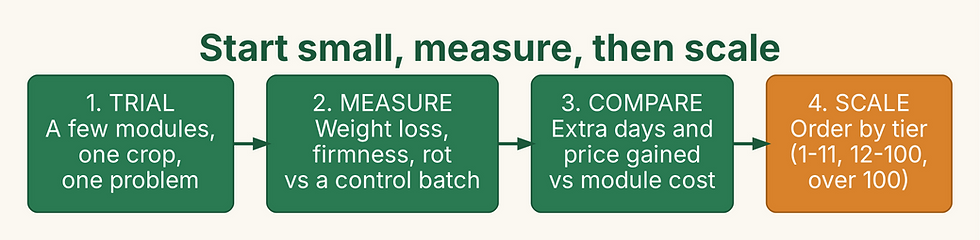
Pick one crop and one problem. For example: "Our mangosteens lose too much quality before they reach the buyer."
Run a side-by-side test. Put part of a batch in modules and keep the rest your usual way. Same cold room, same temperature.
Measure what matters. Weight loss, firmness, colour, rot, days to sale and price received.
Check the atmosphere. Janny MT sells Tiempo Test analysers that read oxygen and carbon dioxide. Its FAQ says storing without one is not recommended.
Scale on your own results. Janny MT prices modules in tiers: 1 to 11, 12 to 100, and over 100. A 40-foot container holds up to 95 modules.
Field-Tested Play: Write down the numbers from your trial before you talk money. A distributor who can show real numbers, such as lower weight loss and more days to sell, has a much stronger case with a bank, a partner or a board. My guide to writing a business plan the bank will read shows how to lay those numbers out. |
Questions to Ask Before You Buy
This is not legal or financial advice. These are the questions I would want answered before any order.
About your produce
Has Janny MT tested this crop and variety? What temperature, fill weight and membrane setting does it recommend?
How ripe should the fruit be when it goes in?
How long should readaptation take before packing?
About your cold room
Can my cold room hold the right temperature for this crop, every day?
How many modules fit, stacked safely?
Do I need an oxygen and CO2 analyser? Which one?
About exports and rules
Do my target market's phytosanitary rules or protocols say anything about storage before export?
Will storage affect any required treatments, lab tests or traceability records?
Who in my team keeps the storage records?
About money
What is the price per module at my order size?
What are delivery, import duty and set-up costs?
How many seasons until the modules pay for themselves, based on my own trial numbers?
Reality Check: Check the import duty and any import rules for the modules themselves with your customs broker. And for fruit, Malaysia's Department of Agriculture said in July 2026 that overland fresh durian exports to China are not allowed under the current protocol. Rules change, so check before every season. |
For a broader look at risk, see how to write a risk management plan.
Where Bloopy Durians Fits In
Bloopy Durians is my durian farm in Bentong, Pahang. It welcomes visitors from all over the world, and many companies send their staff and management to the farm. We also supply durians for corporate events.
Our seasons are short, about four to five months a year. So I know the glut problem first-hand. When the trees drop at once, every day of shelf life counts.
That is why I tested Janny MT modules on my own fruit, and why Bloopy Durians took on the rights to distribute and sell them in Malaysia. We can supply modules to exporters, distributors, packhouses and farms across South East Asia and Asia.
Over the years, people have contacted me from Singapore and China to ask how to export durians. I shared that story in 7 Benefits of Agritourism and Why Small Farms Should Have One. If you also host visitors, Agritourism in South East Asia shows how farms in the region earn more from the same harvest. And if you sell premium fruit to hotels, read how a premium durian partnership can win back VIP guests.
Frequently Asked Questions
Can I ship produce inside Janny MT modules?
Janny MT's company timeline says that in 2018 it began selling a controlled-atmosphere module it describes as adapted to transport, with nestable bins and a 9-membrane lid. Ask Janny MT exactly what transport use it covers for your crop and route before you plan around it. The main use is storage in a cold room.
Do Janny MT modules replace a cold room?
No. The modules do not make their own cold. Janny MT says they must be used in a cold room, and the produce must be cooled first.
Will Janny MT modules work on durians?
In my own tests at Bloopy Durians, the module extended durian shelf life by 5 to 10 days. That is my field finding, not a published study. Test your own fruit on a small batch first.
How long will produce keep in a Janny MT module?
It depends on the crop. Janny MT lists up to 10 months for apples, 5 months for kiwis, 21 days for lettuce and 12 days for strawberries. In my tests, mangosteens lasted up to 18 days.
Do I need gas tanks or a machine?
No. Janny MT says no gas injection is needed. The produce uses up oxygen as it breathes, and the membranes hold the gas balance.
How many modules fit in a shipping container?
Janny MT's FAQ says a 40-foot container holds up to 95 modules, and a truck up to 117. That is for delivering the modules to you.
Where can exporters in Asia buy Janny MT modules?
Bloopy Durians holds the rights to distribute and sell Janny MT modules in Malaysia and can supply them across South East Asia and Asia. WhatsApp Stephen on 017-9250613.
Your Next Step
Time is the one thing every shipment runs out of. If you export, distribute or pack fruit in Asia, a small trial will tell you how much time Janny MT modules can buy you.
WhatsApp Stephen 017-9250613 · www.bloopydurians.com
Still planning your farm's next income stream? Take the free Farm Readiness Quiz.
Want the full checklist for adding visitor income to your farm? Get the free 21-Point Agritourism Blueprint.
P.S. Remember those 100-plus Thai containers rejected in January 2025? Paperwork stopped them, and the fruit paid the price in lost days and lost value. Every extra day you can hold your fruit is a day you choose when and where to sell it. Start with a small trial this season.
Stephen Loke of AgritourismSuccess.com, whose farm is featured in Bloomberg News and Asahi Shimbun. Figures are from the sources below and may change. This article is general information, not legal, financial or customs advice. Stephen's shelf-life results are his own field tests at Bloopy Durians, not published studies.
Sources
FAO SDG Indicators Data Portal, Indicator 12.3.1 Global food losses (2023 data): https://www.fao.org/sustainable-development-goals-data-portal/data/indicators/1231-global-food-losses
CodeBlue, "Up To 50% Fruits, Vegetables Lost In Supply Chain: KPKM" (25 Sept 2025): https://codeblue.galencentre.org/2025/09/up-to-50-fruits-vegetables-lost-in-supply-chain-kpkm/
Khaosod English, "Thai Durian Prices Crash After China's Chemical Test Rules" (16 Jan 2025): https://www.khaosodenglish.com/featured/2025/01/16/thai-durian-prices-crash-after-chinas-chemical-test-rules/
The Star, "FAMA moves to stabilise durian prices amid supply glut" (24 June 2026): https://www.thestar.com.my/news/nation/2026/06/24/fama-moves-to-stabilise-durian-prices-amid-supply-glut
New Straits Times, "Durian glut drives premium prices below RM20 per kg" (25 June 2026): https://www.nst.com.my/amp/news/nation/2026/06/1472247/durian-glut-drives-premium-prices-below-rm20-kg
South China Morning Post, "China breaks durian import record" (23 Jan 2025): https://www.scmp.com/economy/global-economy/article/3295825/china-breaks-durian-import-record-vietnam-malaysia-nip-thailands-heels
FreshPlaza, "Thailand-China rail link cuts durian transport times and prices" (6 May 2026): https://www.freshplaza.com/north-america/article/9835373/thailand-china-rail-link-cuts-durian-transport-times-and-prices/
The Star, "Fresh not frozen" (30 Aug 2024): https://www.thestar.com.my/news/nation/2024/08/30/fresh-not-frozen
The Star, "M'sia eyes land routes for durians" (21 Oct 2026): https://www.thestar.com.my/news/nation/2026/10/21/msia-eyes-land-routes-for-durians
Malay Mail / Bernama, "Malaysia's durian exports to China hit RM6.37b since 2018" (7 Oct 2025): https://www.malaymail.com/news/malaysia/2025/10/07/malaysias-durian-exports-to-china-hit-rm637b-since-2018-govt-eyes-new-markets-in-taiwan-and-peru/193710
The Star, "Sea trial opens door for Malaysian durian exports" (22 Sept 2026): https://www.thestar.com.my/business/business-news/2026/09/22/sea-trial-opens-door-for-malaysian-durian-exports
FreshPlaza, "Malaysian durians reach China fresh after 12-day sea shipment" (22 Sept 2026): https://www.freshplaza.com/oceania/article/9875559/malaysian-durians-reach-china-fresh-after-12-day-sea-shipment/
FreshPlaza / Wan Hai Lines, "First sea shipment of tree-ripened Malaysian durians completed in two weeks" (8 Oct 2026): https://www.freshplaza.com/asia/article/9881054/first-sea-shipment-of-tree-ripened-malaysian-durians-completed-in-two-weeks/
FreshPlaza, "Malaysia says overland durian exports to China are not permitted" (3 July 2026): https://www.freshplaza.com/article/9853670/malaysia-says-overland-durian-exports-to-china-are-not-permitted/
FreshPlaza, "France: New trend to strategic preservation: asparagus growers who earn more money" (27 Mar 2013): https://www.freshplaza.com/north-america/article/2107429/france-new-trend-to-strategic-preservation-asparagus-growers-who-earn-more-money/
Pakkasarn, S., Kanlayanarat, S. and Uthairantanakij, A. (2003), "Effect of controlled atmosphere on the storage life of mangosteen fruit", Acta Horticulturae 600: https://www.ishs.org/ishs-article/600_116
Romphophak, T., Kunprom, J. and Siriphanich, J. (1997), "Storage of Durians on a Semi-Commercial Scale", Agriculture and Natural Resources 31(2): https://li01.tci-thaijo.org/index.php/anres/article/view/240803
Janny MT, Controlled atmosphere concept page: https://jannymt.com/atmosphere_controlee/presentation_concept.htm
Janny MT, FAQ: https://jannymt.com/faq.htm
Janny MT, About us: https://jannymt.com/entreprise/qui_sommes_nous.htm
Stephen Loke, own field tests of Janny MT modules at Bloopy Durians, Bentong, Malaysia, unpublished (as reported by Stephen, Oct 2026)


Comments