




World Food Prices Just Hit a Near 4-Year High. Why Families Are Driving Out to Farms to Buy Direct (and How Your Farm Keeps the Retail Price)

Update (October 2026): Cheap imports are squeezing vegetable growers worldwide. Read how to compete with cheap imported produce.
This spring, a Florida TV crew visited Wesley Wells on his 400-acre farm in St. Augustine. His diesel and fertilizer bills had jumped as conflict in the Middle East rattled supply chains. Then he said the line every farmer knows by heart: "everything we're being paid stays the same."
Wells sells potatoes to brokers who supply Walmart, Costco and BJ's. He doesn't set that price. But he keeps 25 acres for families who come to pick their own vegetables, and there, families pay the farm's price.
Six months later, the whole world is feeling what Wells felt. The UN's Food and Agriculture Organization (FAO) says world food commodity prices in September 2026 were the highest since November 2022.
Here's the part most farmers miss. When food gets expensive, shoppers pay retail prices while most farmers are still paid commodity prices. The farms that sell direct get to keep the difference.
The Short Answer The FAO Food Price Index averaged 136.0 points in September 2026, its highest since November 2022 and 5.8% above a year earlier, led by cereals, especially wheat and corn. Yet U.S. farms receive only 11.8 cents of every dollar spent on domestically produced food, according to USDA. When you sell through a farm shop, pick-your-own, farm boxes or harvest days, you set the price and keep most of the dollar. And when food is expensive, families value two things a farm sells best: fresh food and a good day out together. |
What the FAO Actually Reported
The FAO Food Price Index tracks world prices for a basket of traded food commodities. It rose 1.5% from August to September, the third monthly rise in a row.
Index | September 2026 | Change from August | Change from a year earlier |
Overall Food Price Index | 136.0 | +1.5% | +5.8% |
Cereals | 122.8 | +5.1% | +17.2% |
Vegetable oils | 198.6 | +0.9% | +18.3% |
Sugar | 114.0 | +6.1% | +14.7% |
Meat | 127.9 | -1.1% | About flat |
Dairy | 119.1 | -0.1% | -19.1% |
Wheat prices rose 6.3% in the month and corn (maize) 5.6%. FAO pointed to disrupted Black Sea shipping, dry weather in North America, weaker U.S. corn yields, fewer exports from Brazil and worries about fuel, fertilizer and freight costs around the Strait of Hormuz.

FAO's chief economist, Máximo Torero, warned that if the pressure lasts, it will reach consumer food prices, especially in countries that import much of their food and energy.
Reality Check Shop prices haven't jumped everywhere yet. UK food inflation was 1.3% in September, and USDA expects U.S. grocery prices to rise about 2.4% in 2026. The index is still about 15% below its March 2022 peak. The FAO's October figure is due on November 6, 2026. |
The Farmer's Trap: You Sell at the Commodity Price, They Pay the Retail Price
USDA's Food Dollar series shows how little of a food purchase reaches the farm. In 2024, farms received 11.8 cents of every dollar Americans spent on domestically produced food. For groceries eaten at home, it was 18.5 cents.
Crop producers kept just 2.5 cents of each food dollar, according to the American Farm Bureau Federation's reading of the same data.
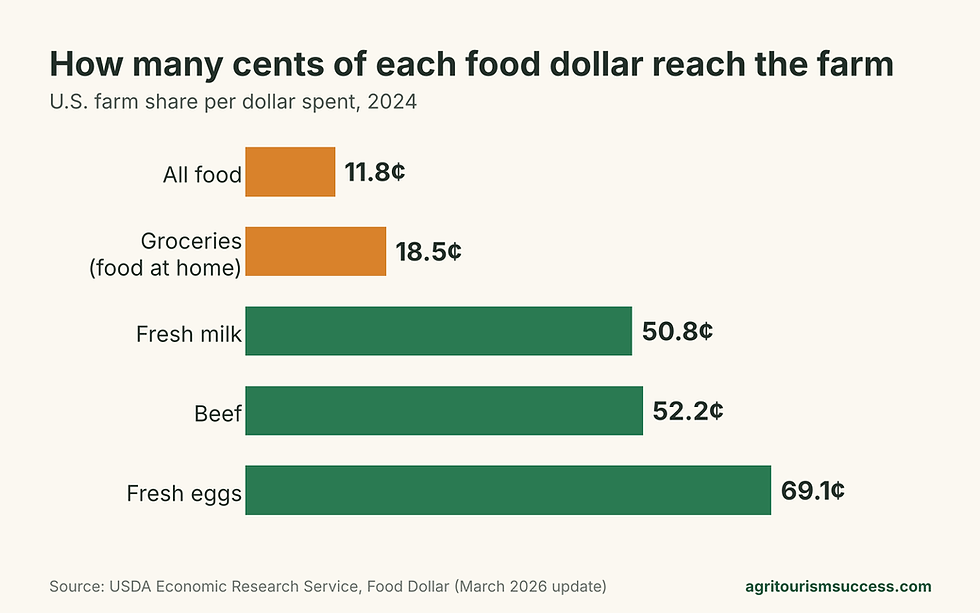
Look at the right side of that chart. Fresh eggs returned 69.1 cents per dollar to the farm. Fresh milk returned 50.8 cents. The closer a product stays to the way it left the field, the more the farmer keeps.
Now take that one step further. When you sell the egg, the apple or the pumpkin yourself, there's no processor, trucker or supermarket between you and the customer. You keep the whole dollar, minus your own costs.
I covered the same squeeze from the other side in Crop Prices Falling? How Farms Are Using Agritourism to Fill the Gap. Rising prices and falling prices tell the same story: the price you're paid is set by someone else.
Why Families Drive Out to Farms When Food Gets Expensive
Families don't drive to a farm to save a few cents on carrots. They come for three reasons, and expensive food makes all three stronger.

1. Fresh food that feels like good value. Economists quoted by Action News Jax say buying locally grown produce at farms and farmers' markets can help families cut grocery costs. A Baltimore Sun report on farm stands this September said people come for rising costs and to know where their food comes from.
2. A day out that doesn't cost a fortune. USDA expects restaurant prices to rise about 3.5% this year, faster than grocery prices. Picking strawberries and eating them on a hay bale is a family outing and a food purchase in one.
3. The farm itself. A 2022 study by Harper Adams University for the Farm Retail Association found customers are drawn to farm shops by the quality of the food, the service and the farm setting. It counted about 1,581 farm retailers in Britain selling £1.4 billion a year, and 89% reported higher sales since 2019.
This has happened before. Emma Mosey, then chair of the Farm Retail Association, said in 2025 that during the high inflation of the 1970s, many British farmers moved into pick-your-own and farm-gate sales.
The Retail Price Gap, in Real Numbers
Here's what the same crop earns two different ways.
Crop | What the grower was paid | What families paid at the farm | Gap |
Apples | About 66¢ a pound (U.S. fresh-market grower price, July 2024) | $38 a peck (roughly 10 pounds), about $3.60 to $3.80 a pound, pick-your-own at Applecrest Farm Orchards, NH (2026) | About 5.5 to 5.8 times |
Pumpkins | About 20¢ a pound (U.S. average grower price, 2024, all uses) | 50¢ to 95¢ a pound, pick-your-own in MD, NJ and OR (2026) | 2.6 to 4.8 times |

Applecrest's owner, Peter Wagner, once had nearly 90% of his business in wholesale. By 2014, 80% came from retail. You can read how he did it in my Applecrest Farm Orchards case study.
Plenty of farms already do this. The 2022 U.S. Census of Agriculture counted 116,617 farms selling directly to consumers, with $3.3 billion in sales, up 16% from 2017. That's about $28,000 a farm on average. My roundup of agritourism statistics has more of the numbers.
5 Ways to Capture the Retail Price This Season

1. Open a Farm Shop or Roadside Stand

Start with a table, an honesty box or a small shed by the road. Price off what your nearest farmers' market charges, and treat the supermarket as your floor, not your target. See How to Set Up a Farm Stand to Attract Visitors.
2. Let Families Pick Their Own
Your customers do the harvesting, carry the crop and pay for the fun of it. Read Creating a Pick-Your-Own Experience and How to Start a Pumpkin Patch for the numbers.
3. Sell Farm Boxes or a Prepaid Farm Card
Applecrest's MarketShare lets members prepay into a house account and adds a 5% bonus on $200, rising to 20% on $800. The farm gets cash before the season. The family gets a bonus on what they spend, and a balance that keeps them shopping at the farm.
4. Host Harvest Days

A named weekend turns a crop into an event: apple day, sweet corn day, the first frost. Give families a reason to come on a set date. My guide to organizing a farm harvest festival shows how.
5. Turn Surplus Into Value-Added Products
Jam, cider, baked goods and dried fruit sell at a premium and last longer than fresh produce. Start with How to Sell Preserves, Jams and Jellies and Creating Unique Farm Products to Boost Revenue.
Field-Tested Play: Run the One-Crop Test Choose your best crop. Write down what a buyer paid you per pound or per kilo last season. Then sell one small batch direct this month, at your gate or as pick-your-own, and write down that price too. The difference is your retail gap, and the next step is to widen it with upsells and experience pricing. |
What Selling Durians Direct Taught Me
My own farm, Bloopy Durians in Bentong, Malaysia, welcomes visitors from all over the world. Our durian seasons are short, about four to five months a year across two windows.
The most reliable income we have isn't a single big sale. It's our WhatsApp list of loyal customers who buy whenever durians are available. We message them, and they come.
That's the hidden prize of selling direct. A wholesaler buys your crop once. A direct customer can buy from you every season, and tell friends.
Reality Check Selling direct isn't free money. You take on staff time, card fees, signs, parking, waste and customer service. If fuel costs are squeezing you too, my article on diesel prices and ticket pricing shows how one farm repriced without losing visitors. |
Questions to Ask Before You Sell Direct
This isn't legal advice. Rules change from state to state and country to country, so ask these questions before your first sale.
Your county or council: Do I need a permit or zoning approval for a farm stand, parking or signs? See farm stand permits.
Your health department: Which foods can I sell without a licensed kitchen? My guide to selling food on your farm lists the common permits.
Your weights and measures office: If I sell by weight, does my scale need to be legal for trade?
Your accountant: Do I need to collect sales tax on produce, prepared food or admission?
Your insurance agent: Does my farm policy cover visitors on my land and the food I sell? Get the answer in writing. Start with what agritourism insurance covers.
What to Watch on November 6
The FAO publishes its October figure on November 6, 2026. If prices keep climbing, food costs will stay in the news through the holidays.
That gives you a timely message for your customers: fresh, local and priced fairly, straight from the farm. Late autumn is also a smart time to launch holiday farm boxes or a prepaid card for next season.
Frequently Asked Questions
What is the FAO Food Price Index?
It's a monthly measure of world prices for a basket of traded food commodities: cereals, vegetable oils, meat, dairy and sugar. The UN's Food and Agriculture Organization publishes it in Rome.
Why did world food prices rise in September 2026?
Mostly cereals, vegetable oils and sugar. FAO linked the rise to disrupted Black Sea shipping, dry weather, lower U.S. corn yields, fewer exports from Brazil and fuel, fertilizer and freight concerns around the Strait of Hormuz.
How much of the food dollar does a farmer get?
In the U.S., 11.8 cents of each dollar spent on domestically produced food in 2024, and 18.5 cents for groceries, according to USDA. Less processed foods return more: 69.1 cents for fresh eggs.
Is selling direct to consumers more profitable than wholesale?
Often, per pound. Apples that earned U.S. growers about 66 cents a pound in 2024 sell for about $3.60 to $3.80 a pound as pick-your-own at one New Hampshire orchard. But direct sales add labor, permits and insurance costs, so test small first.
What's the easiest way for a farm to start selling direct?
A simple farm stand or one pick-your-own weekend using a crop you already grow. Check permits and insurance first, then grow from there.
When is the next FAO Food Price Index release?
November 6, 2026, followed by December 4, 2026.
Find Out Which Direct-Sales Idea Fits Your Farm
Not every farm should open a shop, and not every crop suits pick-your-own. The Farm Readiness Quiz takes a few minutes and shows you what your farm is ready for and what to fix first.
Then grab my free ebook, 150 Ways to Unlock Hidden Wealth From Your Farm. It lists 150 ways to earn more from the land and equipment you already own, with the difficulty, a possible price setup and the earning potential for each.
P.S. Wesley Wells can't set the price his brokers pay. On his 25 acres of pick-your-own, families pay the farm's price. Which part of your farm could you take back this season? Take the free quiz and find out.
Written by Stephen Loke of AgritourismSuccess.com, whose farm is featured in Bloomberg News and Asahi Shimbun. Figures come from the public sources listed below and may change. This article is general information, not legal, tax, insurance or financial advice.
Sources
Fastmarkets: FAO Food Price Index rises in September (October 2026)
World Grain: FAO Food Price Index up 6% year on year (October 2026)
Dairy News: FAO index reaches highest level since November 2022
Bernama: Global food prices hit four-year high in September (October 2026)
Action News Jax: From farm to table, rising food prices amid a global conflict (April 2026)
American Farm Bureau Federation: Farmers receive less than 6 cents of the food dollar
Syngenta Canada market news: farm share of eggs, beef and milk (2024 data)
Grocery Trade News: UK food inflation 1.3% in September 2026
Baltimore Sun: Farm stands tap into nostalgia as demand for local food grows (September 2026)
Shropshire Star: Shoppers flock to farm retailers as sales hit £1.4bn
Shropshire Star: Pressures could spur resurgence of farm shops (February 2025)
Washingtonian: Pick your own pumpkins at farms near DC (2026)


Comments