



Tilted Barn Brewery Case Study: How a Rhode Island Christmas Tree Family Grew From a 2-Barrel Kit to 1,000 Barrels a Year in Their Own Barn


In the mid-2000s, Kara Richardson gave Matt, her future husband, a present. It was a basic homebrew kit.
Matt was no hardcore hobbyist. He was an environmental consultant who later went to work for the U.S. Department of Agriculture. He told Good Beer Hunting he was never "one of those crazy set-up homebrewers."
But that small box led to one of Rhode Island's most praised farm brewery stories. It happened on a Christmas tree farm in Exeter, Rhode Island, that Kara's grandparents bought in 1954.
So can a farm start a brewery small, without millions of dollars and without a city location? Yes. The Richardsons opened Tilted Barn Brewery in November 2014 on a used 2-barrel system that "cost every penny they had." By 2018 they were making about 1,000 barrels of beer a year. In 2019, every drop was still sold at the farm.
The Short Answer: Yes, a farm brewery can start small. Tilted Barn Brewery opened on a used 2-barrel system, kept its early hours short, kept both owners' day jobs until 2016, and grew to about 1,000 barrels a year by 2018. A 2016 report said they had no outside investors. The catch: licences, zoning and money rules are different in every state, province and country. You must check yours first. |

If you have an old barn, a crop you can brew with and people nearby who like a cold beer on a Saturday, this case study is for you.
Below are the real timeline, the numbers, the paperwork questions and 12 lessons you can use whether you ever brew a drop or not.
Who Are the Richardsons Behind Tilted Barn Brewery?
Kara Richardson grew up on her parents' farm, just down the road. Matt grew up in Warwick, Rhode Island. They met in 2000 while working in the greenhouse at Schartner Farms, another farm in Exeter.
They married in 2007. Soon after, they moved onto Kara's grandparents' farm to help when her grandmother fell ill. In 2011 they bought the property from her.
Kara's grandparents had used the land to grow Christmas trees. The Boston Globe reported the property at 30 acres.
In 2013, Kara was a middle-school teacher and Matt worked for the USDA. Young children, full-time jobs and a farm. Sound familiar?
Here is the part I want you to notice. Matt told the Boston Globe in 2021:
"We never wrote a formal business plan."
They were not rich investors. They were a farm family with a barn, a hobby and a lot of grit. Kara put it this way: "I've learned about hard work through farming."
The Tilted Barn Timeline: From Christmas Trees to 1,000 Barrels
Here is how a Christmas tree farm became a farm brewery, step by step.

Year | What happened | What it tells you |
|---|---|---|
1954 | Kara's grandparents buy the farm and grow Christmas trees | The land was a working farm long before beer |
Mid-2000s | Kara gives Matt a basic homebrew kit | The skill started as a cheap hobby |
2007 | Matt and Kara's brother Joel start growing hops as Ocean State Hops | A farm crop came first, then the brewery |
2011 | Matt and Kara buy the farm from Kara's grandmother | Ownership, then the plan |
2013 | Indiegogo campaign raises $6,365 from 94 donors | Small money, big proof of local interest |
Nov 2014 | Tilted Barn Brewery opens on a 2-barrel system | They started tiny |
2015 | $20,000 state LASA grant to improve the barn brewery and expand hops | Free money with a duty attached |
2016 | Upgrade to a 7-barrel system | The first step up |
Around 2016 to 2017 | Their own canning line and custom labels | Cans brought bigger crowds |
2018 | About 1,000 barrels a year | The headline milestone |
Nov 2020 | New post-and-beam barn with a 30-barrel brewhouse opens | The next chapter |
May 2025 | Exeter Town Council votes 5-0 to back new "Farm Café" rules | They keep pushing the rules forward |
Note the 2018 line. That is the year Good Beer Hunting reported about 1,000 barrels. That is the milestone in the headline. No later barrel figures have been published, so I won't guess them.
The Growth Staircase: Small Kit, Then More Beer
The thing that hits me about this story is the order. They did not buy the big kit first and hope the crowds came. They bought small, filled it, then bought bigger.

A quick word on units. A "2-barrel system" makes about 2 barrels per batch, and a US barrel is 31 gallons. The 1,000 barrels is everything they made in 2018.
For their first few years, they made about 250 to 300 barrels a year. Then in 2018, about 1,000. That is three to four times more beer, on a Christmas tree farm.
12 Lessons From Tilted Barn Brewery for Your Farm
Swap "beer" for cider, jam, flowers or farm tours, and most of these still work.
Lesson No. 1: Start With What You Can Afford, Not What Impresses People
The Richardsons bought a 2-barrel brewhouse with 2-barrel fermenters from a brewery that had recently closed. Good Beer Hunting said it "cost every penny they had."
They had no outside investors and not a lot of debt, according to Yankee Brew News in 2016. Matt said: "We only have to answer to ourselves."
When a bank or investor owns part of your venture, they own part of your decisions too.
Field-Tested Play: Write down the smallest version of your idea that could take a paying customer this year. Price used equipment first. Closed businesses sell good gear cheaply, and every dollar you don't borrow is a dollar of freedom. |
Lesson No. 2: Keep the Day Job Until the New Income Pays
Both Matt and Kara kept full-time jobs until 2016, the Boston Globe reported. Matt only left the USDA once brewery sales could support him full-time.
That is about two years of running a brewery on top of full-time jobs. Tiring, yes. It is also how you avoid losing the farm.
Field-Tested Play: Set a clear "quit number." For example: "When the new venture has covered my salary for six months in a row, I'll cut back my off-farm hours." Until then, the off-farm job is your safety net and your bank. |
Lesson No. 3: Use the Barn and Land You Already Have
Back in 2013, Matt told Patch: "We have the equipment, we have the barn … we have the space."
A city brewery pays rent. A farm family already has the building, the parking field, the view and the story.
Even in 2019, their production and taproom space was only about 500 square feet, including the upstairs loft.
If you have an old building doing nothing, read my guide on what to do with an old barn. And before any visitor sets foot inside, check whether your barn is legal for visitors under building codes.
Field-Tested Play: Walk your farm with a notebook. List every building, field and view. Next to each, write one way paying visitors could use it. The cheapest square foot is the one you already own. |
Lesson No. 4: Grow a Crop That Gets You in the Door, but Don't Bank on It
In 2007, Matt and Kara's brother Joel started growing hops as Ocean State Hops. They sold to homebrewers and local breweries. The 2013 Indiegogo campaign called it "Rhode Island's first commercial hop farm."
Matt said in 2013: "Growing the hops has really gotten us in the door." But the hops did not make them rich. Matt told the Globe the hop farm "all told we maybe lost a couple thousand dollars." He also said: "It was a lot of work for not really a lot of return." And to Good Beer Hunting: "They're kind of a pain in the ass."
Reality Check: Hops sell cheap in bulk. The USDA's December 2025 hop report put the average US price at about $5.38 a pound. A University of Vermont Extension budget for Northeast growers assumed a price of $15 a pound. A small farm's hops earn their money in its own beer and its own story, not on the commodity market. |
Field-Tested Play: If you grow a "brewer's crop" like hops, barley or fruit, treat it as marketing and an ingredient for your own products first. Count it as a door-opener, not your main income. |
Lesson No. 5: Put the Farm in Every Glass
The Richardsons made a wheat beer called Spruced with spruce tips from their own Christmas trees. They made Jack, a roasted pumpkin beer, with farm pumpkins. They brewed with maple sap. Matt even captured and isolated wild yeast on the farm.
Matt told So Rhode Island that almost every beer would "have some aspect of the farm in it."
A city brewery can copy your recipe. It can't copy your trees.

And it paid off. Spruced won Gold for American Pale Wheat at the 2025 Untappd Community Awards for Rhode Island. Hop Culture reported in June 2025 that Tilted Barn won 20 medals at the latest Untappd Community Awards, the second-most in the state.
If you grow Christmas trees, this is gold. Trees take 7 to 10 years to grow, Rutgers says, and a tree farm earns mostly in a short holiday window. My guides on Christmas on the farm and choose-and-cut Christmas tree prices show how to make that window pay more. Tilted Barn shows how the same trees can earn in spring, when the tips are picked.
Field-Tested Play: List every crop and by-product on your farm: tips, peels, honey, herbs, fruit seconds. Ask, "Could this go into a product with my farm's name on it?" |
Lesson No. 6: Sell at the Farm First, Because That Is Where the Margin Is
In 2019, Good Beer Hunting reported that Tilted Barn's beer was sold only at the farm. That was not an accident. Selling direct is where the money is.
The Brewers Association's Financial Benchmarking Survey (2023 data, reported by Brewbound) found beer sold direct to consumers brought in about $1,276 a barrel. Beer sold through distributors brought in about $602 a barrel.

That is about twice as much for every barrel you pour yourself, before you count merchandise and event tickets.

Today (November 2026) their beer is sold in restaurants, bars and liquor stores all over Rhode Island, and their website says it also goes to Maine, Vermont, Massachusetts and New York, and "periodically" to Virginia and overseas. But they built the base at the farm first.
Field-Tested Play: Make your farm the first and best place to buy your product. Sell wholesale later, once the farm customers are steady. My guide to upsells that double your agritourism revenue shows how to raise what each visitor spends. |
Lesson No. 7: Open Few Hours, Then Add More When People Ask
In December 2015, Motif reported the hours were Saturday 1 to 4 pm. That's it. Three hours a week.
By April 2019, Matt told Rhode Island Monthly they were "only open on Fridays from 12 to 8 p.m." and on Saturdays from 1 to 4 pm.
Today (November 2026) the taproom is open Wednesday to Sunday, with up to 19 beers on draft, food trucks and live music.
Short hours let the family keep their jobs and made each opening feel like an event. Yankee Brew News reported that at their first annual celebration they had to turn people away within half an hour of opening.
Field-Tested Play: Start with one or two fixed open days a week and stick to them. Scarcity builds crowds. Add hours only when you are turning people away. |
Lesson No. 8: If the Rule Doesn't Exist, Help Write It
Good Beer Hunting says the couple overcame zoning hurdles and "drafted Exeter's first ordinance to allow farm breweries." Yankee Brew News said they worked "with the town of Exeter to create a Farm Brewery ordinance." Dave Witham of Proclamation Ale Company in Warwick supported them through the process.
Exeter's zoning ordinance defines a "Farm Brewery." Here is the definition as quoted at the Planning Board in October 2024 (the Town Council approved changes to the farm definitions in May 2025, so check the current text):
It must be on a farm of no less than five acres.
It must use at least one primary ingredient (hops or grain) grown on the farm.
Production is capped at 150,000 gallons a year.
It is allowed by right in certain rural zones. Tilted Barn is in one of them.
Reality Check: Rhode Island has no separate farm-brewery licence in state law. Bills to create one were introduced several times, including in 2013, 2014, 2019 and 2022, and none became law. Exeter Planning Board minutes from October 2024 record that Tilted Barn has a manufacturer's licence, the ordinary Rhode Island brewery licence. "Farm Brewery" in Exeter is a local zoning definition, not a state licence. Licences and zoning vary hugely from place to place. |
Field-Tested Play: Before you spend a dollar, book a friendly meeting with your town planner. Ask: "Is there a definition for what I want to do?" If not, ask how a farmer can propose one. Bring a mentor who has done it, and talk to your neighbors before the hearing, not after. |
Lesson No. 9: Take Small Money That Comes With Strings You Can Live With
In 2013 the Richardsons ran an Indiegogo campaign. The Brown Daily Herald reported it raised $6,365 from 94 donors. Not a lot of money, but 94 people paid before a single pint was poured. That is proof.
Then, in 2015, Rhode Island's Department of Environmental Management awarded Tilted Barn a $20,000 Local Agriculture and Seafood Act (LASA) grant to improve the barn brewery and expand hop production. The deal: they had to host a workshop at hop harvest for Rhode Island farmers who wanted to supply craft brewers or start a farm brewery.
LASA grants go up to $20,000 with no match required. The 2026 round gave $450,000 to 25 recipients.
For bigger projects, the USDA Value-Added Producer Grant is worth a look. For FY2026, the caps were $50,000 for planning grants and $200,000 for working capital, with a 1:1 match. That round has closed, so check the current one.
Field-Tested Play: Look up your state's small farm grants this week. Start with my agritourism grants by state list and my guide to the USDA Value-Added Producer Grant. Small grants with no match are often easier to win than big ones. |
Lesson No. 10: Make It a Family Team, With Clear Jobs
In 2019, Good Beer Hunting listed who did what. Matt ran brewing and production. Kara scheduled taproom staff and did the label artwork and merchandise. Then the family and friends:
Stew: packaging and pouring
Judy (Kara's mother): labelling and babysitting
Gary (Matt's father): weekend traffic
Amanda (Matt's sister): social media
Joel (Kara's brother): weekend bar
Erica Vigneau (Kara's cousin): label design
In August 2018 a hired brewer, Cobi LaBine, joined from Springdale (Jack's Abby Brewing). In 2019, Good Beer Hunting said the brewery still relied heavily on family and friends.
Labour is one of the biggest costs in any farm business. A family team with clear roles keeps it low while you find your feet.
Field-Tested Play: Write a one-page "who does what" sheet for open days: parking, greeting, selling, cleaning, social media. Give each job one name. Then plan your first paid hire for the job that drains you most. |
Lesson No. 11: Grow in Steps, and Know What Each Step Costs You
The Richardsons went from 2 barrels to 7 barrels in 2016. Around 2016 to 2017 they bought their own canning line. Canning brought crowds. Matt told the Globe: "It was scary."
Then, at their five-year anniversary in November 2019, they announced a new post-and-beam barn with a 30-barrel brewhouse. It opened in November 2020, during the pandemic, on a hill overlooking the Christmas trees and the original tilted barn. The brewery's blog said it "chose to keep our new brewery on our farm rather than look elsewhere."
Reality Check: In 2019, Matt said: "Not too big—just big enough." The brewery then got much bigger than that, with a new barn, a 30-barrel brewhouse and distributors in several states. Good Beer Hunting warned the most immediate risk of growth was losing their "homespun charm." Growth brings bigger crowds, bigger staff, bigger bills and bigger rules. Decide your own "big enough" before the crowds decide it for you. |
Field-Tested Play: Before each upgrade, write three numbers: what it costs, how much more you must sell to pay for it, and how many more hours a week it will take from your family. If any one of the three scares you, wait a season. |
Lesson No. 12: Protect Your Home, and Keep Asking the Town for the Next Step
Their house was about 75 feet from the original brewing operation, the Globe reported, so the new barn was partly about privacy. Matt said: "When you're home, you're home."
And they didn't stop growing the rules either. In May 2024, the Richardsons asked the Exeter Planning Board for a way to serve food. Under the rules, adding food would make them a "tavern," which was not allowed in their zone. They said guests leave around 5 to 6 pm to eat elsewhere, and food trucks are unreliable.
On 5 May 2025, the Exeter Town Council voted 5-0 to approve Planning Board recommendations, including a new "Farm Café" definition, with two edits, and put them on its July agenda for review. The minutes record Matt saying that allowing farm cafés is a benefit to farms and another outlet to sell their products. I could not confirm the final adoption or whether a café has opened yet.
Field-Tested Play: Draw a line on a map between "home" and "business." Keep visitors, parking and noise on the business side. Then list the one rule that stops your next step, and start that conversation with your town early. Food rules are a common one; see my guide to selling food on your farm. |
Reality Check: "We never wrote a formal business plan" worked for the Richardsons. Don't copy that part. The brewery market is tougher now. A simple plan helps you talk to banks, grant panels and town boards. Use my free agritourism business plan template. |
The Farm Brewery Money Table: What a Barrel Is Worth
Let's talk money, in plain numbers.
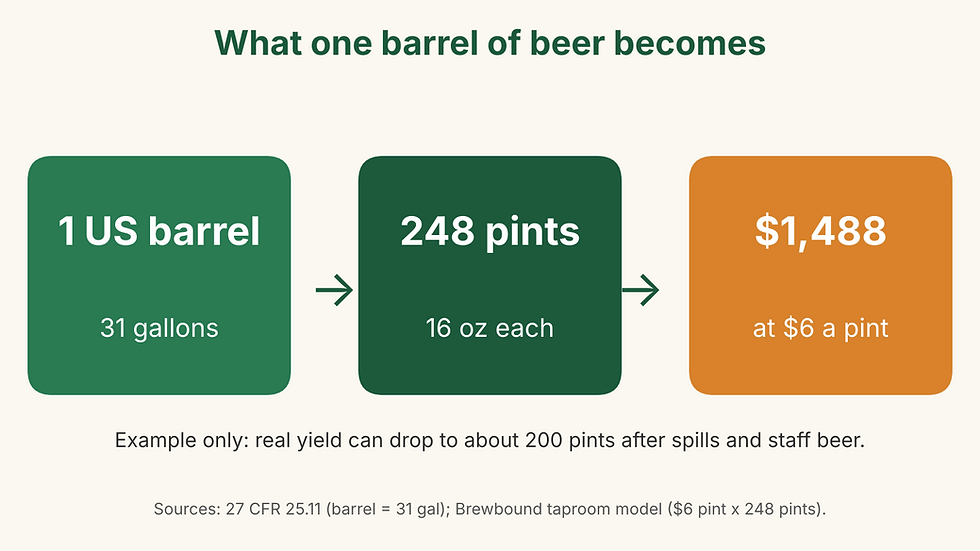
Figure | Number | Source and note |
|---|---|---|
One US barrel | 31 gallons, 248 pints of 16 oz | Federal definition (27 CFR 25.11); pints derived |
Real pints after spills and staff beer | About 200 | Brewbound taproom model |
Example value of one barrel at $6 a pint | $1,488 | Brewbound model, example only |
$1,276 per barrel | BA benchmarking, 2023 data | |
Average distributed revenue | $602 per barrel | BA benchmarking, 2023 data |
Taproom revenue benchmark | $1,300 to $1,500 per barrel | "SBS Benchmark" in BA Brewery Profit Workshop slides, 2026 |
Federal excise tax, small brewers | $3.50 per barrel on the first 60,000 | TTB; about $3,500 a year at 1,000 barrels (derived) |
Hypothetical profit, 300-barrel taproom | About $100,000 | Brewbound model, illustrative |
Hypothetical profit, 1,000-barrel taproom | About $300,000 | Brewbound model, illustrative |
Tilted Barn's accounts are private, so I won't guess their revenue. Their beer now also goes out through distributors, so no single per-barrel figure fits them. But here is what the sales channel means for any brewery. At the BA's 2023 averages, 1,000 barrels sold direct would bring in about $1.28 million, while 1,000 barrels sold through distributors would bring in about $600,000. That is a general illustration, not Tilted Barn's figure.
Compare that with the farm's original crop. In the 2022 Census of Agriculture, about 16,000 US Christmas tree farms shared $553 million in sales. A taproom can change the scale of what the same acres earn.
How Much Does a Nano Brewery Cost to Start?
Generic "how to start a brewery" guides talk about $500,000 to $1.5 million. That's a full commercial build-out. A farm starting small can look very different.

System size | Published range | What it includes | Source and date |
|---|---|---|---|
Nano, 1 to 3 barrels | $10,000 to $30,000 | Equipment budget | Micet Group guide, Jan 2024 |
1 to 3 barrels | $25,000 to $85,000 | Equipment, no building work; add 20 to 40% contingency | Yolong Brewtech guide, Sep 2025 |
3.5 barrels, new | $12,999 | Brewhouse only | BrewBids listing, 2026 |
7 barrels, turnkey | $85,000 | Fermenters, brite tanks, chiller, cleaning system | ProBrewer listing, 2025 to 2026 |
5 to 15 barrels | $60,000 to $100,000 | Equipment budget | Micet Group guide, Jan 2024 |
7 barrels plus taproom | $200,000 to $300,000 | Totals brewers reported (old figures) | ProBrewer forum, 2014 |
"Average" brewery | $500,000 to $1.5 million | Generic full build | Toast guide, Nov 2024 |
Reality Check: The kit is often the cheap part. The building work, power, water, drains, permits, insurance and working capital can cost more. One brewer told Brew Your Own: "You can never have enough working capital when you are starting up." Treat these as rough ranges, not quotes. Get real quotes for your farm. |
For a wider view of setup costs across farm ventures, see how much it costs to start an agritourism business.
The Hard Truth About the Brewery Market Right Now
Reality Check: According to the Brewers Association, 2025 saw 300 brewery openings and 481 closings. In 2024, closings (591) also beat openings (518), so 2025 was the second year in a row with more closings than openings. Craft beer production fell about 4%. The US ended 2025 with about 9,600 craft breweries. A new brewery today enters a crowded, shrinking market. |
But look closer and there is a bright spot for farms. In the BA's 2025 midyear report, half of breweries making under 1,000 barrels a year reported growth. Taprooms and brewpubs did slightly better than breweries focused on distribution.
Small, local, direct and memorable is holding up best. That describes a good farm brewery.
Agritourism in general is growing too. The 2022 Census of Agriculture counted $1.26 billion in US agritourism income, and the 28,617 farms reporting it averaged $44,004 each. For the bigger picture, read how much agritourism farms really make.
You're Not Alone: Other Farms That Started a Brewery
Tilted Barn is not a one-off. Here are four other farm breweries built on farm or family land.
Plan Bee Farm Brewery, New York. Founded in 2013 by Emily and Evan Watson on a small leased farm in Fishkill. In 2015 they bought a 25-acre farm in Poughkeepsie. They brew on a 10-barrel brewhouse in a renovated 1830s barn and make "100% New York-ingredient farmhouse ales."
Hill Farmstead Brewery, Vermont. Founded in 2010 by Shaun Hill on his family's ancestral land in Greensboro, where the Hill family arrived in 1791. It began in a "modest garage-style brewery atop the rise on Hill Road."
Scratch Brewing Company, Illinois. Opened in 2013 on co-founder Aaron Kleidon's family property, on a two-barrel brewhouse, using foraged ingredients. Co-founder Marika Josephson said: "We made a core decision to stay local."
Hogs Back Brewery, Tongham, Surrey, UK. Brewed its first beer in 1992 at Manor Farm in Tongham, in 18th-century barns. By 2003 it had 18 staff and made about 140 barrels (UK barrels) a week.
Different countries, different rules, same pattern.
What This Means for YOUR Farm
You may never brew beer. The Tilted Barn method still works for almost any farm product.
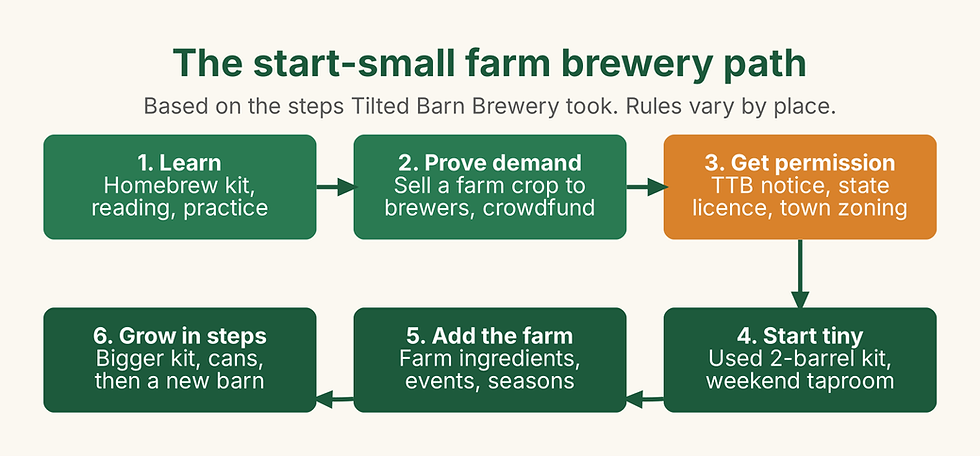
Learn cheaply. Prove demand with a crop, a crowdfund or pre-orders. Get permission before you spend. Start tiny, with used gear and family on the jobs. Put your crops, seasons and views into the product. Then grow only when demand forces you to.
If your farm is small, my research on farms under 10 acres shows small farms can grow visitor income too. For another Rhode Island success story, read my Hunt Club Farm case study.
What I Learned From My Own Farm, Bloopy Durians
I am the founder of Bloopy Durians, a durian farm in Bentong, Malaysia. Different crop, same lesson.
Our durian seasons are short, about 4 to 5 months a year, roughly December to February and June to August. Like the Richardsons' Christmas trees, one crop with one short season can only earn so much.
So we built an experience around the fruit. Visitors reach our farm on a four-wheel-drive adventure. We welcome visitors from all over the world. Many companies send their staff and management to the farm.
And we built a direct list. Our WhatsApp list of loyal customers buys durians whenever they are available.
That's the Tilted Barn lesson in another crop. The trees alone were limited. The trees plus an experience plus a direct relationship with customers made the farm pay.
Farm Brewery License, Zoning and Insurance: Questions to Ask
This is not legal advice. These are the questions to take to your licensing office, town planner, lawyer and insurance agent before you spend money.
Federal (US): The TTB Brewer's Notice
Have I filed for a Brewer's Notice with the TTB? There is no federal fee, and you can apply online.
How long will approval take? TTB statistics showed a median of 31 to 35 days for brewery applications from July to September 2026.
Do I need a bond, or am I exempt? Brewers expecting $50,000 or less in federal excise tax a year can be exempt.
State or Province: Which Licence Fits?
Farm brewery licences differ hugely. A few examples:
Place | Licence | Key farm rule |
|---|---|---|
New York | Farm Brewery licence | 60% New York-grown ingredients until 2029, then 90% |
Maryland | Class 8 Farm Brewery | At least one ingredient grown on the farm; up to 15,000 barrels (2015 guide) |
Virginia | Limited brewery on a farm | Up to 15,000 barrels; ingredients grown on the farm; land zoned agricultural |
Massachusetts | Farmer Brewery licence | Fees from $22 under 5,000 gallons |
Rhode Island | No farm-brewery licence | Tilted Barn has a manufacturer's licence (2024 town minutes) |
British Columbia | On Agricultural Land Reserve land | At least 50% farm product |
Questions to ask:
Does my state or province have a farm brewery licence, or only a standard brewery licence?
What share of my ingredients must I grow, and does that share rise over time?
How much can I sell on site per visitor per day? In Rhode Island, the manufacturer's licence sets daily sales limits.
Is server training required? Rhode Island's law requires it, along with liquor liability insurance.
In Ontario, much depends on local zoning; in 2019 one township treated breweries as industrial, so a hop grower could not brew on its farm without a rezoning. In the UK, ask about HMRC's Alcoholic Products Producer Approval, a council premises licence and Small Producer Relief on duty.
Local: Zoning and Building
Does my town's zoning code define a "farm brewery," the way Exeter's does?
What minimum acreage, ingredient and output rules come with it?
Is my barn legal for visitors? Fire exits, toilets, septic and parking all count.
If I want to serve food, does that turn me into a "tavern" or restaurant in my zone? That exact issue drove Tilted Barn's farm café request.
Insurance and Liability
Do I have liquor liability insurance, and does my farm policy cover a public taproom, events and parking?
Does my state's agritourism liability law cover alcohol at all, or only farm activities? Ask; don't assume.
For more on this, read my guides on agritourism laws by state and agritourism insurance.
Frequently Asked Questions About Starting a Farm Brewery
How did Tilted Barn Brewery start?
Matt and Kara Richardson started it on Kara's family Christmas tree farm in Exeter, Rhode Island. Matt learned on a basic homebrew kit, the family grew hops as Ocean State Hops from 2007, and they opened the brewery in November 2014 on a used 2-barrel system.
How big is Tilted Barn Brewery now?
They made about 1,000 barrels in 2018, the latest published figure. In November 2020 they opened a new post-and-beam barn with a 30-barrel brewhouse. Their beer is now sold in bars, restaurants and stores around Rhode Island and is also sent to other states.
Does Rhode Island have a farm brewery license?
No. Bills to create one were introduced several times but none became law. Town minutes from 2024 record that Tilted Barn has a manufacturer's licence, the ordinary Rhode Island brewery licence. The town of Exeter has a "Farm Brewery" definition in its zoning ordinance.
How much does a nano brewery cost?
Published ranges for 1 to 3 barrel equipment run from about $10,000 to $85,000. Building work, permits and working capital are extra and can cost more than the kit.
Do I have to grow my own hops to open a farm brewery?
It depends on your rules. Exeter's definition (as quoted in 2024) needs at least one primary ingredient grown on the farm. New York requires 60% New York-grown ingredients until 2029. Rhode Island's state licence has no such rule.
Is a farm brewery profitable?
It can be, but nothing is guaranteed. Taproom sales earn about twice as much per barrel as distributor sales, yet in 2025 more US breweries closed than opened.
Can I start a farm brewery if I'm in Canada or the UK?
Yes, but the rules differ. In British Columbia, breweries on Agricultural Land Reserve land must use at least 50% farm product. In the UK you need HMRC producer approval, and usually a premises licence from your council to sell on site.
Your Next Step: Plan Your First Season Before You Spend a Dollar
The Richardsons started when the craft beer market was growing. You don't have that luxury. You need a plan.
That's why I wrote The First-Season Profit Plan: How to Plan, Budget and Open Your Farm to Paying Visitors, Even If You've Never Hosted a Single Guest.
It is a 39-page workbook with 6 printable worksheets. It walks you through the four decisions that decide whether your first season makes money:
Scout your 40-mile market and choose your launch season.
Size and lay out your land for your busiest hour.
Budget year one and know your break-even number.
Put insurance, permits, parking, an emergency plan and a bad-weather policy in place.
Inside, you'll see two ways to open the same farm, a "Lean Launch" and a "Big Splash," with a $36,170 difference in year-one cost. That is the Richardsons' 2-barrel lesson, worked out on paper for your farm. You also get the 12-Week Countdown and the Opening Day Scorecard.
Whether your idea is a taproom, a Christmas tree experience or a farm tour, you plan it on paper before you risk real money. It's $37, an instant download, with a 30-day money-back guarantee.
Not sure your farm is ready? Take my free quiz to see where your farm is strong and where it needs work.
Want more ideas like the spruce-tip beer? Grab my free ebook of ways to earn more from the land, buildings and crops you already have.
P.S. Remember that basic homebrew kit Kara gave Matt? It was a small, basic gift. Nobody knew it would lead to a 30-barrel brewhouse in a new barn on a hill above the Christmas trees. Your farm's "homebrew kit" might already be sitting in your barn. The only question is whether you'll open the box.
Written by Stephen Loke of AgritourismSuccess.com, whose farm is featured in Bloomberg News and Asahi Shimbun. This article is for education only and is not legal, tax or financial advice. Check the rules in your own state, province or country before you start.
Sources
Good Beer Hunting, "Farm to Can — Tilted Barn Brewery in Exeter, RI", Kristen Foster, 8 May 2019
RI DEM, "2015 Local Agriculture and Seafood Act (LASA) Grant Recipients Announced", 29 May 2015
Boston Globe, "Tilted Barn Brewery is straight-up thriving in Exeter, R.I.", Gary Dzen, 22 Jun 2021
Brewbound, "Rhode Island Hop Farmers to Open Tilted Barn Brewery", 2013
Brown Daily Herald, "Hops farm transforms into R.I.'s first farm brewery", Oct 2014
Yankee Brew News, "A Family Affair At…", Larry Brown, 9 Feb 2016
So Rhode Island / RhodyBeat, "Crafting Holiday Cheer at Tilted Barn Brewery" (undated)
Rhode Island Monthly, "Hoppy Days are Here at Tilted Barn Brewery", 11 Apr 2019
Rhode Island Monthly, "Tilted Barn Brewery Plans to Grow with New Barn and Tasting Room", 7 Nov 2019
Hop Culture, "The 9 Best Breweries in Rhode Island", 10 Jun 2025
Brewers Association, Brewery Profit Workshop Part 2: Taproom Profit Principles, 2026
Brewbound, "Beer Business Finance: Breaking Down the Taproom-Focused Brewery Model"
TTB, Statistics: Original Applications to Operate, 19 Oct 2026
Farmtario, Ontario on-farm processing restriction, 15 Jul 2019
ProBrewer forum, realistic capital for a 5-7 bbl brewery and taproom, 2014
USDA NASS, 2022 Census, Rhode Island Table 40 (Christmas trees)
Craft Beer & Brewing, "Breakout Brewer: Scratch Brewing", 18 Jan 2016


Comments