



Agritourism and Taxes: Questions to Ask Your Accountant


Your farm can be full of smiling visitors on Sunday—and leave you scrambling for tax money on Monday.
The gate receipts look wonderful. The bookings arrive. You sell fruit, tours, lunch, a few souvenirs and perhaps a night in the farmhouse. Then the accountant asks a question you were not expecting: “What, exactly, did each customer pay for?”
That question can affect more than your tax return. It can affect your ticket price, your records, the money you must keep aside and whether your next investment makes financial sense.
The expensive mistake is assuming that everything happening on a farm receives the same tax treatment as farming.
Agritourism gives farmers a way to earn from what visitors experience, as well as what the land produces. But a farm tour, a wedding venue, a café and an overnight stay can raise different questions—even when they share one gate, one family and one bank account.
This guide gives you a practical agenda for a serious accountant meeting. You do not need to become a tax specialist. You need to know which questions to ask before a good season becomes a cash-flow surprise.
Scope and date: Researched on 15 October 2026. This is general educational information, not tax, legal, accounting or insurance advice. Tax treatment varies by country, state, province, municipality, entity, activity and tax year. U.S. and UK examples illustrate particular rules; they are not rules for every reader. Consult qualified local tax/accounting professionals and, where appropriate, a lawyer, property assessor and insurance adviser. Confirm current legislation, effective dates and filing requirements before acting. No tax savings or Google rankings are promised.
Start here: the five answers you need before your next busy season
Ask your accountant to help you answer five questions in writing:
What are we selling, and how is each income stream classified?
Which taxes must we charge, collect, report or pay—and when?
Which costs belong to farming, tourism, both activities or personal use?
How much cash should we reserve after each profitable month?
Which changes must we discuss before signing a contract or buying an asset?
Bring a sample ticket, booking confirmation, customer invoice, refund policy and settlement report. Those documents show the real business more clearly than the sentence “We do agritourism.”
The objective is not the biggest possible deduction. It is a profitable, well-documented business that can pay its bills, meet its obligations and keep welcoming visitors.
Why farmers cannot afford to treat visitor money casually
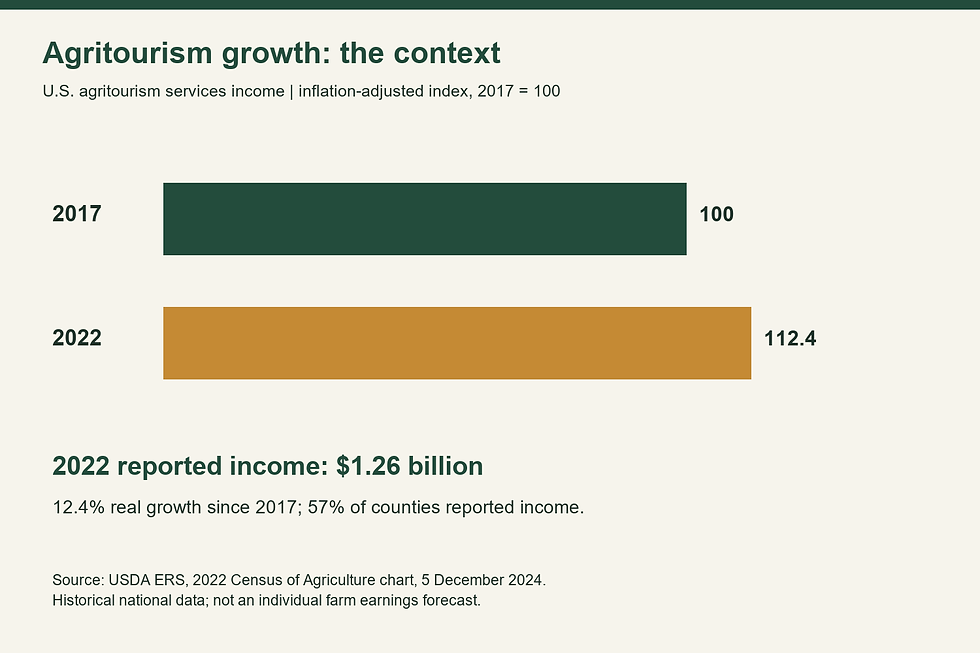
USDA’s Economic Research Service reports that U.S. farms and ranches generated $1.26 billion from agritourism services in 2022, up 12.4% from 2017 after adjusting for inflation. About 57% of U.S. counties reported agritourism income. This is a historical U.S. measure of agritourism services, not a forecast of what an individual farm will earn. Source: USDA ERS.
Growth creates opportunity. It also creates more transactions to classify, more staff to manage and more cash moving through booking platforms.
University of Vermont collaborators surveyed 1,834 U.S. farmers, ranchers and vineyard operators between November 2019 and February 2020. Their revenue and profitability brief reports that more than three-quarters of respondents had positive agritourism profits. It also records this observation from a Massachusetts cranberry farmer: “We have been very successful at increasing revenues; profits, however, are tough.” This was an online, pre-pandemic respondent sample, not a guarantee or a current census of every operator. Source: UVM revenue and profitability brief.
That farmer’s distinction deserves a place above your desk. Sales, profit, taxable income and available cash are different numbers. Your accountant should help you reconcile them.
UVM also reports a separate national agritourism research project completed in 2026, combining interviews and survey data. Its findings and focused briefs offer newer operational context; the older survey figures above are deliberately labeled with their collection dates. Neither project determines your tax liability. Source: UVM national agritourism study.
1. “Which parts of my agritourism business count as farming?”
Begin with activities, not labels. “Family farm” is a meaningful description of your business. It is not a complete tax analysis.
Make a revenue map containing everything customers can buy: your own produce, purchased produce, admission, guided tours, rides, food, accommodation, venue hire, workshops, merchandise and online products. Include income that arrives only a few times each year.
For each stream, record who supplies it, who owns the goods, who performs the service and which entity receives payment. Describe what customers actually get. A school visit could involve education, transport, food and produce; the details matter.
For U.S. readers, the IRS Farmer’s Tax Guide explains federal farming taxation, but it should not be treated as permission to put every visitor-business receipt into farm reporting. Ask your adviser which returns and schedules fit your activities and entity. Source: IRS Publication 225, 2025 edition.
A practical revenue classification sheet
Revenue stream | What to document | Question for your accountant |
Own-grown produce | Crop, quantity, sale location | How is production income reported? |
Bought-in goods | Supplier invoice, stock movement | Does resale need separate treatment? |
Tours and admission | Ticket terms, included activities | What income and consumption-tax rules apply? |
Café and tastings | Menu, service, alcohol if relevant | Are food and beverage rules different? |
Farm stays | Services, nights, platform reports | What income and lodging taxes apply? |
Venue hire | Contract, staffing, equipment | Is this rental, services or a combined supply? |
The sheet is an information-gathering tool, not a classification ruling.
Suppose you grow pumpkins and introduce an admission ticket that includes a maze and a pumpkin. The customer sees one autumn outing. Your accountant may need to examine several components, the applicable local rules and how the price is advertised. Do that work before printing 10,000 tickets.
Leave with: A written classification of every material revenue stream, including the assumptions that would change the answer.

2. “Where do we have tax obligations?”
Your farm’s location is the starting point. It may not be the only relevant location.
Tell your accountant where your land, buildings, operating entity and workers are located. Add any second venue, off-farm market, online shop and overseas sales. Explain whether a platform sells as principal, acts as agent or merely processes your payment; the contract should establish the answer.
Ask which national and local registrations apply to the actual activities. The list may include income or corporate tax, consumption taxes, payroll, property-related charges and lodging or tourism levies. Not every category applies everywhere.
A Malaysian farm should not use a U.S. sales-tax article to configure its checkout. A British operator should not import another country’s agricultural exemption. Even farms in neighboring districts can need different local advice.
Ask about reporting currency and foreign payment settlements if your visitors pay in different currencies. Keep the original transaction and conversion records. A small conversion difference repeated across a season can make reconciliation unnecessarily difficult.
Leave with: A jurisdiction-and-registration list, the responsible person for each filing and the next deadline. Have your adviser identify where a specialist opinion is needed.
3. “Must we charge sales tax, VAT, GST or another consumption tax?”
Do not ask only, “Are farms exempt?” Ask, “How is this specific product or service treated here?”
Fresh produce, prepared food, admission, rides, accommodation and merchandise may fall under different rules. Exemptions, registration thresholds and recoverability of tax on purchases also depend on the jurisdiction and facts.
New York illustrates why the detail matters: its tax bulletin explains that admission to places of amusement is generally subject to state and local sales taxes, with specified exemptions. The bulletin also discusses combined events and particular admission arrangements. That does not establish the treatment of every farm tour, and it is not a nationwide U.S. rule. Source: New York admission-charges bulletin.
The bundle question that belongs before the launch
Imagine a package containing entry, a tractor ride, a meal and a produce basket. Ask whether local law treats it as one supply or several, whether allocation is permitted or required, and what evidence supports the allocation.
Separate invoice lines can improve records. They do not automatically change the legal substance of a package. Do not invent a token price for the taxable component and assume the problem is solved.
Check the checkout itself. Is the advertised price inclusive of tax? Does the booking fee follow the same treatment? How are discounts, refunds, cancellations and complimentary tickets recorded? Who remits the tax if a platform is involved?
Request a product-by-product tax matrix that your bookkeeper can implement. Have the accountant review a test transaction and a refund, not merely the list of settings.
Leave with: A documented tax code for every item, the supporting authority and a process for reviewing changes.
4. “What does a tax-inclusive ticket really leave us?”
A full car park can hide a weak price. If you advertise a fixed consumer price and must account for consumption tax inside it, part of the receipt may already belong in your tax reserve.
Hypothetical illustration only: A farm collects $100,000 in tax-inclusive ticket receipts. Assume, solely for the calculation, that all receipts are taxable at 10%. Revenue excluding that tax is $100,000 ÷ 1.10 = $90,909.09. The tax component is $9,090.91. These are invented assumptions, not an applicable tax rate or a farm’s reported results.
Subtracting 10% from $100,000 would produce the wrong tax-exclusive figure in this example. The inclusive calculation divides by one plus the rate.
Now suppose cash operating costs are $60,000. The remaining amount before income tax, capital spending, debt principal and owner withdrawals is $30,909.09—not $40,000. That is a planning comparison, not a taxable-income calculation.
Ask your accountant to connect this calculation to your pricing model. What happens if the legal rate changes? What if some components are exempt? What if a platform commission is deducted before you receive payment?
Then ask the commercial question: “At this price, after the correct taxes and costs, are we earning enough for the work and risk?”
Leave with: A price model showing gross receipts, tax collected, net sales, variable costs and contribution per visitor. Decide how advertised prices will comply with local consumer rules.
5. “Which expenses can we deduct—and what proof do you need?”
Think in four groups: costs directly connected to tourism, costs directly connected to production, shared costs and personal costs. Give your accountant the facts needed to apply local deduction rules.
Typical discussion items include advertising, booking charges, visitor insurance, staff costs, cleaning, professional fees, repairs, utilities, training and supplies. This is a review list, not a promise that each item is deductible in full or immediately.
Keep the invoice, payment evidence and business purpose together. A payment shown on a bank statement may not explain what was purchased, which activity used it or whether part was personal.
The IRS recordkeeping guidance emphasizes supporting income, expenses and the basis of property. Its broader business-records publication also discusses separate records when a taxpayer operates more than one business. These U.S. resources are useful starting points for discussing an appropriate system with your own adviser. Sources: IRS recordkeeping and Publication 583.
Use a shared-cost method you can explain
Suppose a hypothetical $12,000 annual electricity bill covers irrigation, visitor facilities and the family home. Do not simply call all of it a tourism expense because tourists helped pay the bill.
Discuss submeter readings, equipment use, floor area or another evidence-based method appropriate to the cost. A reasonable method for building insurance may be unsuitable for tractor fuel. Record the method and review it when use changes.
Do not deduct the same shared bill twice across activities. Your management accounts should also make it clear whether an allocation transfers cost internally or creates an actual payment between separate entities.
Leave with: A receipts checklist, an allocation policy and a list of expenses requiring special substantiation or restriction checks.
6. “Is this a repair, a startup cost or a capital improvement?”
Replacing a broken latch and converting a barn into an event venue are different projects. Ask about the tax treatment before approving the work.
The accountant may need itemized quotations, contracts, photographs, invoices, the asset’s use and the date it becomes available for business. Ask which amounts are expenses, which must be capitalized and which rules govern recovery over time.
For U.S. businesses, IRS Publication 946 explains depreciation, including when property is placed in service and the conditions surrounding different deduction methods. Eligibility depends on the property, dates, use and other requirements; a generous headline allowance is not a blanket write-off for every farm building. Source: IRS Publication 946.
Do not buy a deduction you cannot afford
Here is a hypothetical commercial calculation: spend $50,000, assume the entire amount is currently deductible, and assume an effective marginal tax saving of 25%. The modeled tax reduction is $12,500. You have still spent a net $37,500 before considering financing, other taxes or future effects.
The example does not establish eligibility, timing or your tax rate. It shows why “tax deductible” does not mean “free.”
Ask your accountant to compare buying now, buying later, leasing and starting with a smaller asset. Include maintenance, interest, insurance and a quiet-season cash buffer. Where accelerated deductions are available, ask about future years and any consequences of sale or reduced business use.
Leave with: An asset register and a written investment comparison based on after-tax cash, not the size of the deduction alone.
7. “When do deposits, gift cards and advance bookings become taxable?”
Your booking calendar and your tax year do not necessarily move together.
A customer might pay in November for a March wedding. Another buys a gift voucher that is redeemed months later. A school cancels and receives a partial refund. A platform keeps your settlement on hold.
Ask how your accounting method and local tax rules treat each arrangement. Income recognition, consumption-tax timing and the accounting treatment of a customer obligation may not coincide. A refundable security deposit may require different analysis from a nonrefundable booking payment.
Keep contracts and policies consistent with actual practice. If you describe a payment as refundable but routinely retain it, explain that to the accountant. The label on the spreadsheet is not the whole transaction.
Build a deposit register showing booking reference, customer payment date, event date, refund terms, amount received, tax handled and the remaining obligation. Reconcile it to your booking system and bank.
Leave with: An agreed treatment for each payment type and instructions for cancellations, postponed events, voucher expiry and year-end balances. Never assume “we have not hosted them yet” automatically means “no tax is due yet.”
8. “Are seasonal staff employees or independent contractors?”
Harvest tourism often means hiring quickly. That makes the setup meeting more valuable, not less.
Describe the work: who sets hours, supplies tools, trains the worker, supervises the task and bears financial risk? Explain whether the person is greeting visitors, picking crops, cleaning accommodation or operating a ride. Give your accountant contracts and actual working arrangements.
For U.S. federal employment-tax purposes, IRS guidance looks at behavioral control, financial control and the type of relationship. Calling someone a contractor does not settle the issue. Other employment laws and jurisdictions may use different tests. Source: IRS worker-classification guidance.
Also discuss family workers, young people, casual helpers, tips, accommodation provided to staff and any genuine volunteer arrangement. Payment in cash does not make a working relationship disappear.
The IRS explains that employers have withholding, reporting and payment responsibilities and lists different employment-tax returns, including agricultural and general employer forms. Ask which rules apply when the same operation has farm-production and visitor-service work. Source: IRS employment-tax overview.
Leave with: A reviewed payroll process, worker records, filing calendar and instructions for mixed duties. Coordinate with a local employment adviser where tax classification and labor-law questions overlap.
9. “Could tourism change our land, property or agricultural relief position?”
Before you turn a paddock into permanent visitor parking, call the relevant professionals.
Ask whether the planned use affects agricultural assessment, property classification, local rates, exemptions, reliefs or a prior undertaking. Find out which authority decides and whether there are notification requirements or possible charges when use changes. Do not assume that a particular relief exists in your area.
Bring a site plan identifying production areas, visitor areas, accommodation, parking and shared buildings. Explain both current use and intended expansion. A planner’s permission, a tax classification and an insurance policy answer different questions.
A successful application in one system is not proof of success in the others. Ask your accountant to coordinate with the assessor or local authority and a lawyer when the consequences are material.
Consider succession too. If family ownership or transfer planning relies on agricultural or business relief, ask whether diversification changes the analysis. Do not wait until a sale, retirement, death or family dispute makes restructuring harder.
Leave with: A written list of property-related checks and responses from the authorities or advisers responsible. This is particularly important before borrowing against land or committing to a permanent conversion.
10. “Should farming and tourism operate in the same entity?”
There is no universal answer. The right discussion includes tax, liability, insurance, administration, ownership and finance.
Ask your accountant and lawyer to compare realistic structures. Include setup and annual costs, payroll, tax registrations, profit extraction, succession, asset ownership and the treatment of payments between related entities.
A separate tourism company may create additional contracts and accounting requirements. It does not automatically produce tax savings or eliminate personal exposure. A company name also does not make an uninsured activity insured.
If one entity owns the barn and another hosts events, document the arrangement. Who pays utilities and repairs? Who receives deposits? Who employs staff? Who carries the policy? Who is named in the customer contract? Your documents should tell the same story.
Give the insurance adviser a complete activity list, expected attendance and any transport, animals, food, alcohol or accommodation involved. Ask about suitable cover and exclusions. Tax deductibility of a premium and adequacy of coverage are separate judgments.
Leave with: A coordinated recommendation with total annual costs and responsibilities. Do not restructure solely because another farmer said their company “pays less tax.” Their facts may be completely different.
11. “Can we use losses, and how do we demonstrate a commercial business?”
Starting a visitor enterprise can involve substantial costs before bookings become reliable. That does not automatically determine whether a loss can reduce other income.
Ask about the applicable local rules for business status, loss restrictions, ownership, participation and carryforwards. Have the accountant explain what evidence matters and which limitations require a specialist review.
For U.S. readers, the IRS distinguishes a business from a hobby using the facts and circumstances, including businesslike conduct and efforts to improve profitability. A loss year alone does not answer the question. Nor does putting “business” in your social profile. Source: IRS hobby-versus-business guidance.
Build the commercial file as you operate: a budget, visitor targets, pricing decisions, marketing records, separate activity results and documented changes after poor performance. If rainy weekends repeatedly lose money, record the decision to shorten hours, require bookings or redesign the offer.
Those records are useful even when no tax authority asks for them. They help you decide whether the attraction deserves another season of your family’s time.
Leave with: A clear explanation of possible loss treatment and a practical evidence plan. Do not manufacture transactions or spend money simply to create a loss.
12. “How do we reconcile booking platforms, grants and insurance receipts?”
A platform settlement is a payment movement. It may not equal your gross sales.
Reconcile gross bookings, discounts, refunds, taxes, commissions, processing fees, withheld balances and bank deposits. Determine which party is responsible for each tax under the relevant law and agreement. Keep the platform’s transaction exports, not only screenshots of the final payout.
Do the same for cash sales. Record ticket counts, cash counted, refunds, authorized complimentary entries and deposits. A simple daily close signed by the responsible person can save hours of reconstruction later.
Tell your accountant about grants, crowdfunding, sponsorships, prizes, insurance proceeds, barter and complimentary visits exchanged for promotion. Do not assume that money described as support is tax-free, or that a noncash exchange requires no record.
Bring the grant agreement or insurance settlement letter. Ask whether there are restrictions, timing issues, effects on asset costs or separate reporting requirements. These are fact-specific questions; the article cannot classify a payment without its terms and jurisdiction.
Leave with: A monthly reconciliation template and a rule that unusual receipts go to the accountant before being coded. Your bookkeeper should know when to ask rather than guess.
13. “How much tax cash should we reserve?”
Do not choose a universal percentage from a social-media post. Ask your accountant to model your actual expected position.
Separate consumption tax collected, payroll-related obligations and income-tax estimates. Their calculation bases and deadlines differ. An income-tax reserve built from forecast profit does not replace money held for tax collected from customers.
For U.S. taxpayers, IRS estimated-tax guidance explains the pay-as-you-go system and notes special rules for farmers and fishermen. Growing visitor income is a reason to ask whether you still qualify for any farming-specific treatment; never assume last year’s payment calendar remains appropriate. Source: IRS estimated taxes.
Build a forecast that survives the off-season
Start with expected net sales and operating payments by month. Then show tax payments, loan principal, capital purchases, owner withdrawals and a minimum cash buffer separately. Distinguish depreciation from a cash purchase and interest from debt principal.
Run three visitor scenarios: expected attendance, weaker attendance and a weather-disrupted season. Ask whether you could still pay the next tax bill if two peak weekends disappear.
A reserve account can make discipline easier, but the transfer itself is not a deduction and the balance is not proof that the tax estimate is correct. Recalculate when profits, rates, investments or business activities change.
Leave with: Amounts, due dates, a transfer routine and named responsibility. Review the forecast during the season while there is still time to act.
Two real-world lessons—and one worked farm example
Lesson from a cranberry farmer: revenue is only the first scoreboard
The Massachusetts farmer quoted in the UVM brief described rising revenues alongside difficult profits. We do not know that farmer’s tax position and should not invent one. The useful lesson is operational: measure what remains after delivering the experience, rather than celebrating sales alone.
Ask for a monthly statement by activity. A popular event can use so much cleaning, staffing and advertising that it contributes less than a smaller guided tour. Management reports should make that visible before you expand the wrong offer.
Lesson from the UK: tax settings need effective dates
HMRC published a temporary 5% VAT measure for qualifying children’s meals and specified attraction admissions between 25 June and 1 September 2026. Its guidance includes farm visitor attractions, subject to the conditions and exclusions. As of this article’s research date, that stated window has ended. This is a dated UK example, not a current rate instruction for your farm. Source: HMRC temporary VAT guidance.
The lesson is to maintain a change log: authority, affected products, start date, end date, approved setting and test sale. A tax setting can be correct in one month and wrong later.
Hypothetical orchard: busy does not mean cash-rich
An invented orchard records $150,000 of sales excluding consumption taxes. Cash operating payments total $95,000, leaving $55,000 before the remaining items in this simplified example.
It buys equipment for $25,000 and repays $15,000 of loan principal. Only $15,000 remains before income-tax payments and owner withdrawals. The equipment’s tax treatment requires separate analysis; principal repayment should not be confused with a routine operating expense.
If the accountant models a hypothetical $12,000 income-tax payment, just $3,000 remains. This is arithmetic for cash planning, not a tax return, depreciation schedule or recommended reserve percentage.
The owner may feel that a profitable season produced almost no spare cash. The bridge explains why. Ask your accountant to build your own version using actual records, dates and tax rules.

Your accountant meeting pack: bring this, leave with that
Book a planning meeting before the season or major investment. Send the records ahead of time so you can spend the meeting making decisions.
Bring your prior returns, current accounts, bank and platform reports, sales by activity, contracts, employee details, asset register, loan statements, insurance schedule, grant documents and a site-use plan. Include a one-page description of proposed changes.
Also bring the awkward questions: cash that was never reconciled, expenses paid personally, a building used by the family, or a contractor whose role changed. Early disclosure gives the adviser a chance to address the facts.
Before leaving, ask for these deliverables:
A revenue and consumption-tax matrix, with uncertainty clearly marked.
A recordkeeping and shared-expense policy.
An asset and investment review.
A payroll and filing calendar.
A cash reserve forecast and review date.
A list of matters referred to a lawyer, assessor or insurance adviser.
Finally, ask: “What have I not told you that could change your answer?” Then describe your next season: a new café, evening events, school groups, glamping, alcohol service, an online shop or more seasonal workers.
The best accountant meeting does not end with a stack of forms. It ends with fewer unknowns and a clear person responsible for each next step.

A 30-day action plan for a better-controlled farm business
Week 1: Map the money. List every income stream and payment channel. Export a month of transactions. Mark anything that cannot be explained from the supporting documents.
Week 2: Separate and reconcile. Create useful activity codes, identify personal spending and reconcile bank deposits to sales. Do this with your bookkeeper so the process can continue after you return to the field.
Week 3: Meet and decide. Ask the questions in this guide. Agree on registrations, coding, allocations, payroll treatment, investment decisions and a payment calendar. Request written clarification where the answer is conditional.
Week 4: Test and monitor. Run a sale, refund and deposit through the system. Check the records and accounting treatment. Establish a monthly review and a trigger for contacting your adviser when activities change.
Keep the system proportional. A farm offering six appointment-only tours needs different administration from a year-round attraction with accommodation and a café. Both need records that explain the money.
Frequently asked questions about agritourism taxes
Is agritourism income automatically farm income?
No universal rule makes every receipt earned on farm land farming income. Your adviser must examine the activity, entity, jurisdiction and applicable tax definition. Map production, retail, experiences and accommodation separately before deciding how to report them.
Are farm tours and admissions exempt from sales tax or VAT?
There is no global exemption. Treatment depends on local law, the precise supply, exemptions and registration rules. Bundled food, produce, rides or lodging can require further analysis. Have an adviser approve your checkout treatment before selling.
Can I deduct every cost of opening my farm to visitors?
Do not assume so. Some costs may be personal, shared, restricted, capital or subject to timing rules. Keep evidence of business purpose and ask which costs qualify, how much qualifies and when relief is available.
Should I form a separate company for agritourism?
Ask an accountant and lawyer to compare total tax, administration, contracts, ownership, finance and liability implications. A separate company is not automatically the cheapest or safest option. Insurance must match the actual activities and entities.
How much should I set aside for tax?
Use an adviser’s forecast based on your expected profit, tax collected, payroll obligations, payment dates and other relevant circumstances. Revisit it during the season. A fixed percentage borrowed from another farm can leave you short.
When should I speak to my accountant?
Before launching a new activity, changing ticket packages, hiring staff, accepting major advance bookings, converting property or buying significant assets. Continue with scheduled reviews; waiting until the return is due limits your planning choices.
Your next step: protect the income you worked so hard to earn
Opening the gate is a business decision. Keeping useful records and asking better tax questions makes it a more informed one.
This week, list your revenue streams, collect one month of supporting records and book the planning meeting. Bring this article. Ask for the answers that apply to your farm, in your jurisdiction, for the relevant tax year.
For the commercial side of that preparation, use our agritourism business-plan guide. Then start with the free 21-Point Agritourism Blueprint on the Agritourism Success homepage.
Your accountant handles the tax analysis. Your job is to give them a clear picture of the business—and use their answers before the next big decision.
Remember: This guide is educational. Tax treatment varies by jurisdiction and circumstances. Obtain qualified local tax/accounting advice, and confirm current rules before acting.


Comments