



One Acre, $0 at the Gate and No. 1 of 83 Things to Do on a Tourist Island: How Phu Quoc Bee Farm Gets Paid (13 Lessons Western Farmers Can Use)

In the summer of 2023, beekeepers in Vietnam's Nghe An province were selling honey for 8,000 to 9,000 dong a kilo, roughly 35 US cents. A year earlier they had been paid about twice that. One beekeeper told Nong Nghiep newspaper that "a kilogram of honey cannot even be exchanged for a loaf of bread."
In the far southwest of the same country, on the island of Phu Quoc, a family with somewhere between 20 and 60 hives does something that looks completely backwards.
They charge nothing at the gate. Nothing for the guided tour. Nothing for the honey tasting. They refuse to pay tour companies a commission on what their groups buy.
And yet Phu Quoc Bee Farm sits at No. 1 of 83 things to do on Phu Quoc Island on Tripadvisor, ahead of cable cars, theme parks and beaches on an island that drew about 8.1 million visitors in 2025. On Google it holds 4.8 stars from 793 reviews. By 2021 it had already welcomed guests from 65 countries.
I host visitors on my own durian farm in Bentong, Malaysia, so I've learned to pay attention when a small farm beats the big attractions. This one does it on roughly one acre of garden.
So I went through everything I could find: the farm's own website and partner policy, its older website, Viet Nam News, Vietnamese food and travel reviews, dozens of Tripadvisor reviews, Vietnamese government tourism figures and USDA honey data. What came out is a playbook that Western farmers, from Iowa to Devon to Ontario, almost never use.
Give the experience away. Sell the memory.
Here are 13 lessons, translated so a farmer with 5 acres or 500 can put them to work this season.

What you will learn ✅ Why a free tour can earn more than a ticket booth, and when it can't ✅ How eight fixed tour times a day turn chaos into a system ✅ The tasting order that ends with a "wow" and a full basket ✅ How one jar of honey becomes a six-step product ladder ✅ Why this farm pays zero commission to tour operators, and still wins ✅ What all of this means for a farm in the United States, Europe or Canada |
Phu Quoc Bee Farm at a Glance
Fact | Detail |
Location | Hamlet 2 (Ap 2), Cua Can, in the north of Phu Quoc island, Vietnam. Since 2025 the address reads Phu Quoc Special Zone, An Giang Province |
Founded | Investment began in 2014; opened to visitors in May 2015 |
Owners | Co-founders Tran Anh Dung and Tran Quang Anh, run as a family business |
Size | About 4,000 square metres (roughly one acre) of tropical garden with a lake |
Bees | 20 to 60 hives depending on the weather, mostly Italian honey bees, plus an area kept for the island's local bees (2021) |
Price to visit | Free entry, free 15–20 minute guided tour, free honey tasting |
Tours | Eight a day, from 9:30 am to 4:30 pm, in English or Vietnamese. Closed on Wednesdays |
Ways to spend | Farm shop (honey, infused honey, honeycomb, beeswax goods, herbal tea, gift boxes) and the Bee Kitchen & Bee Bar café |
Reviews | 4.8 stars from 793 Google reviews; 4.8 on Tripadvisor and No. 1 of 83 things to do on Phu Quoc Island (October 2026) |
Giving | Part of daily revenue goes to three local charities, since June 2024 |
The Origin Story: Two Founders, a Forest Edge and a Stubborn Idea
Phu Quoc Bee Farm began in 2014, when co-founders Tran Anh Dung and Tran Quang Anh started investing in what their first website called the island's first ecological honey bee farm.
The location was no accident. The farm sits in Cua Can, in the buffer zone of the island's national forest, which is part of a UNESCO world biosphere reserve. Around it grow the plants bees love: melaleuca, eucalyptus, acacia and forest flowers, plus fruit trees such as rambutan, durian and longan.

In May 2015 the gate opened to the public, with no entrance fee. Viet Nam News visited in 2021 and described a simple garden built around a lake, with durian, mango, rambutan, avocado and jackfruit trees, and small signs teaching visitors about bee species, how a hive is built and even how to sort rubbish.
Tran Quang Anh told the paper the goal was to "combine eco-tourism and education through interesting stories on bees' role" in our environment.
Read that again. The founders didn't set out to sell honey. They set out to tell a story, and honey became the souvenir.
Here's a detail most farmers would miss. A visitor writing on the Vietnamese food site Foody.vn in 2017 reported that staff described the place as a farm that keeps bees, not one that raises bees mainly to harvest honey. When demand for bee products rises, Viet Nam News reported, the farm works with neighbouring farms to set up hives, rather than turning its own garden into an industrial apiary.

Insight Most farms start with a product and later try to bolt on visitors. Phu Quoc Bee Farm did the opposite: it started with a visitor experience and let the product follow. That order matters. When the experience comes first, the product carries a story, and a story is what lets you charge retail instead of wholesale. |
Why a Vietnamese Bee Farm Should Matter to a Farmer in Iowa, Devon or Ontario
You might be thinking: nice story, but my farm isn't on a tropical island.
Look closer at the economics, because the trap this family escaped is the same trap Western farmers live in.
The commodity trap is global. Vietnam's honey industry was built on exports. Vietstock reported in 2024 that about 90% of the country's honey was exported, most of it to the United States. Then the US hit Vietnamese honey with anti-dumping duties. Preliminary rates announced in late 2025 topped 400%; a later preliminary review brought most of them down to about 58–61%, and lower for some exporters, though the trade site Antidumping.vn stressed in May 2026 that these were still not final. Vietnamese honey exports to the US fell to $29.5 million in 2025, down more than 31%, and the site reports that exports now take just over 10% of the country's output. The 2023 Nong Nghiep report blamed exactly this kind of trade barrier for the price collapse in Nghe An.
American beekeepers feel a version of the same squeeze. In 2025, according to the USDA's National Agricultural Statistics Service, US honey production fell 14% to about 116 million pounds. Beekeepers who sold to co-ops and private buyers averaged $2.45 a pound. Those who sold retail, straight to the customer, averaged $7.15.

Same bees. Same flowers. Nearly three times the money per pound, just by selling direct.
Phu Quoc Bee Farm takes that one step further. It doesn't just sell honey direct. It sells the bees, the garden, the tasting and the story, gives most of it away free, and lets the shop and café do the earning.
And it isn't only an Asian idea. Slovenia, a small European country with about five beekeepers for every 1,000 people, the highest rate in the EU according to the Slovenian government, has built a whole tourism niche around bees. Rough Guides describes Slovenian apitourism trips with honey tastings, hands-on beekeeping camps, a museum of painted hive panels and even naps beside humming hives. Slovenia was also one of the first countries to certify apitourism providers, and it led the push for the United Nations' World Bee Day on May 20.
Farm visits are a proven business in the West too. US farms earned $1.26 billion from agritourism and recreation in 2022, up 12.4% from 2017 after inflation, according to the USDA's Economic Research Service. I unpack those numbers in my agritourism statistics report and in Is Agritourism Profitable?.
Reality check You don't need bees to use this playbook. Swap "honey" for apples, cheese, lavender, maple syrup, olive oil or durian. The question is the same: are you selling your crop by the truckload, or selling the experience of your farm and the crop as the souvenir? |
The Tourist Tide the Bee Farm Rides
Location still matters, so let's be honest about the tailwind.
Vietnam welcomed a record 21.2 million foreign visitors in 2025, up 20.4% on 2024, according to the Vietnamese government. On December 15, 2025, the country's 20-millionth foreign visitor of the year stepped off a plane at Phu Quoc International Airport, as Tuoi Tre reported. By mid-December, Bao Van Hoa estimated that Phu Quoc alone had drawn about 8.1 million visitors in 2025, nearly 1.8 million of them from abroad.


But plenty of farms on Phu Quoc sit in the same tide. Travel guides such as Vietjet's point visitors to several pepper farms and at least two other honey farms on the island, all chasing the same tourists. A good location gets you a chance. It doesn't get you to No. 1.
The lessons below explain what got this farm to No. 1.

The Free Front Door: How the Money Machine Works
Here's the whole business on one page. Notice what sits in the middle: a gate that costs nothing to walk through.

Picture a couple from Melbourne arriving by scooter at 10:25. At 10:30 a guide walks them to the hives and lets them hold a frame of bees. Fifteen minutes later they're tasting cinnamon honey, then pepper honey, then a spoon of honey with chili that makes them laugh out loud. They sit down for a honey kombucha and a plate of fried banana with cinnamon honey. On the way out they buy two jars, a beeswax wrap and a gift box for her mother.
Nobody paid to get in. Everybody paid.
Now let's take the machine apart, piece by piece.
13 Lessons Western Farmers Can Learn From Phu Quoc Bee Farm
Lesson 1: Give the Tour Away, and Sell Everything That Comes After It
The farm's website is blunt about money: "We DO NOT charge an entrance fee or tasting fee." The 15–20 minute guided tour is free. The honey tasting is described as a free gift.
That sounds like money left on the table. It isn't. A free tour removes the one decision that stops a tourist turning off the main road. Once they're inside, the farm has a shop full of gifts and a café full of drinks waiting for them.
Free also changes how people feel. One Tripadvisor reviewer from Stockholm noted that nobody pushed visitors to buy, and that relaxed feeling is exactly what makes people buy.
The same logic works in the West. New Hampshire's Applecrest Farm Orchards charges nothing for parking, entry or tractor rides, and earns its money from picking, donuts, ice cream and the farm market. I broke that down in the Applecrest case study.
Field-Tested Play: Try This on Your Farm List everything a visitor can do on your farm and mark each one free or paid. If you have fewer than three paid stations, keep your entry fee. If you have four or more, test one free-entry weekend and compare spend per car with a paid weekend. Read The Best Way to Set Entry Fees and Ticket Pricing and Upsells That Double Your Agritourism Revenue. |
Lesson 2: Run Your Tours Like a Bus Timetable
Most small farms run tours whenever someone shows up. That's how farmers burn out.
Phu Quoc Bee Farm runs eight fixed tours a day: 9:30 am, 10:30 am, 11:30 am, 12:30 pm, then 1:30, 2:30, 3:30 and 4:30 in the afternoon. The farm opens at 9 am, the last tour starts at 4:30 pm, and every Wednesday it closes.

That's 48 tour slots a week, each one short and predictable. The guide knows when to be at the hives. Visitors who arrive early have time to wander the garden or sit in the café. And the family gets one full day a week to breathe.
Short matters too. Tripadvisor lists the visit at less than an hour. Fifteen to twenty minutes with the bees is long enough to amaze people and short enough to leave them wanting the café.
Field-Tested Play: Try This on Your Farm Pick three to five fixed tour times a day and print them on your gate, website and Google profile. Keep each tour under 30 minutes. Choose one day a week to close, and protect it. See How Long Should Your Farm Tour Be? and The Farm Tour Formula. |
Lesson 3: Let Visitors Touch the Thing They Came to See
Watching bees through glass is a museum. Holding a frame of live bees is a story people tell for years.
At Phu Quoc Bee Farm, guides open the hives and let visitors interact with the bees and take photos up close. Recent Tripadvisor reviewers describe holding bees in their hands and watching the guide hunt through the frames to find the queen. A Foody.vn reviewer in 2017 wrote about being handed a honeycomb to hold for photos.

The safety rules are clear and posted: tell staff about pollen or bee-venom allergies, never enter the hive area without a guide, no sudden movements near the bees, and keep children supervised.
That's the balance every Western farm needs. Hands-on sells. Hands-on without rules gets you sued.
Field-Tested Play: Try This on Your Farm Find the one moment on your farm where a visitor can touch, hold or feed something: a frame of bees, a newborn lamb, a warm egg, a just-picked peach. Build your tour around that moment, then write simple safety rules and post them where people will read them. Read 10 Ways to Make Your Farm Tour More Interactive and Agritourism Warning Signs: Where to Post Them. |
Lesson 4: Turn the Tasting Into a Little Show With a Big Finish
Most farm tastings are a row of jars and a basket of plastic spoons. This one is staged like a meal.
After the tour, family members walk guests through a set order. First the pure honey. Then a run of infused honeys: cinnamon, ginger and turmeric for warmth, ginseng, kumquat, and Phu Quoc's famous pepper with garlic. The finale is Hot Honey, a bold mix of honey and chili that the farm promises will amaze you.

That order is clever. It starts familiar, builds curiosity and ends with a surprise people talk about. And because a family member tells the story behind each flavour, every spoon becomes a sales conversation without anyone selling.
Field-Tested Play: Try This on Your Farm Design a tasting of five to seven samples in a fixed order: start with your plainest product, move through two or three flavour twists and finish with something surprising. Have the person pouring tell one sentence of story for each sample. See How to Speak to Farm Visitors and Turn Them Into Raving, Paying Fans. |
Lesson 5: Build a Product Ladder, Not a Shelf
Look at the farm shop as a ladder, and you'll see how one jar becomes a basket.

At the bottom sits a small 95 ml jar of pure honey, an easy first buy. Then the 250 ml jar. Then the infused honeys, including cinnamon, ginger, garlic, Phu Quoc peppercorn and hot chili. Then a 500 g honeycomb. Then beeswax goods: a food wrap, a lemongrass candle, lip balm and honey soap. Alongside sit herbal tea, bee pollen and Vietnamese cinnamon powder. At the top is a "Taste of Vietnam" gift box with honey, Vietnamese Culi coffee, bamboo straws and a wooden honey dipper.
Every item is packed by hand, and each one carries a small wooden bee as a keepsake. That bee is a tiny thing. It's also the reason the jar ends up on a shelf in Seoul or Sydney instead of the bin.
Beeswax is the hidden gem here. It turns a by-product into lip balm, candles and wraps, and a Hanoi visitor told Viet Nam News he bought beeswax lip balm for his wife because he hadn't found it anywhere else.
The farm doesn't publish its prices online, and prices reported by visitors years ago are long out of date, so I won't guess at them. The structure is the lesson.
Field-Tested Play: Try This on Your Farm Lay out your shop in five or six steps: a small taster under $10, your classic size, two or three flavoured versions, a showpiece, a by-product line and a gift box at the top. Use your by-products. Add one small keepsake to every purchase. Read Creating Unique Farm Products to Boost Revenue, Creating a Farm Souvenir Shop and How to Sell Preserves, Jams and Jellies. |
Lesson 6: Put Your Crop on the Café Menu
The Bee Kitchen & Bee Bar turns honey into a reason to stay another hour.
The menu leans on the farm's own honey and herb garden. There's fresh passion fruit juice with honey, home-brewed honey kombucha (a best seller), Vietnamese coffee sweetened with honey and a passion fruit mojito made with Vietnamese rum. The signature dessert, Bánh Ong, is banana, sweet potato and baby corn fried with sesame and served with cinnamon honey. There's grilled pineapple with cinnamon honey, a herbal curry, herbal fried rice, spring rolls and fried breadfruit, with vegan and gluten-free choices marked.
Even the ice is a selling point: the farm says it makes its own cubes from purified water, a small detail that reassures nervous travellers.
Tripadvisor reviewers keep mentioning the kombucha, the curry and the smoothies. The café isn't a side business. It's where people sit, talk about the bees and decide what to buy.
Field-Tested Play: Try This on Your Farm Create three menu items that use your own crop: one drink, one snack and one dessert. Name one of them after your farm. Check your local food rules before you serve anything. Start with Selling Food on Your Farm: The Permits Each Option Needs. |
Lesson 7: Plant a Garden That Makes People Linger
After the hives, the tour moves through a tropical fruit garden and a herb sanctuary. The star is what the farm calls its Mint Collection: more than ten mint varieties that visitors can touch and smell, including cat mint, chocolate mint, sweet mint, Japanese mint and lemon mint.

It's cheap to plant, it smells wonderful, it feeds the bees, and it gives people something to photograph that nobody else on the island has. It also stretches the visit, and on a farm with a café and a shop, every extra ten minutes is money.
Field-Tested Play: Try This on Your Farm Plant a small "smell and touch" bed by your entrance or café: mints, lavender, lemon balm, basil, sunflowers or whatever thrives in your climate. Label every plant. Choose varieties your bees and butterflies love too. See Creating Wildlife-Friendly Habitats to Attract Visitors. |
Lesson 8: Make Green Packaging Part of the Brand
Phu Quoc Bee Farm doesn't just say it's eco-friendly. You can see it in your hand.
The farm says it keeps single-use plastic to a minimum: glass jars, bamboo straws and recycled paper packaging. Back in 2021 Tran Quang Anh told Viet Nam News the farm was already wrapping things in banana leaves and using cloth bags and paper boxes, and planned to develop cloth food wrappers coated in beeswax to replace plastic bags. Today a beeswax food wrap is on the shelf.

Notice the double win. The green choices protect the island the farm depends on, and they create new products to sell.
Field-Tested Play: Try This on Your Farm Swap one plastic item this season: paper bags instead of plastic, glass instead of plastic tubs, reusable cups in the café. Then turn one green idea into a product, such as a reusable tote with your logo or a beeswax wrap. Read How to Offer Low-Waste and Zero-Waste Agritourism Experiences and What Is Eco-Agritourism?. |
Lesson 9: Teach the Children, and the Parents Will Follow
The farm's website calls the garden an outdoor classroom, and the founders mean it. Tran Quang Anh told Viet Nam News that educating people, especially children, about protecting bees was the farm's most meaningful work. By 2021 it had hosted classes for more than 600 local pupils.

The message has teeth. In 2021 the farm was campaigning against buying wild-bee honey, because honey hunters had destroyed thousands of wild colonies, and it set aside space to protect the island's local bees.
The science gives you an easy lesson plan. More than 75% of the world's food crops depend at least in part on pollinators, according to the international science panel IPBES, and the crops pollinators affect are worth an estimated $235 billion to $577 billion a year.
The business case is just as strong. When Covid stopped foreign tourists, the farm lost its main customers almost overnight. One of its plans in 2021 was to design education tours with bilingual schools in big cities. Children who learn on your farm bring their parents back at the weekend.
Field-Tested Play: Try This on Your Farm Turn your best story into a 45-minute school program with one hands-on activity and one take-home item. Offer it to three local schools before the next term starts. Read The Exact Farm Experiences Schools Happily Pay For and Partnering With Schools for Educational Programs. |
Lesson 10: Refuse Kickbacks, and Say Why in Writing
In many tourist hotspots, drivers and guides expect a cut of whatever their passengers spend in the shops they stop at. Phu Quoc Bee Farm has a written policy that says no.
On its page for tour operators, the farm explains that it pays no commission on guests' shopping. It says the rule protects tourists, stops the practice of trading guests between companies and follows the local tourism code of conduct. Groups are still welcome, with free experiences, but they must book ahead and tell the farm their arrival time, group size and nationality so staff can prepare.
There's a cost, and the farm accepts it. One Tripadvisor reviewer in 2024 noted that because the farm pays no commission, tour operators won't take you there.
Yet the farm is No. 1 anyway, which tells you its visitors find it through reviews and word of mouth rather than through middlemen. And it gets to keep its prices honest and its customers trusting.
Field-Tested Play: Try This on Your Farm Write your partner policy on one page: what you offer tour operators, hotels and bus companies, what you don't pay, and what you need from them before arrival. Put it on your website. Fair, clear rules attract the partners you actually want. See How Your Farm Can Partner With Hotels, Resorts and Tour Companies. |
Lesson 11: Speak Your Visitors' Languages
Phu Quoc Bee Farm runs its tours in English and Vietnamese, takes bookings on WhatsApp in English and on Zalo, Vietnam's own messaging app, and offers its website in more than 100 languages through a language menu at the top of every page.
That's not decoration. By 2021 the farm had welcomed guests from 65 countries and territories. Vietnam's biggest sources of foreign visitors in 2025 were China, South Korea, Taiwan, the US and Japan.
You don't need 100 languages. But if bus tours from Quebec, or families from Germany, or students from China come through your area, a translated page and a messaging app they already use can win you the booking.
Field-Tested Play: Try This on Your Farm Check your Google profile and visitor book: where do your guests come from? Translate your welcome page, prices and safety rules into the top one or two languages, and add the messaging app those visitors use. Read Why International Tourists Love Farm Experiences and Simple Website Setup for Agritourism Farms. |
Lesson 12: Let Reviews Do the Selling
A farm that pays no commissions and runs no flashy ads needs another sales force. Phu Quoc Bee Farm's is its reviewers.
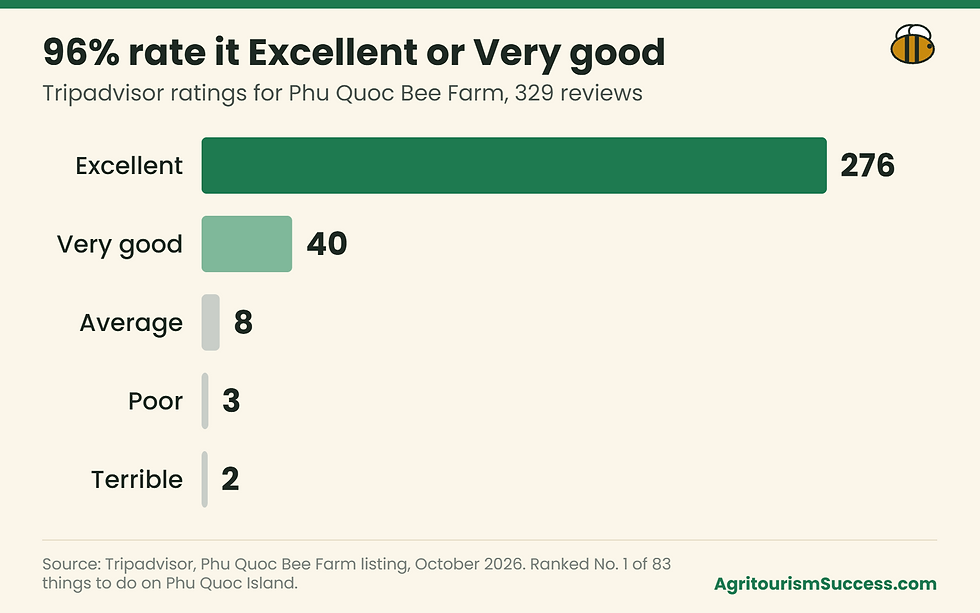
On Tripadvisor, 276 of 329 reviews rate the farm Excellent and another 40 rate it Very good. That's 96% in the top two boxes. One UK visitor called it "a little hidden gem not to be missed on a trip to Phu Quoc."
Read through the reviews and the same themes appear again and again: a warm family welcome (reviewers mention being welcomed by the father, son and daughter), the chance to hold bees, the free tour, fair prices and the kombucha. The farm's website shows its Tripadvisor award badge right at the top of the home page.
Field-Tested Play: Try This on Your Farm Ask for a review at the happiest moment of the visit, not at the till: right after the tasting, the hayride or the first bite of pie. Put a QR code there. Reply to every review, good or bad, within a week. See How Reviews Turn Small Farms Into Tourist Destinations, Getting Found on Google Maps and the word-of-mouth marketing study. |
Lesson 13: Give Back, and Let Visitors Share the Credit
Since June 2024, Phu Quoc Bee Farm has given part of its daily revenue to three local causes: a shelter for children in difficult circumstances, a nursing home that cares for poor elderly people over 70, and a humanitarian clinic offering free treatment in the Mekong Delta.
The website thanks every guest for turning a jar of honey or a glass of juice into a gift to those projects, and signs off with a bee pun about doing better together.
Visitors notice. A reviewer from the Netherlands wrote in late 2024 that the tour was free and that the family supports a local orphanage. Details like that end up in reviews, and reviews bring the next visitors.
Field-Tested Play: Try This on Your Farm Choose one local cause your customers care about: a school, a food bank, a hospice or a 4-H club. Give a set share of one product or one day's sales, tell people exactly how it works, and report the total each year. |
Where Phu Quoc Bee Farm Still Struggles (and What That Teaches You)
No case study is honest without the weak spots.
It's small. About one acre and a visit of under an hour. One reviewer in January 2026 said he wished it were bigger.
Getting there takes effort. A 2026 reviewer found the road in a bit bumpy, and an earlier one found the address a little hard to find.
Tourism can vanish overnight. When Covid closed borders, the farm lost the foreign tourists who were its main customers.
Small frictions show. A January 2026 reviewer noted a 3% surcharge on card payments, with cash preferred.
The facts online don't match. At least one travel site claims the farm has more than 1,000 hives. Viet Nam News reported 20 to 60 hives, mostly Italian honey bees, on 4,000 square metres.
That last one is a lesson for every farm. Customers and Google read what others write about you. Check your Google profile, your website and the big travel sites once a year and correct anything wrong.
Phu Quoc Bee Farm vs a Typical Western Farm Attraction
What many Western farm attractions do | What Phu Quoc Bee Farm does |
Charge at the gate, then hope people buy | Free gate, free tour, free tasting; the shop and café earn the money |
Tours on demand, whenever someone asks | Eight fixed tour times a day and one day closed each week |
Look, don't touch | Hold a frame of live bees, with clear safety rules |
A row of jars and spoons | A tasting with a set order and a hot-honey finale |
One product in one size | A six-step ladder from a 95 ml jar to a gift box |
Plastic bags at the till | Glass jars, bamboo straws, paper and beeswax wraps |
Pay commissions to bring groups in | Zero commission, written policy, booking required |
English only | Tours in two languages, a website in 100+ languages, WhatsApp and Zalo |
Charity as an afterthought | A share of daily revenue to three named local causes |
How to Apply the Phu Quoc Playbook on Your Farm
You don't need bees, an island or a million tourists. Here's how each big move translates.
What Phu Quoc Bee Farm did | Your farm's version |
Free 15–20 minute guided tour | A short free walk to your best spot, ending at your shop |
Fixed tour times | Three to five set times a day, printed everywhere |
Visitors hold live bees | One safe hands-on moment with your animals or crop |
Tasting with a hot-honey finale | A five-to-seven sample flight with a surprise at the end |
Six-step product ladder | Taster, classic, flavours, showpiece, by-products, gift box |
Honey kombucha and Bánh Ong | Three menu items made with your own crop |
Mint collection with 10+ varieties | A labelled smell-and-touch garden by the café |
600+ pupils taught | A 45-minute school program for local classes |
Zero-commission partner policy | A one-page partner policy on your website |
Part of daily revenue to charity | One local cause, with a yearly total you report |
Your 90-Day Phu Quoc-Style Launch Plan
Days 1 to 15: find your "bees". Pick the one thing on your farm visitors would most love to touch, taste or watch.
Days 16 to 30: design the free walk. A 15 to 30 minute route, three to five set times a day, ending at your shop or café.
Days 31 to 45: build the ladder. Five product steps from a small taster to a gift box, plus one keepsake.
Days 46 to 60: stage the tasting. Five to seven samples in a fixed order with a surprise finish.
Days 61 to 75: set your rules. Safety rules on signs, a one-page partner policy and one day off a week.
Days 76 to 90: switch on reviews. A QR code at the happiest moment, replies to every review and one local cause to support.
Frequently Asked Questions About Phu Quoc Bee Farm
Where is Phu Quoc Bee Farm?
In Hamlet 2 (Ap 2), Cua Can, in the north of Phu Quoc island in southern Vietnam. Since Vietnam's 2025 provincial changes, the farm's address reads Phu Quoc Special Zone, An Giang Province.
Is Phu Quoc Bee Farm free?
Yes. The farm charges no entrance fee and no tasting fee, and the 15–20 minute guided tour is free. Visitors pay only for what they buy in the farm shop or the café.
What are the opening hours of Phu Quoc Bee Farm?
According to its website, it opens daily from 9 am to 5 pm, with tours from 9:30 am and the last tour at 4:30 pm. It is closed on Wednesdays, and groups must book ahead.
Who owns Phu Quoc Bee Farm?
The farm's earlier website lists Tran Anh Dung and Tran Quang Anh as co-founders and owners. It began in 2014, opened to visitors in May 2015 and is run as a family business.
How many hives does Phu Quoc Bee Farm have?
Viet Nam News reported 20 to 60 hives in 2021, depending on the weather, mostly Italian honey bees, on about 4,000 square metres. A claim of more than 1,000 hives on at least one travel site doesn't match that report.
What can Western farmers learn from Phu Quoc Bee Farm?
Give a short, hands-on experience away free, run tours at fixed times, stage a tasting, build a product ladder, sell your crop in a café, teach school groups, refuse kickbacks and let reviews do the selling.
Your Next Step: Find Out Where Your Farm Stands
At one end of Vietnam, a kilo of honey couldn't buy a loaf of bread. At the other, a family with a few dozen hives gives its tours away and still out-ranks 82 other attractions on a tourist island.
Same country. Same bees. Different business.
Your farm has its own version of that choice. The hard part is knowing which pieces of the Phu Quoc playbook fit your land, your crop and your budget.
That's exactly why I built the Farm Readiness Quiz. In a few minutes it shows you which parts of your farm are ready for visitors and which ones to fix first, so you don't waste money building the wrong thing.
Then grab my free ebook, The 21-Point Agritourism Blueprint. It walks you through the checklist I use to plan, price and open a farm to paying visitors, step by step.
P.S. Remember the beekeeper whose kilo of honey couldn't buy a loaf of bread? Phu Quoc Bee Farm sells the same golden stuff with a story, a spoon and a wooden bee attached. Your farm has its own version of that gap. Take the free quiz now and find it.
Sources
Phu Quoc Bee Farm: official website (story, tour, tasting, menu, shop, community)
Viet Nam News: Farm offers fresh look at life of bees (March 26, 2021)
Antidumping.vn: The US reduces anti-dumping duties on Vietnamese honey (May 29, 2026)
Vietstock: Vietnam's honey is ready to make waves in the global market (May 2024)
USDA ERS: Agritourism income in the 2022 Census of Agriculture
Vietnam Government News: Foreign arrivals soar to record high in 2025 (January 6, 2026)
Tuoi Tre News: Vietnam welcomes 20-millionth foreign visitor of 2025 in Phu Quoc (December 16, 2025)
Bao Van Hoa: Phu Quoc, the island the world is flocking to (December 14, 2025, in Vietnamese)
IPBES assessment on pollinators, via Future Earth (February 26, 2016)
Vietjet: Ecotourism experience in Phu Quoc, pepper farms, bee farms and fishing villages
Visit Phu Quoc: Phu Quoc Bee Farm listing (example of conflicting hive figures)
Photo credits
Tour group at a bee farm in Ben Tre, Vietnam: Rudolph.A.Furtado, CC0, Wikimedia Commons
Pepper farm on Phu Quoc island (2015): Tonbi ko, CC BY-SA 4.0, Wikimedia Commons
Aerial view of Phu Quoc and its international airport (2025): Elmschrat, CC0, Wikimedia Commons
Beekeeper holding a frame of honey and bees: Ivan Radic, CC BY 2.0, Wikimedia Commons.jpg)
Raw honey for sale: Hanlu Cao, CC BY-SA 3.0, Wikimedia Commons.jpeg)
Beeswax wrap covering a bowl: Mw1234567, CC BY-SA 4.0, Wikimedia Commons
Variegated apple mint at Hardwick Hall herb garden: Victuallers, CC BY-SA 3.0, Wikimedia Commons
Disclaimer
This article is an independent case study written by AgritourismSuccess.com for educational and informational purposes only. All facts, figures, quotes and other details about Phu Quoc Bee Farm, its owners and its business were compiled from publicly available information, including the farm's own websites, news articles, government and university publications, travel sites and review platforms, as listed in the Sources section above. We have not independently verified this information, and it may be incomplete, inaccurate, out of date or changed since publication. Any opinions or interpretations are our own and do not represent the views of Phu Quoc Bee Farm or its owners.
AgritourismSuccess.com does not take any responsibility or accept any liability for errors or omissions in this information, or for any loss, damage or decision arising from reliance on it. This article is not sponsored by, endorsed by or affiliated with Phu Quoc Bee Farm or any business or person named in it, and all trademarks and brand names belong to their respective owners. Nothing here is financial, legal, tax or professional advice. Please check current details directly with the business concerned and seek qualified advice before making decisions for your own farm.
Photos are resized but otherwise unaltered. No photo in this article was taken at Phu Quoc Bee Farm; all are illustrative. Charts and diagrams by AgritourismSuccess.com.


Comments