The Cheapest Marketing Tool in Agritourism Isn't Online, and a New University Study Proves It

Here's a question that should keep every farm owner up at night.
What if the money you spend trying to be "seen" online isn't what's actually filling your farm?
Picture a small herb and seed farm tucked along a forested stretch of road near Alsea, Oregon. No billboard on a busy highway. No big-city foot traffic. A marketing budget that one of its owners describes as "super small."
By every rule of modern marketing, this farm should be invisible.
Instead, The Thyme Garden has turned its remote location into a destination. Visitors walk through the herb beds, taste meals seasoned with what grows there, and leave calling the place "magical and peaceful." Then they do the one thing no advertisement can buy.
They tell other people.
"Without letting people in, I don't know how we would make it," Bethany Glanville, who runs the farm with her sister Emily Stimac, told the agricultural newspaper Capital Press. "We're just so far out here and there are so many seed companies." Her sister put it even more plainly: "What agritourism has done for this company is made it into a viable business."
Now a new study from Oregon State University has put hard evidence behind what farms like The Thyme Garden have known for years. If you run an agritourism business, or you're thinking about starting one, what the researchers found should change where you put your next dollar and your next hour.
In this article, I'll show you what they discovered, why it matters, and exactly how to turn it into a simple system that fills your farm without a bigger ad budget.
Key Takeaways
Recommendations beat ads. Advice from friends, family and co-workers was by far the most common way visitors found the farms they visited, ahead of social media and online search.
Visitors want to learn. Education was the top reason people gave for why the public should visit farms, followed by knowing where their food comes from.
Food tips the decision. On-site food was a significant factor in which farm people chose.
The takeaway: a memorable experience does more for a farm than a bigger ad budget.
What the Oregon State University Study Actually Found
In 2025, Oregon State University surveyed nearly 500 people who visited 11 agritourism farms across Oregon. The goal was practical: understand how visitors think and spend, so growers could market themselves better.
The research team went in with an assumption most of us share. "We assumed that they learned about farms from Facebook or social media or doing online searches," Audrey Comerford, OSU's agritourism program coordinator, told Capital Press.
That's not what the data said.
"One of the more surprising things was that it's more from recommendations," Comerford said. "Word-of-mouth recommendation is still really top."
Here are the three findings every farm owner needs to understand:
Word of mouth wins. Advice from friends, family and co-workers was by far the most common way visitors found the farms they chose to visit, ahead of social media and online search.
Visitors come to learn. When asked why it's important for the public to visit farms, respondents ranked education first, followed by knowing where their food comes from.
Food tips the decision. On-site food was a significant factor in which farms people chose to visit, alongside locally grown products and family-friendly activities.
And the stakes are bigger than most people realize. In a separate OSU study of Oregon's Willamette Valley, farmers reported earning roughly half of their revenue from agritourism. When the researchers added up farm sales and visitor spending, they estimated direct sales of more than $985 million a year, supporting close to 11,000 jobs.

This isn't a side hustle. For many farms, visitors are the business. That makes "How do visitors find us?" the most important marketing question you will ever answer.
Does this apply if your farm isn't in Oregon?
It's a fair question. The survey covered 11 Oregon farms, and your market may look very different. But this finding isn't a one-off. Oregon State University's agritourism guidance for farmers notes that most studies show word of mouth is the most effective way to promote agritourism ventures, and it attaches an important warning: successful word of mouth depends entirely on customer satisfaction.
Whether you run a pumpkin patch in Ohio, a tea estate in Sri Lanka or a durian orchard in Malaysia, the human behavior underneath is the same. People trust people more than they trust ads. The details of your market will differ. The principle won't.
Why a Friend's Recommendation Beats Your Best Ad
Let me hit you with a hard truth.
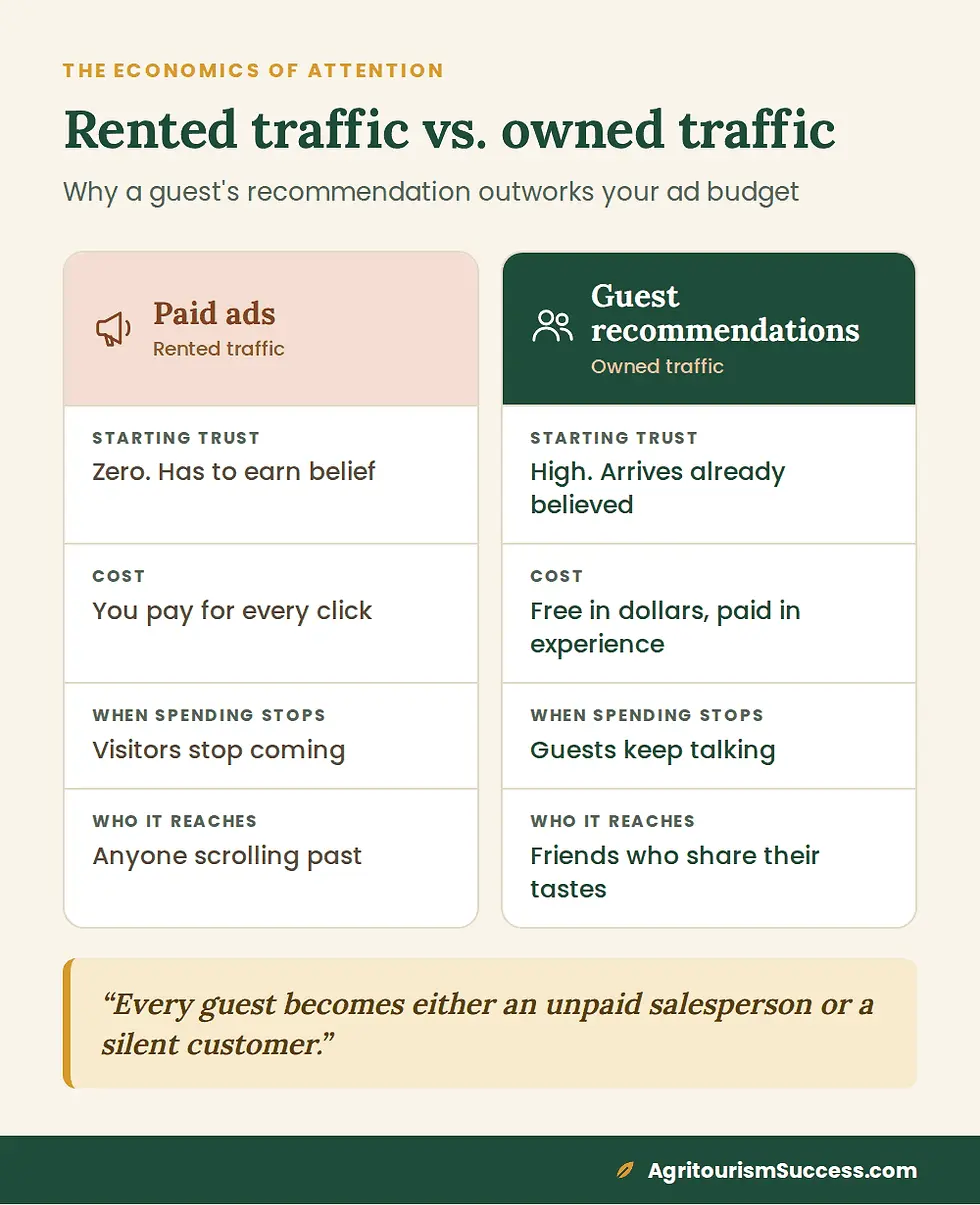
Every ad you run starts from zero trust. The person scrolling past your sponsored post doesn't know you, and they've been burned by glossy photos before. Your ad has to fight for belief, and most of the time it loses.
A recommendation from a friend arrives already believed.
When someone's sister says, "You have to take the kids to this farm. They let them feed the lambs, and the ice cream is made from their own cows' milk," most of the selling is done before your farm's name is ever typed into a search bar.
Then there's the math. Paid traffic is rented traffic. The moment you stop paying, the visitors stop coming. A delighted guest keeps selling for you, for free, for months or even years. And they sell to exactly the right people: friends and family who share their tastes.
That's why The Thyme Garden can survive on a tiny marketing budget. "We definitely depend on that and it's been really reliable just because it is so outstanding," Emily Stimac said.
But notice the catch hidden in her words: because it is so outstanding.
Word of mouth is free in dollars. It is not free in effort. You pay for it up front, in the quality of the experience you deliver.
Every guest who leaves your farm becomes either an unpaid salesperson or a silent customer. Which one is entirely up to you.
I see the same principle on my own durian farm in Malaysia, where we welcome visitors from all over the world each year. Being featured in Bloomberg News and Asahi Shimbun was an honor, but a news story has a short shelf life. A guest who goes home and tells their family about the durian they tasted straight from the tree keeps talking about it for years.
If you want to go deeper on building a farm that fills itself without paid ads, read my guide: The Zero-Ad Tourist Magnet: How to Pack Your Destination Year-Round Using Pure Organic Strategy.
The Catch: Word of Mouth Starts the Journey, Your Online Presence Finishes It
Before you delete your Instagram account, read this carefully.
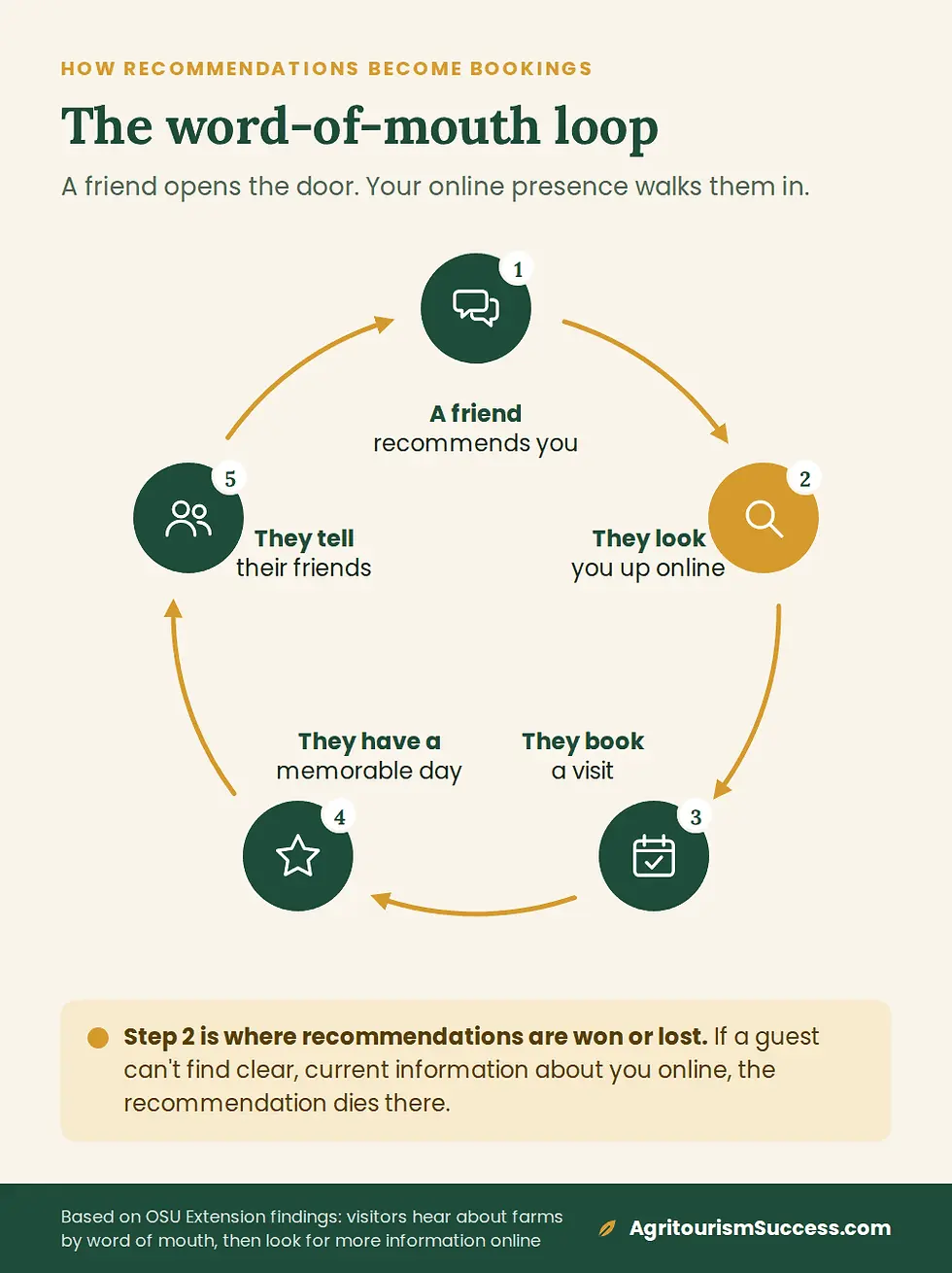
The OSU research doesn't say online marketing is useless. At the OSU Extension Service Small Farms Conference in February, the university's agritourism team explained that customers often discover farms through word of mouth from friends or family, but then want to follow them or find more information online.
Here's how that plays out in real life. A friend recommends your farm over dinner. The next morning, your future guest searches for your name. What do they find?
If they find an outdated website with no opening hours, a Facebook page that hasn't been updated since last season and a handful of old reviews, the recommendation dies right there. If they find clear information, recent photos, glowing reviews and an easy way to book, the recommendation turns into a visit.
The friend opens the door. Your online presence walks them through it.
Think of your website and social media as the closing tools that turn a recommendation into a booking. These two guides will help you get them right:
Simple Website Setup for Agritourism Farms shows you how to turn your site into a 24/7 salesperson instead of a dusty digital brochure.
Instagram for Agritourism: What Actually Works explains why authentic, behind-the-scenes content beats a perfectly curated feed.
Finding #1: Visitors Come to Learn, Not Just to Look
Here's the finding that should reshape your visitor experience. When OSU asked respondents why it's important for the public to visit farms, education came out on top, followed by knowing where their food comes from.
Your visitors aren't just looking for a pleasant day out. They're hungry to understand what you do.
Scottie Jones, who runs Leaping Lamb Farm near Alsea and offers tours and overnight stays, said the survey validated her belief that an agritourism venture must amount to more than a "petting zoo." Her approach balances education and entertainment. She explains how the farm operates, then lets guests enjoy it on their own terms, whether that means a picnic, a hike, exploring the nearby creek or simply hanging out with the animals.
"I'm making a connection for people," she said.
That connection is what gets talked about. Nobody goes home and tells their friends, "We saw some sheep." They say, "Did you know that...?"
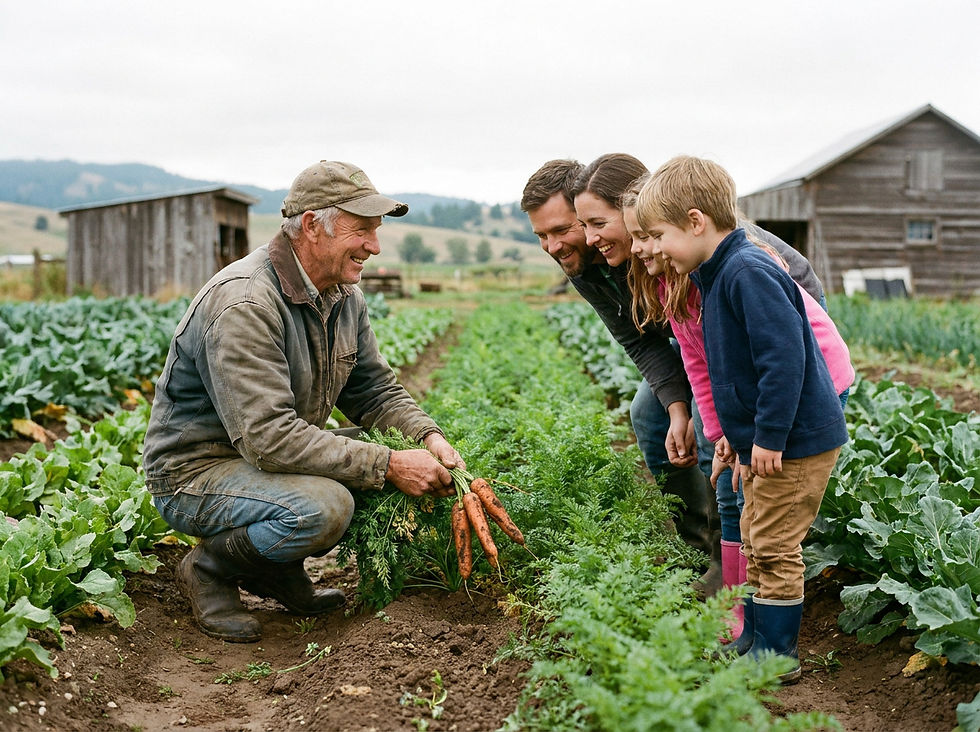
Education builds trust, too. At TMK Creamery near Canby, Oregon, visitors can walk from the creamery to the on-site dairy, pet the cows and ask how the farm is managed. Marc Koch, whose family runs the operation, said those conversations help visitors understand practices they were unsure about, and once the reasoning is explained, most visitors find that it makes sense.
"We want people to understand the process and to understand the end product," he said.
You don't need a big team to make this work. Comerford noted that farms teach in different ways. Smaller operations might talk with each guest personally, while others do a great job with educational signs, such as signs describing apple varieties, what each one is good for and when it comes into season.
Three ways to add education this weekend, without hiring anyone:
Put up "Did you know?" signs at your three busiest spots. One surprising fact per sign, short enough to read in ten seconds.
Run a 10-minute farm talk at fixed times, such as 11am and 2pm. Guests plan their visit around it, and you only deliver it twice a day.
Create a "question corner" near the animals or crops, where you or a family member answers questions. The questions guests ask will tell you what to put on your next sign.
For a deeper look at why this works, read Why People Will Travel Hours to Visit a Well-Run Farm.
Finding #2: Food Decides Which Farm Wins
Now for the finding that separates the busy farms from the empty ones.
OSU's survey found that on-site food was a significant consideration in which farms people chose to visit, alongside locally grown products and family-friendly activities.
Tessa Koch of TMK Creamery put it bluntly: "People need to eat and drink at these farms. It's hard to get foot traffic out unless you have that."
Her family's creamery serves cheese, ice cream and vodka made from the dairy's own milk, along with burgers made from beef raised on the family's cattle ranch. "We actually produce the booze on the farm. We actually produce the cheese and the ice cream and the beef right there," she said. "We're producing everything that we're trying to sell."

The sisters at The Thyme Garden made a point every farm owner should write down. Visitors don't necessarily want to buy a plant or carry something heavy home, Emily Stimac explained, "but they do have to eat pretty much every day. And so this is a great way for them to taste a really local flavor."
Her sister Bethany added: "When we think about traveling, eating something and actually ingesting it, I feel like that's a very memorable, usually pleasurable experience that gets people excited."
Memorable. Exciting. Those are exactly the feelings that fuel word of mouth.
Here's the key insight: the most powerful food experiences are tied directly to what you grow. A roadside café sells a sandwich. A farm serves something guests can't get anywhere else, made from the crops or animals they just walked past. That's what turns a meal into a story worth repeating.
It's the same principle I break down in Stop Selling Produce, Start Selling Immersion: The Sydney Oyster Farm Profit Strategy, where a dozen oysters that might sell for about $20 at a market command $200 or more as part of an on-farm experience.
A word of caution before you open a café. Comerford pointed out that on-farm food brings risk management, product insurance, health department rules and inspections into play, and in Oregon, food service on farmland has long been debated by regulators and lawmakers. Rules differ widely between countries, states and counties, so check with your local authorities before you serve anything. Start small, with something like a tasting of your own produce, and grow from there.
The Word-of-Mouth Engine: 5 Steps to Make Your Farm Worth Talking About
Knowing that word of mouth works is useless unless you can make it happen on purpose. Here's the five-step system I recommend. Think of it as an engine: each part feeds the next, and once it's running, it keeps bringing new guests with far less paid advertising.
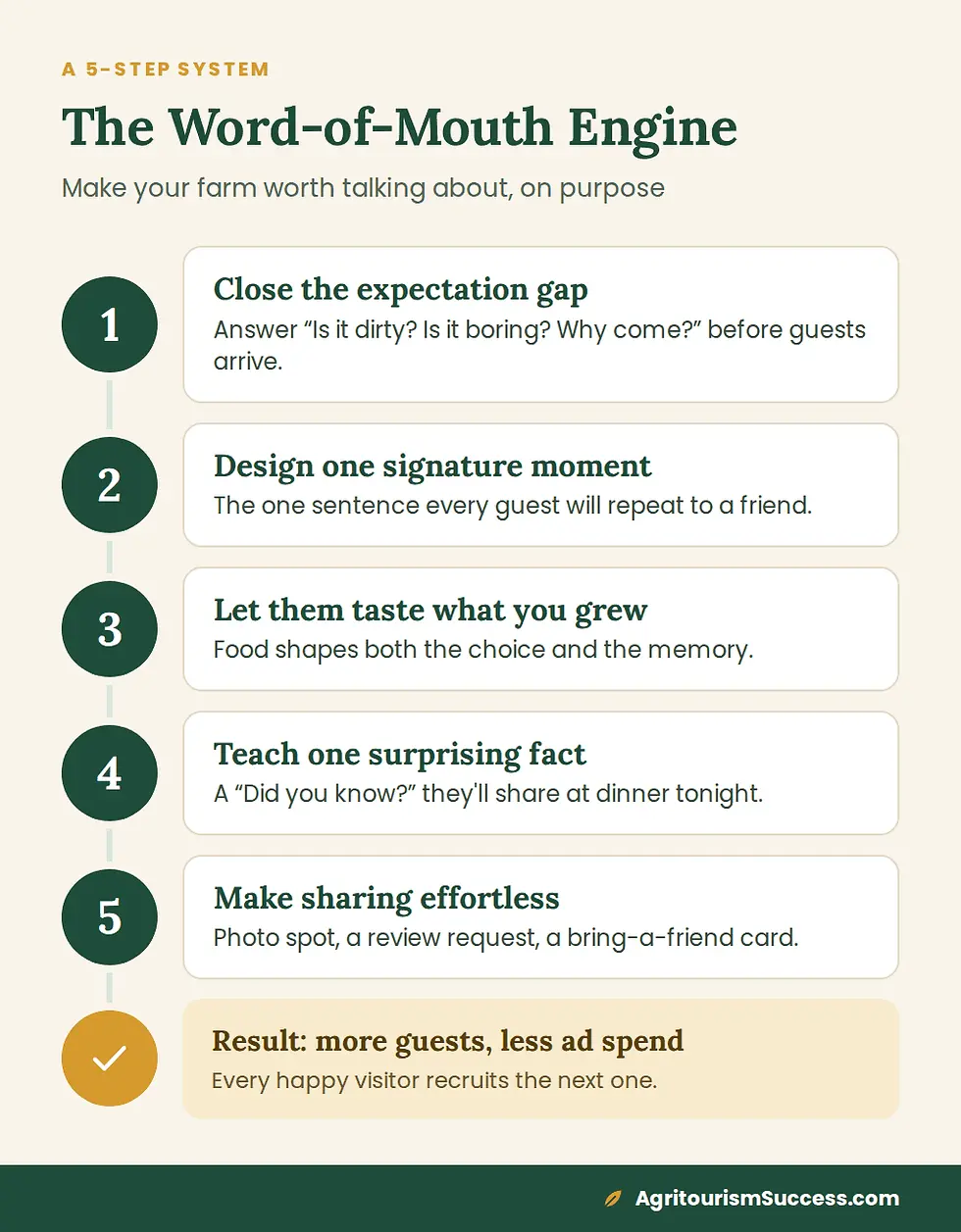
Step 1: Close the expectation gap before guests arrive
Scottie Jones described what first-time visitors from the suburbs and cities are often thinking: "Is it going to be dirty? Is it going to be boring? Why am I doing this?"
Answer those worries before guests arrive. Send a short pre-visit message covering what to wear, where to park, what they'll see and do, and what's on the menu. Include two or three real photos. A guest who arrives relaxed is a guest who is ready to be impressed.
What first-time visitors wonder | What your pre-visit message should cover |
"Is it going to be dirty?" | What to wear and bring, where to park, and where to wash hands. |
"Is it going to be boring?" | What they'll see, do and taste, with two or three real photos. |
"Why am I doing this?" | The signature moment waiting for them, and what they'll take home. |
Step 2: Design one signature moment
What is the one thing guests will describe to a friend in a single sentence? Feeding a newborn lamb. Picking fruit straight from the tree. Watching the milking. Build your visit around that moment and make sure every single guest experiences it.
If you can't name your signature moment in one sentence, your guests can't either.
Step 3: Let them taste something you grew
As the OSU findings show, food shapes both the choice and the memory. Even a simple tasting of your fruit, honey, cheese or tea, served where it was grown, gives guests a story to tell.
Step 4: Teach one surprising fact
Give every guest one "Did you know?" they'll repeat at dinner that night. When they repeat it, they're recommending you, whether they realize it or not.
Step 5: Make sharing effortless
Set up a photo spot with your farm's name in the frame. Ask happy guests for a review before they leave, while the experience is still fresh. Hand out a small "bring a friend" card with an offer for their next visit.
Reviews matter here because they're the online proof that backs up the recommendation. Learn how to collect them systematically in How Reviews Turn Small Farms into Tourist Destinations.

Why This Matters for Your Farm Right Now
Let's bring this home.
The research is clear. The people most likely to visit your farm next month are sitting across a dinner table from someone who visited this month. What your current guests say about you matters more than what your ads say about you.
That's good news, especially if you're just starting out. You don't need a huge budget to compete with bigger operations. You need an experience worth talking about, and a simple system that makes it easy for guests to talk about it.
A memorable experience does more for a farm than a bigger ad budget.
And you don't have to build a resort to start. You can test your first visitor experience in an afternoon, and I show you how in From Farm to Cash Flow: How to Test Agritourism With a 60-Minute MVP. If you're worried about cost, How to Launch an Agritourism Business Using Only the Infrastructure You Already Own shows you how to start with what's already on your land.
P.S. If your farm already offers a great experience but not enough people know about it, my guide From Invisible to Fully Booked walks you through turning happy guests into a steady stream of bookings. It's the fastest way to put this research to work on your farm.
Sources
Word-of-mouth still the top draw for agritourism, Mateusz Perkowski, Capital Press, September 28, 2026.
Oregon State experts: Online tactics help unlock agritourism success, Rogue Valley Times, February 2026.
An Initial Economic Impact Estimate of Agritourism in Oregon's Willamette Valley, Oregon State University Extension Service.
Agritourism's annual impact in the Willamette Valley nears $1 billion, Oregon State University Extension Service.
Agritourism, Oregon Sea Grant, Oregon State University.


Comments