



For Every Farmer Under 35, There Are Four Over 65. Who Will Run Your Farm When You Can't? A Farm Succession Plan That Gives Your Kids a Reason to Stay

Years ago, when three of his children wanted to come home, North Dakota rancher Jerry Doan told them a hard truth: "There's not income to support all of you."
His family had run cattle on that land since the 1880s. He wasn't pushing his kids away. He was telling them the ranch couldn't pay them.
The Doans didn't stop there. They built new businesses on the same land: a hunting outfitter, a guest lodge, an event barn, a craft brewery and direct sales of beef and bison. Three sons came home, and each one runs a piece of it.
So who will run your farm when you can't? On most farms, nobody has decided yet. The answer takes two things: a farm that can pay a second household, and a handover plan written down while you are still well enough to lead it.
The Short Answer In the United States, about 1.29 million farm producers are 65 or older and only about 0.30 million are under 35. That is more than four older farmers for every young one. Young people say the main reason they don't come back is the lack of a steady income. In 2024 the median U.S. farm household actually lost $1,830 from farming. So a plan on paper is not enough. The farm also needs a second paycheck that the next generation can own and run. Agritourism (farm stays, pick-your-own, events, tours) is one of the few ways to add one on land you already have. The families below did it, and the smart ones wrote the handover down. |

The Four-to-One Problem: How Old Are Farmers Now?
The U.S. Department of Agriculture's 2022 Census of Agriculture counted 1,293,993 farm producers aged 65 or older. It counted just 296,480 under the age of 35. Do the division and you get 4.36 older farmers for every young one.
Five years earlier, in 2017, the same ratio was 4.04. The gap is getting wider, not narrower.

The same Census shows the average U.S. producer is now 58.1 years old. Producers aged 65 and older grew 12.1% in five years, while the 35 to 64 age group shrank 9%. There are even more producers aged 75 or older (467,062) than under 35.
The land is about to change hands
Age matters because land follows people. USDA's newest farmland ownership survey, released in March 2026, found that about 43 million acres (just under 5% of farmland) are expected to be sold or gifted in the next five years. Another quarter, about 227 million acres, is set to pass by will or trust.
The average landlord who rents out farmland is 69.2 years old, and 52% have never farmed at all. Whether that land goes to a young farmer, a developer or an investor depends on the plans families make now.
It isn't only America
Farmers are getting older almost everywhere I look.
In England, 36.1% of principal farmers are 65 or older and only 6.8% are under 35, according to government figures released in September 2026. That is more than five older farmers for every young one.
In the European Union, only 5.6% of farm managers were under 35 in 2023. Japan's 2025 farm census counted 1.02 million core farmers, down 25.1% in just five years, with an average age of 67.6.

Reality Check: Age Is Not the Real Enemy Not every economist calls this a crisis. Carl Zulauf of Ohio State argues that older farmers are a natural result of how much capital farming takes. He has a point, and it sharpens mine. Your birthday is not the problem. The problem is who inherits your land, and whether the farm can pay a second household. |
If you are over 60 and worried that it is too late to start anything new, read Your Grey Hair Is a Selling Point: Why Visitors Will Pay to Learn From a 60-Year-Old Farmer. Your experience is exactly what visitors pay for.
Why the Kids Aren't Coming Home (It's Not Love. It's Money.)
Here is the part most farm parents don't want to hear.
A study of young adults from farm families found that 70% of farming parents expected their children to come back and take over. Only 54% of the young people said they would. The top reason they gave for not returning was the lack of a steady income.
That study is from 2017. The money problem has not gone away since.

The farm that is rich on paper and poor at the kitchen table
Look at what USDA's economists found for 2024. The median U.S. farm household earned $102,748 in total. But its income from farming itself was minus $1,830. Median off-farm income, from jobs, pensions and other sources, was $86,900.
In fact, 86% of family-farm households earn more than half their income off the farm. The farm doesn't pay the family. The family pays to keep the farm.
In 2023, the median family-farm household had about $1.4 million in wealth, compared with $200,662 for all U.S. households. That is the trap. The farm is worth a fortune, but it pays its owners almost nothing in cash.
Now picture your son or daughter at 28, wanting a house and children of their own. A farm that loses money can't pay them a salary, and they can't easily buy land either. U.S. cropland topped $6,000 an acre for the first time in 2026, and in a 2022 national survey, 59% of young farmers said finding affordable land to buy was very or extremely hard.
One English farm family said it plainly
Michael Hutchinson ran a 220-acre arable and beef farm in North Yorkshire. His daughter Katherine had written her university dissertation on farm shops. He told the Yorkshire Post that "the income from the farm business alone wasn't enough to get Katherine working here."
So they opened Roots Farm Shop and Cafe in 2008. By 2014 it had 50 staff on the books.
That is the pattern you will see again and again below. The children didn't need persuading to love the farm. They needed a job on it.
If falling crop prices are already squeezing your farm, read Crop Prices Falling? How Farms Are Using Agritourism to Fill the Gap.
The Second Paycheck: How Agritourism Gives the Next Generation a Reason to Stay
Let me be honest before I show you the stories. No study has proven that agritourism brings farm children home. I looked.
But the logic is strong. The main reason children give for not returning is income, and the main reason a farm can't take on a second household is income. Agritourism is one of the few ways to add a new business on land you already own, one that a son, daughter or son-in-law can build, run and eventually own.
A 2014 Nuffield Farming report on farm tourism put it simply: an agritourism business "can provide an opportunity for another family member to join the family business." It also found the key person in a farm's tourism venture was often a family member who loved people, not the farmer.
What agritourism really pays
Here are the honest numbers, good and bad:
28,617 U.S. farms earned $1.26 billion from agritourism and recreation in 2022, an average of $44,004 per farm.
That income rose 12.4% after inflation between 2017 and 2022, even though the number of farms doing it barely changed.
In a 2024 national survey of 2,139 agritourism operators, 32.1% of those who reported their 2023 profit made no profit or a loss, while 11.0% netted more than $100,000.
In a separate national survey run by the University of Vermont in 2025, 41% of agritourism operators said providing family employment was a very important goal.
So agritourism is not magic. Done well, it can become the biggest earner on the farm. For the full picture, read Is Agritourism Profitable? Real Numbers From U.S. Farms and Agritourism Statistics.
Now let me show you six families who used it to keep the next generation on the land.
1. Dull's Tree Farm, Indiana: the engineer son who came home with a pumpkin plan
In 1980, Tom and Kerry Dull went back to his family's corn, soybean and hog farm in Thorntown, Indiana. High interest rates killed their plan to expand the hogs. So they planted Christmas trees to help pay for their children's college.
In the first year they sold 200 trees. Tom had said 100 would count as a success.
Their son Lucas trained as an engineer and left a corporate job to come home. He brought a proposal: add pumpkins and fall activities beside the trees. The first pumpkin crop came in 2014.
The pumpkin and tree seasons grew so big that the family stopped farming row crops. Today the farm welcomes about 80,000 visitors a year, offers 45 activities, hires about 115 seasonal workers and sells about 6,000 Christmas trees a year.

What makes Dull's special is how they handed it over. Lucas and his wife Dana worked as paid employees for two years first, to prove their commitment. The handover was planned over about eight years, with a business coach and a financial planner.
By early 2026, Lucas and Dana were the majority owners, with Tom and Kerry advising. Back in 2020, Lucas summed up the family's thinking in one line: "We asked: What will we regret more?"
Field-Tested Play: The Successor's Project Lucas didn't inherit his parents' business first. He started his own inside it. If you have a son or daughter who might come home, ask them what they would add, then let them run it. To see what that could look like, read How to Start a Pumpkin Patch. |
2. Southern Belle Farm, Georgia: nearly $60,000 an acre, and a son who opened the gate to visitors
The Carter family bought its first 50 acres in Henry County, Georgia, in 1938. They ran a dairy, with about 350 Holsteins at its peak, until 1986, and then switched to beef and hay.
By the late 1990s, Atlanta's suburbs were pushing in. Developers near the family land were paying nearly $60,000 an acre.
Jake Carter, a University of Georgia business graduate, came home and pushed an idea the family had first talked about when it left dairying in 1986: instead of selling, open the farm to visitors. His father let him try.
Southern Belle Farm opened to the public in October 2006 with a corn maze, a pumpkin patch and school tours. Strawberries, blueberries, peaches, a farm market and a bakery came later.
About 3,000 people visited that first year. Today the farm draws about 500,000 visitors a year, with more than 150 staff and nearly 30 activities, open about 20 weeks a year across spring, summer, fall and Christmas.

Jake's advice to other farm families was short: "You have to be willing to change."
He also keeps the next handover honest: his own three children are not being pushed to join. Southern Belle started with a corn maze. If you want to try one, read How to Start a Corn Maze.
3. Black Leg Ranch, North Dakota: one ranch, three sons, several paychecks
The Doans' ranch near McKenzie, North Dakota, covers about 20,000 acres, with about 3,000 cattle and 400 bison. After Jerry's warning, the family stacked new businesses on the same land:
Jeremy started a hunting outfitter, Rolling Plains Adventures, around 2000.
Jay left an off-farm career and came home to run the agritourism side, including a 13,000-square-foot event barn for up to 450 guests and a craft brewery opened in 2018.
Jayce runs the cattle, the bison and direct sales of meat to customers.
The family turned a 1917 farmhouse into a guest lodge.
A buffalo bull hunt costs up to $7,500. Guided ranch tours have brought visitors from all 50 states and 65 countries.

Jerry says the family used professionals to plan the handover from father to sons. His message to other parents, in short: if you want your kids back in agriculture, don't stand in their way.
An event barn can be one of the bigger earners on a farm, but it also brings some of the toughest zoning and safety rules. Before you build one, read Farm Wedding Venue Zoning.
4. Briarlands Farm, Scotland: the farm park that kept the farm
Briarlands is a third-generation family farm at Blair Drummond, near Stirling. Robin Inglis took it over in 2016 after his older brother John died.
The family opened a farm park in 2006. In 2024 it had a record 82,000 visitors. Robin says the park now earns more than five times as much as the farm itself, which runs 60 Simmental-cross cattle and makes hay.
His wife Mary manages the park and cafe. Their daughter Lucy, 24, is the kitchen manager, and Janey, 21, helps in the holidays while studying accountancy.
Robin is blunt about what the park did for his family: "I am certain we wouldn't still be farming the land today" without it.
Reality Check: Not Every Activity Survives Briarlands is ending its pick-your-own strawberries after 2025 because rising costs made them unsustainable. Even a winning farm park drops what doesn't pay. Keep testing, and keep only what earns its place. |
For more British farms that diversified and won, read 9 Lessons From the 2026 British Farming Awards.
5. Minami Farm, Japan: 14 generations and a strawberry greenhouse
In Neyagawa City, Osaka, the Minami family has farmed for 14 generations, mostly rice. Housing now surrounds their fields.
In a 2022 profile, Japan's agriculture ministry called one moment the turning point. Two years earlier, Mr Yasuji Minami's son had begun farming as his successor.
To keep farming in the middle of a city, the family chose farming that works with the local community. They are moving from mainly rice to a strawberry-picking farm, with three greenhouses of strawberries, sweet potato digging, a herb garden and grape picking planned next. Their goal is a year-round farm tourism destination for Osaka.

Notice the order. The son came home first, and then the family built a visitor business so the farm could support the next generation in the middle of a city. A successor and a second business go together.
6. Kenzell Farm, Australia: the lease that pays both generations
Near Jenolan Caves in New South Wales, Jacqui Harman's parents built a bed and breakfast in about 2016. They wanted more income and less heavy work as they got older.
In 2019 Jacqui moved home when her mother's health declined. She now leases 100 hectares (250 acres) of her parents' farm for her own agritourism business: a six-bedroom homestead, farm tours, animal feeding, donkey walks, camp-oven meals and a mobile petting zoo.
Her visitors pay her household, and her lease payments pay her parents. Nobody had to buy the farm for both generations to be paid.

It hasn't been easy. The Black Summer bushfires cut off her main source of visitors, petting-zoo insurance was hard to find, and staff shortages stopped her hosting weddings.
If a farm stay is the business your successor might run, start with How to Start a Farm Stay on Your Farm.
The six farms side by side
Farm | Where | What the next generation added | What happened |
Dull's Tree Farm | Indiana, U.S. | Pumpkins and fall activities beside Christmas trees | About 80,000 visitors a year; son and his wife now majority owners |
Southern Belle Farm | Georgia, U.S. | Corn maze, U-pick fruit, market and bakery | About 3,000 visitors grew to about 500,000; the land stayed a farm |
Black Leg Ranch | North Dakota, U.S. | Hunting, lodge, event barn, brewery, direct meat sales | Three sons home, each running a piece |
Briarlands Farm | Scotland | A farm park and cafe | Record 82,000 visitors; the park earns over five times the farm |
Minami Farm | Osaka, Japan | Strawberry-picking greenhouses | A 14-generation farm with a named successor |
Kenzell Farm | New South Wales, Australia | Farm stay, tours and animal experiences | Daughter earns a living at home; the lease helps support her parents |
7 Lessons From Farms That Kept the Next Generation
Here is what these families have in common. You can use every one of these on your farm, at any size.
Field-Tested Play: No. 1: Let the young one pitch the idea At Dull's it was pumpkins. At Southern Belle it was opening the gate to visitors. The parents' job was to say yes, and then get out of the way. |
Field-Tested Play: No. 2: Give each successor their own enterprise Black Leg Ranch didn't make three sons share one job. Each got his own business on the same land to build and run. |
Field-Tested Play: No. 3: Pay them before you hand them anything Lucas and Dana Dull worked as paid employees for two years before they owned a share. A wage proves commitment on both sides. |
Field-Tested Play: No. 4: Use a lease when a sale is too big Most young people can't buy a farm. A lease gave Jacqui Harman land to build on and helped support her parents. |
Field-Tested Play: No. 5: Put the people-person in charge of visitors The key person in a farm's tourism venture is often a family member who loves people, not the farmer. That might be your daughter, your son-in-law or your wife, as at Briarlands. Children can start young too: read Why Farm Kids Make the Best Tour Guides. |
Field-Tested Play: No. 6: Pair visitors with direct sales In the 2017 Census, U.S. farms that combined agritourism with direct sales skewed younger, with 15.1% run by operators under 35. Visitors who buy your food, trees or meat on the day can be worth far more than visitors who only pay at the gate. |
Field-Tested Play: No. 7: Don't expect visitors alone to solve succession The same data showed farms doing agritourism without direct sales skewed older, with 35.5% of operators aged 65 or older. Visitors create the income. A written plan decides who gets it. |
When There Is No Plan: Three Endings No Farm Family Wants
Now the other side. None of these families did anything wrong by loving their farm. One had no one in the family to hand it to. The others hadn't put the plan in writing.
A loved U-pick orchard with no one to take it
Wasem Fruit Farm in Milan, Michigan, is a third-generation orchard with U-pick apples, a farm store, cider and doughnuts. On October weekends it can sell up to 500 dozen doughnuts.
Co-owner Bruce Upston, 77, and his wife were getting close to a sale around the time he was diagnosed with cancer. Neither their son nor their daughter, who live out of state, wanted to run the orchard. In 2022 the likely buyer was someone who already worked at the farm, and Bruce planned to train the new owners.
"It's got to be in somebody's blood," Bruce said. That looked like a soft landing, because the couple chose a buyer they trusted. But even a busy, much-loved visitor farm doesn't solve succession by itself.
A verbal promise that ended in a court-ordered auction
On the island of Jersey, a family potato farm passed jointly to four siblings when their father died in 2019. The brother who had worked the farm for decades said his parents had promised it to him. His three sisters wanted it sold so they could receive their shares.
In January 2025, the island's Royal Court found no firm evidence of a promise. The father had never changed his will. The court ordered the farm sold by public auction, with up to 10 months to agree a private sale or split first. It even noted an auction "may result in a less favourable sale price than a private sale."
A promise made at the kitchen table is not a plan. If it isn't in the will, it may not count.
Two months to buy out a sister, or lose the farm
In New Zealand, a brother and sister inherited a Gisborne farm worth about NZ$3 million as equal owners, with no agreed plan. The brother stayed on the farm after their mother died in 2018. The sister, who was renting in Auckland, couldn't get at her share.
In 2026 the High Court ordered him to buy her out within two months, or the farm would be sold on the open market.
Reality Check: Equal Is Not Always Fair Leaving a farm "equally" to children who don't all farm can force a sale. The child who farms needs the land. The children who don't farm need to be treated fairly in some other way. That is a conversation for your lawyer and accountant now, not for a judge later. |
How to Write a Farm Succession Plan: The Six-Step Handover
The best plan I found in my research belongs to Dull's Tree Farm. Here is a simple roadmap based on how they did it.

Step 1: Talk
Hold the kitchen-table meeting. Ask every child, including the ones who live in the city, what they want. Ask them one at a time too, because some children won't say no in front of their parents.
Step 2: Trial
Let the successor work as a paid employee first. Dull's did two years. Missouri Extension's planning guide suggests successors often spend 3 to 5 years working off the farm, then a 1 to 2 year trial on it.
Step 3: Give them a piece
Let the successor build their own enterprise: a pumpkin patch, a farm stay, an event or a farm shop. Need ideas? Read How Small Farms Can Make Their First $1,000 From Visitors and How Much Does It Cost to Start an Agritourism Business?
Step 4: Write it down
This is the step most families skip. Put it on paper with a lawyer and an accountant: wills, the business structure, how a successor buys in, and how children who don't farm are treated fairly.
One Pennsylvania dairy family did it in 2012. Their son and his wife bought the home farm on 20-year monthly payments set slightly below market value, and received another 21% of the farm business, which took them to 51% and majority control. A second farm went into a family limited partnership owned by the three siblings who don't farm, with the farming son as manager. It took a year with an estate attorney and an advisor, and cost about $7,500 to $10,000.
The Suydams, a New Jersey pick-your-own and Christmas tree family, moved their farm into a family limited partnership in 1982 after about five years of planning. They gifted shares each year below the taxable limit, and grandson Ryck became the farmer. His verdict: "It's not easy, but boy is it worth it."
Banks, insurers and your successor will also want to see a written business plan. Start with Free Agritourism Business Plan Template.
Step 5: Transfer slowly
Move shares, decisions and signing power over years, not overnight. Dull's planned about eight years, so the successor could make mistakes while the parents were still there to help.
Step 6: Step back
Agree on your new role in writing. Stepping back is hard, but a successor who can't make decisions isn't really a successor.
Reality Check: A Planner Can Break a Family Too In a 2005 New Jersey state booklet of farm transfer stories, one family's estate planner broke confidentiality. One child sued, and after about a year of litigation the farm was split. Choose advisors who work for the whole family, and keep the conversation open. |
The Legal, Tax and Insurance Questions to Ask Before You Hand Over the Keys
I'm not your lawyer, and rules differ from country to country and state to state. So instead of answers, here are the questions to take to the professionals. Ask all of them.
Ask | The question | Why it matters |
Lawyer | If I died tomorrow, who would own this farm? | Without a clear will, the law decides. In Jersey, a promise that wasn't in the will didn't hold up in court. |
Lawyer | Should the land and the visitor business be in separate entities? | A successor may be able to own the business long before they inherit the land, and liability can be kept apart. |
Lawyer | What happens if my children disagree after I'm gone? | Buy-out terms written now can stop a forced sale later, as the New Zealand siblings learned. |
Lawyer | Who can sign for me if I'm sick? | A power of attorney keeps the farm running if you can't make decisions. |
Accountant | Will our estate owe estate or inheritance tax? | The U.S. federal exemption is $15 million per person in 2026, but 12 states plus Washington, D.C., have their own estate tax. Oregon's starts at $1 million. |
Accountant | Can we gift shares over time? | In the U.S., each person can give up to $19,000 per recipient in 2026 without using up their lifetime exemption. |
Accountant | Will visitor activities change how our land is taxed? | In 2026, AAP reported that a NSW winery with a cellar door and a cherry farm with pick-your-own were charged land tax after Revenue NSW ruled the land was not used mainly for farming. |
Insurer | Will my policy still cover visitors when my son or daughter runs the business, or leases the land? | The named insured, the business entity and the activities must match who is actually running things. |
Two more facts to bring to that meeting. In the U.S., the One Big Beautiful Bill Act, signed on July 4, 2025, set the federal exemption at $15 million per person ($30 million per married couple) from 2026, with no end date and inflation increases from 2027. Above it, the top rate is still 40%. In the United Kingdom, from April 2026, full (100%) agricultural and business property relief from inheritance tax is capped at £2.5 million per person (up to £5 million for a married couple or civil partners), with 50% relief above that. The government had first planned a £1 million cap.
For the tax side of a visitor business, read Agritourism and Taxes: Questions to Ask Your Accountant. For the insurance side, read Agritourism Insurance: What It Covers and What It Costs and Do Liability Waivers Protect Your Farm?. And check your state's protections in Agritourism Laws by State.
Reality Check: Estate Tax Is Not Your Biggest Risk For most farm families, the bigger dangers are no plan, a family fight and a farm that can't pay the next generation. Fix those three first. |
What If Your Children Don't Want the Farm?
Some children will say no, and that's all right. A "no" doesn't have to mean a developer.
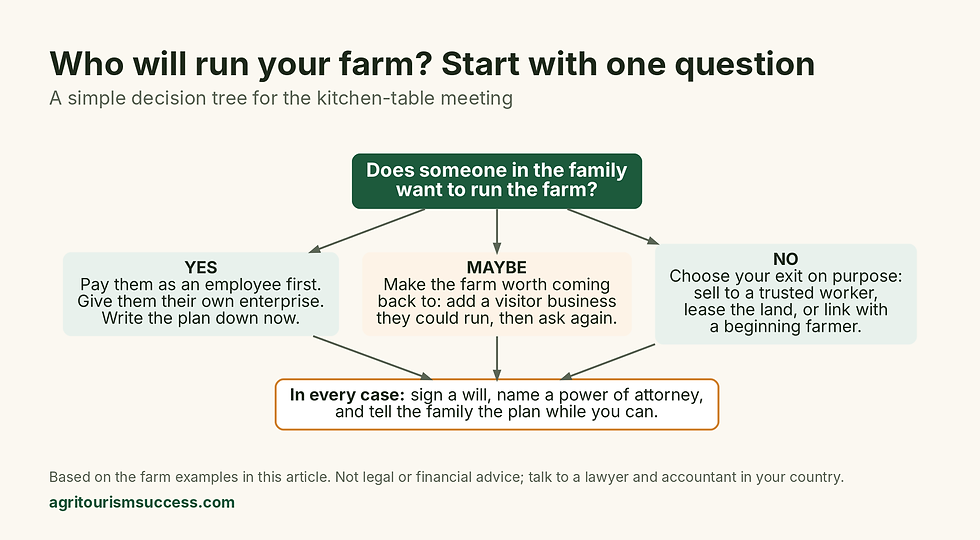
Sell to someone who already loves the place. Wasem's likely buyer already worked there.
Lease the land. A lease, like Kenzell's, can bring in income while a younger farmer builds a business.
Look beyond family. In the 2022 national young farmer survey, 78% of young farmers did not come from farm families. Many want land and don't have it, so look for a farm-link or land-matching program near you.
Whatever you choose, sign a will and name a power of attorney. A "no" from your children is a plan. Silence is not.
What My Own Farm Taught Me About Building Something You Can Hand Over
I run Bloopy Durians, a durian farm in Bentong, Malaysia, where our durian seasons last only about four to five months a year. Building it taught me something that applies straight to succession: the most valuable things a visitor business creates are not only on the land.
There is our WhatsApp list of loyal customers, who buy whenever durians are available, one of our most reliable sources of income. There is our place at the top of Google for searches like "eat Musang King", which keeps visitors coming. And there are the companies we supply with durians for corporate events.
It takes years to learn how to grow a tree. But a customer list, a Google listing, a booking routine and business relationships can be written down and handed over on day one. That is a far easier gift to pass on than a lifetime of know-how stored only in your head.
Your 30-Day Kitchen-Table Plan
You don't have to fix everything this month. You just have to start.
Week 1: Write down three numbers. What does the farm earn in cash? What do you need to retire? What would a successor need to live on?
Week 2: Hold the meeting. Ask each child what they want and what they would add to the farm.
Week 3: Pick one visitor business to test. Choose something small a successor could run, like a pumpkin weekend or a farm tour. First read 21 Signs Your Farm Is Ready for Paying Visitors.
Week 4: Book the professionals. See a lawyer and an accountant. Sign a will and a power of attorney, even if the full plan takes years.
Need money to start? Read Agritourism Grants and Funding in 2026. For inspiration, read These 10 Young Farmers Proved Them Wrong.
Frequently Asked Questions About Farm Succession
What is farm succession planning?
It is deciding who will own and run your farm after you, and putting that decision in writing. A good plan covers the land, the business, taxes, your retirement income and fair treatment of children who don't farm. It usually takes years, so start early.
What is the average age of farmers?
In the United States, the average farm producer was 58.1 in the 2022 Census of Agriculture. In Canada the average operator was 56.0 in 2021, and Japan's core farmers averaged 67.6 in 2025. The U.S. has more than four producers aged 65 or older for every one under 35.
How many farms have a succession plan?
It depends on how you define a plan. A 2023 Purdue survey of 403 U.S. producers found 55% had a written plan. Canada's 2021 Census found only 12.0%, and a 2023 NFU Mutual survey in the UK found 48%.
What happens to a farm if the owner dies without a plan?
The law where you live decides who inherits, and the result may not be what you wanted. Equal shares among children can force a sale, as in the Jersey and New Zealand cases above.
Does agritourism help keep a farm in the family?
No study has proven it. But the top reason young people give for not returning is the lack of a steady income, and agritourism is one of the few ways to add a second business a successor can run. The Dulls, the Carters and the Doans used it to make room for their children.
How much is the U.S. estate tax exemption in 2026?
The federal exemption is $15 million per person, or $30 million for a married couple, and it rises with inflation from 2027. Some states set much lower thresholds; Oregon's estate tax starts at $1 million.
What can I do if my children don't want the farm?
You can sell to a trusted worker or neighbour, lease the land to a younger farmer, or look for a farm-link program. Whatever you choose, write it down so your family isn't left to fight over it.
Don't Leave It to the Lawyers After You're Gone
Your children can only say yes to a farm that can pay them, and they can only take over a farm you have handed over on paper. Start with where your farm stands today: the Farm Readiness Quiz shows which parts of your farm are ready for paying visitors, and what to fix first.
Then download the free 21-Point Agritourism Blueprint, your first steps toward a second paycheck that gives the next generation a reason to stay.
P.S. Jerry Doan told his children the ranch couldn't support them all. Most parents would have stopped there and watched them leave. He built a ranch that could. Your farm may not need a brewery or a 13,000-square-foot barn, but it does need the conversation, and a second paycheck started while you are still the one making decisions.
Stephen Loke of AgritourismSuccess.com, whose farm is featured in Bloomberg News and Asahi Shimbun. This article is general information, not legal, tax, insurance or financial advice. Please talk to a qualified lawyer, accountant and insurer in your country before making succession decisions.
Sources
USDA NASS, 2022 Census of Agriculture, Table 52, Selected Producer Characteristics (Feb 2024)
USDA NASS, 2022 Census of Agriculture Highlights: Farm Producers (Feb 2024)
Farm Policy News, "U.S. cropland tops $6,000 per acre for first time in 2026" (Aug 3, 2026)
Defra, Agricultural workforce in England at 1 June 2026 (Sep 24, 2026)
Eurostat, Farmers and the agricultural labour force, statistics
Statistics Canada, The Daily, 2021 Census of Agriculture (May 11, 2022)
Qazinform (Kyodo), Japan's 2025 agriculture census (Nov 28, 2025)
Carl Zulauf, "Age of US Farmers: Not a Problem," farmdoc daily (May 8, 2024)
USDA ERS, Farm household income estimates (updated May 2026)
USDA ERS, America's Farms and Ranches at a Glance, 2025 Edition (Feb 2026)
USDA ERS, Chart of Note on farm household income and wealth (Jan 27, 2025)
National Young Farmers Coalition, 2022 National Young Farmer Survey
Caroline Millar, "Selling the Farm Experience," Nuffield Farming Scholarships (Jan 2014)
Penn State NERCRD, 2024 National Agritourism Producer Survey (Apr 2025)
Penn State, U.S. agritourism and direct sales factsheet (2017 Census data)
DTN Progressive Farmer, "America's Best Young Farmers and Ranchers" (Dec 31, 2025)
DTN Progressive Farmer, "Agritourism Generates Fresh Money for Many Farms" (Sep 30, 2026)
AgWeb, "How To Transition From Row Crop To AgriTourism Business" (Nov 15, 2020)
Purdue College of Agriculture, Dull's Tree Farm (Oct 16, 2023)
UGA Terry College of Business, "Greener pastures" (Jun 3, 2024)
Dickinson Press (Forum News Service), McKenzie ranch expands into agritourism
Japan MAFF Kinki Regional Agricultural Administration Office, Minami Farm photo report (Aug 2022)
Bridge Michigan, Wasem Fruit Farm (Oct 10, 2022, updated May 15, 2025)
Bailiwick Express, Jersey farm court-ordered sale (Feb 9, 2025)
Carey Olsen via Mondaq, "Proprietary estoppel and licitation in Jersey law" (Mar 31, 2026)
Anderson Lloyd, "When farm succession goes wrong: lessons from Sewell v Sewell" (Jul 9, 2026)
farmdoc daily, "Factors Impacting Succession Planning" (Sep 8, 2023)
IRS, Tax inflation adjustments for tax year 2026 (Oct 9, 2025)
NC State Extension Farm Law, estate tax exemption in the One Big Beautiful Bill (Jul 7, 2025)
Tax Foundation, State estate and inheritance taxes (Oct 2026)
Business Wales (Welsh Government), inheritance tax relief threshold rise (Dec 23, 2025)
The New Daily (AAP), agritourism families and NSW land tax (Jun 14, 2026)


Comments