



The Farm Couldn't Pay One More Wage. So the Family Opened a Farm Shop and Café That Grew to Employ 50 People: The Roots Farm Shop Story


Picture a 220-acre rented farm in North Yorkshire with 35 suckler cows, and a daughter with a first-class business degree who wants to come home.
She wants to work on the family farm. Her father wants that too. But the sums don't work.
Years later, her father Michael put it plainly to the Yorkshire Post: "the income from the farm business alone wasn't enough to get Katherine working here."
So how did this modest, tenanted beef and arable farm end up with 50 people on its books? The family turned old livestock buildings into a farm shop, butchery and café. They sold their own beef straight to the public. That created the job the farm couldn't pay for, and dozens more besides.
The business is Roots Farm Shop & Café at Home Farm, East Rounton, near Northallerton. It opened in 2008, in the middle of a recession. It is still trading 18 years later.
The short answer: If your farm can't support one more wage, a farm shop and café can create that wage by selling what you already grow, direct to the people who drive past your gate. Roots was built on rented land with a modest suckler herd (35 cows by about 2014), opened in old farm buildings in 2008, won a regional Newcomer award within about a year, and had 50 staff on its books about six years later. Today it employs 35 local people, with 20 full-time roles. |
I welcome visitors from all over the world to my own farm, so I read every story like this looking for one thing: what can a farmer actually copy on Monday morning? This case study gives you the full Roots story, then 10 numbered lessons, the "one more wage" money maths, and the questions to ask your landlord before you start.
Grab a cup of tea. This is a long one, and it is worth it.
Roots Farm Shop & Café at a glance | Details |
Location | Home Farm, East Rounton, near Northallerton, North Yorkshire |
Opened | 2008 |
The farm | 220-acre mixed arable and beef farm, tenanted from the local estate |
Herd (about 2014) | 35 suckler cows, plus around 50 store cattle bought in |
Early win | Newcomer award, Deliciouslyorkshire Awards 2009 (268 entries) |
Staff reported around 2014 | 50 on the books (Yorkshire Post, about 2014) |
Staff today | 35 local staff, 20 full-time roles (Roots' website, 2026) |
What it runs now | Farm shop, butchery, café open 7 days, gift shop, makers markets, workshops |
Chapter 1: The Wage the Farm Couldn't Pay
Home Farm sits just outside the village of East Rounton, with easy access to the A19. The Hutchinson family are the third generation to farm it.
They don't own it. Michael told the Yorkshire Post the 220 acres of arable and beef were tenanted from Sir John and Lady Venetia Bell.
The livestock side was modest. Around 2014 they had 35 suckler cows and bought in around 50 store cattle from Ruswarp Mart. That is the kind of herd many readers of this site will recognise.
A daughter with a plan
In 2004, Harper Adams announced that Katherine Hutchinson, then 22 and from East Rounton, had won the Lloyds TSB Prize for the best overall mark on her business course. She graduated with a first-class degree.
Her dissertation asked a question that would shape the next 20 years: "How can a farm business meet consumer demand for local produce", with a focus on farm retailing.
The university noted that her long-term aim was to set up her own company. Four years later, Roots opened its doors.
Katherine had also worked at Sam Turner's in Northallerton. She told the Yorkshire Post that her old boss there, Charlie Turner, got her interested in customer service.
The moment it all hinged on
Here is the heart of the story. The farm alone could not pay Katherine a wage.
That is not a failure. It is one of the most common problems in family farming. Plenty of family farms can feed one household. Far fewer can feed two.
So the family had a choice. Katherine could take her degree to a job in town. Or they could build a second business on the farm that would pay her.
They built the business.

Why this is your problem too
Run the numbers on one extra wage in 2026 and you can see why so many farm kids leave.
From 1 April 2026, the UK National Living Wage for workers aged 21 and over is £12.71 an hour. A full-time week of 37.5 hours, for 52 weeks, comes to about £24,785. Add employer National Insurance and the minimum workplace pension, and one worker costs around £28,300 a year.
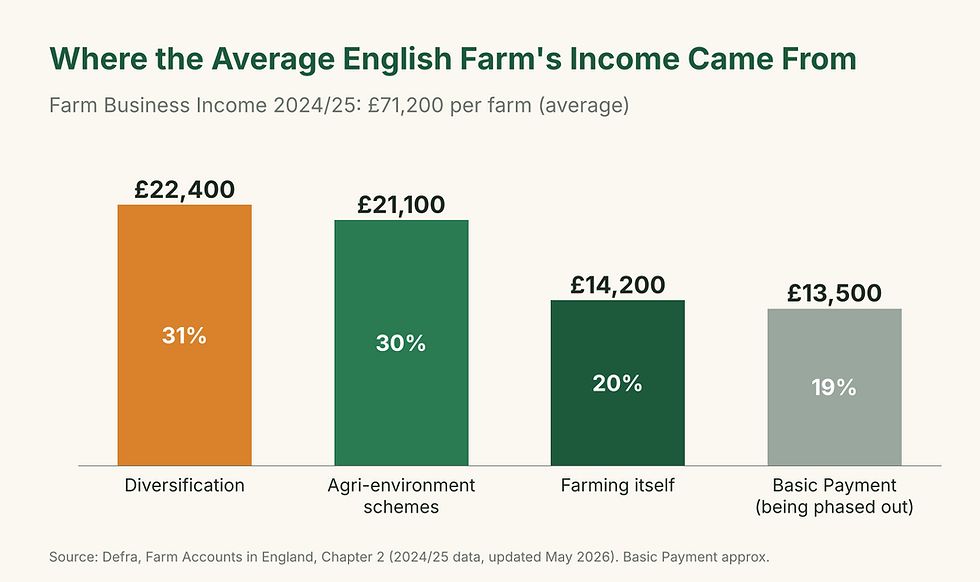
Now look at Defra's figures for 2024/25. The average English farm made a Farm Business Income of £71,200. But only £14,200 of that came from farming itself.
The rest came from diversification (£22,400), agri-environment schemes (£21,100) and the old Basic Payment (about £13,500). And Defra adds that "21% of farms failed to make a profit" that year.
Even that Basic Payment is going. As Farmers Weekly reported in June 2026, "2027 will be the last year of delinked payments for farmers in England."
So on the average farm, farming alone earns about half of what one extra worker costs. That is one big reason the next generation so often leaves. If that worries you, read my guide to a farm succession plan that gives your kids a reason to stay.
Chapter 2: Opening a Shop in 2008, With a Recession Coming
Roots opened in 2008. If you remember that year, you'll remember banks wobbling and families cutting back.
It was a brave time to ask people to drive down a country lane for their sausages and scones.
They started with buildings they already had
The family didn't build a shiny new shop. The Yorkshire Post reported that Roots is housed in what were livestock buildings, designed to match the other farm buildings.
And these were not just any sheds. Roots says it developed Victorian barns originally designed around 1870 by Philip Webb, whom Roots calls the father of the Arts and Crafts Movement. Webb designed the nearby Rounton Grange, since demolished, for Isaac Lowthian Bell.
That gave Roots a ready-made story and a beautiful setting, for the price of converting what was already there. If you have empty buildings, see how other farms turned theirs into income in From Dairy Barn to $2.8 Million.

They sold what the farm already grew
This is the clever bit. The cows were already there. So the family opened a butchery alongside the shop and café.
The family told the Yorkshire Post that the suckler cows' calves are fattened and go through the butchery. The rest of the butchery's meat came from neighbouring farms, with animals going to the slaughterhouse and coming back as whole carcases to be cut or processed on site.
That means the farm's beef no longer had to be sold only at the auction price. Some of it now earns the retail price, and some earns even more as a steak sandwich in the café.
Chapter 3: The Award That Said "You're Onto Something"
About a year after opening, Roots entered the 2009 Deliciouslyorkshire Awards. The awards drew 268 entries, judged by 25 industry experts.
Roots won the Newcomer award.
Speciality Food magazine reported the win in November 2009. The shop's manager, Barry Hutchinson, said that among Yorkshire's many independent retailers, "it's great to be singled out."
The same report noted that he was optimistic about the shop's future despite opening in the middle of a recession. Deliciouslyorkshire's chief executive also pointed out that more than half the shortlisted companies were under two years old.
Why an early award matters so much
An award in year one does three jobs at once.
It tells nervous customers you are worth the drive. It gives local papers a reason to write about you. And it tells your own family, after a hard first year, that the gamble is working.
For more on how awards help farm businesses, see the 9 lessons from the 2026 British Farming Awards finalists.
Chapter 4: From One Family Job to 50 on the Books
About six years after opening, around 2014, the Yorkshire Post went to see how Roots was doing. The farm that couldn't pay one more wage now had 50 staff on its books.
The café ran on waitress service. Katherine's mother, Kay, was among the team getting ready for the day's trade. Katherine said she loved dealing with the public.
More reasons to visit
Roots had also become a meeting place. The Stokesley Farmers Market was being held at the farm on the third Sunday of every month.
That is smart. A farmers market brings in people who might never have found the shop. Once they are there, they buy coffee, cake and the week's meat.
Not everything went their way
Katherine would have welcomed signs on the A19, the busy road nearby. The Yorkshire Post reported that signs had so far been refused, and the cost of trying had put them off.
So Roots had to build its trade without signs on the main road. That is encouraging if your farm is also tucked down a lane.
How Roots compares
A 2022 study by Harper Adams University researchers, funded by the Farm Retail Association, estimated there were 1,581 farm retailers in Britain. Together they had sales of £1.4 billion and employed 25,000 people.
That works out at roughly 16 people per farm retailer on average (my calculation). Roots, with 50 on its books around 2014 and 35 staff today, is well above that average. (It is a rough comparison, as the figures come from different years.)
Chapter 5: What Roots Is Today
Visit Roots today and you'll find a much bigger operation than one shop. Here is what its own website describes.
Part of the business | What Roots offers (from its website, accessed November 2026) |
Farm shop | Food from local and regional producers, many in Yorkshire: dairy, cheese, preserves, groceries, sweets, drinks, fresh fruit and veg, a frozen section |
Traditional butchery | About 90% of its beef from Home Farm; hung at least 21 days; free-range pork from a Yorkshire farm |
Café | Open 7 days, 9am to 4pm; farmhouse breakfasts, scones baked daily, steak sandwiches, a dog-friendly heated annexe |
Roots Curiosities | A sister gift shop with its own website, selling gifts, homewares and cards |
Makers markets | A Spring Makers Market in the Roots Barn on 9 May 2026 |
Workshops | "Weaving Wild Ways" craft workshops (for example, £30 at Rounton Village Hall in April 2026) |
Opening hours | Shop and butchery Monday to Saturday 9am to 5pm, Sunday 9am to 4pm |
The butchery is the engine
Roots says about 90% of its beef comes from Home Farm. The cattle are grass-fed and brought indoors only for finishing. The beef is hung for at least 21 days and aged with Himalayan rock salt.
The pork is free range, from Anna's Happy Trotters at Howden in Yorkshire. Chicken, veal and game in season are sourced locally.
And the café uses meat from the on-site butchers. So one carcass can earn money at the counter and on the breakfast plate.

The café brings people back
The café serves breakfast until noon and lunch until 3pm. The menu includes a full farmhouse breakfast, a "sconewich" made with a savoury home-baked scone, and coffee roasted in East Rounton.
In November 2025, Roots shared a surprise write-up from The Northern Echo, which described its breakfast as legendary. That kind of press coverage money can't buy.
A family travel blogger who visited back in 2016 paid £6.95 for a roast beef Sunday lunch and noted the café supported 17 local suppliers. The blogger also mentioned a pop-up Christmas shop in an outbuilding, and that visitors could see the farm's cows in their shed.

The staff today
Roots' website now says: "We employ 35 local staff and work as a close team." It adds that there are 20 full-time roles at the farm shop and café.
That is fewer than the 50 on the books around 2014, though the two figures may not be counted the same way ("on the books" can include part-timers and seasonal staff), and Roots doesn't say why the number changed. Farm retailers have faced rising wages, employer National Insurance and business rates in recent years. Either way, 35 local jobs from a farm that once couldn't pay one extra wage is a remarkable result.
Customers from further afield
Roots says it now draws customers from Teesside, Darlington and further afield in Yorkshire. Its farm shop, café and butchery are open every day of the week.

Chapter 6: Keeping the Farm the Main Thing
Here is the part I admire most. Around 2014, Katherine told the Yorkshire Post that, first and foremost, the family wanted to keep the working farm side as the main thing.
Many diversified farms lose that. The shop takes over, and the farm becomes a backdrop.
Roots has done the opposite. Its home page still introduces the family as third-generation farmers with their own beef herd. It says the family works towards regenerative farming methods, and its About page focuses on soil health, biodiversity and the water cycle.
That keeps the business honest. And it keeps it different from a supermarket, which can copy a café but can't copy a real herd grazing over the hedge.

The 10 Lessons Every Struggling Farmer Can Take From Roots
No. 1: Price the Wage First, Then Build the Business to Pay It
The Hutchinsons didn't start with "let's open a café." They started with a real problem: the farm couldn't pay Katherine.
That gave the shop a clear job. It had to earn at least one full wage, plus its own costs.
A lot of diversification plans drift because nobody sets a target. Set yours in pounds, or dollars, before you buy a single shelf.
Field-Tested Play: Write down the yearly cost of the person you want to keep on the farm. In the UK in 2026, a full-time worker at the National Living Wage costs about £28,300 with National Insurance and pension. That number is your first target. Every idea you look at must show how it reaches it. |
No. 2: Sell What You Already Grow, Then Add Value Twice
Roots had cattle. So it opened a butchery. Then the café turned that beef into sandwiches and breakfasts.
That is adding value twice. Once from auction price to retail price. Again from retail price to a plated meal.
You don't need beef to do this. Apples become juice and pies. Milk becomes ice cream. Lamb becomes burgers at a barbecue night.
Field-Tested Play: List everything your farm produces. Next to each item, write one shop product and one café or event product it could become. Circle the one with the shortest path to a paying customer. Start there. |
No. 3: Let the Next Generation Lead
Katherine wrote her dissertation on farm retailing four years before Roots opened. She had worked at Sam Turner's in Northallerton. She loved customers.
The business was built around her strengths. That is likely one reason it has lasted.
If you want your children to stay, give them something to run, not just jobs to do. For a gentle way to start, use my 7 questions to ask your kids at the next family dinner.
Field-Tested Play: Ask the young person in your family one question this week: "If you could run one new thing on this farm, what would it be?" Then ask them to write one page on how it would earn a wage. Their answer may be your Roots. |
No. 4: Start in the Buildings You Already Have
Roots opened in former livestock buildings. No land purchase. No new-build shop.
In England, the rules changed in May 2024 to help farmers do this. The government doubled the floor space that can be converted from agricultural to flexible commercial use, from 500 to 1,000 square metres, and named larger farm shops as one example. You still need prior approval from the council on issues such as transport and flooding.
Before you invite the public in, check your building is safe and legal for visitors. My guide Is Your Barn Legal for Visitors? walks you through it.
Field-Tested Play: Walk your yard with a notebook. For each building, note its size, condition, access for cars and whether it has water and power. The one nearest the road with parking space is usually the best first shop. |
Reality Check: Old buildings can hide big costs. Drainage, fire exits, disabled access, toilets and kitchen extraction can cost more than the shop fit-out. Get a builder and your council's planning team to look before you commit. |
No. 5: Let the Café Bring People and the Shop Send Them Home Full
A farm shop on its own can be a quiet place on a wet Tuesday. A café gives people a reason to come even when the fridge is full.
Once they're sitting down with a scone, they walk past the butchery counter on the way out. That is how one visit turns into two or three sales.
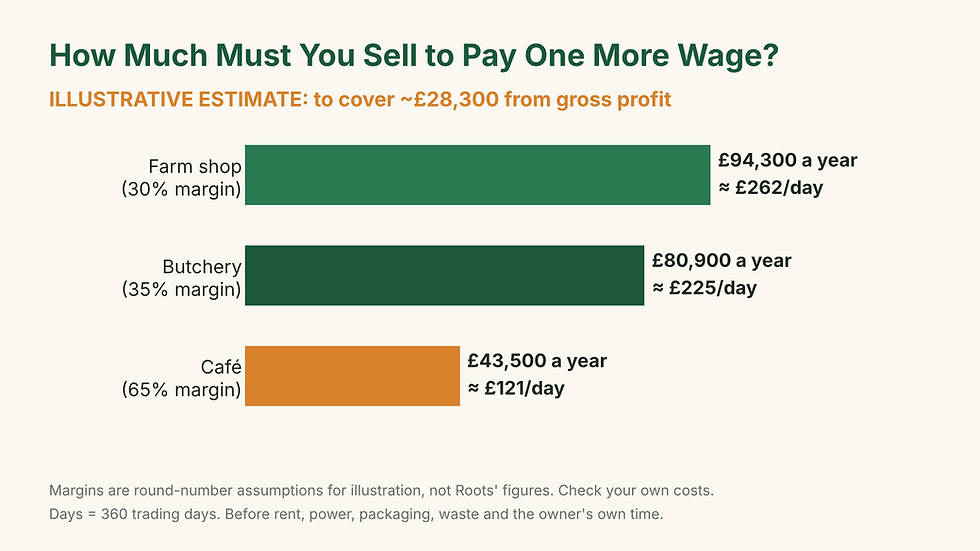
The illustrative chart below shows why. A café usually keeps more of each pound after paying for ingredients than a shop does. So it can cover a wage on fewer sales. But it also needs more staff and more kitchen rules.
Field-Tested Play: Before a full café, test with a coffee and cake counter on weekends. Count how many people buy a drink, and how many of them also buy something from the shop. If more than half do, a café is worth planning. |
No. 6: Win Something Early
Roots won a regional Newcomer award about a year after opening. That gave it press, trust and confidence.
Most counties, states and provinces run food or tourism awards. Many have a "new business" category that small farms can win.
Field-Tested Play: Search today for food, farming and tourism awards in your area. Put the entry deadlines in your calendar. Ask your best customers for short written comments now, so you have them ready when the entry form asks. |
No. 7: Invite Other Producers In
Roots didn't try to make everything. Its shop stocks cheese, preserves, drinks and sweets from other producers, many of them in Yorkshire. It hosted a monthly farmers market. Today it runs makers markets in the Roots Barn.
Every producer you stock brings their own fans. And every market day fills your car park with new faces.
Field-Tested Play: List five local producers whose products would sit well beside yours. Visit two this month. Offer to stock their best seller, and ask if they'd share your shop on their social media in return. |
No. 8: Keep Adding Small Reasons to Come Back
Over the years Roots added a gift shop, a Christmas pop-up, a dog-friendly café annexe, slow-stitching evenings and seasonal craft workshops.
None of these is huge on its own. Together, they mean there is always something new to see.
That is how you grow income without needing many more visitors. I explain the idea in upsells that double your agritourism revenue.
Field-Tested Play: Plan one "reason to return" for each season. A spring lambing weekend. A summer barbecue night. An autumn workshop. A Christmas market. Put the dates on your shop wall and website now. |
No. 9: Your Staff Are Part of the Product
Roots ran waitress service in its café. Its butchers are happy to explain how to cook each cut. Katherine's love of customers was built into the business from the start.
That is harder than it sounds. In the Harper Adams study, attracting talent or skilled staff was the biggest challenge farm retailers named, cited by 35%.
Before you hire, learn the rules. My guide to hiring seasonal staff and the legal tips that go with it covers contracts, pay and training.
Field-Tested Play: Write a one-page "how we welcome people" sheet before you hire anyone. Include how to greet customers, how to talk about the farm, and one fact about your animals or crops every staff member should know. |
No. 10: Keep the Farm the Main Thing
The Hutchinsons kept the working farm at the centre. Their beef herd is the story. Their regenerative aims are part of the brand.
Visitors come to farm shops because they want a real farm. Never let the shop hide it.
It also protects you. If shop trade dips one year, the farm still stands. If beef prices fall, the shop still earns. Each half steadies the other.
Field-Tested Play: Put your farm on show. A viewing spot over the cattle shed, a board saying what's happening in the fields this week, or photos of the herd by the till. Let customers see where their food comes from. |
The "One More Wage" Money Maths
Roots does not publish its turnover, so I won't guess it. Instead, here is the maths you can do for your own farm.
First, what one full-time worker really costs in the UK in 2026.
Cost item (UK, 2026/27) | How it's worked out | Yearly cost |
Wage | £12.71 an hour x 37.5 hours x 52 weeks | £24,785 |
Employer National Insurance | 15% on pay above £5,000 a year | about £2,968 |
Minimum workplace pension | 3% on qualifying earnings above £6,240 | about £556 |
Total cost of one worker | about £28,300 |
Small employers may be able to claim the Employment Allowance, worth up to £10,500 in 2026/27. That could cut or cancel the National Insurance on a first employee. Ask your accountant.
Second, how much you'd need to sell to pay that wage from gross profit. These are illustrative estimates, using round-number margins I have chosen for the example. Your real margins will differ.
Type of sales | Assumed gross margin (illustrative) | Yearly sales to cover £28,300 | Per trading day (360 days) |
Farm shop goods | 30% | about £94,300 | about £262 |
Own-farm butchery | 35% | about £80,900 | about £225 |
Café food and drink | 65% | about £43,500 | about £121 |
That is before rent, power, packaging, card fees, waste, business rates and your own time. So treat these numbers as a floor, not a finish line.
Still, look at that café line. About £121 a day is roughly 10 to 12 lunches at £10 to £12 each. For many farms near a busy road or a walking route, that is reachable.
Reality Check: A café's high margin is before its own staff. A café usually needs at least one cook and one server, so it often has to cover two or three wages, not one. Build your plan around the whole team, not just the one family member you want to keep. |
Want a full plan for the bank? Use my free agritourism business plan template. And if you are in England, Wales or Scotland, check whether your shop could qualify for help with rates in How Your Shop or Café Could Pay Zero Business Rates.
Rented Land? The Questions to Ask Before You Diversify
Roots was built on a tenanted farm. That makes its story especially useful, because many struggling farmers rent some or all of their land.
What follows is not legal advice. Rules differ between England, Scotland, Wales, Northern Ireland, the US and Canada. Use these questions to have a better conversation with your landlord, solicitor, insurer and council.

Questions to ask your landlord or estate
Does my tenancy allow non-farm use? Many older tenancies limit the land to agricultural purposes only. Opening a shop without consent could put you in breach.
Will you give consent in writing, and on what terms? Some landlords grant a separate licence for the new use, with its own fee and a clearly defined use.
How will this affect my rent at the next review? Agree it now, in writing.
Who pays for building work, and who owns the improvements when the tenancy ends? If you spend £50,000 on a barn you don't own, you need to know what happens if you leave.
How long is my tenancy, and could it be extended? A shop takes years to pay back. A short term may not give you enough time.
Reality Check: The Tenant Farmers Association has warned that some landlords block diversification with blanket bans. Talk to your landlord early, bring a written plan, and show how the project helps the estate too: a better-kept building, a busier village, a tenant who can pay the rent. |
Questions to ask your council (or county)
Do I need full planning permission, prior approval under permitted development, or a change of use? In England, the 2024 rules widened what farm buildings can become, but prior approval still applies.
Will I need consent for signs? Roots was refused signs on the A19, so don't build your plan around roadside signs until you have permission.
Do I need to register as a food business? In the UK, you must register with your local council at least 28 days before you start food operations. It is free.
Will the shop pay business rates, and can I get relief? Farmland and farm buildings are usually exempt from business rates, but a shop or café usually is not.
For a plain guide to permits for farm cafés, dinners and food sales, read Selling Food on Your Farm (and the Permits Each One Needs).
Questions to ask your insurer
Do I have employers' liability insurance? In the UK it is a legal requirement as soon as you employ someone (with some exceptions, such as employing only close family members), with cover of at least £5 million. GOV.UK warns you can be fined £2,500 for every day you are not properly insured.
Am I covered for public liability, so if a visitor slips in the car park or café? And for product liability, if someone is ill after eating something I sold?
Does my farm policy cover a retail business in farm buildings? Many do not. Tell your insurer before you open, not after.
My guide to agritourism insurance and what coverage you need explains each type in plain words.
What This Means for Farms in the US and Canada
You don't need to be in Yorkshire for this to work.
The USDA's 2022 Census of Agriculture found 116,617 US farms selling food directly to consumers, worth $3.26 billion. The same census found 28,617 farms earning money from agritourism and recreation, totalling $1.26 billion, or about $44,004 per farm on average.
The succession problem is the same, too. The average US producer was 58.1 years old in 2022. Producers aged 65 and over made up 38% of the total, while those under 35 made up just 9%.
In England, the picture is similar. Defra's June 2026 survey found 36.1% of principal farmers were 65 or older, and only 6.8% were under 35.
The paperwork differs, though. In the US, start with your county zoning office and county health department. In Canada, check with your municipality and provincial health authority. Ask about farm retail permits, food handling rules and liability cover in your state or province.
The Same Principle on My Own Durian Farm
I see the Roots principle every season on my own farm, Bloopy Durians in Bentong, Malaysia. Our farm has been featured in Bloomberg News and Asahi Shimbun.
We welcome visitors from all over the world. Many companies also send their staff and management to the farm.
But durian season only lasts a few months a year. So, like Roots, we sell direct to our own customers.
We have a WhatsApp list of loyal customers. Whenever durians are available, they buy. That list has become a reliable source of income for the farm.
Different country, different crop, same lesson. When you sell direct, you keep the margin a middleman would take. And you build loyal customers who come back.
What Roots Did NOT Do
It's just as useful to see what the family avoided.
They didn't start by buying land. They grew the business on a tenanted farm, in buildings already there.
They didn't wait for perfect times. They opened in the middle of a recession.
They didn't hide the farm. The herd and the farming story stayed at the centre.
They didn't rely on roadside signs. When A19 signs were refused, they kept building the business without them.
They didn't try to make everything themselves. They stocked other local and regional producers and invited markets and makers in.
Frequently Asked Questions
What is Roots Farm Shop & Café?
Roots Farm Shop & Café is a farm shop, traditional butchery and café at Home Farm, East Rounton, near Northallerton in North Yorkshire. It opened in 2008 on a 220-acre tenanted arable and beef farm run by the Hutchinson family, the third generation to farm there.
Why did the family start a farm shop and café?
Because the farm alone could not pay another family wage. Michael Hutchinson told the Yorkshire Post the farm's income wasn't enough to bring his daughter Katherine into the business. The shop, butchery and café created that job and many more.
How many people does Roots employ?
The Yorkshire Post reported 50 staff on the books around 2014. Roots' own website now says it employs 35 local staff, with 20 full-time roles at the farm shop and café.
Can a small farm start a farm shop and café?
Yes, if it has a road people can reach, a building that can be converted, and something to sell. Roots was built on a modest suckler herd of about 35 cows. Many farms begin with a small honesty shop or weekend coffee counter, test demand, then grow. My guide to farms under 10 acres shows what small farms can do.
Do I need planning permission for a farm shop in England?
Often you need either planning permission or prior approval under permitted development. Since May 2024, up to 1,000 square metres of agricultural floor space can change to flexible commercial use, including larger farm shops, subject to prior approval. Always check with your local planning authority first.
Can a tenant farmer open a farm shop?
Usually only with the landlord's written consent, because many tenancies limit land to farming. Ask about consent, rent reviews, who pays for building work and what happens to improvements if the tenancy ends. Take advice from a specialist solicitor before you sign anything.
How much does a farm shop need to sell to pay one wage?
In the UK in 2026, one full-time worker at the National Living Wage costs about £28,300 a year with employer costs. As an illustrative estimate, at a 30% gross margin a shop would need around £94,300 of yearly sales just to cover that wage, before other costs.
Is a farm café more profitable than a farm shop?
A café usually keeps more of each sale after ingredients, but it needs more staff, a kitchen and stricter food safety rules. Many farms find the two work best together: the café brings people in, and the shop sends them home with the week's food.
Your Next Step
The Hutchinsons didn't have a big estate, a huge herd or perfect timing. They had a modest suckler herd, some old buildings, a daughter with a plan, and a clear target: create the wage the farm couldn't pay.
You might have more than that already.
Your farm is part of a bigger picture, too. Diversification income now matters more than ever, as I showed in how paying guests carried 6 family farms through drought and bad seasons. And with tax changes ahead, read why your farm needs an income the taxman can't squeeze. For another UK family success story, see the Farmer Copleys case study.
The best first step is to find out what your farm is ready for. Take my free Farm Readiness Quiz. It takes a few minutes and shows where your farm is strong and where it needs work.
P.S. Remember Katherine, with her first-class degree and a family farm that couldn't pay her? The family didn't wait for farming to get better. They built the job themselves, in buildings they already had, and it grew to 50 people on its books. If someone in your family wants to stay, the quiz above is the quickest way to find out what your farm could build for them.
Written by Stephen Loke of AgritourismSuccess.com, whose farm is featured in Bloomberg News and Asahi Shimbun. This article is for education only and is not legal, tax or financial advice.
Sources
Yorkshire Post, "Student's farm shop idea proves a perfect match" (undated, about 2014): https://www.yorkshirepost.co.uk/news/environment/student-s-farm-shop-idea-proves-a-perfect-match-1-6928430
Roots Farm Shop & Café, home page: https://rootsfarmshop.co.uk/
Roots Farm Shop & Café, About Us: https://rootsfarmshop.co.uk/about-us/
Roots Farm Shop & Café, Traditional Butchery: https://rootsfarmshop.co.uk/roots-traditional-butchery/
Roots Farm Shop & Café, Café: https://rootsfarmshop.co.uk/cafe/
Roots Farm Shop & Café, Makers Market in May: https://rootsfarmshop.co.uk/news/makers-market-in-may/
Roots Farm Shop & Café, Weaving Wild Ways: https://rootsfarmshop.co.uk/news/weaving-wild-ways/
Roots Farm Shop & Café, Surprise Write Up From The Northern Echo (November 2025): https://rootsfarmshop.co.uk/news/surprise-write-up-from-the-northern-echo/
Roots Curiosities: https://rootscuriosities.com/
Speciality Food Magazine, "Best New Farm Shop" (13 November 2009): https://specialityfoodmagazine.com/content/news/best_new_farm_shop
Harper Adams University, "North Yorkshire Student Awarded Lloyds TSB Prize" (11 October 2004): https://www.harper-adams.ac.uk/news/2558/
Farm Retail Association, member listing for Roots Farm Shop: https://www.farma.org.uk/members/view/roots-farm-shop/
North East Family Fun, "Family Sunday Lunch at Roots Farm Shop & Cafe" (November 2016): https://www.northeastfamilyfun.co.uk/2016/11/sunday-lunch-menu-roots-farm-shop-cafe-review.html
Defra, Farm Accounts in England, Chapter 2: Key results (updated 12 May 2026): https://www.gov.uk/government/statistics/farm-accounts-in-england/chapter-2-key-results-and-overview-across-england
Defra, Farm Accounts in England, Chapter 5: Diversification (updated 12 May 2026): https://www.gov.uk/government/statistics/farm-accounts-in-england/chapter-5-diversification--2
Defra, Farm Business Income by farm type in England 2024/25: https://www.gov.uk/government/statistics/farm-business-income/farm-business-income-by-farm-type-in-england-202425
Defra, Agricultural workforce in England at 1 June 2026 (24 September 2026): https://www.gov.uk/government/statistics/agricultural-workforce-in-england-at-1-june/agricultural-workforce-in-england-at-1-june-2026
Defra, Farm Household Earnings 2024/25 (30 July 2026): https://www.gov.uk/government/statistics/farm-household-earnings/farm-household-earnings-202425
GOV.UK, "National Living Wage increases to £12.71 per hour" (1 April 2026): https://www.gov.uk/government/news/national-living-wage-increases-to-1271-per-hour
GOV.UK, Rates and thresholds for employers 2026 to 2027: https://www.gov.uk/guidance/rates-and-thresholds-for-employers-2026-to-2027
GOV.UK, Workplace pensions: what you, your employer and the government pay: https://www.gov.uk/workplace-pensions/what-you-your-employer-and-the-government-pay
GOV.UK, Employers' liability insurance: https://www.gov.uk/employers-liability-insurance
GOV.UK, "Planning red tape slashed for farmers" (21 May 2024): https://www.gov.uk/government/news/planning-red-tape-slashed-for-farmers
Defra Farming blog, "Changes to permitted development rights" (10 May 2024): https://defrafarming.blog.gov.uk/2024/05/10/changes-to-permitted-development-rights
Leeds City Council, Register a food business: https://www.leeds.gov.uk/environmental-health-for-business/food/register-a-food-business
Farmers Weekly, "Delinked payments axed early as farm support is phased out" (2 June 2026): https://www.fwi.co.uk/news/farm-policy/delinked-payments-axed-early-as-farm-support-is-phased-out
Farmers Weekly, "'Inflexible' landlords refusing farm diversification consent" (December 2018): https://www.fwi.co.uk/business/diversification/inflexible-landlords-refusing-farm-diversification-consent
Farrer & Co, "Diversification under AHA tenancies" (January 2022): https://www.farrer.co.uk/news-and-insights/diversification-under-aha-tenancies/
Harper Adams University, research on the £1.4 billion sales impact of Britain's farm shops (2 March 2022): https://www.harper-adams.ac.uk/news/206784/
USDA NASS, 2022 Census of Agriculture Highlights: Farm Producers: https://www.nass.usda.gov/Publications/Highlights/2024/Census22_HL_FarmProducers_FINAL.pdf
Entsminger and Schmidt, NERCRD Data Brief: Direct-to-Consumer Sales, 2022 Census of Agriculture: https://nercrd.psu.edu/wp-content/uploads/2024/06/Data-Brief_CoA2022_DTC-Sales_FINAL.pdf
Entsminger and Schmidt, NERCRD Data Brief: Agritourism and Recreational Services, 2022 Census of Agriculture: https://nercrd.psu.edu/wp-content/uploads/2024/05/AgritourismDataBrief.May2024.pdf
Wikipedia, Rounton Grange: https://en.wikipedia.org/wiki/Rounton_Grange
Roots Farm Shop & Café, Farm Shop: https://rootsfarmshop.co.uk/farm-shop/
This article is independent and is not sponsored by or affiliated with Roots Farm Shop & Café. Figures are as reported by the sources listed, on the dates given.


Comments