



Half of Farmers With Children Haven't Named a Successor. 7 Questions to Ask Your Kids at the Next Family Dinner

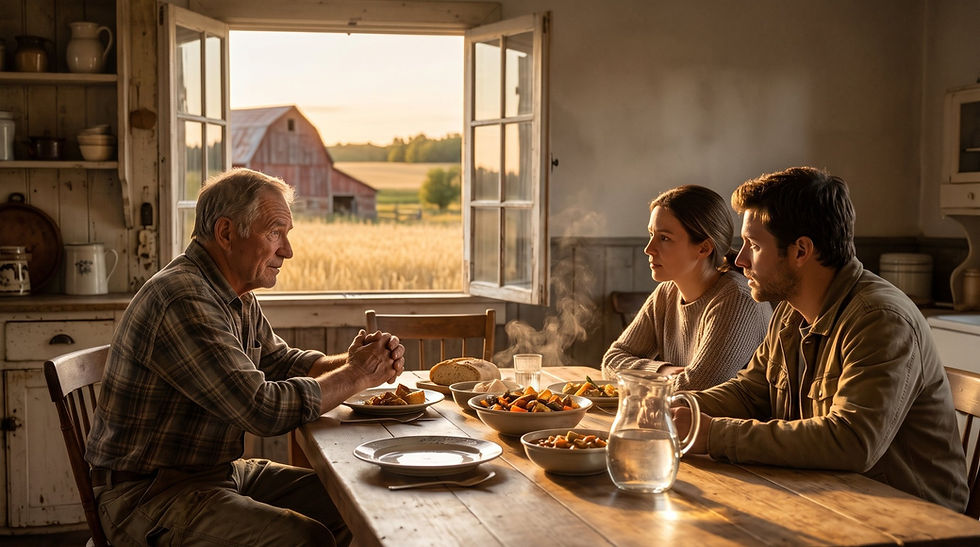
Andrew Guest worked on his family's Welsh dairy farm for more than 30 years, often for less than the minimum wage. His parents told him, again and again, that a big share of Tump Farm would one day be his. Then the family fell out, and he ended up taking his own parents to court.
So how do you start the farm succession conversation before it comes to that? Not with lawyers or land values. You start at the dinner table, with seven calm questions asked in the right order over a few meals.
Here's how the Guest story ended. Andrew left school at 16 and stayed on the farm in Monmouthshire until 2015. In 2014 his parents made new wills that left him out. The case went all the way to the UK Supreme Court. On 19 October 2022, the court ruled that those kitchen-table promises counted. The remedy it set out was either a discounted lump sum for Andrew, or the farm held in trust for him with a life interest for his parents. A farm the family had worked since 1938 would now pass on terms shaped by judges.
A calm conversation early on about what each person understood might have changed how this played out. That is the conversation this article helps you start.
By the end of this article you'll have all seven questions, a printable list for the fridge, and the paperwork questions to take to your advisers.
The Short Answer A University of Exeter study for NFU Mutual found that only around half (50.7%) of UK farmers with children had identified a potential successor. Over a quarter (27%) had not discussed their later-life plans with anyone. The fix starts small: one relaxed family dinner and seven questions, from "What does this farm mean to you?" to "If I were gone tomorrow, would you know what to do?" Then you take the answers to a lawyer, an accountant and an insurance broker. A farm with a second income, such as farm visits or direct sales, also gives your children a real reason to come home. |
The Numbers Behind the Silence
You might think your family is unusual. It isn't. The silence on Tump Farm is close to normal.
What the NFU Mutual study found
The University of Exeter's Centre for Rural Policy Research surveyed farms in England, Scotland and Northern Ireland for NFU Mutual. The report was written by Rebecca Wheeler, Matt Lobley and Richard Soffe and dated July 2020. The university announced the findings on 9 October 2020.
Here is what farmers told the researchers:
Only 50.7% of farmers with children had identified a potential successor.
27% had not discussed their later-life plans with anyone at all.
Just 18.8% planned to fully retire. Most planned to semi-retire, and about one in five said they would never retire.
83.6% had a will, but only 18% had a formal succession plan.

Most farmers have done the legal minimum. Very few have done the family work. A will says who gets the land when you die. It says nothing about who runs the farm next year or what they get paid.
It's the same story in North America
Statistics Canada's 2021 Census of Agriculture found that only 12.0% of Canadian farms reported a succession plan. That's about one farm in eight. A 2023 report from RBC, BCG's Centre for Canada's Future and the University of Guelph's Arrell Food Institute forecasts that more than 40% of Canadian farm operators will retire by 2033.
In Iowa, a 2019 survey of 739 farmers by Iowa State University's Beginning Farmer Center found 66% had no formal succession plan. Across the US, the average producer is now 58.1 years old.

Country | Key figure | Source and year |
United Kingdom | 50.7% of farmers with children have identified a potential successor; 18% have a formal plan | University of Exeter for NFU Mutual, 2020 |
Canada | 12.0% of farms report a succession plan; average operator age 56.0 | Statistics Canada, 2021 Census of Agriculture |
Canada (forecast) | More than 40% of operators expected to retire by 2033 | RBC, BCG Centre for Canada's Future and Arrell Food Institute, 2023 |
United States | Average producer age 58.1; 38% aged 65 or older; 9% under 35 | USDA NASS, 2022 Census of Agriculture |
Iowa, USA | 66% have no formal succession plan; about 40% have identified a successor | Iowa State University FARMTRANSFERS survey, 2019 |
England | 36.1% of principal farmers are 65 or older; 6.8% are under 35 | Defra, Agricultural Workforce in England, 2026 |
Ireland | 46.5% of farm holders have a succession plan | Central Statistics Office, Farm Structure Survey 2023 |
I covered the age gap and the money gap in depth in my main guide, Farm Succession Planning: Who Will Run Your Farm When You Can't?. This article does a different job. It hands you the words for the first talk.
Why Farm Families Avoid the Talk (and Why Waiting Costs More)
Most farmers aren't lazy about this. They're scared of it, for good reasons.
It feels like planning your own funeral. Nobody wants to talk about dying over roast chicken.
It might start a fight. Three children and one farm means someone may feel let down.
You don't know the answer yet. Many parents wait for a finished plan before they speak. The plan never comes.
You think the kids already know. This is the most dangerous belief of all. Andrew Guest believed the farm would be his. His parents' wills said otherwise. The courts spent years sorting it out.
Reality Check: Silence Is Also a Decision When you say nothing, the law decides for you. If you die without a valid will, default rules divide what you own. Those rules weren't written for a working farm. They can split land between heirs who don't farm or leave the child who stayed home with nothing in writing. |
There's a quieter cost too. In the Exeter study, a third of farmers over 65 had a successor who was already 35 or older. A 40-year-old who has waited 20 years for Dad to decide may simply stop waiting. Some take jobs in town. Some, like Andrew, call a lawyer.
Before the Dinner: Set the Table Right
Pick a normal night. Not Christmas, not a funeral, not the day the bank calls. A plain Sunday dinner is perfect.
Tell them the topic a few days ahead. "On Sunday I'd love to hear what you each think about the farm's future. No decisions, just listening." Nobody likes an ambush.
Invite every adult child, not just the farming one. The child in the city still cares about the place they grew up. Leave them out now and you may hear from them later.
Decide on purpose whether spouses come. Some families start with blood relatives, then widen the circle. Others include in-laws from day one.
Keep a notebook on the table. Purdue University's Institute for Family Business recommends family meetings with agendas, ground rules and written notes shared afterward. A notebook is the simple version.
Field-Tested Play: The Two-Dinner Rule Plan for at least two dinners, not one. Use the first for questions 1 to 3, which are about dreams. Use the second, a few weeks later, for questions 4 to 7, which are about fairness, promises and risk. People open up more when they know there's no deadline tonight. |
The 7 Questions to Ask Your Kids
These questions climb like a ladder. They start soft and get harder. Each one opens a door for the next. Ask them in order, and let silence do some of the work.

No. 1: "What does this farm mean to you?"
Start here because there's no wrong answer. One child may talk about calving at 2 a.m. Another may talk about the swing in the old oak tree. You're not hunting for a successor yet. You're listening for attachment.
Listen for: pride, old hurts, and any sign that someone feels the farm took their parents away from them.
No. 2: "If money were no worry, would you farm here? Doing what?"
This removes the biggest excuse and shows you the dream underneath. The son you thought would run the cattle may say he'd rather run a farm shop. The daughter in marketing may want to host farm stays. Neither is "farming" the way you know it. Both could keep the land in the family.
Listen for: any idea that uses the land differently from you. Write it down. Don't argue with it yet.
No. 3: "What would it take for you to earn a living here?"
Now money comes back in. This is the question most families skip, and it's often the real reason children stay away. A farm that barely pays one household cannot pay two. Ask what income they'd need, and be honest about what the farm makes now.
This is where a second income stream changes the talk. Farm visits, a farm shop, pick-your-own or farm stays can become a business your child builds without pushing you aside. If you want ideas, start with 25 Proven Agritourism Income Streams You Can Start Immediately. If you want honest numbers first, read Is Agritourism Profitable?.

Listen for: a number. If your child can name what they'd need, you can start working out how to get there.
No. 4: "What do you expect, and what feels fair to your siblings?"
This is the first hard rung. Ask each child what they expect to receive, and what would be fair to the others.
Fair is not always equal. The child who works the farm may need the land kept in one piece. The child who left may get other assets or life insurance money. Farm Credit Canada makes a similar point: land and machinery are valuable, but they aren't cash. You're still the decision-maker. Their answers inform you. They don't bind you.
Listen for: gaps between what each child expects. Those gaps are where future fights live.
No. 5: "What have you heard me promise you?"
This is the Tump Farm question. Ask it gently, and be ready for answers you don't remember giving.
Parents say things in passing. "One day this will all be yours." "Don't worry, you'll be looked after." Children remember those lines for decades and make life choices around them. In the Guest case, years of repeated assurances, and a son who relied on them, were enough for the courts to step in.
The aim is to get every promise into the open, so you can keep it, change it honestly, or put it in writing.
Listen for: any promise you can't keep. Fixing it now, at the table, is far cheaper than fixing it in court.
No. 6: "What do you need from me, and by when?"
Turn the spotlight on yourself. Your successor may need a real wage, a title, some decisions of their own, a house on the farm, or a date when you'll step back.
Purdue's specialists suggest turning wishes into concrete steps. If your child says "I want more say," ask which one decision they'd like to own this year.
Listen for: a timeline. "Someday" is not a plan. "By the time I'm 40" is a start.
No. 7: "If I were gone tomorrow, would you know what to do?"
End here, because it pulls everything together. Would your children know where the will is? Who the accountant is? Which bank holds the loans? Who to call about the cows on day one?
This isn't morbid. It's the most loving question on the list. Animals need feeding the morning after a funeral.
Listen for: blank faces. Each one is a job for your notebook.
Who Decides What: Keep Three Areas Apart
Family business researchers often picture a family business as three separate areas: family, business and ownership. Many fights start when they get mixed up.

Family decisions belong to everyone. Business decisions belong to whoever runs the farm day to day. Ownership decisions belong to the owners, guided by advisers.
When your non-farming daughter questions the price of hay, that's a business question, and it isn't really hers. When your farming son decides who inherits the house, that's an ownership question, and it isn't his either. Name the area, and half the heat leaves the room.
The Paperwork Questions: What to Ask Your Lawyer, Accountant and Insurer
This isn't legal, tax or insurance advice. Rules differ between the US, Canada, the four UK nations and beyond. These are questions to take into each adviser's office.
Questions for your lawyer (solicitor, attorney or notary)
Is my will up to date, and does it match what I've told my children?
Could anything I've said to a child be treated as a binding promise where I live?
Who legally owns the farm: me, a partnership, a company or a trust? Do I need a power of attorney?
Should we have a written partnership or shareholder agreement with the child who farms?
If the land is rented, can the tenancy pass to my successor?
Adding visitors? See Legal Essentials for Starting an Agritourism Business.
Questions for your accountant or tax adviser
What inheritance, estate or death taxes could apply to the farm, and roughly how much?
What reliefs or exemptions for farm property apply in my country, and what conditions do they set?
Is it better to pass on assets now, gradually, or at death?
How should my successor be paid so it's fair and tax-efficient?
Tax rules change, so ask about this year's numbers. In the UK, as announced by the government in December 2025, combined agricultural and business property relief of 100% applies from 6 April 2026 to the first £2.5 million, with 50% relief above that. In the US, the federal estate tax basic exclusion for 2026 is $15 million per person, though some states have their own taxes. In Canada, the lifetime capital gains exemption for qualified farm property sold after 24 June 2024 is $1.25 million. Your adviser will tell you how these apply to you.
Questions for your insurance broker
If I died or became disabled, is there enough life or disability cover to keep the farm running and treat non-farming children fairly?
Who is named as the beneficiary on each policy, and does that match the will?
If my successor starts a visitor business, is it covered? Farm policies often exclude paying guests.
That last point catches many families out. Read Agritourism Insurance: What It Covers, What It Costs and How to Get Quotes before the first guest arrives.
Reality Check: A Will Is Not a Succession Plan The Exeter study showed 83.6% of farmers had a will, but only 18% had a formal succession plan. A will deals with ownership at death. A succession plan deals with management, income and timing while you're still alive. You need both. |
An Illustrative 10-Year Handover
Every farm is different. Use this as a picture, not a rule.

The step most worth your attention is years 2 to 5, when your successor runs one enterprise from start to finish. A farm stay, farm shop or tour business fits well here. It lets them prove themselves without you losing control of the core farm. And review the plan every few years, because births, marriages, divorces and deaths all change it.
Field-Tested Play: Give Them a Business, Not Just Chores A successor who only "helps Dad" learns to wait. One who runs a real business learns to lead. Hand over one enterprise with its own bank account and targets. A farm stay, pick-your-own patch or school trips work well because they're small, separate and visible. Look at how farm kids can grow into paid tour guides, or start a farm apprenticeship program to bring in extra hands. |
Why a Visitor Business Can Bring the Kids Home
The kids usually don't leave because they don't love the farm. They leave because it can't pay them. In US Farm Debt Just Hit a Record $605 Billion I showed how many farmers climbing out are adding visitors, not acres.
USDA figures show US farms earned $1.26 billion from agritourism and recreational services in 2022, up 12.4% from 2017 after inflation. It's a small slice of farm income, but it's growing, and it's money a young person can build with their own hands.
A visitor or direct-sales business does three things for succession. It creates a second income. It uses young people's skills, like social media and bookings. And it can give a non-farming child a role: the teacher daughter could run school visits.
You don't need to build a resort. Some of the best first steps need almost no building. See Asset-Light Agritourism: How to Monetize Your Farm Without Building a Thing.
For real families who turned heritage into income, read the Greenwell Farms legacy case study and the Kuipers Family Farm case study. And if you're the parent wondering whether you're too old to start, Your Grey Hair Is a Selling Point is for you. Young farmers are proving the model works too, as you'll see in these 10 young farmers' success stories.
Reality Check: Agritourism Is Not a Magic Fix A visitor business brings income, but also work, insurance, rules and weekends with strangers. It suits some children and not others. If no one wants it, better to know before you build anything. |
When you're ready to put the idea on paper, my free agritourism business plan template gives you and your successor a shared plan to work from.
What I've Learned on My Own Farm
My farm, Bloopy Durians, is in Bentong, Malaysia. It welcomes visitors from all over the world, and many companies send their staff and management to spend time on the farm. We also have a loyal WhatsApp customer list of people who buy whenever our durians are in season. We supplied durians to a Mayor of Kuala Lumpur tourism event, and Kuala Lumpur City Hall gave our team a plaque of appreciation.
Visitors, events and loyal repeat buyers are what make the farm a business and not just a harvest. A farm with its own customers and its own income outside the commodity market can be easier to hand on, because a young person can see what they would be taking over.
The 7 Questions: Your Printable List
Print this box, stick it on the fridge, and bring it to the table. Ask one rung at a time.
The Keep-the-Farm-in-the-Family Dinner Questions Dinner one: the dreams No. 1: What does this farm mean to you? No. 2: If money were no worry, would you farm here? Doing what? No. 3: What would it take for you to earn a living here? Dinner two: fairness, promises and risk No. 4: What do you expect, and what feels fair to your siblings? No. 5: What have you heard me promise you? No. 6: What do you need from me, and by when? No. 7: If I were gone tomorrow, would you know what to do? Ground rules: No decisions tonight. Everyone gets a turn. Write it down. Take the notes to your lawyer, accountant and insurance broker. |
Frequently Asked Questions
How do I start the farm succession conversation with my kids?
Tell them the topic a few days ahead, pick a calm dinner, and promise no decisions that night. Start with "What does this farm mean to you?" and work up to harder questions over several meals.
What percentage of farmers have a succession plan?
It depends on the country and how the question is asked. A University of Exeter study for NFU Mutual found 18% of the farmers it surveyed had a formal succession plan. Statistics Canada found 12.0% of Canadian farms reported one in 2021. An Iowa survey found 66% of farmers had no formal plan.
At what age should farm succession planning start?
Earlier is better. A good time is when your children are adults making career choices. If you're already over 60, start now.
Should the children who don't farm inherit equally?
Not always. Many families aim for fair rather than equal. The farming child may get the land and business, while others get other assets or insurance proceeds. Ask your lawyer and accountant what suits your farm.
Can a promise to my child about the farm be legally binding?
In some places, yes. In England and Wales, the Guest v Guest case showed that repeated assurances a child relied on, to their cost, over many years can be enforced by the courts. The rules differ by country and state, so ask a lawyer where you live.
Is a will the same as a succession plan?
No. A will says who owns what when you die. A succession plan covers who manages the farm, how they're paid and when control moves across while you're alive. Most farm families need both.
How can agritourism help with farm succession?
It can create a second income so the farm supports two households, and it gives a successor a business of their own to run.
Do we need a facilitator for the family meeting?
Not for the first dinner. If talks get stuck, a neutral facilitator or mediator can help. Extension services and farm advisory bodies can often point you to one.
Your Next Step: Book the Dinner
This week, pick a date, tell your children the topic, and print the seven questions. You don't need a plan to start the conversation. The conversation is how you get the plan.
When you're ready to turn the answers into action, grab my free checklist. It lists the people to call, the papers to find and the decisions to make, in order.
Not sure whether your farm is ready to add a visitor business your children could run? Take the quiz. It takes a few minutes and shows you where you stand.
And if you want the step-by-step starting plan, download the blueprint.
P.S. The Guest family's story is a warning about promises that were never talked through. An honest dinner early on can give your family the clarity theirs lacked. Your dinner can happen this Sunday.
Stephen Loke of AgritourismSuccess.com, whose farm is featured in Bloomberg News and Asahi Shimbun. This article is general information, not legal, tax or financial advice. Talk to a qualified adviser about your own farm.
Sources
University of Exeter news archive, "Less than a fifth of farmers plan to fully retire, new university study finds", 9 October 2020: https://news-archive.exeter.ac.uk/2020/october/title_820932_en.html
Wheeler, R., Lobley, M. and Soffe, R., Inheritance and succession, final report for NFU Mutual, University of Exeter Centre for Rural Policy Research, July 2020: https://exeter.ac.uk/v8media/research/crpr/documents/Inheritance_and_succession_Final_report_for_NFUM_FINAL_version_30.07.20.pdf
UK Supreme Court, Guest and another v Guest [2022] UKSC 27, judgment 19 October 2022: https://www.supremecourt.uk/cases/uksc-2020-0107.html
Farming Online, "Guest v Guest - where are we now?", 19 February 2025: https://farming.co.uk/news/guest-v-guest---where-are-we-now-
Dorset Life, "Farmer's son wins long-running inheritance case", 7 November 2022: https://dorsetlife.co.uk/?p=23080
Kingsley Napley, Trust and estate disputes quarterly round-up Q4 2022, 18 January 2023: https://www.kingsleynapley.co.uk/our-insights/articles/trust-and-estate-disputes-quarterly-round-up-q4-2022/
Statistics Canada, The Daily, 2021 Census of Agriculture, 11 May 2022: https://www150.statcan.gc.ca/n1/daily-quotidien/220511/dq220511a-eng.htm
USDA NASS, 2022 Census of Agriculture Highlights: Farm Producers, February 2024: https://www.nass.usda.gov/Publications/Highlights/2024/Census22_HL_FarmProducers_FINAL.pdf
USDA ERS, Chart of Note on agritourism revenue, 5 December 2024: https://ers.usda.gov/data-products/charts-of-note/110552
Conway, S.F. et al., "Farm Succession and Retirement across Continents and Cultures: A Focus on Ireland and Iowa", Agricultural Policy Review, Winter 2022: https://agpolicyreview.card.iastate.edu/winter-2022/farm-succession-and-retirement-across-continents-and-cultures-focus-ireland-and-iowa
The Canadian Press via SooToday, "More than 40% of farm operators to retire by 2033: report", 10 April 2023: https://sootoday.com/national-business/more-than-40-of-farm-operators-to-retire-by-2033-report-6830458
Defra, Agricultural workforce in England at 1 June 2026, 24 September 2026: https://www.gov.uk/government/statistics/agricultural-workforce-in-england-at-1-june/agricultural-workforce-in-england-at-1-june-2026
Central Statistics Office Ireland, Farm Structure Survey 2023, Agriculture Labour Force, 17 December 2024: https://www.cso.ie/en/releasesandpublications/ep/p-fss/farmstructuresurvey2023/agriculturelabourforce/
Purdue Institute for Family Business, Wiatt, R. and Bullock, V., "Navigating Difficult Conversations in Family Farm Succession Planning", 2026: https://ag.purdue.edu/department/agecon/fambiz/_docs/newsletters/2026newsletter1_1.html
Farm Credit Canada, "3 questions to ask your kids about your will": https://fcc-fac.ca/en/knowledge/kids-will-questions
Tozers LLP, "Government increases IHT relief for farms and businesses to £2.5 million", 23 December 2025: https://www.tozers.co.uk/insight/articles/breaking-news-government-increases-iht-relief-for-farms-and-businesses-to-2-5-million/
IRS, What's new: estate and gift tax: https://www.irs.gov/businesses/small-businesses-self-employed/whats-new-estate-and-gift-tax
Canada Revenue Agency, Line 25400 capital gains deduction: https://www.canada.ca/line-25400


Comments