



Does Your Petting Zoo Need a USDA Exhibitor License? The Farm Owner's Guide to APHIS Rules, Exemptions and the $120 Fix

Last reviewed: October 2026. General education for farm owners, not legal or insurance advice. Confirm your own situation with USDA APHIS Animal Care, a licensed agent and an attorney in your state.
In September 2003, a federal inspector opened the Michigan Directory of Farm Markets and found a listing for Montrose Orchards, a family pick-your-own farm near Flint that grows apples, blueberries, pumpkins and Christmas trees. The listing said the farm had animals. So he drove out to look.
He found a pig, a cow, some goats, Barbados sheep and a few English fallow deer in big pens by the parking lot. There were signs pointing visitors to the animals, gumball-style machines selling feed, and a hand-washing station. The farm charged no admission to see any of it.
The inspector told the owner he needed a USDA exhibitor license. The owner said no, he did not. His animals were farm animals, and most of them ended up as food. He even brought deer sausage to the hearing to prove it.
That disagreement lasted almost five years. It ended in May 2008 with a federal order telling the farm to stop showing its animals until it got licensed. The farm's argument, that food animals are exempt and a free display is not an "exhibit", lost on both counts.
If you run a petting zoo, a barnyard corner, goat yoga, bottle-feeding sessions or a few friendly alpacas beside your farm shop, this article answers the question the Montrose owner spent years asking the USDA to answer in writing: does my petting zoo need a USDA exhibitor license, and what happens if I guess wrong?
THE SHORT VERSION 1. If you show warm-blooded animals to the public and get any benefit from it, including more customers, the USDA may call you an "exhibitor" under the Animal Welfare Act. No admission fee does not mean no license. 2. Three exemptions cover most small farms: only farm animals shown at agricultural fairs and shows, 8 or fewer animals kept for exhibition, or only non-covered animals such as reptiles and horses. 3. Add one wallaby, deer or camel, or grow past 8 animals at an on-farm attraction, and you are probably in license territory. 4. The license costs a flat $120 for three years. Skipping it can cost up to $14,575 per violation, and each day can count as a new violation. 5. APHIS runs a free online screening tool. Use it, then get the answer in writing and put it in your insurance file. |

Does Your Petting Zoo Need a USDA Exhibitor License? The 30-Second Answer
Maybe, and the answer turns on three things: which animals you show, how many, and where and why you show them.
The USDA's Animal and Plant Health Inspection Service (APHIS) enforces the Animal Welfare Act. Its own licensing guide says plainly that petting zoos with regulated animals must be licensed, unless an exemption applies. The same guide then carves out the exemptions that keep many small farms out of the system.
So the honest answer for a typical farm is this. A couple of goats and a pony that only appear at the county fair? Almost certainly exempt. A barnyard attraction with 15 goats, sheep and rabbits that brings customers to your pumpkin patch every weekend? Treat it as license territory until APHIS tells you otherwise in writing.
Let me show you exactly how the rules work, with the real case files, so you can place your own farm on the map in a few minutes.
Why This Question Matters More Every Season
Farm visits are a real business now, not a hobby. According to the USDA Census of Agriculture, U.S. farms earned $1.26 billion from agritourism and recreational services in 2022, up from $950 million in 2017 and $704 million in 2012. More than 28,000 operations reported this kind of income in 2022.
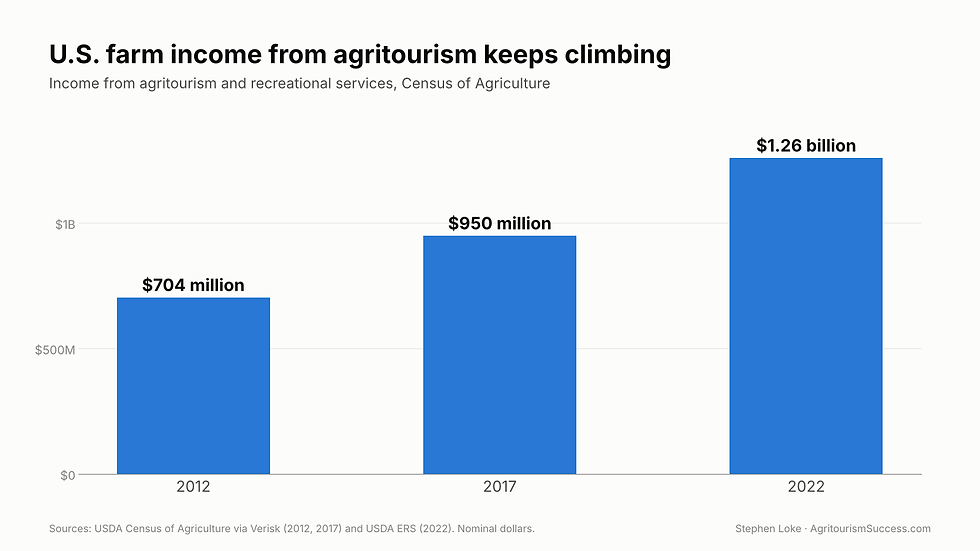
Animals are one of the biggest draws in that business, and they are the one attraction that brings a federal agency into the picture. A corn maze answers to your county. A petting zoo can answer to Washington.
There is also a public health side that regulators and insurers watch closely. The 2023 Compendium of Measures to Prevent Disease Associated with Animals in Public Settings, published by the National Association of State Public Health Veterinarians, counted 156 outbreaks linked to animals in public settings from 2010 to 2020. Those outbreaks made 6,388 people sick, put 1,233 in hospital and caused 10 deaths.

The USDA license is mainly about animal welfare, not visitor illness. But when a child gets sick at your farm, lawyers and adjusters will look at every rule you did or did not follow. A missing license is the kind of detail that turns a defensible claim into an expensive one. I cover the illness side and its insurance traps in depth in The $7.55 Million Petting Zoo. Here we stay focused on the license.
What the Animal Welfare Act Actually Covers
Two definitions in the Animal Welfare Act decide almost everything: what counts as an "animal" and who counts as an "exhibitor".
Which animals count
The Act covers dogs, cats, rabbits, guinea pigs, hamsters, monkeys and any other warm-blooded animal the USDA decides is used for exhibition, research or as a pet. It then excludes farm animals, such as livestock and poultry, that are used or intended for use as food or fiber.
Read that exclusion carefully, because it is where most farmers trip. It does not say "farm animals are exempt". It says farm animals used for food or fiber are excluded. APHIS has long said the exclusion covers farm animals used for traditional production agriculture. The moment you put those same animals on display to draw visitors, they have a second job, and the second job is regulated.
That is exactly how the Montrose case was decided. The Judicial Officer agreed the farm's animals were raised for food. He held that when an animal serves two purposes, one exempt and one regulated, the owner needs a license covering the regulated purpose.
Who counts as an exhibitor
Under the Act, an exhibitor is anyone who shows animals to the public for compensation. The Act itself excludes people who take part in state and county fairs, livestock shows, rodeos and other fairs or exhibitions intended to advance agricultural arts and sciences.
"Compensation" is broader than a ticket price. In the Montrose decision, the Judicial Officer pointed to an earlier case about a dolphin at a resort. Nobody paid to see the dolphin, but it drew guests to the resort, and that was enough. The same logic applied to the orchard: animals that attract customers to buy apples are being exhibited for compensation, even if viewing is free.
PRO TIP "We don't charge for the animals" is one of the most common assumptions behind farms that turn out to be exhibitors. If the animals help you sell tickets, pumpkins, birthday parties or farm-shop sales, assume they are part of your business, on your license questions and on your insurance application. |
APHIS also says display includes television, movies, the internet and social media. If your goats are the star of your Instagram feed and the reason families book, that is part of the picture too.
Which Animals Does the USDA Care About?
Here is how the rules sort the animals most farms put in front of visitors.

Animal group | Covered by the Act? | What usually decides it |
Reptiles, amphibians, fish | No | Cold-blooded animals are outside the Act |
Horses, donkeys, mules | No (unless used in research) | APHIS lists horse exhibits among non-regulated shows |
Goats, sheep, cows, pigs, llamas, alpacas | Yes, when exhibited | Exempt at agricultural fairs and shows, or under the 8-animal rule |
Rabbits | Yes, when exhibited or sold as pets | Same farm-show exemption; count toward the 8-animal rule |
Guinea pigs, hamsters, ferrets, chinchillas | Yes | Pet animals; count toward the 8-animal rule |
Deer, bison, camels, zebras, wallabies, kangaroos | Yes | Wild or exotic animals; plan on a license |

The Exemptions That Keep Most Small Farms Out
APHIS lists several exempt exhibitors. Four of them matter for farm petting zoos.
1. Farm animals at agricultural shows and fairs
Anyone who arranges or takes part in showing only domesticated farm-type animals at agricultural shows, fairs and exhibits is exempt. APHIS gives petting zoos with cows, pigs, sheep, goats, rabbits, llamas and alpacas as an example.
There is a catch in the same paragraph. If you exhibit other regulated animals alongside your farm animals for non-agricultural purposes, APHIS says you must be licensed. Its example is camel rides at carnivals.
2. The 8-animal hobby exhibitor rule
Since a 2018 rule change, anyone who keeps a total of eight or fewer pet animals, small exotic mammals and domesticated farm-type animals for exhibition is exempt from licensing. The regulation names cows, goats, pigs, sheep, llamas and alpacas as examples.
Three details decide whether you really qualify:
It is a total, not a count per species. Six goats plus three rabbits is nine animals.
It does not cover "other types of animals". One deer or wallaby in the mix takes you out of the exemption.
Partners count together. The exemption does not apply if you act together with others who, between you, keep more than eight of these animals for exhibition, regardless of who owns them.
3. Non-covered animals only
If every animal in your display is outside the Act, such as reptiles, fish, horses, donkeys and mules, there is nothing to license. APHIS lists reptile houses and horse exhibits as examples.
4. You do not show animals to the public at all
Animals you keep only for your own enjoyment, and never put on show, are a private collection. Farm animals raised only for food, fur and fiber are exempt by law. The trouble starts when the private animals become part of the visitor experience.

The gray zone: your own farm, every weekend
Here is the part nobody likes. The fair exemption speaks of agricultural shows, fairs and exhibits. A year-round petting area at your own farm, used to sell pumpkins, parties and farm-shop goods, looks a lot more like the Montrose orchard than a county fair.
Iowa State University's Center for Agricultural Law and Taxation put it this way when it reviewed the North Carolina fair cases: exhibitors who show farm animals for non-agricultural purposes, such as petting zoos, must be licensed under the federal Animal Welfare Act.
My advice: if you keep more than eight animals as an on-farm attraction, assume you need a license and ask APHIS to tell you otherwise in writing. Do not decide it alone. Montrose did, and spent five years in proceedings.
The Free APHIS Screening Tool: Use It Before You Open the Gate
APHIS runs a free online Licensing and Registration Assistant at efile.aphis.usda.gov/LRAssistant/s/. It asks about your animals and activities and tells you whether you are likely to need a license or registration.
Here is how I would use it:
List every animal by species and number, including the ones that only come out for parties or holidays.
List every activity: on-farm petting, feeding, bottle-feeding, goat yoga, school visits, birthday parties, animals taken to fairs or events, and photo shoots.
Note every place the animals appear, including off-site events and your social media.
Run the Assistant and save or print the result with the date.
Email APHIS Animal Care at animalcare@usda.gov, or call (970) 494-7478, with your list and ask for a written answer.
File the reply with your insurance papers and update it whenever you add animals or activities.
WHY "IN WRITING" MATTERS In the Montrose case, the owner asked repeatedly for a written explanation of why his farm needed a license. The Judicial Officer found APHIS had no legal duty to give one. He still treated the owner's efforts as good faith, and that is a big reason no fine was imposed in the end. A dated email showing you asked the right question is cheap protection. |
The Montrose Orchards Story: How a Free Animal Display Became a Federal Case
The full record of this case is public, and it is the clearest real-world lesson on this topic I know of. Here is how it unfolded.

After the first visit in September 2003, the inspector came back in October. On December 1, 2003, he returned with his supervisor and a senior investigator and handed the owner an official notice of violation. More inspections followed in 2004, 2005 and 2006. Each time the animals were still on show, and each time the owner said the farm was exempt.
USDA filed a formal complaint in January 2006. After a hearing in Flint, Michigan, the Chief Administrative Law Judge ruled in April 2007 that the farm was an exhibitor and assessed a $1,000 penalty. APHIS had asked for $4,000.
On appeal, the Judicial Officer's final decision in May 2008 went further on the law and softer on the money. He held that animals with both a food purpose and a display purpose need a license. He ordered the farm to stop exhibiting until it was licensed. Because the rules were genuinely unclear on dual-purpose animals and the owner had acted in good faith, he decided no fine was warranted.
Three lessons for your farm:
"They end up as food" is not a defense once animals are also used to attract visitors.
"We don't charge admission" is not a defense when the display brings customers in.
Good faith matters. The owner who asks questions in writing is treated very differently from one who ignores the notices.
What It Costs to Get Licensed
Compared with almost anything else on a farm, a USDA exhibitor license is cheap.
Since APHIS's 2020 licensing rule took effect, every license costs a flat $120 and lasts three years. Under the old system, licensees paid annual fees that could run from $40 to $760. You must be 18 or older to apply, and you can apply online or on APHIS Form 7003A.

The real work is the inspection. You must be fully compliant to pass a pre-license inspection. You get up to three inspections within 60 days of the first one to fix problems. Fail all three and you must wait at least six months before applying again.
Once licensed, inspectors make unannounced visits. The standards cover humane handling, housing, space, feeding and watering, sanitation, ventilation, shelter from extreme weather, adequate veterinary care and keeping incompatible animals apart.
A few rules catch growing farms out:
Licenses are issued in blocks of 50 animals on hand at any one time. Go over your authorized number and you need a new license first.
A new license is needed when you change ownership, location or type of activity.
Showing animals away from your approved site, at fairs, schools or parties, must be declared on your application, with itineraries filed under the regulations.
Plan renewal early. APHIS asks licensees to apply at least 90 days before the current license expires.
PREPARE FOR THE PRE-LICENSE INSPECTION LIKE AN UNDERWRITER WOULD Before you apply, walk your animal area with a notebook. Clean water and feed, sound fencing, shade and shelter, a written relationship with a vet, records of animals on hand, and a cleaning schedule. Everything an inspector checks is also something a liability insurer wants to see. Do it once and you satisfy both. |
What It Costs If You Skip It
Now the other side of the ledger.
The Animal Welfare Act lets the USDA assess a civil penalty for each violation, and it says each day a violation continues is a separate offense. The statutory maximum of $10,000 per violation has been adjusted for inflation to $14,575 for violations after May 29, 2025. Knowingly ignoring a cease-and-desist order carries its own penalty of $2,185 per offense, again counted per day. An exhibitor who knowingly violates the Act can also face criminal charges, with up to one year in prison, a fine of up to $2,500, or both.
The USDA must consider the size of your business, how serious the violation is, your good faith and your history when it sets a penalty. That is why small, cooperative farms often get warnings first.

What enforcement looks like in practice:
An official warning. In May 2021, APHIS issued an official warning to Second Chance Rescue and Exotics in Lake City, Michigan, after officials saw the business exhibiting animals to the public for a fee without a license in October 2020. The notice warned that future violations could bring civil penalties or criminal prosecution.
A cease-and-desist order. That is how Montrose ended: no fine, but no animal display either until the farm got licensed.
A negotiated penalty. Arbuckle Adventures, a licensed walk-through and drive-through zoo in Oklahoma, agreed to a $30,000 civil penalty in a USDA consent decision that also required its drive-through park to pass inspection before being added to its license.
The penalties are not the biggest risk, though. The biggest risk is what an unlicensed operation does to you after a visitor gets hurt or sick.
The Insurance Side: What Every Petting Zoo Owner Should Know
This is where I want you to slow down, because the license and your insurance are tied together in ways most farm owners never see until a claim.
A USDA license is not insurance
An APHIS license says your animals are cared for to federal standards. It says nothing about your liability coverage. Plenty of licensed exhibitors are underinsured, and plenty of farms with good insurance have no idea they need a license. You need both conversations.
Your application answers can come back to bite you
When you apply for farm or agritourism liability coverage, the insurer prices the risk based on what you tell it. If you describe "a few farm animals" and the adjuster later finds a 20-animal petting attraction drawing hundreds of families, the insurer may argue you misrepresented the risk. Depending on your state and the wording, that can mean a denied claim or a cancelled policy.
Petting zoos are usually treated as a separate exposure. A standard farm liability policy may not cover them until they are added, often through an agritainment endorsement such as the ISO form FL 05 01 that covers only the activities scheduled on it. The National Agricultural Law Center's agritourism insurance fact sheet notes that foodborne illness is not usually addressed in a general farm liability policy.
A missing license is a gift to the other side's lawyer
In a lawsuit, the question is whether you acted reasonably. In many states, breaking a safety-related rule can be used as evidence that you did not. An inspector's notice or a missing license will not decide a case by itself, but it hands the plaintiff an easy story: this farm ignored federal rules about animals. Defense lawyers hate that story, and adjusters price it into settlements.
Real money, real farms
Two cases show how far the numbers can go when animal contact goes wrong:
Big Fresno Fair, California. A 2-year-old girl developed kidney failure and strokes after E. coli linked by her family to the fair's petting zoo. The fair paid $2.15 million and the company that supplied the hand-washing stations paid $50,000. The petting zoo operator's own insurer denied coverage.
Dehn's Pumpkins, Minnesota. In 2016 a jury awarded $7.55 million to a child who developed hemolytic uremic syndrome after an E. coli outbreak linked to cows children petted and fed at a pumpkin farm. I break this case down, along with the five coverage trapdoors behind it, in The $7.55 Million Petting Zoo.
RED FLAG CHECK FOR YOUR POLICY Ask your agent three questions in writing: Is my petting zoo or animal exhibit named on my policy? Does any endorsement exclude communicable disease, bacteria or animals? Does my umbrella sit over the animal activity? If any answer is "I'm not sure", you have homework before next season. |
If your current carrier will not write animal contact at all, read what to do when your farm insurer says no, and for a full picture of policies and prices, see agritourism insurance: what it covers, what it costs and how to get quotes.
State Rules Sit on Top of the Federal License
The USDA license is only the federal layer. Your state may add its own rules, and some were written in response to tragedy.
In October 2004, an E. coli outbreak at the North Carolina State Fair sickened 108 people. The CDC reported 15 cases of hemolytic uremic syndrome, a dangerous kidney complication, mostly in young children. One of them was a 2-year-old named Aedin. In 2005 the state passed what became known as Aedin's Law, which requires permits, hand-washing stations, special signs, food and drink limits and supervision of children under six at animal exhibits at North Carolina agricultural fairs.
Even with those rules in place, the 2012 Cleveland County Fair outbreak was traced to a petting zoo. It left 106 people ill, and a 2-year-old boy died. Investigators said heavy rain during the fair may have spread contamination from the petting area. Rules reduce risk. They never remove it.
Most states also have an agritourism liability statute. The National Agricultural Law Center counts about 40 states with some kind of agritourism law. These laws can limit your liability for inherent risks, often only if you post a warning sign with exact wording. They rarely protect you from your own negligence, and operating without a required license is exactly what a plaintiff will call negligence. Check your state in my 50-state guide to agritourism laws, see where to post your warning signs, and read whether liability waivers really protect your farm.
Your 7-Day Petting Zoo Compliance Plan
You can get this whole question settled in a week. Here is the plan I would follow.
Day 1: Count. Write down every animal by species and number, including the ones that only come out for events.
Day 2: Map your activities. On-farm petting, feeding, parties, school groups, off-site events, photo shoots and social media.
Day 3: Screen. Run the APHIS Licensing and Registration Assistant and save the result.
Day 4: Ask in writing. Email APHIS Animal Care with your list and the Assistant's result. Ask whether you need a Class C license.
Day 5: Check your state. Call your state department of agriculture about animal exhibit permits and review your state's agritourism statute.
Day 6: Call your agent. Disclose every animal activity, confirm it is named on your policy, and ask about disease exclusions and umbrella coverage.
Day 7: Build your file. Put the APHIS answer, the state answer, your insurance confirmation, your vet contact and your cleaning log in one folder. Update it every season.
Frequently Asked Questions
Do I need a USDA license for a farm petting zoo?
Not always. You may be exempt if you show only domesticated farm animals at agricultural fairs and shows, keep eight or fewer animals for exhibition in total, or show only animals the Act does not cover, such as reptiles and horses. A larger on-farm petting attraction, or any exotic animal in the mix, usually needs a USDA Class C exhibitor license.
What is a USDA Class C exhibitor license?
It is the license the USDA's Animal and Plant Health Inspection Service issues under the Animal Welfare Act to people who exhibit regulated animals to the public. Class A and Class B licenses are for breeders and dealers.
How much does a USDA exhibitor license cost?
A flat $120 for a three-year license, under APHIS's 2020 licensing rule. You must also pass a pre-license inspection before the license is issued.
Do goats, sheep and pigs need a USDA license?
Farm animals used only for food or fiber are excluded from the Animal Welfare Act. Once they are exhibited to attract visitors, they can be regulated. Showing them only at agricultural fairs and shows, or keeping eight or fewer for exhibition, can keep you exempt.
I don't charge admission. Do I still need a license?
Possibly. In the Montrose Orchards case, the USDA found that free animal displays which attract paying customers are exhibited for compensation. No admission fee does not, by itself, mean no license.
How do I check if I need a USDA exhibitor license?
Use APHIS's free online Licensing and Registration Assistant at efile.aphis.usda.gov/LRAssistant/s/, then email APHIS Animal Care at animalcare@usda.gov with your animal list and ask for a written answer.
Does a USDA license protect me from lawsuits?
No. A license shows your animals meet federal care standards. It does not replace liability insurance, a disease-coverage check, warning signs or a written safety system.
The Bottom Line
The USDA exhibitor license is one of the cheapest pieces of protection in all of agritourism. For $120 every three years, plus an inspection you should want to pass anyway, you remove a federal enforcement risk and take away one of the easiest arguments a plaintiff's lawyer could make against you.
If you are clearly exempt, wonderful. Get that in writing too. Either way, the farms that do well with animals are the ones that settle these questions before the first family walks through the gate, not after the first notice arrives.
If you want to see how ready your farm really is for visitors, including the rules and insurance questions most farms miss, start with my free Farm Readiness Quiz. Or grab my free 21-Point Agritourism Blueprint, the step-by-step checklist I used to build a farm that welcomes 50 to 100 visitors a week in season.
Sources
USDA APHIS: Licensing and Registration Under the Animal Welfare Act (Program Aid 1117, revised 2023)
9 CFR 2.1: Licensing requirements and exemptions (Cornell LII)
7 U.S.C. 2149: Penalties under the Animal Welfare Act (Cornell LII)
USDA APHIS official warning: Second Chance Rescue and Exotics (2021)
USDA consent decision: Arbuckle Adventures, LLC, AWA Docket No. 16-0003
Kansas KDHE: Fairs and Festivals Disease Prevention (citing the NASPHV 2023 Compendium)
CDC MMWR: E. coli O157:H7 outbreaks associated with petting zoos, 2004 and 2005
Iowa State CALT: 2004 North Carolina State Fair E. coli case and Aedin's Law
Food Poison Journal: Cleveland County Fair petting zoo outbreak findings
Minnesota Lawyer: $7.5 million E. coli verdict against Dehn's Pumpkins
National Agricultural Law Center: Agritourism and insurance fact sheet
National Agricultural Law Center: Webinar on agritourism and equine liability statutes
This article is general education, not legal or insurance advice. Rules change and every farm is different. Confirm your licensing status with USDA APHIS Animal Care, and your coverage with a licensed agent and an attorney in your state.


Comments