



The Invisible Thief on Your Farm: How Post-Harvest Losses in Southeast Asia Quietly Steal Up to Half Your Fruit Money (And How to Stop Him)

Update (October 2026): No big CA room? Read Controlled Atmosphere Storage Without a Big Cold Room: A Plain-English Guide

Here is a hard truth most growers never hear.
The fruit you lose is not the fruit you see rotting in the bin.
The real loss is quieter. It hides in the 4% of weight that dries away on the lorry. It hides in the "Grade B" price a buyer hands you for fruit that was "Grade A" yesterday. It hides in the durians you sell for RM5 a kilo because the whole country harvested at the same time and you had nowhere to keep them.
None of that shows up on an invoice. None of it has a line in your accounts. So most farmers never add it up.
In this article, we will add it up together. We will look at what the best research says about post-harvest losses in Southeast Asia and in Malaysia. We will walk the chain from the tree to the market and point to the exact places where your money leaks out. Then we will look at what packhouses and exporters around the world are now doing to stop the leak, including the controlled atmosphere modules we are testing on our own durians at Bloopy Durians in Bentong.
Read it slowly. One idea in here could be worth more to you than a whole season of hard work.
Key Stat Up to 20% to 50% of fruits and vegetables are lost in Malaysia's food supply chain, according to the Ministry of Agriculture and Food Security's draft National Food Security Blueprint 2030.
Why Farmers Don't See the True Loss
Ask ten growers how much they lose after harvest. Most will say "a little bit." Maybe 5%. Maybe "only the bad ones."
That is because we only count what we throw away.
But a post-harvest loss has three faces. Only one of them is easy to see.
Loss you can see: fruit that rots, splits, bruises or gets eaten by pests. It goes in the bin.
Loss you can weigh: water that leaves the fruit after picking. The fruit still looks fine. But you are paid by the kilo, and the kilos are gone.
Loss you can't feel until payday: quality drops, so the price drops. Or the market is flooded, so you sell cheap or not at all.
The first face is maybe a third of the story. The other two are where your money really disappears.
Field Note Researchers at a leading US extension service note that most fresh produce can no longer be sold once it has lost about 3% to 5% of its fresh weight. Your fruit can look perfect to you and still be "too tired" for a picky buyer.
The Big Picture: Post-Harvest Losses in Southeast Asia
Let us start wide, then zoom in to your farm.
The world loses about 13% of its food before it reaches a shop
The UN Food and Agriculture Organization (FAO) tracks food loss from the farm, through transport, storage, wholesale and processing. Its latest figure is about 13.3% of all food lost after harvest in 2023. FAO says the world has made no real progress on this since 2015.
For Eastern and South-Eastern Asia, the figure is about 13.9%.
That number sounds manageable. Until you look at what kind of food is being lost.
Fruit and vegetables lose the most, by far
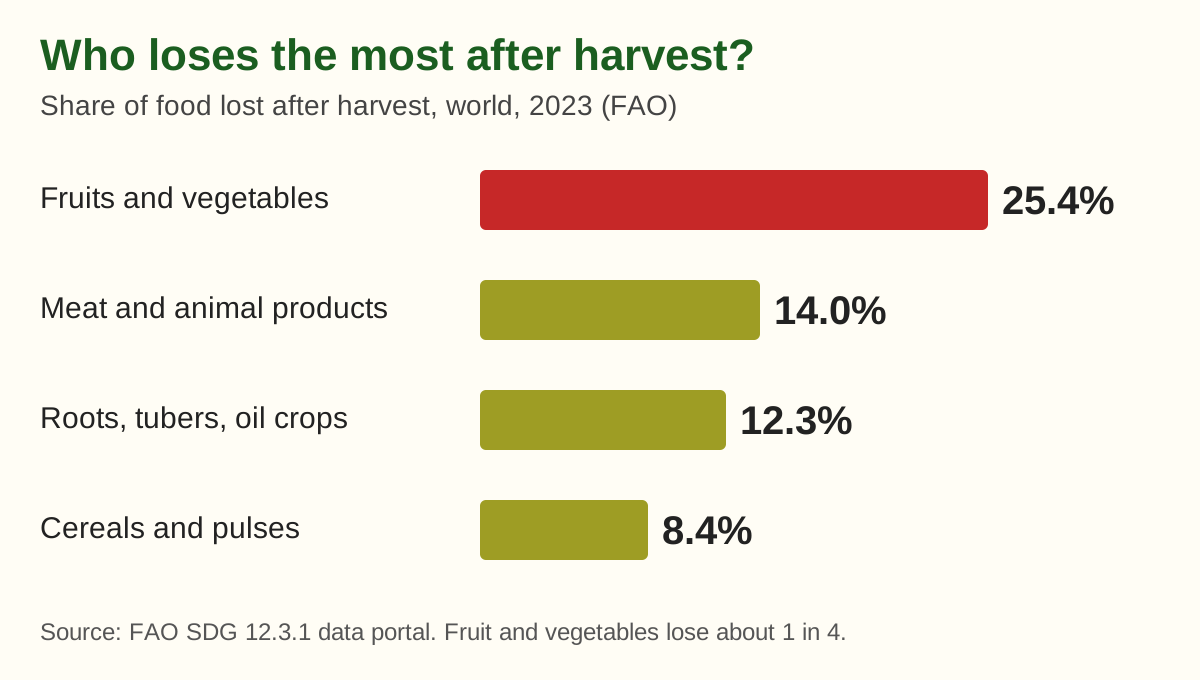
FAO breaks the loss down by type of food. Here is the 2023 picture:
Type of food | Share lost after harvest (world, 2023) |
Fruits and vegetables | 25.4% |
Meat and animal products | 14.0% |
Roots, tubers and oil crops | 12.3% |
Cereals and pulses (rice, wheat, beans) | 8.4% |
Read that again. One in every four fruits and vegetables grown in the world is lost before it reaches a shop. And that share went up from 23.2% in 2015.
Rice and grain are dry. They forgive mistakes. Fruit does not. A mangosteen, a pineapple or a durian is still alive after you cut it. It keeps breathing. It keeps using up its own sugar and water. Every hour you wait, it gets a little older.
Across the region, the numbers get worse
A McKinsey analysis published in 2023 put food lost or wasted in Southeast Asia at close to 17% of the food available in the region. It reported Indonesia losing about 20% of harvested crops a year and the Philippines losing up to 50%.
Now look at one real study from the Philippines. It was funded by the Asian Development Bank and carried out by SEARCA, a regional farm research centre. The team followed produce from farm to Manila markets:
Mango from Iloilo to Manila: about 34% lost, worth about P434 million.
Fresh onion from Nueva Ecija to Manila: about 45% lost, worth about P1.96 billion.
Tomato from Bukidnon to Manila: about 24% lost. The study linked the higher loss to the longer journey.
And here is the part that should make every packhouse owner sit up. The same study found cold-stored onions on the same route lost even more, about 64%.
How can cold storage make it worse? Because a cold room is only as good as the fruit you put into it and the way you manage it. Damp, bruised or badly sorted produce rots faster when you seal it away and forget it. We will come back to this lesson later. It matters.
Money Lesson Buying a cold room does not buy you profit. Good harvest handling plus the right storage, used the right way, buys you profit. The equipment is the last step, not the first.
Post-Harvest Losses in Malaysia: What the Government's Own Numbers Say
Now let us come home.
Up to 20% to 50% of fruit and vegetables lost in the supply chain
In 2025, the Ministry of Agriculture and Food Security (KPKM) released its draft National Food Security Blueprint 2030. It said up to 20% to 50% of fruits and vegetables are lost in Malaysia's food supply chain.
The blueprint also named the reasons. They will sound familiar to anyone who has worked a Malaysian harvest:
Limited knowledge of good handling practice.
Cold chain facilities that don't connect from farm to market.
Old transport and poor rural roads, so produce spends longer in the heat.
Collection and packing centres that lack proper sorting, packing and pre-treatment.
Overproduction and poor market distribution, so surplus fruit gets thrown away.
Two numbers from that report stand out:
Key Stat About 27% of Malaysia's fruits and vegetables go straight to wholesalers with no post-harvest handling at all. And only 14% of stakeholders use cold storage, mainly because of cost, limited space and distance.
MARDI's farm-level study: 14% lost in a normal year, up to 50% in bad weather
MARDI, the Malaysian Agricultural Research and Development Institute, has started measuring food loss crop by crop. Its early work on pineapple, watermelon and mustard greens found losses of up to about 14% at farm level in normal weather.
In 2026 the ministry added a warning. When the weather turns unpredictable, or harvest falls in the rainy season, those losses can climb to as much as 50%.
MARDI's researchers also spotted a pattern worth remembering. Losses rose with every extra round of handling and every extra day in the supply chain. For pineapple, the critical point was harvest itself, mostly from physical damage. For watermelon, the biggest losses came at the wholesale stage, from pests and disease.
In plain words: the more times your fruit is touched, and the longer it waits, the more you lose.
Field Note MARDI's figures count fruit that leaves the food chain completely. They do not count lost weight or lost grade. So the true money loss on many farms is higher than the headline number.
The Loss Chain: Where Your Money Disappears, Step by Step
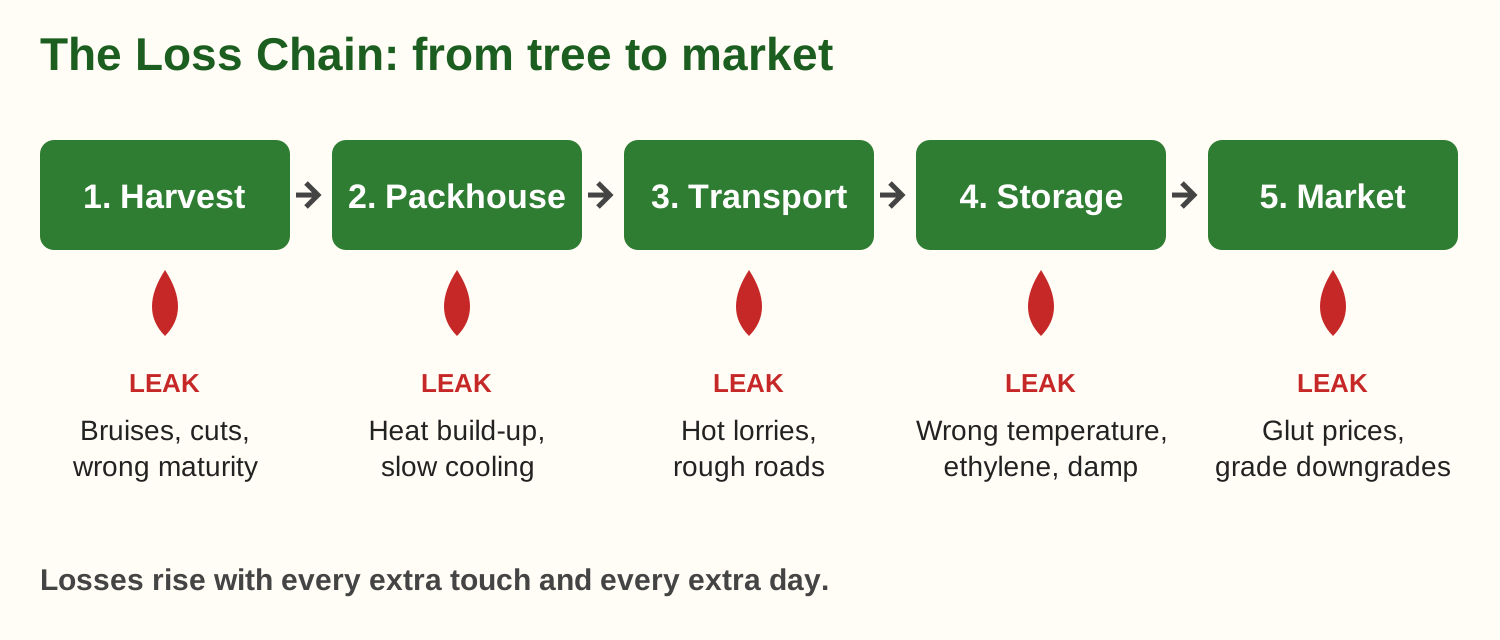
Picture your fruit's journey as a pipe running from your tree to your customer. Every joint in that pipe can leak. Here are the five joints where most of the money escapes.
Leak No. 1: Harvest
This is where damage starts. A pineapple dropped into a trailer. A durian that hits a rock instead of a net. Mangosteens tipped from one basket into another.
Bruises don't always show on day one. They show on day three, at the buyer's stall, as brown flesh and a lower price.
Picking at the wrong maturity is another silent leak. Fruit picked too early never tastes right. Fruit picked too late has no shelf life left to sell.
Leak No. 2: The field and the packhouse
Fruit picked at noon in Pahang can be very hot inside. That heat is the enemy.
Post-harvest scientists use a simple rule: for many crops, the breathing rate of fresh produce roughly doubles for every 10°C rise in temperature. Faster breathing means faster ageing. One extension guide puts it bluntly: a 10°C rise can cut shelf life roughly in half.
So a crate left in the sun for two hours, waiting for the lorry, is quietly losing days of selling time.
Leak No. 3: Transport
KPKM's blueprint points straight at transport. Cold chains that don't connect, ageing vehicles and poor rural roads all mean more time in the heat.
The Philippine study showed the same thing. Tomatoes on the longer Bukidnon route lost more than twice as much as those on a shorter route.
Leak No. 4: Storage
Storage is where good fruit is supposed to be protected. Often, it is where fruit quietly dies.
Too warm: the fruit breathes fast and ages fast.
Too cold: many tropical fruits suffer chilling injury. That means skin damage, dark spots, or flesh that never ripens properly. Pineapple, for example, is at risk below about 7°C.
Too dry: the fruit loses water and weight.
Ethylene: this is a natural ripening gas that fruit gives off. Even tiny amounts can speed up ripening in nearby fruit. One ripe fruit can push a whole room to ripen early.
Leak No. 5: The market
This is the biggest leak of all, and the one farmers talk about least.
When everyone harvests at the same time, prices fall through the floor. You have two bad choices. Sell cheap now. Or watch the fruit spoil while you wait for a better price.
Without a way to hold fruit in good condition, you have no power to wait. The market sets your price, not you.
Action Step Take a notebook to your next harvest. Write down how long each batch waits in the sun, how many times it is moved, and how long until it is cool. Most farmers are shocked at what they find.
The Durian Problem: A Fruit That Gives You Almost No Time
If any fruit shows the true cost of post-harvest loss, it is the durian.
A very short selling window
Malaysian growers traditionally wait for the fruit to drop. That gives the best flavour. But it also starts a very fast clock.
A study from Universiti Putra Malaysia noted that ripe, fallen durians split open (dehisce) within about 3 days of ripening. A logistics report on Malaysian durian exports described naturally fallen, fully ripe durians as lasting only about one to two days at their best. That short window is a big reason so much Malaysian durian has been frozen for export.
Cooling helps, but only up to a point. Durian is a tropical fruit and does not like real cold.
A Thai research team found that holding durian at 12°C for a week caused chilling injury to the rind and the unripe flesh.
Another Thai study found younger fruit got chilling injury at 13.5°C, while storage life overall topped out at about 2 weeks at around 13.5°C to 16.5°C, depending on maturity.
So you can't just throw durians into a cold room and walk away.
China wants fresh durian, and the bar is high
Here is why this matters right now.
In June 2024, Malaysia signed a protocol allowing fresh whole durians to be exported to China. Before that, Malaysia could only send pulp, paste and frozen whole fruit. By June 2025, KPKM reported Malaysia had shipped 773 tonnes of fresh durian to China, worth nearly RM50 million.
China's appetite is huge. Chinese customs data reported over 1 million tonnes of durian imported in just the first half of 2026, up from 708,000 tonnes a year earlier. Malaysia's share is still small, but its export value to China jumped 342% in that half-year.
Fresh fruit pays more than frozen. But fresh fruit must arrive in China still firm, still sound, still smelling right. Every day of shelf life you add is a day more of buffer for customs checks, port delays and the buyer's own shelf.
The glut: when too much fruit becomes a loss
Then there is the flip side. In January 2026, The Star reported Musang King selling at around RM20 to RM30 a kilo, down from RM60 to RM80 the season before, as harvests in several states landed at the same time. In June 2026, a FAMA official said kampung durian was fetching just RM1 to RM4 a kilo at the farm gate, with Musang King spotted as low as RM5 a kilo in Bentong.
A Penang agriculture officer called it a capacity problem, not a demand problem.
Think about that. The demand is there. The fruit is there. What's missing is the ability to hold good fruit for a few more days or weeks, until the price recovers or the export lorry is ready.
Key Stat Musang King: about RM60 to RM80/kg in one season, about RM20 to RM30/kg the next (The Star, Jan 2026). Same fruit. Same farms. The only difference was timing.
Squeezed by falling prices and rising costs? Read why you pay for months before you get paid, see how farms use agritourism to fill the gap when crop prices fall, and learn how Malaysian vegetable growers fight cheap imports.
What a 10% Loss Really Costs You (Plain Numbers)
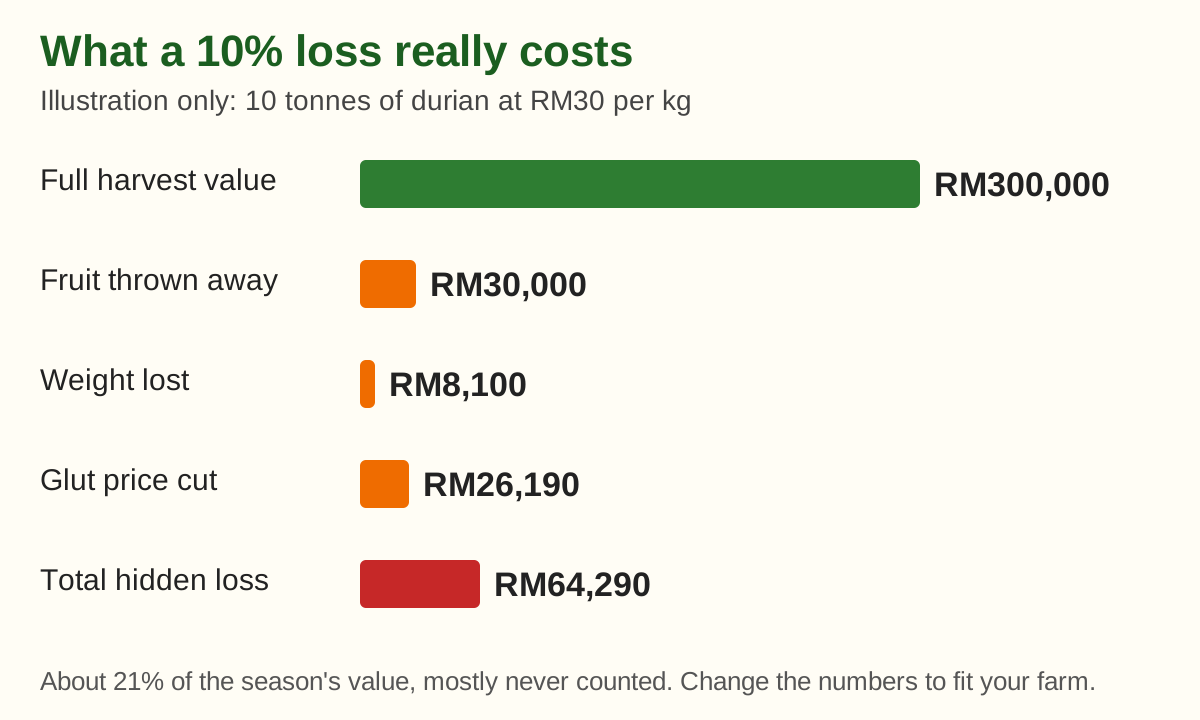
Let us put this into ringgit. The numbers below are an illustration only. Change them to fit your own farm.
Say you sell 10 tonnes of premium durian in a season, at an average of RM30 per kg.
Item | Illustration |
Fruit harvested | 10,000 kg |
Price per kg | RM30 |
Full value of the harvest | RM300,000 |
Fruit lost or unsellable (10%) | 1,000 kg = RM30,000 gone |
Water weight lost on the rest (say 3%) | 270 kg = RM8,100 gone |
Forced to sell 20% of the crop in a glut at RM15 instead of RM30 | 1,746 kg x RM15 = RM26,190 gone |
Total hidden loss | about RM64,000, or over 21% of the season |
Only the first line, the RM30,000, is the loss most farmers ever count. The other RM34,000 just quietly never arrives.
Now picture saving even half of that. RM32,000 a season. For a smaller farm, that could be the difference between a year of profit and a year of debt.
For a packhouse or exporter moving hundreds of tonnes, add a zero. Or two.
Money Lesson Every ringgit you save after harvest is pure profit. You already paid for the land, the fertiliser, the labour and the waiting. Saving fruit you have already grown is the cheapest growth any farm can buy.
How to Keep Fruit Fresh After Harvest: The Basics Come First
Before we talk about any equipment, here is the honest truth. Most post-harvest loss is fixed with discipline, not money. These steps cost little and pay back fast.
Harvest at the right maturity. Know your variety's signs. Train your workers to know them too.
Handle like eggs. Use padded crates. Never throw or drop fruit. Cut the number of times each fruit is moved.
Get it into shade fast. Every minute in the sun costs shelf life.
Cool it quickly, to the right temperature. Not too cold for tropical fruit. Check the safe range for each crop.
Sort hard. Pull out damaged and diseased fruit before storage. One rotten fruit can infect a whole bin.
Keep fruit dry going into storage. Fruit picked in rain or packed wet rots faster.
Separate fruit that gives off a lot of ethylene from fruit that is sensitive to it.
Plan your sales before you harvest. Know where each batch is going, and when.
Do these well, and you are already ahead of most of the market.
But even perfect handling has a ceiling. A fresh fruit is a living thing, and it will keep ageing in normal air. To go further, you need to slow the fruit down.
Controlled Atmosphere Storage: Slowing the Clock
This is where the world's biggest apple and pear growers have been ahead of us for decades.
What is controlled atmosphere storage?
Normal air is about 21% oxygen. Fruit uses that oxygen to breathe and ripen.
Controlled atmosphere storage (often called CA storage) keeps fruit in cool air with much less oxygen and a bit more carbon dioxide. With less oxygen, the fruit breathes more slowly. It ages more slowly. It makes less ethylene. In simple terms, you are putting the fruit into a gentle sleep.
Big CA rooms are common for apples in Europe, America and China. But they are costly. And when you open the room, the whole room "wakes up" at once.
What independent research says about CA on tropical fruit
Here is what published studies, not salespeople, have found:
Crop | Normal air | Controlled or modified atmosphere | Source |
Mangosteen (at 13°C) | about 16 days | up to about 28 days | Acta Horticulturae, 2003 (Thai study) |
Pineapple (at 10°C) | 2 to 4 weeks | 4 to 6 weeks | UC Davis Postharvest Center |
Monthong durian (at 15°C) | shorter | up to about 3 weeks, with a membrane-window atmosphere plus a ripening blocker (1-MCP) | International Journal of Fruit Science, 2022 |
Durian (at 22°C) | ripened in 4 to 5 days | 5% to 7.5% oxygen held ripening back for a week, then fruit ripened normally | Thailand Institute of Scientific and Technological Research, 1989 |
Notice one warning inside that durian research. At 2% oxygen, durians were damaged and failed to ripen properly. Too little oxygen is as bad as too much. The atmosphere has to be set right for each fruit. That is why testing comes before scaling up.
Janny MT: Controlled Atmosphere in a Box
Now to the part many packhouse owners and exporters have been asking us about.
Janny MT is a French company that has spent years making CA storage small. Instead of one giant sealed room, it puts controlled atmosphere into individual pallet-sized boxes, called modules.
Bloopy Durians holds the rights to distribute and sell Janny MT modules, and we can supply them across Southeast Asia and the wider Asian region. The modules are still new to Asia. As far as Stephen knows, Bloopy Durians was the first to test them on durians in Malaysia.

How it works, in plain English
Each module is a strong plastic pallet box with a special lid. Here is what happens inside:
You cool the fruit first in your cold room, with the lid off, until it reaches the recommended storage temperature.
You clip the lid on. A seal locks the box.
The fruit keeps breathing and slowly uses up the oxygen inside the box.
Special membranes in the lid let gases pass in and out at a controlled rate. Janny MT says this holds oxygen and carbon dioxide at roughly 1% to 5%.
Removable plugs close or open some of the membranes. That is how the same box is set up for different fruits.

No gas tanks. No pumps inside the box. No chemicals. The fruit's own breathing does the work. Janny MT also sells small gas meters (the Tiempo Test range) so you can check oxygen and carbon dioxide without opening the box. They strongly advise using one.
Because the lid seals in moisture, Janny MT says weight loss is cut to about 1.5% at most, compared with around 10% for some fruits in normal cold storage. That is the company's own claim, made for its European crop list. We have not seen independent tests of that figure on tropical fruit.

The key facts about the module
Feature | Detail | Who says so |
Volume | 610 litres | UK dealer Dejex |
Outside size | about 101 x 121 x 81 cm (a standard 100 x 120 cm pallet footprint) | Dejex; Janny MT FAQ |
Weight | about 50.5 kg | Dejex |
Max payload | about 600 kg | Dejex |
Lifespan | 15 years or more, no membrane replacement needed | Janny MT FAQ |
Consumables | None | Janny MT FAQ |
Cleaning | Washable with water | Janny MT FAQ |
Cooling | The box does not cool itself. It must sit in a cold room or other refrigerated space. | Janny MT FAQ |
Built to stack: save space, grow as you grow
This is one of the biggest practical wins.
Janny MT states that its modules are stackable, up to 9 or 10 high depending on the produce inside. The bottom module can carry up to 2.4 tonnes on top of it. The company says the lid is designed so stacking does not spoil the seal or the storage quality.
What does that mean for you?
You use the height of your cold room, not just the floor. More fruit, same room.
You start small. Buy a few modules this season. Add more next season as your volume grows. No need to build a giant CA room on day one.
You open one box at a time. In a big CA room, opening the door wakes up all the fruit. With modules, you take out only the box you are selling today. The rest stay asleep.
Empty boxes nest. Janny MT says three empty bins take the space of two, which helps in the off-season.
Stacking heights depend on your forklift, your floor and the fruit. Always follow the manufacturer's guidance for your crop.

Into reefers: taking controlled atmosphere on the road
A reefer is a refrigerated truck or a refrigerated shipping container. Think of it as a cold room on wheels.
Here is what we can say with confidence:
The modules are built on a standard pallet footprint, so they can be handled by forklift and loaded like any pallet.
Janny MT says the box does not cool itself and must be used inside refrigeration. A properly set reefer is a refrigerated space.
Janny MT ships its modules worldwide by truck and container. It says a standard truck can carry up to 117 modules and a 40-foot container up to 95. Note: these are the company's delivery figures. They are not the number of fruit-filled modules that fit in a reefer.
Janny MT has also worked on transport. An EU research grant it received in 2018 aimed to help growers move high-value fruit by sea or rail instead of air, using controlled atmosphere.
Yes, the modules fit inside a reefer, and because they stack, you can build the load upward. So the idea is simple. Seal your fruit in the module at the packhouse. Load the modules into a reefer set to the right temperature. The fruit keeps its low-oxygen "sleep" while the reefer keeps it cool. At the other end, the buyer opens one box at a time.
But please be careful with one thing. A reefer full of fruit-filled modules is heavy, and reefers need space for cold air to flow around the cargo. How many filled modules fit in your reefer depends on the box size, the weight limit and airflow rules. Plan the load with your logistics partner and run a trial shipment first. We are happy to help you work it out.

Field Note Janny MT advises making sure the fruit has reached its recommended storage temperature before the lid goes on, and opening the module back inside the cold room after storage, letting the fruit "wake up" for 12 to 48 hours, depending on the product. Taking a cold, sealed box straight into the heat can shock the fruit and cut its shelf life.
What We Found in Our Own Tests at Bloopy Durians
We did not want to sell something we had not tried on our own fruit. So we tested it.
Here is what Stephen saw in his own field tests at Bloopy Durians:
Durians lasted about 5 to 10 days longer in the module than they would normally last.
Mangosteens lasted up to 18 days in the module.
Please read these numbers for what they are. They are our own farm tests, not a published scientific study. They are not a guarantee. Results will vary with the variety, how ripe the fruit was at harvest, the storage temperature, the module setup and how the fruit was handled before it went in.
Even so, think about what 5 to 10 extra days can mean for a durian. It is the difference between selling into a glut and selling after it. It is enough buffer to reach a buyer in another state, or to wait for the export lorry, instead of freezing the fruit or dumping the price.

Which other crops does it suit?
Janny MT says its modules suit many fruits, vegetables, mushrooms and flowers. The crops it names most often are temperate ones, such as apples, pears, plums and kiwi. It does not publish storage figures for durian, mangosteen or pineapple.
A grower in Michigan, USA, told trade magazine Fruitnet that he stored blueberries in the modules and then reused the same boxes for apples in the same year.
For tropical fruit like durian, mangosteen and pineapple, the honest answer is this: the published research on CA for these fruits is encouraging (see the table above), and our own durian and mangosteen tests were promising. But each crop and each variety needs its own setup. Test a small batch first.
Want the full Janny MT picture? Read The Complete Guide to Janny MT Post-Harvest Modules, see how the module stops you dumping harvest at glut prices, and the exporters and distributors guide.
Who This Helps Most
Farmers and smallholders
You can hold your best fruit through a short glut instead of selling at the bottom. You can start with a handful of modules in a small cold room and add more each season.
Packhouses and collection centres
KPKM's blueprint pointed straight at under-equipped packing centres. Modules let you add controlled atmosphere to an existing cold room without building a new CA room. You can run different fruits in different boxes, as long as they share a similar storage temperature.
Exporters
Every extra day of shelf life is buffer against port delays, inspections and long sea routes. Sea freight is usually far cheaper than air freight. Longer life in the box could make sea freight possible for more of your fruit.
Food security planners
When harvests flood the market, surplus fruit gets thrown away. KPKM's own blueprint names overproduction and poor distribution as causes of loss. Storage that can hold produce through a glut and release it over time helps keep supply steady. That is good for farmers, good for prices, and good for the country's food security.
Curious how Malaysia is putting its orchards on the tourism map? Read why Malaysia put 66 farms and orchards on its official tourism menu.
Who It Is Not For (Honest Limits)
We would rather lose a sale than sell you the wrong thing. So here are the limits.
It cannot fix bad fruit. Bruised, diseased or wet fruit will still go bad. Janny MT itself says to store only healthy, disease-free produce, and to avoid fruit picked in the rain.
It cannot fix bad handling. Remember the Philippine onions that lost more in cold storage? No technology replaces good harvest practice.
You need refrigeration. The module does not cool itself. No cold room or reefer, no result.
Tropical fruit can suffer chilling injury. Durian, pineapple and mangosteen each have a "too cold" line. Get the temperature right for each crop and test first.
Too little oxygen is harmful. Research on durian showed damage at 2% oxygen. Each crop must be set up correctly, and you should monitor gas levels.
Don't mix fruits in one box. Different fruits and varieties need different oxygen levels.
Don't open the box mid-storage. Oxygen shoots straight back up to normal and the fruit "wakes up."
It is an investment. It makes the most sense where fruit has good value and you lose real money to spoilage or gluts.
Action Step Start with a small trial: a few modules, one crop, one season. Measure your losses before and after. Let your own numbers decide.
Your 7-Day Plan to Find Your Own Hidden Loss
Day 1: Weigh 10 crates at harvest. Weigh them again when they reach the buyer. Write down the difference.
Day 2: Count how many times each fruit is touched from tree to lorry.
Day 3: Time how long harvested fruit sits in the sun before it is shaded or cooled.
Day 4: Record every grade downgrade and price cut from buyers this month.
Day 5: List how much fruit you sold below your normal price because of a glut last season.
Day 6: Put it all into the "10% loss" table above, using your own numbers.
Day 7: Decide: what is the cheapest fix? Better handling, faster cooling, or longer storage? Most farms need all three.
For more ways to earn more from the fruit you already grow, read whether agritourism is profitable, or learn how paying guests carried six family farms through drought and bad seasons.
Frequently Asked Questions
What are post-harvest losses in Southeast Asia?
Post-harvest losses are the fruit, vegetables and grain lost between harvest and the shop. FAO puts losses in Eastern and South-Eastern Asia at about 13.9% of food, and fruit and vegetables worldwide lose about 25%. In Malaysia, KPKM's draft blueprint says up to 20% to 50% of fruits and vegetables are lost in the supply chain.
What causes post-harvest losses in Malaysia?
The main causes are heat, rough handling, slow cooling, poor packing and sorting, a cold chain that does not connect from farm to market, poor rural transport, and gluts when too much fruit reaches the market at once. Bad weather and harvesting in the rain can push losses much higher.
How can I keep fruit fresh after harvest?
Harvest at the right maturity, handle gently, move fruit into shade quickly, cool it to the right temperature for that crop, sort out damaged fruit, keep it dry, and separate ethylene-producing fruit from sensitive fruit. For longer storage, controlled atmosphere storage slows ripening by lowering oxygen.
Can controlled atmosphere storage extend the shelf life of durian?
Published Thai research shows low-oxygen storage can delay durian ripening, and one 2022 study kept Monthong durian for up to about 3 weeks at 15°C using a membrane atmosphere plus a ripening blocker. In Stephen's own tests at Bloopy Durians, durians lasted about 5 to 10 days longer in a Janny MT module. Results vary, and oxygen that is too low can damage durian, so test first.
Where can I buy Janny MT modules in Malaysia?
Bloopy Durians in Bentong, Pahang, holds the rights to distribute and sell Janny MT controlled atmosphere modules and can supply Malaysia, Southeast Asia and the wider Asian region. WhatsApp Stephen on 017-9250613 for a quote.
Stop Paying the Invisible Thief
Every season, the invisible thief walks through Southeast Asia's farms and packhouses. He takes the weight. He takes the grade. He takes the price. And he never leaves a receipt.
You can't stop him completely. But you can lock a lot more doors.
Start with the basics. Measure your real losses. Then, if you grow, pack or export fruit that is worth protecting, talk to us about adding controlled atmosphere to your cold room or your reefer load.
We will give you straight answers, including when the module is not the right fit for you.
Get a Quote on Janny MT Modules Tell us your crop, your volume and your cold room or reefer setup. We will help you work out how many modules you need. Message Stephen on WhatsApp for a quote: 017-9250613 WhatsApp Stephen 017-9250613 · www.bloopydurians.com
Stephen Loke of AgritourismSuccess.com, whose farm Bloopy Durians in Bentong, Pahang is featured in Bloomberg News and Asahi Shimbun. Bloopy Durians holds the rights to distribute and sell Janny MT controlled atmosphere modules in Southeast Asia and Asia.
Sources
FAO, SDG Indicator 12.3.1a Global Food Loss Index data portal https://www.fao.org/sustainable-development-goals-data-portal/data/indicators/1231-global-food-losses/en
IFPRI, "FAO SOFA report 2019: New insights on food loss and waste" https://www.ifpri.org/blog/fao-sofa-report-2019-new-insights-food-loss-and-waste
McKinsey & Company, "Saving Southeast Asia's crops: Four key steps toward food security" (2023) https://www.mckinsey.com.br/industries/agriculture/our-insights/saving-southeast-asias-crops-four-key-steps-toward-food-security
World Economic Forum, "4 ways to reduce food waste in South-East Asia" (2023) https://www.weforum.org/stories/2023/07/food-waste-harvest-losses-southeast-asia/
SEARCA, "Study bares big postharvest losses in PH mango, onion, tomato" (2022) https://www.searca.org/press/study-bares-big-postharvest-losses-ph-mango-onion-tomato
CodeBlue, "Up To 50% Fruits, Vegetables Lost In Supply Chain: KPKM" (2025) https://codeblue.galencentre.org/2025/09/up-to-50-fruits-vegetables-lost-in-supply-chain-kpkm/
FreshPlaza, "Malaysia's produce faces high post-harvest losses" (2025) https://www.freshplaza.com/asia/article/9768837/malaysia-s-produce-faces-high-post-harvest-losses
FreshPlaza, "Malaysian crop losses reach up to 50% under extreme weather" (2026) https://www.freshplaza.com/asia/article/9824643/malaysian-crop-losses-reach-up-to-50-under-extreme-weather/
Wan Hussin et al. (MARDI), "Measuring Postharvest Losses of Fruits in Malaysia" (ISTF 2024) https://itfnet.org/v1/wp-content/uploads/2025/02/12-1-wan-mohd.pdf
NC State Extension, "Postharvest Engineering 1: Introduction" https://content.ces.ncsu.edu/postharvest-engineering-1-introduction
Universiti Putra Malaysia, "Extending the shelf life of fresh durian (Durio zibethinus)" https://cendekia.unisza.edu.my/neuaxis-e/Record/upm-47357
DHL, "Next-day delivery of durian could help supercharge Malaysian durian exports" (2020) https://lot.dhl.com/next-day-delivery-of-durian-could-help-supercharge-malaysian-durian-exports/
Tongdee and Suwanagul, "Effects of low oxygen atmospheres on ripening in durian" (1989) https://rfcarchives.org.au/Next/Fruits/Durian/DurianRipening7-89.htm
Romphophak, Kunprom and Siriphanich, "Storage of Durians on a Semi-Commercial Scale" (1997) https://li01.tci-thaijo.org/index.php/anres/article/view/240803
Chairat, Lertsiri and Tananuwong, International Journal of Fruit Science (2022) https://doaj.org/article/3d65ca6f63f14102a8641f65b1f8f891
Pakkasarn et al., "Effect of Controlled Atmosphere on the Storage Life of Mangosteen Fruit", Acta Horticulturae 600 (2003) https://www.ishs.org/ishs-article/600_116
UC Davis Postharvest Technology Center, Pineapple produce facts https://postharvest.ucdavis.edu/node/7956
Malay Mail, "Mat Sabu: Malaysia's fresh durians now allowed for export to China" (2024) https://www.malaymail.com/news/malaysia/2024/06/19/mat-sabu-malaysias-fresh-durians-now-allowed-for-export-to-china/140493
Malay Mail, "Malaysia's durian exports to China hit RM6.37b since 2018" (2025) https://www.malaymail.com/news/malaysia/2025/10/07/malaysias-durian-exports-to-china-hit-rm637b-since-2018-govt-eyes-new-markets-in-taiwan-and-peru/193710
Fruitnet, "China's durian imports rise 47 per cent in first half of 2026" https://www.fruitnet.com/asiafruit/chinas-durian-imports-rise-47-per-cent-in-first-half-of-2026/272272.article
The Star, "Musang King now RM20-30/kg" (2026) https://www.thestar.com.my/news/nation/2026/01/10/musang-king-now-rm20-30kg
Business Today, "Oversupply and good weather main reason behind durian price decline" (2026) https://www.businesstoday.com.my/2026/06/24/oversupply-and-good-weather-main-reason-behind-durian-price-decline/
Janny MT, Controlled atmosphere presentation and concept https://www.jannymt.com/atmosphere_controlee/presentation_concept.htm?lng=en
Janny MT, FAQ https://www.jannymt.com/faq.htm?lng=en
Dejex (UK dealer), Janny MT 610H storage module https://www.dejex.co.uk/products/JANNY-MT-610H-STORAGE-MODULE-CAP-S-GREEN.html
European Commission CORDIS, "Perfect Fresh" project (Janny MT, 2018) https://cordis.europa.eu/project/id/808961
Fruitnet, "Janny MT grows in North America" https://fruitnet.com/eurofruit/janny-mt-grows-in-north-america/171451.article


Comments