



One Storm Weekend Cost This Pumpkin Farm £50,000. The 7 Things Every Visitor Farm Must Do Before The Next One


On Sunday 25 October 2026, Bates Farm in Risley, near Warrington, was expecting about 1,000 cars.
It was pumpkin season, and it was set to be the farm's busiest day of the season. The Wilshaw family has farmed there since the 1940s.
Instead, Storm Boelo tore through the site. A marquee and several food vendors' gazebos were destroyed. Sisters Ali and Fiona Wilshaw cancelled the day and told the BBC the financial impact was about £50,000, once you add repairs, lost pumpkin sales, ticket refunds and everything else.
One weekend. About fifty thousand pounds.
So how do you stop one storm from sinking your season? You need a written farm bad weather policy, structures rated for the wind, the right cover, and enough dates spread across the year that no single weekend can carry it. Below are the 7 steps, with the maths, a copy-and-paste rain date policy, and the exact questions to ask your insurer.
The Short Answer: (1) Work out how much of your season rides on each weekend. (2) Add more dates so no weekend carries too much. (3) Sell timed tickets with a written weather policy: rebook first, credit second, refund last. (4) Know the wind rating of every marquee and gazebo, and write down the wind speed at which you shut it. (5) Check your cover for cancellation, business interruption, structures and stock. (6) Run a weather-day playbook with a fixed decision time. (7) Build events across the whole year. |

The Weekend Two Storms Hit Britain's Pumpkin Patches
Bates Farm was not alone.
Storm Austen, the first named storm of the 2026/27 season, hit southern Britain on Friday 23 October. The Met Office recorded gusts of 76mph at St Mary's Airport on the Isles of Scilly. In Devon, the Valley View Café shut its pumpkin patch on Friday and Saturday.
Before Austen had even cleared, the Met Office issued an amber warning for Storm Boelo, covering mainland Scotland, parts of Northern Ireland and the far north of England from Saturday night through Sunday. On Sunday morning, a gust of 82mph was recorded on Tiree in the Inner Hebrides.
Farmers Weekly reported a long list of closures that weekend:
Brookleigh Farm in Menston, West Yorkshire, closed from 3pm on Saturday and all of Sunday.
Greenlands Farm Village in Carnforth, Lancashire, cancelled its Sunday open farm and pumpkin picking after Boelo damaged animal shelters and a tree in the café garden.
High Roosebeck Farm in Cumbria, Brockbushes in Northumberland and Libby's Patch in Cheshire all suspended pumpkin activities.
Farmers Guardian reported that Wrampool Farm in Preston, Lancashire, closed on Saturday afternoon and all day Sunday after winds reached 70mph. In Yorkshire, the Little Leaf Cafe at Calverley closed and cancelled its market after Boelo damaged its polytunnel. Farmer Copleys, the Pontefract festival I wrote about in my case study of how they grew to 300,000 pumpkins, also cancelled that weekend, according to the Wakefield Express.
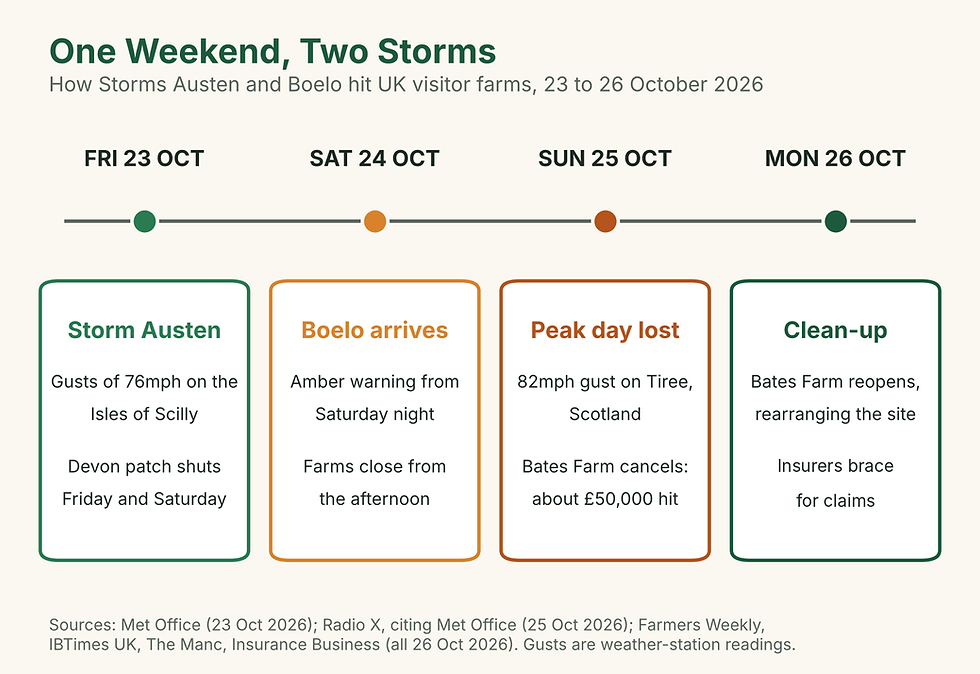
Bates Farm's loss wasn't one big bill. IBTimes UK, citing the BBC, listed what made up the hit: repairs to the marquee and a shed, wood chips to make the ground fit to reopen, refunded booking fees, lost pumpkin sales, and lost stock for the fresh food vendors. Ali Wilshaw said many of the costs were less obvious than you'd think.
That's the trap. The damage you can see is only half of it. The money you never take is the rest.
And the sisters didn't sit still. "We're in a race against time to get open again," Ali said, as reported by IBTimes UK. They reopened on Monday 26 October and said they would add wood chip paths, undercover seating and an indoor barn. That's exactly the right instinct.
Reality Check: This wasn't a freak. Last year, Storm Amy (3 to 4 October 2025) forced Farmer Copleys to cancel a festival Saturday. Rob Copley told the Yorkshire Evening Post, "We had two thousand people booked and we had to close." At £6.50 a ticket, that's about £13,000 in refunded entry alone, before a single lost pumpkin, coffee or burger. Two seasons. Two storms. Same farm. Plan for it. |
Why One Weekend Can Sink a Visitor Farm
Agritourism is real money. In the US, the 2022 Census of Agriculture counted $1.26 billion in agritourism and recreational income across 28,617 farms, an average of $44,004 each. In England, Defra's Farm Business Survey found 72% of farm businesses had some diversified activity in 2024/25, earning an average of £31,100 from it.
The problem isn't the size of the money. It's the timing.
A pumpkin patch might sell for six weeks. A Christmas event for four. A summer trail for eight. And inside those weeks, most of the money lands on Saturdays and Sundays.
Mike Cullipher, a sixth-generation farmer at Cullipher Farm in Virginia Beach, told public radio station WHRO in 2025 that the 18 weekend days of his pumpkin season bring in a third of the farm's annual income. Once, a storm flattened his corn maze. As he put it, "You can't charge anybody to walk through a maze that is flat."
Run his numbers. If 18 days earn a third of the year, each weekend day earns nearly 2% of the whole year's income. Lose one Saturday and Sunday and you've lost close to 4% of your year in 48 hours.
Now picture a farm that only opens for pumpkins and nothing else.

Step 1: Know Your Weekend Concentration Risk
You can't protect what you haven't measured. So do the maths before you do anything else.
Take last season's takings (gate, pumpkins, food, parking, shop) and split them by weekend. If you're new, use your bookings or your best estimate. My free Farm Profit Calculator lets you pick the visitor activities you'd offer and see estimated first-season revenue, costs and profit, which is a good place to start.
Then ask one blunt question: if my single best weekend disappeared, what would be left?

Here's a simple example season. These are illustrative numbers, not any farm's accounts:
Weekend | Share of season | Takings on a £100,000 season | If storm closes it |
Weekend 1 (late Sept) | 8% | £8,000 | Painful |
Weekend 2 | 10% | £10,000 | Painful |
Weekend 3 | 14% | £14,000 | Serious |
Weekend 4 | 18% | £18,000 | Serious |
Weekend 5 (half-term) | 26% | £26,000 | Season-changing |
Weekend 6 (Halloween) | 24% | £24,000 | Season-changing |
Look at the bottom two rows. Half the season rides on two weekends in late October, right when Atlantic storms start to line up. In the 2025/26 season, two of the seven named storms that affected the UK, Amy and Benjamin, arrived in October, according to the Met Office.
My First-Season Profit Plan puts a number on it: one rained-out Saturday can wipe out around a tenth of a whole season.
Field-Tested Play: Write your "concentration number" on a sticky note: the share of your season earned on your single biggest weekend. Above 20%? Steps 2 and 7 are urgent. Above 30%? One storm can decide whether you make a profit this year. Check your break-even too, so you know how many lost days you can survive. My guide to farm cash flow problems shows how to build that cushion. |
Step 2: Spread the Dates So No Weekend Carries the Season
The fix for concentration is simple: more selling days.
Here's where farms find them:
Weekdays in half-term. Families are off school all week, not just at the weekend.
After-school slots. Two or three hours on a weekday evening, with lights, a hot chocolate stand and a short trail.
An earlier start. Open pumpkins a weekend earlier with a "first pick" offer.
School trips. Weekday bookings, made and often paid in advance.
Extra weekend slots. Cut each weekend day into timed sessions so you can add capacity on calm days.
Brecknock Orchard in Pennsylvania did exactly this after rainy Saturdays kept crowds away. It added a Friday night fall festival so people who couldn't come on Saturdays still could.
Look at Farmer Copleys' own 2026 calendar. It runs weekends from late September, then opens every day from 19 October to 1 November, finishing with a fireworks night. With that many dates, one lost weekend hurts, but it doesn't decide the season.
Reality Check: Extra days cost staff, toilets and insurance. Don't open a weekday just to stand in an empty field. Open it with a reason to come: a school-trip package, a "quiet hour" for toddlers, a cheaper weekday ticket. Price the quiet days to fill them. My guide to selling event tickets without losing money on fees covers the booking side. |
Step 3: Sell Timed Tickets With a Written Rain Date Policy
Most pumpkin patch weather disasters get worse at the gate. If you don't know who's coming, you can't tell them not to. If you haven't taken their money, you can't keep it with a rebooking. Timed, pre-paid tickets fix both.
Farmer Copleys' festival page says tickets must be booked online in advance, with no on-the-day sales. That's the model.
But tickets alone aren't enough. You need a written policy, published before anyone buys. Here's the order to offer people when you close:

In the UK, Citizens Advice's guidance on event tickets says that if you bought from an official seller, you can get a refund when the organiser cancels, moves or reschedules the event. It doesn't single out weather, so treat rebooking as an offer, not a trap. Make it so easy and attractive that most families take it.
Rescheduling works too. In Wolverhampton, a pumpkin patch moved its "after dark" event to a new date because of Storm Austen, the Express & Star reported.
Willows Activity Farm in Hertfordshire goes further. Its Rainy Day Return Guarantee gives pre-booked visitors a free like-for-like return visit if it rains "continually for a minimum of 1 hour between 10am and 4pm." That turns a wet day into a second visit, not a refund.
Here's a policy you can adapt. Read it with your own solicitor or adviser, because rules differ in the UK, each US state and each Canadian province.
Field-Tested Play: Copy-and-paste farm bad weather policy When we decide. We check the Met Office forecast and warnings and make a call by 6pm the evening before. We do a final check at 8am on the day. How we tell you. By email and text to the address and number on your booking, on our website banner and on our Facebook and Instagram pages. If we close or cut your session short (our decision). You can choose: a free move to any available date this season; a credit for the full value, valid for 12 months; or a full refund of the ticket price. If we stay open and you'd rather not come. You can move your booking for free up to 24 hours before your slot. After that, tickets are non-refundable, because we've prepared for you. Safety first. We will close any attraction, structure or area at any time if staff judge the wind or conditions unsafe. |
The two lines that save most arguments are "our decision" and the decision time. Customers forgive closures. They don't forgive silence at 9am when they're already in the car.
My guide to setting ticket pricing and entry fees also helps you build in a little margin so rebookings don't wreck your numbers.
Step 4: Use Wind-Rated Marquees and Temporary Structures
Bates Farm's marquee was destroyed. So were several food vendors' gazebos.
This step protects lives, not just money.

The Purple Guide, used by UK event organisers, says structures must be secured to the ground taking account of their wind ratings, and that "wind conditions should be monitored using an anemometer (wind speed device)."
The Made-Up Textiles Association (MUTA) best practice guide for temporary fabric structures (2018) goes into more detail:
Your supplier should tell you the structure's maximum in-service wind speed.
Anchors must follow the manufacturer's manual and resist the maximum expected uplift. Where you can't use ground stakes, ballast weights need proper calculation, and can run to several tonnes per anchor point.
A wind monitoring plan with action levels should be drawn up and handed to you.
Its section on inflatable structures recommends an anemometer with an audible alarm set to your chosen wind speed.
You should have a plan to evacuate when winds approaching the maximum service gust speed are forecast.
The guide lists BS EN 13782, the standard for tents and temporary structures, among its references. If your supplier can't tell you the marquee wind speed limit, find a supplier who can.
Pop-up gazebos are the weak link. Exeter's independent market, for example, requires 10 to 15kg of proper weights on each leg and bans makeshift weights such as water bottles.
Field-Tested Play: Make a one-page "structures register". For every marquee, gazebo, inflatable and polytunnel used by visitors, write: who supplied it, its maximum in-service wind speed, how it's anchored, and the wind speed at which you close it. Then name the one person who makes the call on the day. If vendors bring their own gazebos, make the weight rule part of their booking terms. |
Reality Check: Don't wait for the forecast gust to arrive. Bates Farm faced winds of 50mph, according to IBTimes UK. Wrampool Farm saw 70mph. Would your shutdown number have kept you open, closed you, or left you guessing? Decide your number in calm weather, when nobody's ticket money is on the line. |
Step 5: Get Cover That Fits Visitor Activities
This is general information, not insurance advice. But after this weekend, every visitor farm should sit down with its broker and ask some hard questions.
Insurance Business, the UK trade title, flagged three issues straight after the storms:
Two storms can mean two excesses. Home policies usually apply an excess to each claim, so property hit by both Austen and Boelo could face two, unless the insurer treats it as a single loss. Proving which storm did which damage can be hard. Ask whether your farm policy works the same way.
Business interruption usually needs physical damage. Standard cover normally only responds when something is physically damaged at the insured premises.
Power cuts and road closures alone often aren't covered without a specific extension.
Read that second point again. If you close because of a forecast and nothing is damaged, a standard policy may not pay for the lost trade. That's the gap event cancellation insurance (some insurers sell it as adverse weather cover) is designed to fill.
Here is what each type of cover does and the question to ask:
Cover | What it's for | Question to ask your broker |
Event cancellation / adverse weather | Costs (and on some policies, lost revenue) when weather forces you to cancel, abandon or postpone | "Does it pay if I close on a forecast with no damage? How far ahead must I buy it?" |
Business interruption | Lost income after insured damage at your premises | "Does it cover denial of access, power cuts or a closed road? What's the waiting period?" |
Marquees and structures | Your own and hired marquees, gazebos and polytunnels | "Are hired structures covered while on my land? Is there a wind exclusion?" |
Stock | Pumpkins, food, shop stock | "Is crop in the field covered, or only stock in a building?" |
Public liability | Injury or damage to visitors and vendors | "Am I covered if a structure fails in high winds? Does it cover vendors' gazebos?" |
Excess terms | What you pay per claim | "If two storms hit one weekend, is that one loss or two?" |
Timing matters. One UK events insurer's adverse weather policy, for example, must be bought at least 14 days before the event, and needs photographic evidence and Met Office records to support a claim. Buy it in September, not when you see the forecast.
In the US and Canada, the same questions apply, with local names. Civil Eats noted that USDA insurance programmes such as Whole-Farm Revenue Protection can provide some cover for weather-related losses. Ask your agent whether your agritourism income counts, and whether event cancellation cover is available for your attractions.
You're not alone in finding this hard. In a national US survey of 1,834 agritourism operators (2019-20), 81% said liability was a challenge and 80% said the same about the cost or availability of insurance. My guides to what agritourism insurance covers and the agritourism insurance gap go deeper.
Reality Check: Storms already cost rural Britain dearly. NFU Mutual figures showed Storms Dudley, Eunice and Franklin in February 2022 cost more than £92 million, with claims from over 13,000 of its customers and average damage reported above £7,000. Your broker has seen these claims. Ask them what tripped farms up. |
Step 6: Run a Weather-Day Playbook
Nobody thinks clearly when a storm is coming. Write the plan in August.
Start with the warnings. The Met Office uses three colours, based on both how bad the impacts could be and how likely they are:
Yellow covers a wide range, from minor impacts to severe ones that are less likely.
Amber means a higher likelihood of significant impacts. The Met Office's advice is to consider changing your plans.
Red is kept for the most dangerous weather. Act to stay safe.
In the US, watch the National Weather Service. In Canada, Environment Canada.

The playbook has five parts:
A fixed decision time. 6pm the evening before, final check at 8am. Families need time to change plans, and you need time to cancel staff and food orders.
One decision-maker. One named person makes the call, with a named deputy.
Ready-made messages. Write the "we're closed", "we're open with changes" and "we're closing early" messages now. Save them as templates.
Every channel at once. Email, text, website banner, social media and your phone voicemail. My email marketing guide shows how to build that list.
Records. Photograph damage, screenshot the warnings, log wind readings and keep your refund list. That's your insurance file.
NFU Mutual's Hannah Binns gave the right advice straight after the storms. Put safety first. Don't attempt risky repairs during a storm. Check warnings and prepare for power cuts. She also warned the Met Office was issuing further yellow warnings with "the potential for a third named storm."
Your farm's risk management plan and first aid and emergency plan should both include this weather page. My earlier guide on preparing for weather-related risks in agritourism covers heat, flooding and other weather too.
Field-Tested Play: Look at how Bates Farm wrote to customers. Their Instagram post said "your safety and our integrity will always come first." Ticket holders were refunded and invited to book another date. Calm, honest, safety-first, with a way back in. Write your template in that tone before you ever need it. |
Step 7: Build Year-Round Events So No Weekend Can Sink the Year
If pumpkins are 80% of your year, a storm in late October is an existential threat. If pumpkins are 25% of your year, it's a bad week.

Here's how farms build the rest of the year:
Christmas. Trees, Santa visits, wreath workshops. Often indoors and pre-booked. See my guide to hosting a Christmas tree farm experience.
Spring and Easter. Lambing weekends, egg hunts, blossom walks.
Summer. Pick-your-own, sunflower fields and trails through the long school holidays.
School trips. Weekday income through most of the school year.
Farm shop and café. Steady trade that doesn't depend on one event.
Memberships and loyal-customer lists. Money that comes in whatever the weather.
My list of 30 farm event ideas by season, with real ticket prices is a good menu to pick from. For the bigger picture, read the 365-day yield strategy.
Also remember that weather doesn't just close your gate. It hits your crop. This summer's heat cost one British farm 10,000 pumpkins, as I covered in Britain's pumpkin shortage, and a single April freeze can wipe out a U-pick crop, as in this U-pick weather backup plan. Spread your income, and you spread every kind of weather risk.
Field-Tested Play: Build a storm fund. Every good weekend, move a fixed slice of takings, say 5%, into a separate account you don't touch. Its only job is to pay for a closed weekend: refunds, wasted food, staff you still pay. Insurance can take weeks to pay out. A storm fund pays out on Monday morning. |
What a Short Durian Season Taught Me About Weather
I'm the founder of Bloopy Durians in Bentong, Malaysia. Our durian seasons are short, about four to five months a year, roughly December to February and June to August.
We welcome visitors from all over the world. Many companies send their staff and management to the farm, and visitors reach us on a four-wheel-drive adventure. We also supply durians for corporate events.
When your selling window is that short, you can't let walk-ins carry the whole year.
That's why two things matter so much to us. Our WhatsApp list of loyal customers buys whenever durians are available. And our corporate work, supplying durians for events and hosting company visits, doesn't depend on a family deciding that morning whether the sky looks friendly.
That's the same lesson as Bates Farm, Farmer Copleys and Cullipher Farm. Build income that doesn't depend on a sunny Saturday.
Your 7-Step Storm-Proofing Checklist
Tick every box before next season:
Concentration number known. I know what share of my season my best weekend earns.
Dates spread. I've added weekday, half-term or school-trip sessions.
Policy published. Timed tickets, a decision time and a rebook-credit-refund policy are on my website.
Structures registered. I know every marquee's wind rating and my shutdown speed.
Cover checked. I've asked my broker the questions in the table above.
Playbook written. One decision-maker, message templates, every channel ready.
Year spread. No single event earns more than a third of my year, and a storm fund is growing.
Frequently Asked Questions
What should a farm bad weather policy include?
It should say when you decide (for example, by 6pm the evening before with a final check at 8am), how you'll tell customers, what they get if you close (a free rebook, a credit or a refund), what happens if you stay open but they don't want to come, and that staff can close any area for safety at any time.
Do I have to refund tickets if my farm event closes because of weather?
In the UK, Citizens Advice says buyers from an official seller can get a refund if the organiser cancels, moves or reschedules an event. You can offer a rebook or credit first, but don't block a refund. In the US and Canada, check your state or provincial consumer rules and your ticketing platform's terms.
What wind speed should I close a marquee at?
There's no single number for every structure. Ask your supplier for the marquee's maximum in-service wind speed, write your shutdown speed in your plan, and monitor wind on site with an anemometer. The MUTA guide, in its section on inflatable structures, recommends an anemometer with an audible alarm set to your chosen wind speed.
Does business interruption insurance cover a storm closure?
Often only if there's physical damage at your premises. Insurance Business noted that losses from power cuts or road closures alone often aren't covered without a specific extension. Closing on a forecast with no damage usually needs event cancellation insurance or adverse weather cover. Ask your broker.
If two storms hit in one weekend, do I pay two excesses?
You might. Insurance Business noted that home policies usually apply an excess to each claim, so damage from two storms could mean two excesses, unless the insurer treats it as one loss. Ask your broker how your policy handles back-to-back storms before the season starts.
How can I reduce my reliance on October weekends?
Add half-term weekdays, after-school sessions and school trips, then build events in other seasons: Christmas, Easter, summer pick-your-own and a farm shop or café. Loyal-customer lists and memberships add income that doesn't depend on the weather at all.
When is the best time to plan for next season's weather?
Now, while the storms are fresh and you're planning Christmas and next autumn anyway. Write the policy, check the cover and register your structures before you sell a single ticket.
Don't Let One Weekend Decide Your Year
Storms will come again, and they don't check your booking calendar first.
What you can control is how much one weekend matters, how fast you decide, how well your structures stand, and how quickly the money comes back. Do the 7 steps and the next storm becomes a bad weekend, not a bad year.
My ebook, The First-Season Profit Plan, gives you the tools: a printable Bad-Weather Policy Card and One-Page Emergency Plan, the 8 a.m. rule that protects your money and your reviews, 8 questions to ask your insurer before you build, and a one-line break-even formula. It's a 39-page workbook with 6 printable worksheets, an instant PDF download for $37, with a 30-day money-back guarantee.
Not sure where your farm stands? Take the free quiz.
Starting from scratch? Grab my free step-by-step checklist.
P.S. Bates Farm lost its busiest day of the season to one storm, and the Wilshaw sisters were open again the next day, already planning wood chip paths, covered seating and an indoor barn. That's the mindset. Don't wait for your own £50,000 weekend to build your plan. Start with your concentration number tonight.
Stephen Loke of AgritourismSuccess.com, whose farm is featured in Bloomberg News and Asahi Shimbun. This article is general information, not legal, insurance or financial advice. Always check your own policy wording and local rules with a qualified professional.
Sources
Storms force pumpkin patches to close as farms count the cost (Farmers Weekly, 26 Oct 2026)
Family farm sells pink pumpkins for worthy cause (NFU, 27 Oct 2023)
Amber warning issued for Storm Boelo as Storm Austen moves through (Met Office, 23 Oct 2026)
Storm Boelo leaves tens of thousands of homes without power (Radio X, 25 Oct 2026)
Farm profits take battering after double storm hit (Farmers Guardian, 29 Oct 2026)
From Amy to Dave: looking back at the 2025/26 storm season (Met Office blog, 2026)
The autumn economy: Fall in Hampton Roads gives farms a huge boost (WHRO, 22 Oct 2025)
Agritourism income in the 2022 Census of Agriculture (USDA ERS Charts of Note, 5 Dec 2024)
Farm Accounts in England, Chapter 5: Diversification 2024/25 (Defra, updated 12 May 2026)
Survey of Agritourism in the United States: Challenges (University of Vermont, 2021)
Storm Boelo: back-to-back storms test claims and cover (Insurance Business, 26 Oct 2026)
Storm Boelo clean-up puts business interruption in focus (Insurance Business, 27 Oct 2026)
Climate Change Threatens the Agritourism That Helps Small Farms Survive (Civil Eats, 6 Sep 2023)
Farmers told to prepare as 2022 storms saw £92m damage (FarmingUK, 5 May 2023)
How are weather warnings categorised? (Met Office, updated 1 Oct 2026)


Comments