How Small Farms Can Earn $1,000–$10,000 per Month from Visitors (Even Without Fancy Facilities or Huge Land)

1. Introduction: Why Visitors Pay More Than Crops
Most small farms struggle not because they don’t work hard, but because raw produce is one of the hardest products in the world to make money from.
Prices are controlled by the market, margins are thin, and farmers are often forced to sell more just to earn the same amount. No matter how good the crop is, the income usually hits a ceiling.
Visitors change that equation completely.
When people visit a farm, they are no longer paying only for fruit, vegetables, or animals. They are paying for an experience—fresh air, stories, learning, connection, and memories. That’s why two farms growing the same crop can earn wildly different incomes, simply because one welcomes visitors and the other doesn’t.
Small farms actually have a hidden advantage here. Visitors don’t want industrial-scale operations. They want something personal, authentic, and human. A small farm feels real. It feels welcoming. It feels like somewhere they can slow down, ask questions, and reconnect with food and nature.
The most important shift is mental, not physical. The moment a farmer starts thinking like a host instead of only a producer, new income opportunities appear almost immediately.
2. The $1,000–$10,000 Visitor Income Framework
Visitor income becomes powerful when it is predictable. This isn’t about hoping tourists show up. It’s about understanding simple math and building repeatable experiences.
Instead of thinking, “How much can I sell per kilogram?”, the question becomes, “How much does one visitor spend, and how many visitors do I need each month?”
For example, a farm doesn’t need hundreds of people every day to earn meaningful income. A small number of visitors, paying fair prices for a good experience, is often enough. The difference comes from combining entry experiences with food, activities, and small upsells.
There are two main levers in visitor income:
How much each visitor spends
How often visitors come
Some farms focus on volume with lower prices. Others focus on fewer visitors but higher-value experiences. Both approaches can work, as long as the experience is clear and well-managed.
What matters most is consistency. A farm that earns from visitors every weekend will almost always outperform a farm that relies only on seasonal harvests. Even modest goals—such as a few paid experiences per week—can add up to thousands of dollars per month when done consistently.
The key takeaway is simple: you don’t need a big farm, fancy buildings, or daily crowds. You need a clear experience, fair pricing, and a system that repeats week after week.

3. Core Visitor Income Streams
Almost every successful farm experience business starts with just one or two core offerings. Trying to do everything at once usually leads to stress and burnout.
Simplicity wins.
The most common and effective starting point is guided farm tours. Visitors love walking the land with the farmer, hearing stories, learning how food is grown, and asking questions. A good tour doesn’t need to be long or complicated—it just needs to be honest, educational, and personal.
Food-based experiences are another powerful income stream. Tasting sessions, simple farm-to-table meals, or cooked samples allow visitors to experience the farm with all their senses. Eating food where it is grown creates emotional value, which is why people are willing to pay more for it.
Interactive activities add another layer. When visitors can touch, pick, feed, or participate, the experience becomes memorable. These activities don’t have to be elaborate. Often, the simplest hands-on moments are the most impactful.
Most small farms succeed by starting with:
One clear tour experience
One simple food or tasting element
One interactive activity
That’s enough to begin earning visitor income. More can always be added later, once demand is proven.
The goal at this stage is not to build a theme park. It’s to create a genuine farm experience that fits naturally into daily farm life—and that visitors are happy to pay for.

4. Simple Upsells That Multiply Revenue
One of the biggest mistakes small farms make is focusing only on entry fees or tours. The real money often comes after the visitor has already said yes and arrived at your farm. When people are relaxed, happy, and emotionally connected to your place, they are far more willing to spend.
Upsells don’t need to be complicated or pushy. They should feel like a natural extension of the visit.
A small farm shop is one of the easiest ways to increase income. Even with limited products, visitors love taking something home that reminds them of the experience. These can be fresh produce, processed items, or simple branded goods. Scarcity actually helps — “farm-only” items feel special.
Another powerful upsell is pre-orders and post-visit delivery. Visitors may not want to carry heavy items or perishable produce while traveling. Offering delivery a few days later removes friction and increases order size.
Simple but effective upsells include:
Take-home packs prepared at the end of the visit
Pre-orders for future harvests
Home delivery after the farm experience
Small souvenirs or photo opportunities
When done well, upsells can easily double or triple your revenue per visitor. Instead of earning $30–$50 per person, many farms quietly reach $100–$300 per visitor without adding stress or extra time.
5. Pricing Psychology for Farm Experiences
Pricing is where many farmers unintentionally sabotage themselves. Charging too little doesn’t just reduce income — it often reduces trust. Visitors subconsciously associate price with quality, safety, and professionalism.
Farm experiences should never be priced like raw produce. You’re not selling fruit or vegetables. You’re selling:
Access
Story
Experience
Time with the farmer
A memory
One effective strategy is offering tiered pricing. A premium option makes the standard option feel affordable, even if the standard price is already profitable.
It’s also important to recognize that locals and tourists often have different expectations. Tourists are paying for a once-in-a-lifetime experience and are usually willing to spend more. Locals may come more often but spend less per visit. Both groups are valuable, but they should not always be priced the same way.
If you feel nervous about raising prices, raise them slowly and observe demand. Most farms are surprised to find that higher prices attract better visitors, not fewer ones.
The goal is not to be the cheapest farm — it’s to be the most memorable.
6. How to Get Visitors Without Paid Advertising
You don’t need paid ads to attract visitors. In fact, many successful farms rely almost entirely on organic traffic and word-of-mouth.
Your most powerful tool is your Google Business Profile. When travelers search for things to do nearby, farms with good photos, clear descriptions, and strong reviews naturally rise to the top. One well-optimized listing can outperform years of advertising.
Photos matter more than perfection. Real photos of real visitors enjoying the farm build trust faster than polished marketing images. Reviews do the selling for you — visitors trust other visitors more than any advertisement.
Social media should focus on experiences, not farming techniques. People want to see:
Happy visitors
Food being enjoyed
Beautiful moments on the farm
Simple behind-the-scenes stories
Partnerships are another underrated strategy. Hotels, homestays, tour drivers, and guides are constantly looking for unique experiences to recommend. A simple referral arrangement can bring consistent visitors without ongoing marketing effort.
When your farm delivers a great experience, marketing becomes easy — visitors naturally do it for you.

7. Running Visitor Experiences Without Burning Out
One reason many farmers hesitate to welcome visitors is fear of exhaustion. They imagine crowds, constant interruptions, and extra work layered on top of an already full farming schedule. The truth is, well-designed visitor experiences should support your farm life, not overwhelm it.
The key is designing experiences that fit naturally into what you already do. Tours should follow your normal farm routine instead of disrupting it. Activities should be time-boxed, predictable, and easy to repeat.
Setting clear visitor limits is essential. Fewer visitors paying a fair price is almost always better than many visitors paying very little. Time slots protect your energy, your family, and your farm.
Staffing does not have to be complicated. Many farms start as family-run operations and only bring in help when demand is proven. The goal is not growth for its own sake, but sustainability.
A simple operating structure helps prevent burnout:
Fixed visiting hours
Limited daily group sizes
Clear start and end times
Experiences that don’t require constant supervision
When the farm remains enjoyable for you, visitors feel it — and that atmosphere becomes part of what they are paying for.
8. Realistic Monthly Income Scenarios
Visitor income becomes less intimidating when you break it into realistic scenarios. You don’t need a perfect setup or daily tours to generate meaningful cash flow.
Many small farms start with weekend-only experiences, hosting just a few groups per week. This alone can generate an extra $1,000 per month, often with minimal changes to the farm.
As confidence grows, farms may add one or two weekday slots or introduce a higher-value experience. This is where monthly income often reaches $3,000–$5,000 and begins to feel like a serious secondary income stream.
Farms that focus deliberately on visitor experiences — rather than treating them as an afterthought — can reach $8,000–$10,000 per month without becoming tourist attractions or theme parks. The difference is consistency, not complexity.
What matters most is reliability. A steady, repeatable experience that runs every week will always outperform something ambitious that happens only occasionally.
9. Common Mistakes Small Farms Make
Many small farms fail in agritourism not because the idea doesn’t work, but because they overcomplicate it.
One common mistake is trying to copy large attractions. Small farms don’t need big buildings, elaborate facilities, or endless activities. Authenticity is the advantage — not scale.
Another mistake is overbuilding before demand exists. Farmers invest heavily in infrastructure hoping visitors will come later, when in reality visitors come first if the experience is clear and appealing.
Trying to offer too many activities too soon also creates stress. A single, well-run experience is far more profitable than five poorly managed ones.
Finally, ignoring visitor feedback can quietly kill momentum. Reviews, comments, and simple conversations with guests reveal exactly what works and what doesn’t.
Avoiding these mistakes keeps the farm profitable, enjoyable, and sustainable for the long term.
10. Turning Visitors Into Long-Term Income
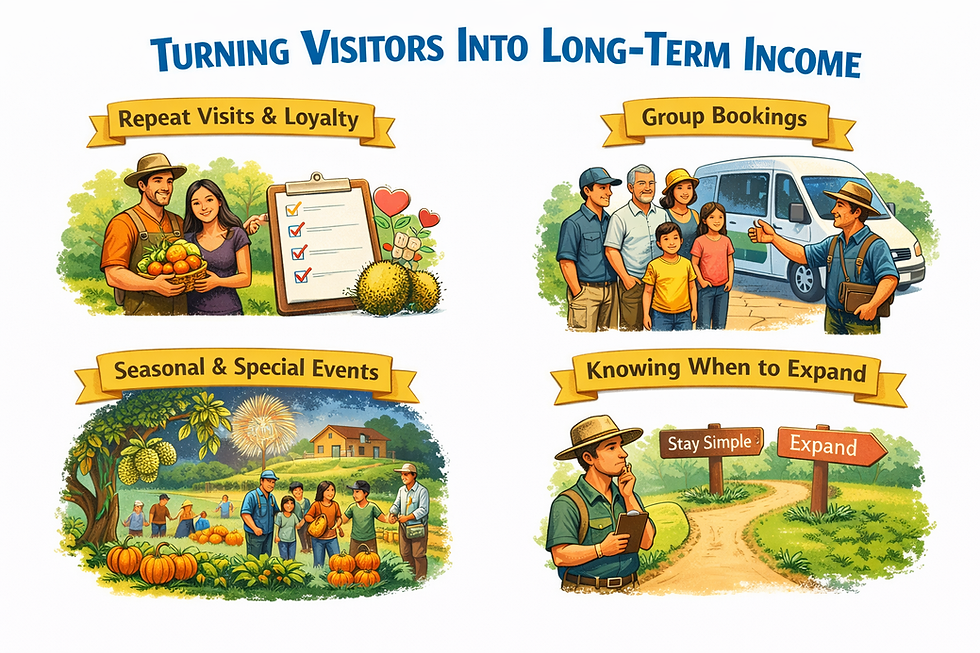
The most profitable farms are not the ones with the most visitors — they are the ones that turn first-time visitors into repeat customers. Long-term income comes from relationships, not constant marketing.
Once someone has visited your farm, trust is already established. They’ve seen your land, met you, tasted your food, and felt the atmosphere. This makes future sales far easier than attracting a brand-new visitor.
Repeat visits can take many forms. Some visitors return seasonally. Others come back with friends or family. Many become regular buyers of farm products even if they don’t visit often.
Group bookings are another powerful income stream.
Schools, corporate teams, private groups, and special-interest communities are always looking for meaningful, outdoor experiences. These bookings are often higher value and easier to manage because they come in planned blocks rather than scattered individuals.
Seasonal and special events also extend income beyond normal visits. A well-timed experience during harvest season, holidays, or school breaks can generate strong cash flow without running year-round.
What matters most is knowing when to expand and when to stay simple. Expansion should respond to demand, not ambition. A farm that grows slowly but intentionally will stay profitable and enjoyable far longer than one that rushes to scale.
11. Conclusion: Small Farm, Big Opportunity
Small farms are uniquely positioned to succeed with visitors. People are not looking for perfection — they are looking for authenticity, connection, and meaningful experiences. That is something small farms naturally provide.
Earning $1,000–$10,000 per month from visitors is not about doing everything at once. It’s about starting with what you already have and improving step by step. A single well-run experience can outperform multiple complicated activities.
Progress matters more than perfection. Clean paths matter more than fancy buildings. Warm hosting matters more than expensive facilities. Visitors remember how your farm made them feel.
The goal is not to make your farm bigger or more stressful. The goal is to make it more welcoming, more intentional, and more valuable to the people who visit.
When done right, visitor income doesn’t just improve cash flow — it restores pride, stability, and joy in farming.


Comments