Agritourism Business Success
AS FEATURED IN



The Business Times

AS FEATURED IN
Bloomberg News · Asahi Shimbun
For flower growers tired of selling beautiful stems by the bucket for less than a dollar each...
A Minnesota Flower Farmer Put 50 Tickets on Sale for a Thanksgiving Centerpiece Class. They Sold Out in 18 Hours. Here's the Step-by-Step Plan to Turn the Flowers You Sell by the Bucket Into a Paid Flower Arranging Class on Your Own Farm.
How to Start a Flower Arranging Class on Your Farm is a 120-page plan that shows you what to grow, what to teach, what to charge and how to fill every seat. 17 short chapters, 11 fill-in worksheets, 30 copy-and-use scripts, 16 charts and a 30-Day Launch Plan. Instant PDF download. Just $27.
✔ The per-stem math, real seat prices from four countries and a 5-step formula to price your own
✔ A minute-by-minute 2-hour class plan with word-for-word host scripts
✔ What to grow, how many stems each guest needs and how to fill your first 20 seats
Secure checkout. Instant PDF download. 30-day money-back guarantee.


From the desk of Stephen Loke
Founder, AgritourismSuccess.com
whose farm is featured in Bloomberg News and Asahi Shimbun
Dear Fellow Farmer,
In July 2020, a nurse practitioner named Liz Fiedler and her husband Josh started a flower business on his family's century farm in St. Joseph, Minnesota.
That December, Josh died of a heart attack. Liz kept the flowers going.
Then she did something most flower growers never try. She stopped only selling bouquets, and started inviting people in to make their own.
She put 50 tickets on sale for a Thanksgiving centerpiece class.
They sold out in 18 hours.
So she added a second class of 30 tickets.
At another event, called Sunfest, she charged $65 a person for a bouquet built from a 25-stem stem bar. She admits she was nervous. "That's a lot of money," she said.
People paid it anyway.
Now do the math with me. Sell those same 25 stems by the bucket, at the $0.90 a stem a Pennsylvania farm lists for wholesale zinnias, and they bring in $22.50.
Same stems. Same field. Almost three times the money. And instead of a bucket on a truck, you get a happy guest who drives home with flowers she arranged herself, and a story to tell her friends.
Liz told The Floral CEO podcast (January 2024) that her stem bar sales came to about $20,000 the previous year, and that the farm replaced her nurse practitioner revenue. Those are her own statements about her own farm, not a promise of what yours will do. But they show what can happen when flowers stop being a commodity and start being an experience.
So here's my question for you.
How many more seasons will you cut at dawn, strip leaves till your fingers ache, and still sell for less than a dollar a stem?
The Ugly Truth About Selling Flowers by the Bucket
It isn't that your flowers are poor. It's that a stem in a bucket is a commodity, priced by the cheapest seller in the world. Every one of these facts is in the book, with its source:
✔ In the United States, nearly 80% of the value of cut flowers on the market comes from imports, which hit a record $1.98 billion in 2024. Colombia and Ecuador alone supplied 88% of them (University of Illinois farmdoc daily, February 2025).
✔ In the UK, British-grown flowers account for only about 20% of flowers sold (Flowers from the Farm, May 2026).
✔ Canada imported CA$222.41 million of cut flowers and buds in 2024, while its 214 field-grown cut flower farms sold CA$32.4 million (Agriculture and Agri-Food Canada, August 2025).
✔ In a Utah State University Extension survey of florists, 23% said they would pay no premium at all for local flowers, and another 37% would pay less than 5% more (June 2023).
✔ A University of Tennessee zinnia budget assumed $1.00 a stem. After seed, supplies and 112 hours of labor on 1,000 square feet, the net return worked out to about $0.33 a stem (2025).
✔ In the 2024 National Agritourism Producer Survey, 17.8% of US operators had no liability insurance covering agritourism, and another 11.7% weren't sure (NERCRD, Penn State, April 2025).
Thirty-three cents. For a flower you planted, weeded, cut and bunched.
And growing more doesn't fix it. A bigger field just tires your back. A class changes the price per stem itself.
Here's the good news. The demand is already there. Tripadvisor found craft-class bookings rose 88% year over year in the first half of 2026, its fastest-growing experience category. For Mother's Day 2026, the National Retail Federation found 75% of shoppers planned to buy flowers, and a record one-third planned to give experiences. A Mother's Day flower class is both at once.
People want to make something with their hands, somewhere real. You have the somewhere real.
Who Am I to Tell You This?
My name is Stephen Loke, and I'll be honest with you from the start: I am not a florist, and I do not run flower classes. I'm the founder of a durian farm.
My farm, Bloopy Durians in Bentong, Malaysia, has been featured in Bloomberg News and Asahi Shimbun, and welcomes visitors from all over the world. Many companies send their staff and management to us.
Our durian seasons are short, roughly December to February and June to August. Our visitors come for a 1.5-hour farm tour: they ride a four-wheel drive, plant a durian tree, open a durian themselves and learn how to tell a good durian.
That taught me the lesson under every page of this book. People will pay for fruit. They will pay far more, and remember you far longer, to experience it themselves on a real farm, with a real farmer beside them.
Your flowers are no different. A bucket of zinnias is a commodity. A morning in your field, snips in hand, building an arrangement a friend gasps at, is an experience. And experiences are priced on a different scale.
So I studied the flower farms in the United States, Canada, the UK and Australia that already teach: what they charge, how they run their classes, and where some of them went wrong. Then I turned it all into a plan you can follow.
Introducing: How to Start a Flower Arranging Class on Your Farm
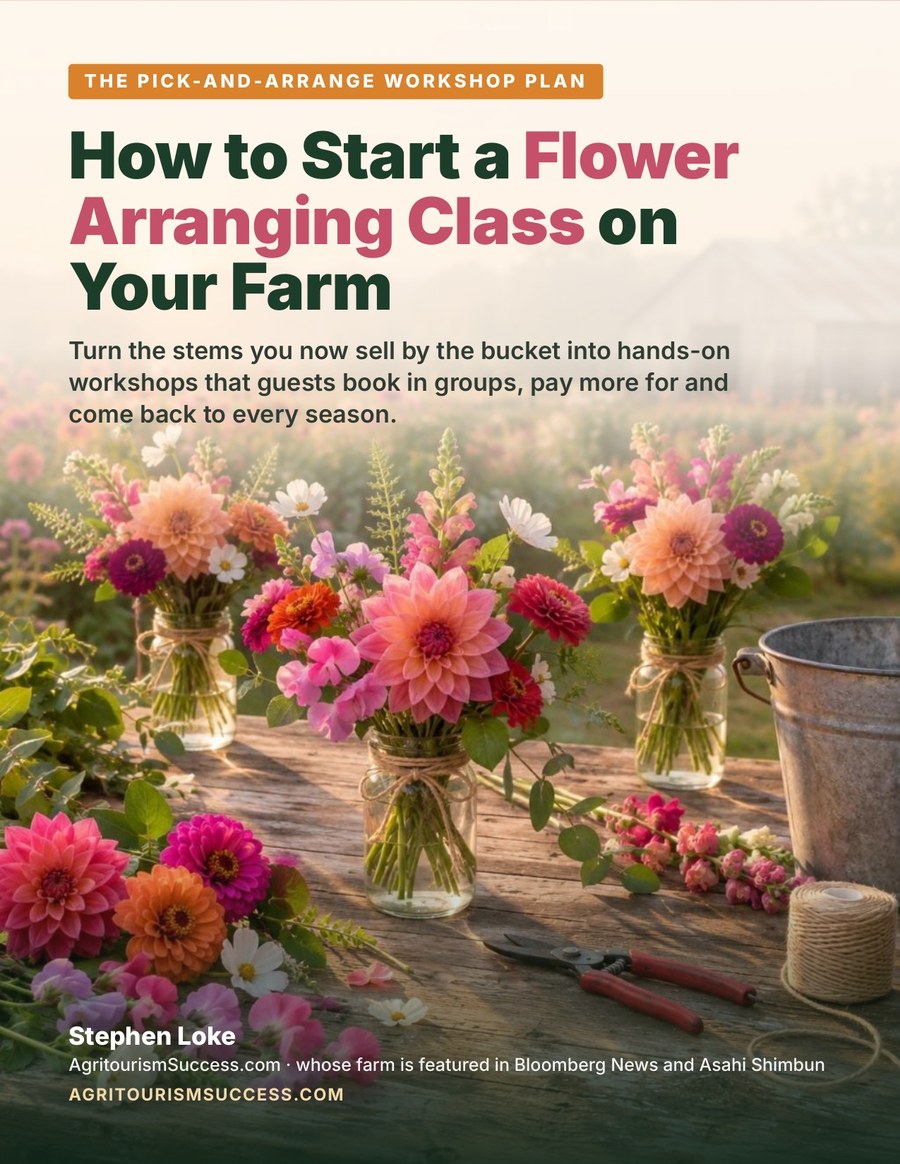
The Pick-and-Arrange Workshop Plan: What to Grow, What to Teach, What to Charge and How to Fill Every Seat.
This is a 120-page plan for turning the flowers you already grow (or could grow) into a paid, hands-on class on your own land.
It starts with the money: the per-stem math, eight real flower farms that already teach, and an honest test of whether a class is right for your farm. Then it walks you through choosing your first format, running a smooth 2-hour class minute by minute, and teaching a recipe so simple that every guest goes home proud.
After that, it shows you how to grow a cutting garden for your classes, price your seat with confidence, build a year of themed classes and group packages, ask the right questions before you open, and fill your first seats.
It won't promise you a number. A $75 seat in one town may be a $45 seat in another. What it gives you is real prices from real farms, a method to find your own, and the exact words to use at every step.
Secure checkout. Instant PDF download. 30-day money-back guarantee.
Here's Just a Small Sample of What You'll Discover Inside
✔ Why the same 25 stems bring in $22.50 in a wholesale bucket and $65 as one workshop seat, and the per-stem chart that shows the gap at a glance. (page 7)
✔ The five things a workshop guest pays for that a wholesale buyer never will. (page 7)
✔ Why one respected workshop host warns against hosting workshops just for the money, and the hidden costs to count before you set a price. (page 8)
✔ The nurse practitioner whose flower farm replaced her nurse practitioner revenue, and the local brewery that brought her the crowd. (page 12)
✔ The simple Australian pick-and-arrange class with a 5.0 rating from 389 reviews, and the three-size price menu that lets every guest choose her own price. (page 12)
✔ How one Indiana farm made $10,950 profit from a single ticketed event day, against $4,015 from a whole month of u-pick. (page 14)
✔ The famous farm whose workshops sold out in under two minutes, crashed its website and "almost killed us," and the cap that protects your family. (page 15)
✔ The 20-point Readiness Score that tells you whether to launch this season, start with one private group or fix one thing first. (page 21)
✔ The one format to start with, and why it's the easiest to teach, uses the fewest stems and travels home safely. (page 24)
✔ The word-for-word welcome, safety talk, demo opener and close, plus the 15-minute timer that stops "the demo that ate the class." (page 31)
✔ The four-part recipe (foliage, focal, filler, airy) that lets a total beginner fill a jar with just 14 stems. (page 34)
✔ The spiral hand-tie in seven steps, and the cheap "practice bundle" that keeps your best dahlias out of beginners' hands. (page 35)
✔ How 72 summer seats could come from roughly 160 square feet of zinnias, sunflowers and celosia: the stems-to-plants formula, worked crop by crop in an illustrative example. (page 45)
✔ The 5-Step Price Formula, and why a $75 jar class breaks even at just 5 guests in the book's illustrative example. (page 54)
✔ Why a bachelorette party can be one of your easiest sales (The Knot puts the average cost at about $1,300 per attendee), and the quick text reply that books the date. (page 69)
✔ The seven questions to ask your insurance agent, word for word, before you sell a single ticket. (page 85)
Take a Look Inside
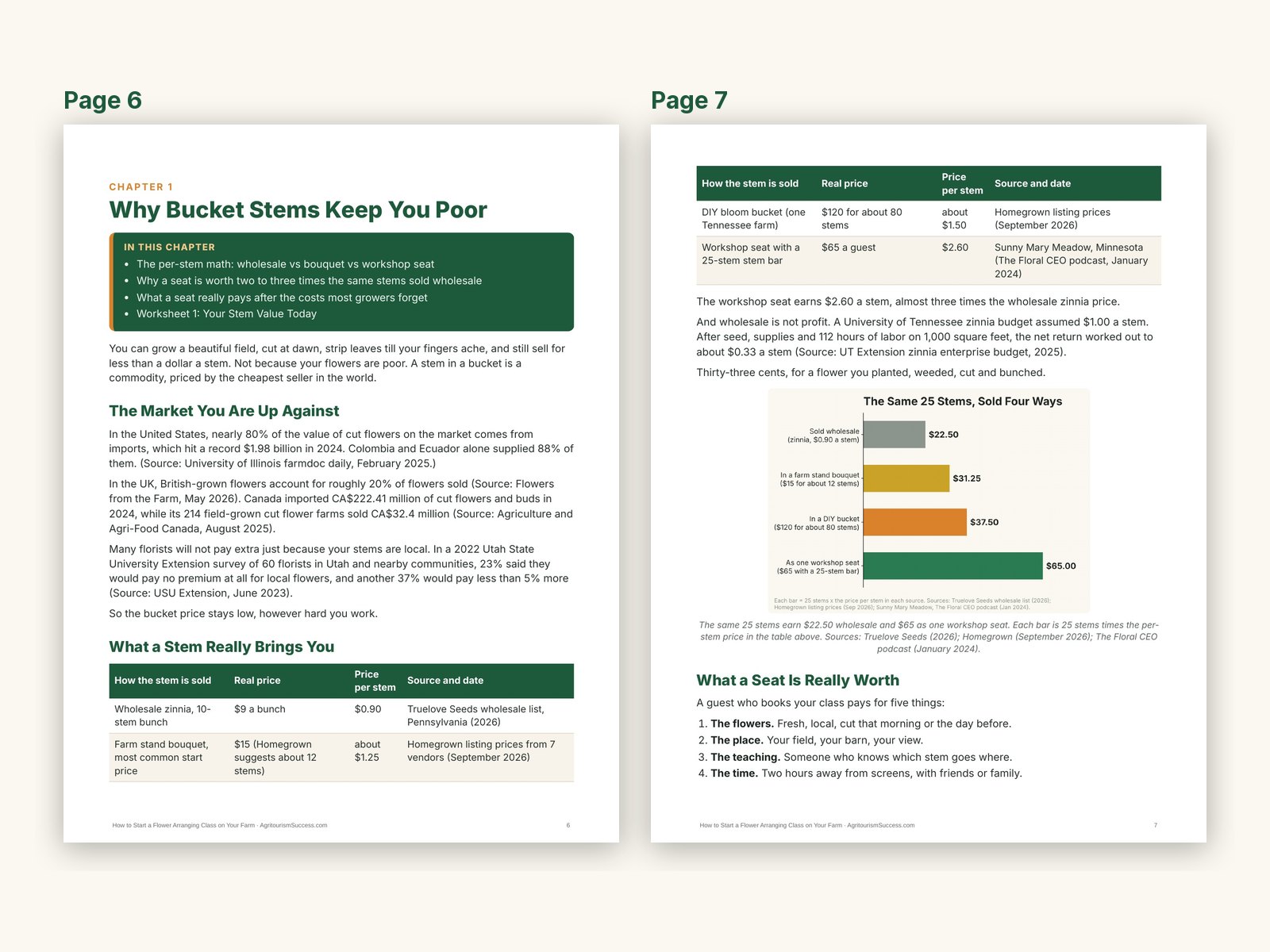
Chapter 1: Why Bucket Stems Keep You Poor. The per-stem table and money chart show the same 25 stems earning $22.50 wholesale and $65 as one workshop seat.
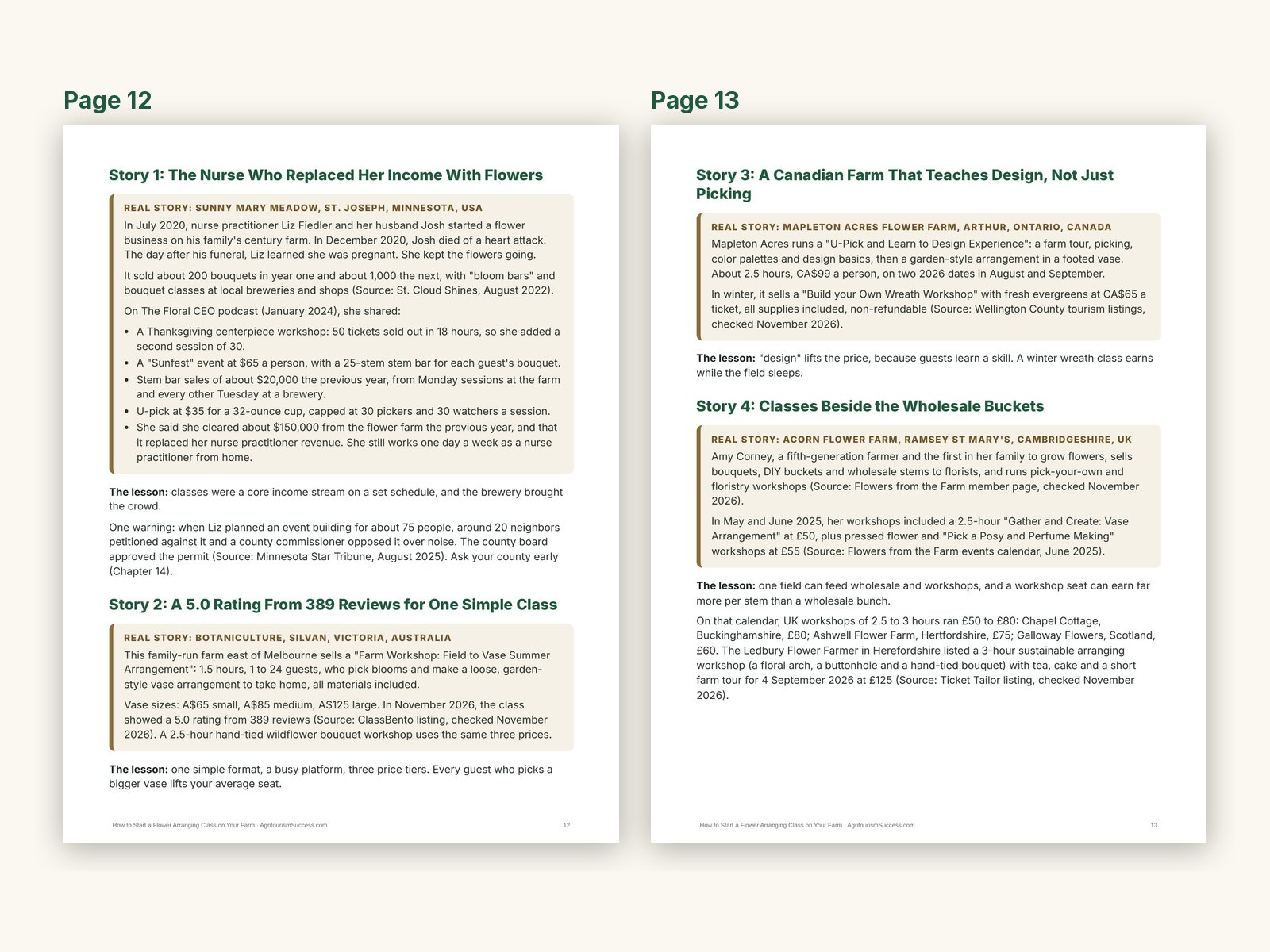
Chapter 2: Real Flower Farms Already Doing It. Eight real farms in the US, Canada, the UK and Australia, with what they charge, how long they teach and how many guests they take.
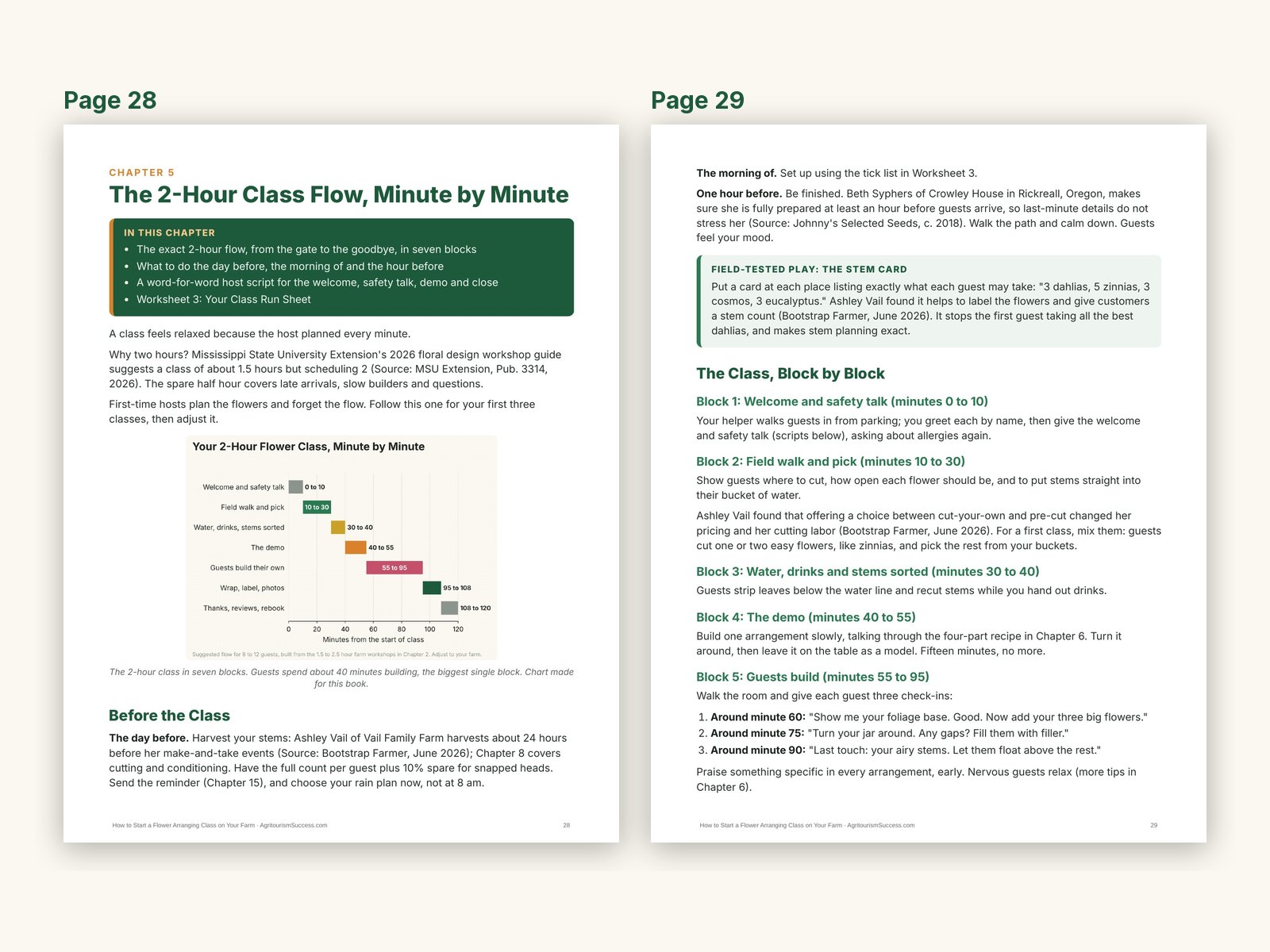
Chapter 5: The 2-Hour Class Flow, Minute by Minute. Seven blocks, from the welcome at the gate to the goodbye at the car, with the host script to match.
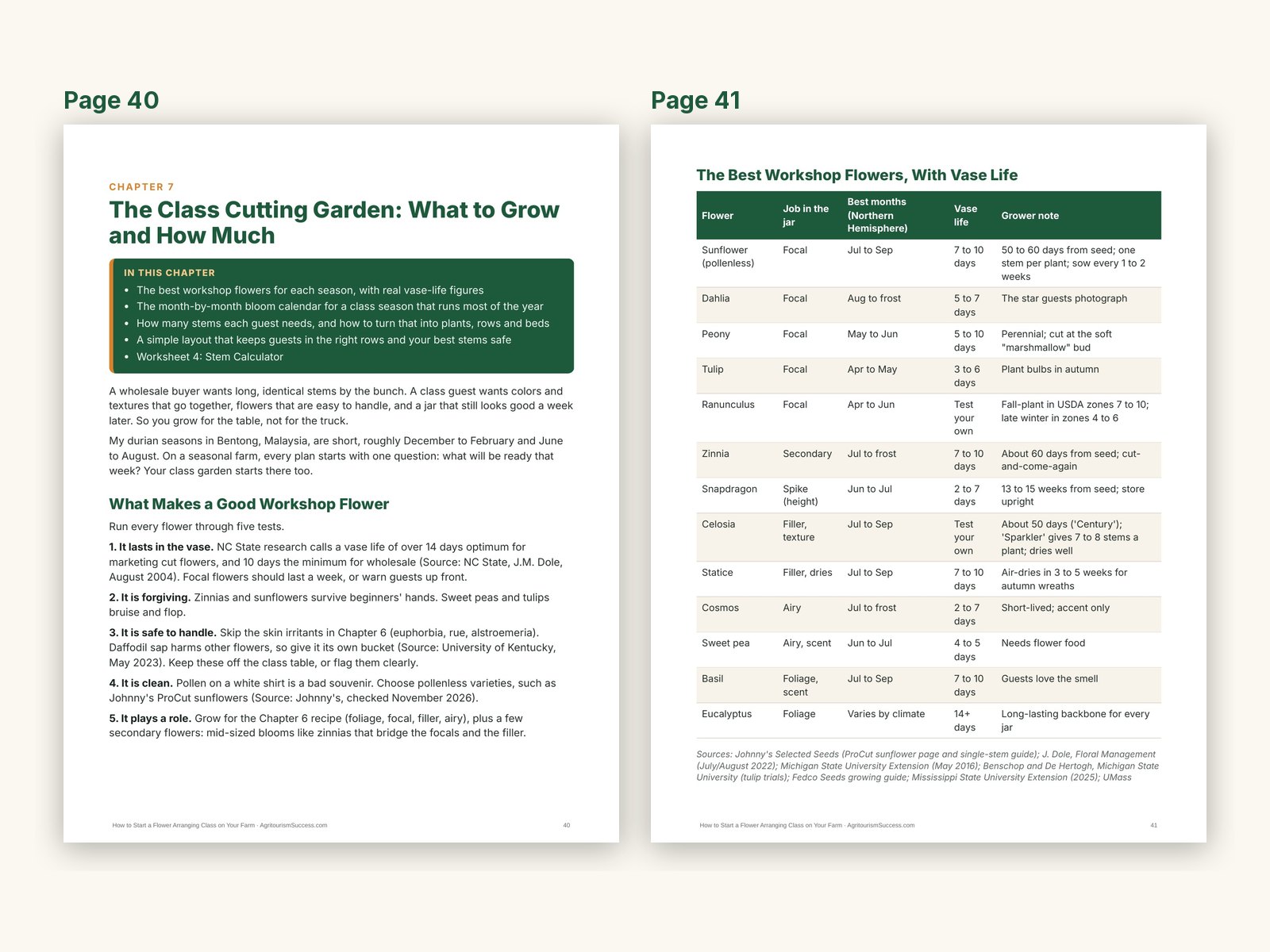
Chapter 7: The Class Cutting Garden. What makes a good workshop flower, and a table of the best ones with how long each lasts in the vase.
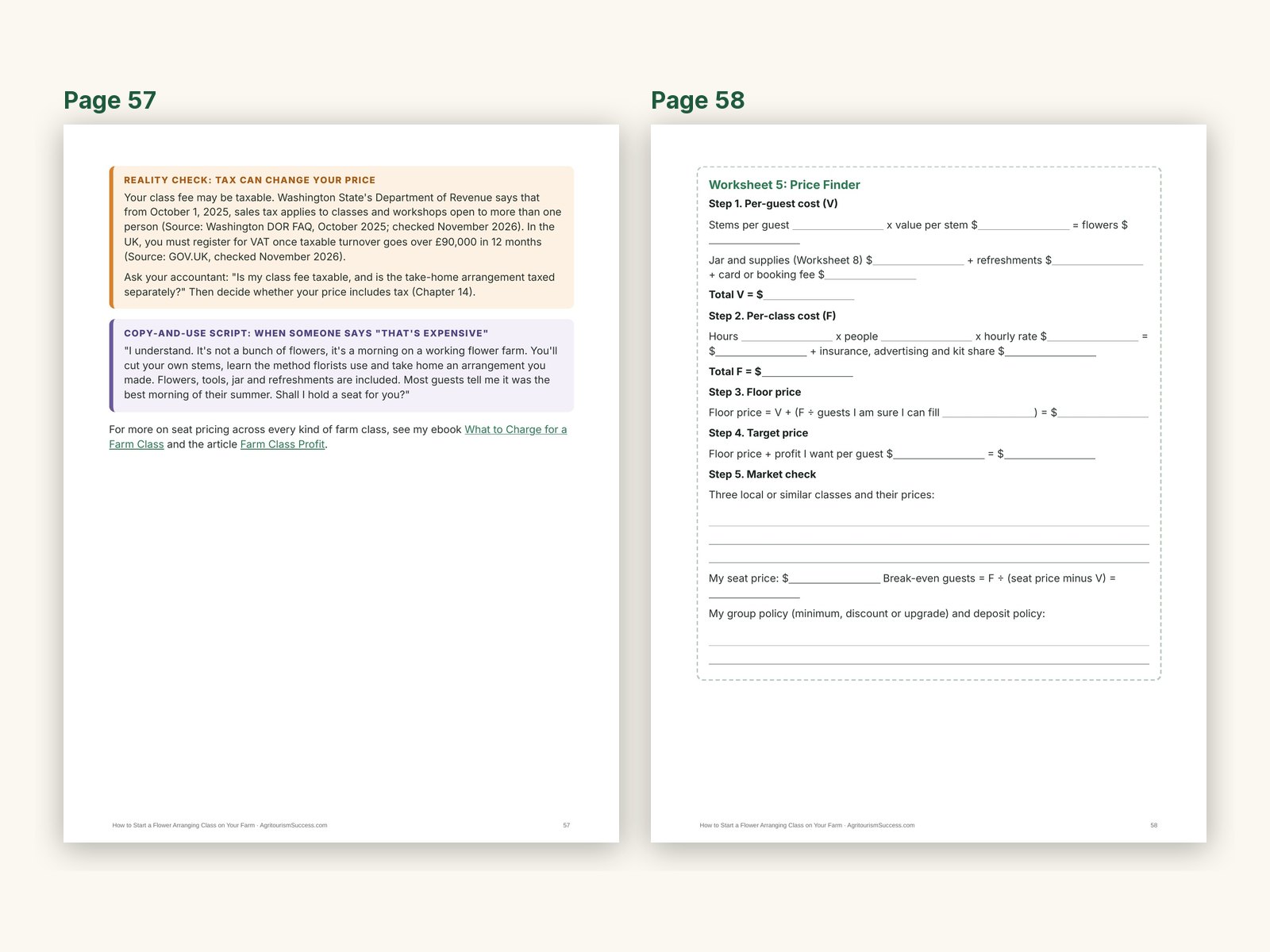
Chapter 9: Price Your Seat With Confidence. The pricing reality checks and Worksheet 5, the Price Finder, that turns your costs into a seat price you can defend.
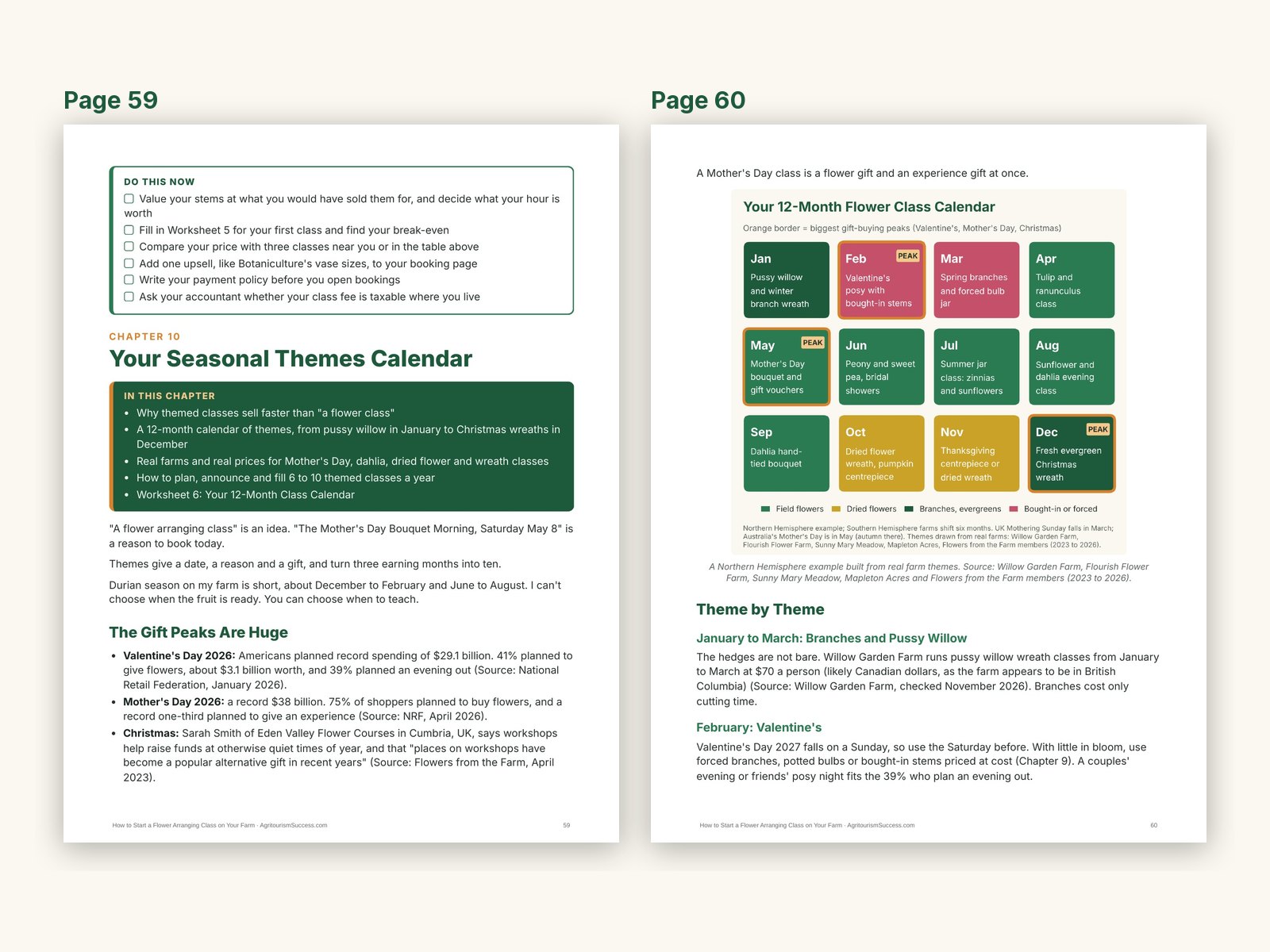
Chapter 10: Your Seasonal Themes Calendar. Twelve months of class themes, from pussy willow in January to Christmas wreaths in December.
Secure checkout. Instant PDF download. 30-day money-back guarantee.
Now Imagine It's a Saturday Morning Next Summer
Your helper is at the gate. Twelve guests pull in, on time, in closed-toe shoes, because your reminder told them to.
Every seat is already paid for. Your insurer's answer is in writing, in a folder on the table. You asked about bee-sting allergies at booking, so you already know who to watch.
A stem card sits at every place: "3 dahlias, 5 zinnias, 3 cosmos, 3 eucalyptus." Nobody grabs all the best dahlias.
You give a three-minute welcome and a one-minute safety talk. You walk them through the guest block, and they cut zinnias with their own snips.
Then you build one jar in front of them, slowly. Foliage, focal, filler, airy. Fifteen minutes, timer set. "Your turn."
Forty minutes later, twelve jars sit on the table. Every one is different. Every one is lovely. Your helper takes the photos at the barn wall, and nobody can stop smiling.
They leave with a care card, a sachet of flower food and your next three dates. Someone asks about a private class for a bridal shower.
That evening, you send one message with the photos and a review link. Then you put your feet up.
And the stems in those twelve jars did a very different job from the one they'd have done in a bucket.
Who This Is For (And Who It Isn't For)
This book is for you if:
✔ You grow cut flowers and sell them by the bunch, the bucket or the bouquet, and you know they're worth more
✔ You don't grow flowers yet, or only a few rows, but you have land and want a better income or a second income from it
✔ You enjoy having people on your farm, or think you would
✔ You can find a shaded spot for 8 to 12 guests, plus parking and a toilet (or can rent one)
✔ You can give one long day per class (the book's planning estimate is about 7.5 to 9.5 hours, including harvest and set-up)
✔ You farm in the US, Canada, the UK, Australia or anywhere else flowers grow
This book is not for you if:
✔ You truly dislike strangers on your land. Guests can tell, and the book's decision flowchart points you to other paths.
✔ You want a guaranteed income figure. Nobody honest can give you one. This book gives you real prices and a method to find your own.
✔ You want to become a professional florist. You don't need to be one to teach a happy beginner class, and this book won't make you one.
✔ You won't call your insurer before you sell a ticket. That call comes first.
✔ You want legal, tax or insurance advice. This book gives you the questions to ask. Your own professionals give you the answers.
Here's Everything You Get
✔ The 120-page book: 17 short chapters in five parts, plus the Toolkit, in plain English with large, easy-to-read charts
✔ The 60-Minute Quick Start: six 10-minute jobs to do in the next hour
✔ 11 fill-in worksheets, plus a quick format fill-in: Stem Value Today, Flower Class Readiness Score, Class Run Sheet, Stem Calculator, Price Finder, 12-Month Class Calendar, Package Builder, Supplies and Budget, Permission and Insurance Questions, First 20 Guests List and the 30-Day Tracker
✔ 30 copy-and-use scripts: the family "kitchen table talk," your welcome, safety talk, demo and close, calming a nervous guest, "That's expensive," quotes for birthdays, hen parties and companies, calls to your insurer, planning office, accountant and portable toilet company, your booking policy, warm-list and partner messages, the same-evening thank-you, plus a 9-part Swipe File of listings and messages
✔ 16 charts and diagrams, from the per-stem money chart and the decision flowchart to the bloom calendar, cost per guest, package ladder and 30-day launch timeline
✔ 19 Real Story boxes from flower farms in the US, Canada, the UK and Australia, plus three cautionary tales
✔ 7 Money Math boxes that show the method with clearly marked illustrative numbers
✔ 15 Field-Tested Plays to copy and 18 Reality Checks to keep you out of trouble
✔ The best workshop flowers with real vase-life figures, a when-to-cut table, a bloom calendar and the stems-to-plants formula
✔ A full supplies list with real US prices, checked November 2026
✔ The questions to ask in the US, Canada, the UK and Australia about insurance, liability laws, zoning, tax, food and safety
✔ The Toolkit: a 30-Day Launch Plan, four printable checklists, a Troubleshooting Table with 20 fixes, the Swipe File and a 25-term glossary
Secure checkout. Instant PDF download. 30-day money-back guarantee.
What Is One Full Class Worth to Your Farm?
Let's use the book's own worked example. This is an illustrative example (made-up numbers to show the method, not a promise of income).
A 2-hour jar class at $75 a seat. Each guest costs $27.74: 20 stems valued at $1.00 each, plus supplies, refreshments and the card fee. Each class carries $220 of fixed costs, including $160 to pay two people $20 an hour for four hours.
In this example, the class breaks even at 5 guests. At 12 guests, you keep $347 after paying yourself $20 an hour (page 54). The same 240 stems sold wholesale at $0.90 would bring in $216, before your time.
Now think about what it costs to get it wrong. A tulip field picked over in a single day. More than 7,000 cars at a sunflower field, until police shut it down. A neighbor petition against an event building. A workshop program so popular it "almost killed" the farm that ran it. Every one of those is a real story in this book, along with what to do instead.
Any one of them costs far more than $27.
Here's another way to look at it. A one-hour consultation with me costs US$150. This book gives you the whole plan, plus every worksheet and script, for less than a fifth of that.
Why Only $27?
Because I want this plan in the hands of every grower who has looked at a bucket of zinnias and thought, "There has to be a better way." That's less than a single seat at any of the flower classes in this book.
And honestly? I'm betting that once you see how practical it is, you'll come back to AgritourismSuccess.com for more.
It's a digital book, so there's no shipping and no waiting. You can do the 60-Minute Quick Start tonight.
My "First Class" 30-Day Money-Back Guarantee
Download the book. Do the 60-Minute Quick Start. Run your stems through Worksheet 1 and score your farm on the Readiness Score.
If it doesn't help you, simply contact me through AgritourismSuccess.com within 30 days and I'll refund your $27 in full. No hard feelings.
You take on no risk. I take it all.
Why You Should Start Today
Flowers keep their own calendar, and it doesn't wait for anyone.
Sunflowers need 50 to 60 days from seed. Snapdragons need 13 to 15 weeks. Tulips go in as bulbs in autumn, and ranunculus is fall-planted in USDA zones 7 to 10. If you want a full flower bar on class day, the sowing dates in Chapter 7 start long before it.
The calls take time too. Your insurer needs to send you a quote and the policy wording. Your planning office needs to tell you whether you need a permit, and how long it takes. That's why the 30-Day Launch Plan puts insurance, planning, tax and the law on Days 2 to 5, and names them among the jobs that cannot slip.
And the big gift days are already on the calendar. In the US, Canada and Australia, Mother's Day 2027 is Sunday, May 9. In the UK, Mothering Sunday 2027 is March 7. The book has you announce themed classes two months ahead, and gift vouchers peak before Christmas and Mother's Day. One farm in the book opens its next year's registration in late November, when people buy Christmas gifts.
If your field is asleep right now, that's not a reason to wait. It's the best time to plan. Winter is wreath season, and the book shows you how hedges, conifers and dried stock become a class when nothing is blooming.
Yes, Stephen! I Want How to Start a Flower Arranging Class on Your Farm for Just $27.
✔ I understand I'll get instant access to the full 120-page PDF, with every worksheet, script, chart and checklist.
✔ I understand I'm covered by your 30-day money-back guarantee.
✔ I'm ready to stop selling my best stems by the bucket and put one class date on the calendar.
Secure checkout. Instant PDF download. 30-day money-back guarantee.
You have two choices.
You can keep cutting at dawn and selling your flowers by the bucket, for whatever the cheapest seller in the world says they're worth.
Or you can spend $27 tonight, score your farm in 20 minutes, and start planning a morning when a table of guests pays to stand in your field, snips in hand, and drives home proud of what they made.
You don't need a perfect farm. You need a plan, a table, some flowers and the courage to put one date on the calendar.
Let's get you there.
Your friend in farming,
Stephen Loke, Founder, Bloopy Durians and AgritourismSuccess.com
P.S. If you only read one chapter tonight, make it Chapter 1, Why Bucket Stems Keep You Poor (page 6). Then fill in Worksheet 1 (page 10) for your biggest crop. If its class value per stem isn't at least double your wholesale price, the book shows you how to fix it on paper before you plant another row.
P.P.S. Turn to The 2-Hour Class Flow on page 28. Seven blocks, from the gate to the goodbye, with the word-for-word welcome, safety talk, demo opener and close. Read it once, and you'll see your first class running in your head.
Secure checkout. Instant PDF download. 30-day money-back guarantee.
© 2026 Agritourism Success · Privacy Policy